The night I decided to follow my housekeeper, I told myself it was about discipline.
That’s how men like me justify things. Not emotion. Not curiosity. Principle.
My wife, Eleanor Sterling, had mentioned it casually over dinner, as if she were commenting on the weather. “She’s been taking food,” she said, slicing into her salmon without looking up. “Not enough to make a scene. Just… disappearing portions. I’ve been watching it for a few weeks.”
I folded my napkin slowly. “How long?” I asked.
She shrugged. “Long enough to be intentional.”
Across the table, my son Leo barely reacted, eyes fixed on his phone. The house was quiet in that curated way expensive homes tend to be—every sound softened, every surface controlled, every detail designed to reflect order.
And inside that order— Something had moved without my permission. That was the part that bothered me. Not the food. Control.
Her name was Isabella Romero.
She had worked for us just under a year. Quiet. Efficient. Nearly invisible. The kind of employee people like me prefer—not because we respect them, but because they don’t require anything from us. No conversation, no emotional labor, no disruption to the rhythm of our lives.
She moved through the house like someone trained not to exist.
And every afternoon at exactly 4:15— She packed food. Carefully. Always the same pattern. Small portions. Never enough to trigger immediate attention. Leftovers, fruit, bread, soup sealed in containers she brought from home.
It wasn’t random. It was practiced.
The next day, I said nothing. At 4:07, I stood in my office and watched her cross the service hallway. At 4:15, she slipped into the kitchen, packed the food, and left through the side door.
I waited thirty seconds. Then I followed.
At first, the drive felt normal. Traffic. Lights. Stores. The outer shell of the city I knew.
Then the streets narrowed. The sidewalks cracked. Paint peeled from buildings like old skin.
Isabella took a bus from a stop with no shade. I followed from a distance, telling myself I was proving a point. Employees who crossed lines would cross others. Rules mattered. Structure mattered.
That’s what I told myself. But something else sat underneath that logic. Something quieter. I didn’t like that she had a life I couldn’t see.
The road eventually turned to dirt. The kind of road that makes you question whether you should keep going—not out of fear, but because it feels like you’re stepping into something that doesn’t belong to you.
I almost turned back. Twice. But I didn’t.
The bus stopped in the middle of nowhere. Isabella got off alone. No buildings. No people. Just heat, dust, and silence.
She started walking. I parked farther back and followed on foot.
It took nearly twenty minutes before I saw it. A cluster of structures that barely qualified as homes. Crumbling walls. Rusted roofs. No paint, no order, no illusion of comfort.
This wasn’t poverty you pass by. This was poverty that stays.
Isabella didn’t hesitate. She walked straight to one of the houses.
Two elderly people were sitting outside. Not on chairs. On crates. Waiting.
Something shifted in me before I understood why. She crossed into that yard— And became someone else.
Her shoulders relaxed. Her face opened. Her voice changed.
“I’m here,” she said softly.
Not like an employee. Like someone returning home.
She knelt in front of the old man first. Touched his shoulder. His face. Checked him.
Then she unpacked the food. Served him. Then the woman.
Carefully. Slowly. Patiently. She cooled the soup before lifting it to their lips. Tore the chicken into small pieces. Wiped the woman’s mouth with a cloth. Listened when she spoke nonsense. Smiled anyway.
There was no performance in it. No obligation. Just care.
And then— The old man raised his hand.
That’s when everything changed. I recognized it. Not immediately in words. But in my body.
The shape of the fingers. The ridge on the nail. The scar near the thumb.
Memory doesn’t always arrive as thought. Sometimes it hits like impact.
I leaned closer. My heart started beating too fast. Too hard.
The wall scraped my sleeve. Dust clung to my shoes.
And suddenly— I couldn’t look away. Because I knew that hand. I had seen it my entire childhood.
I left before she saw me. I didn’t think. Didn’t process. Just walked back to my truck and drove.
That night, I didn’t sleep.
Eleanor asked if I was coming to bed. I told her I already was. But I wasn’t. I was somewhere else entirely.
Fragments kept repeating. The hand. The way Isabella fed them. The house. The crates.
By morning, I was irritable enough to snap at people for things that didn’t matter. By afternoon— I was back on that road.
This time, I arrived early. Before Isabella.
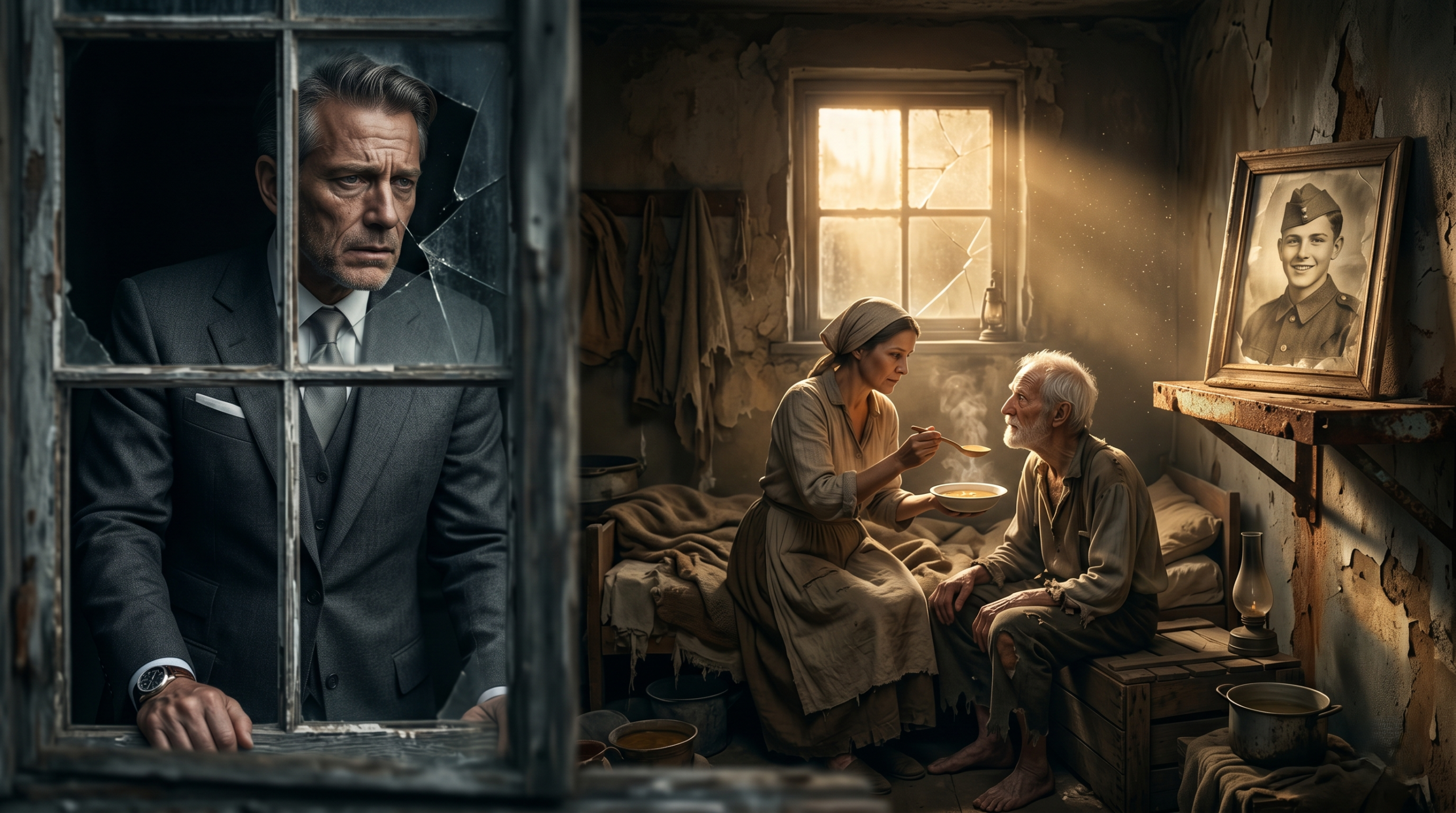
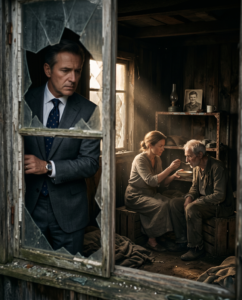
I walked up to the house alone. Through a broken window, I saw them.
The old man asleep. The woman sitting, hands moving through the air like she was remembering something that no longer existed.
The room was nearly empty. No furniture worth naming. No comfort. Just survival.
And then— A photo fell from a shelf.
I stepped closer. Without thinking. Without permission.
And saw my own face. Eighteen years old. Standing in front of a house I hadn’t thought about in decades.
My chest tightened. My vision blurred.
Because I knew that photo. And I knew— Before I even looked back at the man— What I was about to see.
PART 2
I didn’t need another second to confirm it. The moment I saw the photograph, something inside me broke open with a clarity I had spent decades avoiding.
I turned back toward the man on the cot. The same jawline, just hollowed by time. The same brow, heavier now. The same uneven rise in his chest when he breathed.
My father. No hesitation. No doubt. Just truth, arriving too late.
Then I looked at the woman. Her hair thinner. Her face softer, worn by years instead of shaped by them. But the way her lips moved when she whispered to herself—the rhythm of it—
My mother.
Twenty-three years. That’s how long I had been gone. Not lost. Not searching. Gone. By choice.
I stepped back from the window like the truth might burn me if I stood too close. My pulse slammed against my ribs, fast enough to make me dizzy. Every excuse I had ever built—about ambition, distance, timing—collapsed under the simplest fact in front of me “
