The spacecraft was called Faith 7.
For a while, that name sounded less like a symbol and more like a fact.
The launch was clean. The Atlas rocket climbed with brutal force beneath him, pushing him away from Florida, away from the noise of the crowds, away from every hand that had tightened a bolt and every voice that had wished him luck. Within minutes, the world outside his window curved into blue and black, and Gordon Cooper became a man suspended above everything he had ever known.
For the first 18 orbits, Faith 7 behaved like the miracle it had been designed to be.
The instruments were steady. The trajectory was right. The capsule moved around Earth every 90 minutes, and each time, the planet rolled under him like a living map. Oceans flashed beneath him. Continents appeared and vanished. Sunrises came so quickly they almost felt unreal. Darkness swallowed the capsule, then light burst over the horizon again with a thin, electric line of blue.
Cooper watched it all from a cramped metal cabin where every sound mattered. The hum of equipment. The hiss of oxygen. The tiny movements of switches under his gloves. There was no room to stretch, almost no room to turn, but he was exactly where he had trained his whole life to be.
He was calm.
He was focused.
He was becoming the first American to spend an entire day in space.
Then orbit 19 arrived.
A warning light came on.
It claimed the capsule had already begun reentry.
That should have been impossible.
Cooper looked at the instruments. The orbit was stable. The spacecraft was still circling Earth. He could feel the difference between a real emergency and a lying sensor, and this one did not match reality. A lesser pilot might have frozen. A reckless one might have trusted the alarm without thinking. Cooper did neither.
He studied what the capsule was telling him, decided the sensor was wrong, and shut it off.
It was the kind of decision that looks simple only after everyone survives.
In that tiny cockpit, 160 miles above Earth, there was no pause button. No second crewman. No engineer floating beside him to confirm the call. Just one man, one warning light, and a decision that had to be made before fear could get a vote.
For two more orbits, Faith 7 kept moving.
Then the real trouble began.
A short circuit ripped through the electrical system.
The automatic stabilization controls failed.
The systems meant to keep the capsule pointed in the right direction went dark.
Then the carbon dioxide levels began to climb — not just in the cabin, but in Cooper’s suit.
He was sealed inside a machine that was slowly losing its ability to think, breathe, and aim.
Mission Control waited for his report.
Cooper keyed the microphone.
“Things are beginning to stack up a little.”
That was it.
Eleven words.
No panic.
No shouting.
No dramatic announcement that his spacecraft was failing around him.
Just the calm voice of a pilot describing disaster as if he had noticed clouds gathering over a runway.
But behind those eleven words was a problem so severe that it could have ended the Mercury program in fire or silence.
Reentry is not simply falling back to Earth.
It is a needle-threading act performed at thousands of miles per hour.
Come in too shallow, and the capsule can skip off the atmosphere like a stone across water, leaving the astronaut trapped in a dying orbit with no way home.
Come in too steep, and friction turns the spacecraft into a furnace, crushing and burning it before the parachutes ever have a chance.
The margin for survival is measured in fractions of a degree.
That was why the automatic systems existed.
They were built so no single human twitch, hesitation, or miscalculation could decide whether a spacecraft came home or vanished.
And now the automatic systems were gone.
The guidance equipment was unreliable.
The stabilization controls were dead.
The electrical system was crippled.
The air was getting worse.
The clock was moving.
And Gordon Cooper still had to bring Faith 7 home.
So he did something no mission planner wanted to depend on.
Something no computer could improvise.
Something that sounds almost absurd until you remember who was inside that capsule.
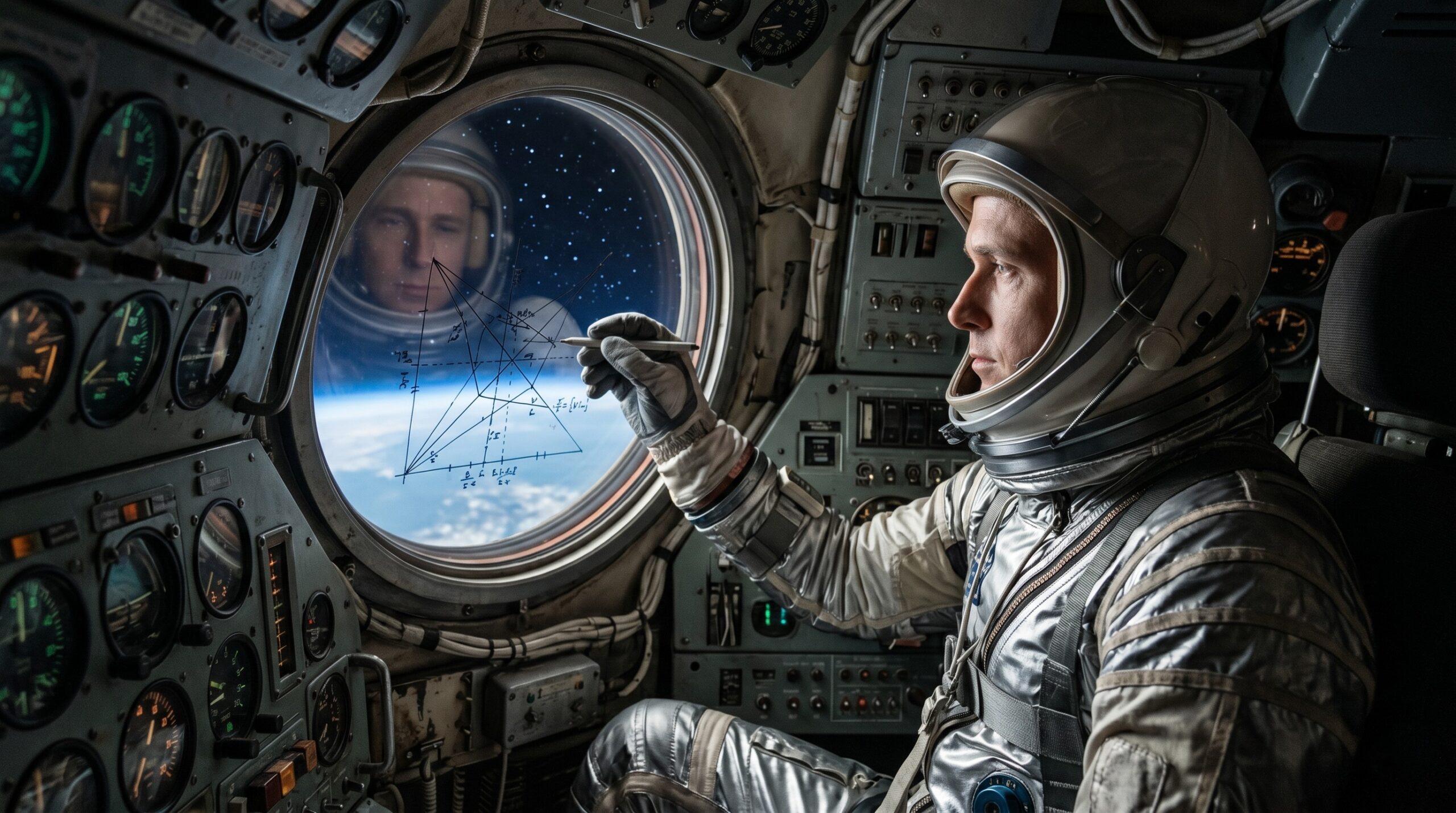
He reached for a grease pencil.
Then he drew lines on the window.
Not on a map.
Not on a screen.
On the actual glass of the spacecraft.
A handmade navigation grid, scratched into existence by a man orbiting Earth while his capsule slowly failed around him.
Those pencil marks became his instrument panel.
The window became his sight.
The stars became his guidance system.
Before launch, Cooper had studied star patterns until they lived in his memory. He knew what he should see. He knew where the horizon should sit. He knew how the capsule had to be angled for the retrorockets to fire correctly.
Now all of that knowledge had to leave his mind and become action.
No automation.
No computer countdown.
No system waiting to correct him.
He used the constellations to orient the capsule.
He lined the stars against the crude marks on the window.
He held the spacecraft at roughly 34 degrees of pitch, manually, by judgment and feel, knowing a single degree could separate the Pacific Ocean from oblivion.
Inside the capsule, every motion mattered.
Too much correction, and he could oversteer.
Too little, and the angle would drift.
The air was thickening with carbon dioxide.
The spacecraft was aging by the second.
Mission Control could advise him, but they could not fly it for him.
Then Cooper looked at his wristwatch.
That was his countdown.
Not a glowing computer display.
Not an automated voice.
A wristwatch.
The kind of thing any man might wear to dinner, now deciding whether an astronaut would live.
He waited for the exact moment.
His hand stayed steady.
His eyes stayed on the stars, the horizon, and the lines he had drawn himself.
Then he fired the retrorockets.
Faith 7 answered.
The capsule shuddered.
The carefully held angle became destiny.
Cooper had done everything by hand — aimed by stars, timed by watch, guided by memory, nerve, and a lifetime of flying.
Then the sky turned to fire.
As Faith 7 plunged back into the atmosphere, superheated plasma wrapped around the capsule. Outside the window, the world became flame. The radio went silent. Mission Control lost contact.
For those long minutes, nobody on Earth could help him.
They could not see his face.
They could not hear his breathing.
They could not know whether his hand-drawn lines had been enough.
They could only wait.
Inside Faith 7, Cooper was alone inside a roaring fireball, strapped into a capsule that had lost the systems meant to protect him, trusting the angle he had held with his own hands.
If he had been wrong, there would be no correction.
If he had been off, there would be no second try.
If fear had entered the cockpit, it would have found no room to sit.
Then the trajectory held.
Faith 7 came through.
The parachutes deployed.
The capsule hit the Pacific Ocean approximately 80 miles southeast of Midway Atoll, less than five miles from the USS Kearsarge, the primary recovery ship.
It was the most accurate splashdown of the entire Mercury program.
More accurate than any automated reentry before it.
When Gordon Cooper was pulled from the water, he was calm, alert, and ready to debrief.
Not because nothing had happened.
Because everything had happened, and he had refused to come apart.
The engineers had built an extraordinary spacecraft. The controllers had planned with precision. The systems had been designed to protect him. But at the final moment, when relays failed, sensors lied, circuits died, and the capsule stopped behaving like a machine that wanted to live, the last working system was not electrical.
It was human.
Cooper later wrote that his electronics were shot, and a pilot had the stick.
That was the truth Faith 7 carried back from orbit.
When the safety nets disappear one by one, when the checklist stops matching reality, when the lights go out and the voices from the ground can no longer reach you, what remains is not the machine.
It is the mind that stays clear.
The hand that stays steady.
The courage to trust training when panic would be easier.
Gordon Cooper did not freeze.
He did not spiral.
He did not wait for rescue from a system that had already failed.
He drew lines on a window with a grease pencil.
He looked at the stars.
He checked his watch.
And he flew himself home more precisely than any machine in the Mercury program ever had.
The final backup was never the software.
It was the man inside the capsule, staring through fire, realizing the only thing left between him and the dark was…
May 15, 1963. Gordon Cooper climbed into a capsule no bigger than a phone booth, bolted himself on top of a rocket, and pointed himself at the sky.