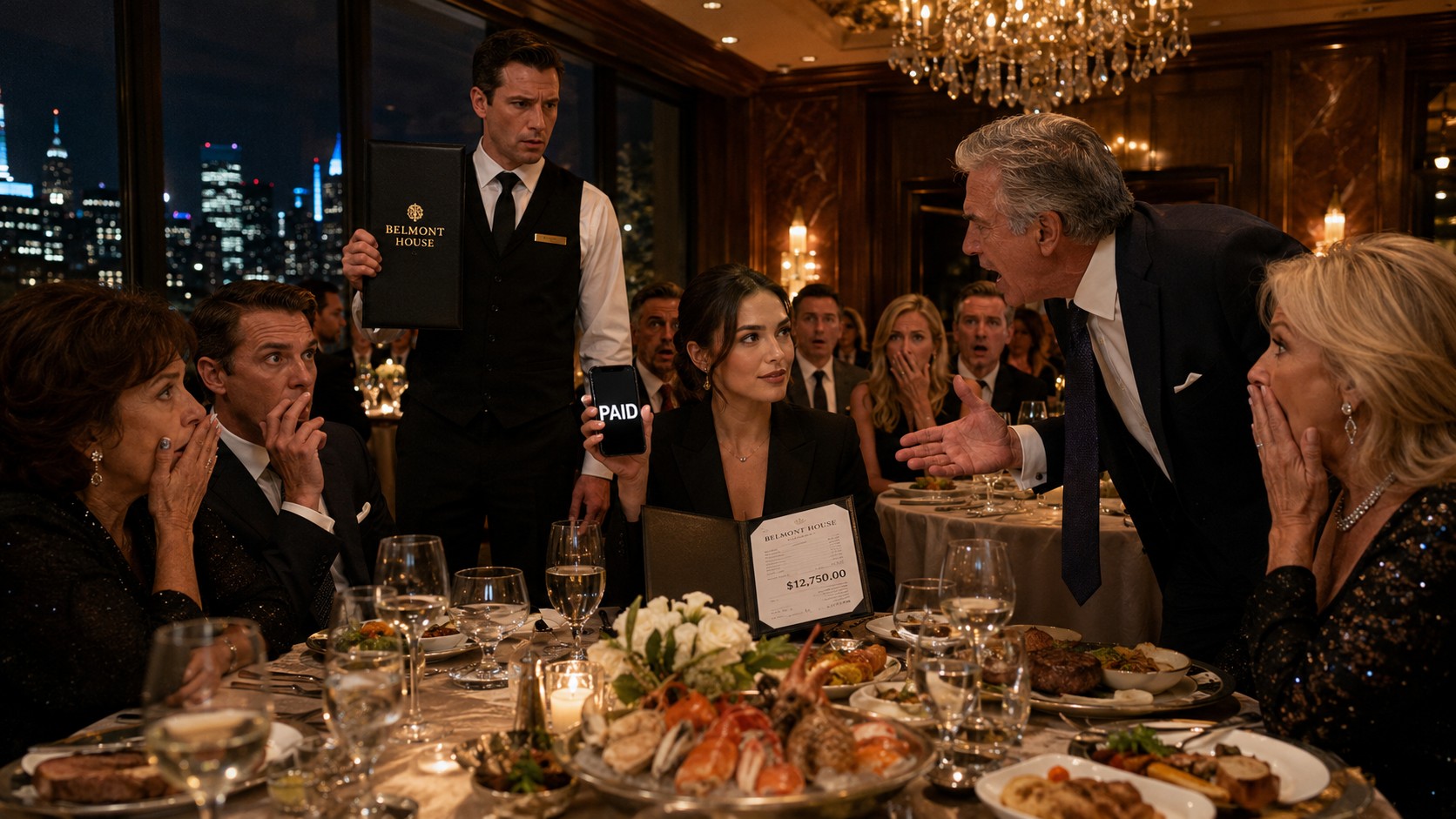
Fifteen minutes later, my family stopped smiling.
It happened slowly at first.
Ryan was the first to notice the manager walking toward us. He was a tall man in a charcoal suit, with silver at his temples and the controlled expression of someone who had learned to carry bad news on a polished tray.
Behind him came our waiter, Marcus, holding not one bill folder, but three.
My father watched them approach and sat up straighter, already preparing his voice. The voice he used with service workers. The voice that said he had money even when someone else was paying.
“Is there a problem?” he asked.
The manager stopped at the head of the table.
“Good evening,” he said. “My name is Mr. Langford. I’m the floor manager here at Bellmont House. I understand there’s been some confusion regarding payment.”
My mother’s smile returned instantly, thin and bright.
“Oh, no confusion,” she said, looking at me. “Our daughter is handling it.”
“Our daughter,” I repeated softly.
My father narrowed his eyes.
Mr. Langford glanced at me, then opened the first bill folder.
“Actually,” he said, “Ms. Claire Whitaker asked us to verify the reservation details before processing anything.”
A small silence opened around the table.
Ryan gave a sharp laugh. “Verify what? It’s dinner. She’s paying.”
Mr. Langford looked at him without blinking.
“The reservation was made under the name Harold Whitaker,” he said.
My father’s jaw moved once.
“That’s me,” he said.
“Yes, sir. And when the reservation was confirmed yesterday afternoon, our hostess explained our policy for large parties. For groups over twelve, we require the booking party to place a card on file and accept responsibility for the full bill unless payment is divided before ordering.”
My mother’s face changed.
Not much. Just enough.
The corners of her mouth twitched, and her hands tightened beneath her chin.
I looked at my father.
For the first time all night, he wasn’t looking at me.
Mr. Langford continued, his tone calm enough to cut glass.
“The card on file belongs to you, Mr. Whitaker. You also signed the large-party agreement digitally at 4:12 p.m. yesterday. We have the signed copy available.”
Aunt Carol inhaled through her nose.
One of my cousins whispered, “Wait, what?”
Ryan leaned forward. “That doesn’t matter. She agreed to come.”
“No,” I said. “I agreed to dinner with Mom and Dad.”
My mother turned to me quickly. “Claire, don’t do this.”
There it was.
Not don’t misunderstand.
Not we’re sorry.
Not this got out of hand.
Don’t do this.
As if the trap snapping shut on them was cruelty from me.
Mr. Langford opened the second folder and placed a printed document on the table. My father stared down at it like it was a snake.
His name was there.
Harold James Whitaker.
His email.
His phone number.
The timestamp.
And beneath the neat paragraphs of restaurant policy was his digital signature.
Ryan grabbed the paper first.
“This is ridiculous,” he said, scanning it. “Dad, tell them.”
My father snatched it from him.
His face flushed darker than the Cabernet.
“I didn’t read all that,” he snapped.
Mr. Langford nodded once. “I understand, sir. However, the agreement remains valid.”
My mother’s voice dropped into that soft, trembling register she used when she wanted witnesses.
“Claire, sweetheart, we invited you because we wanted peace. Is this really how you want to behave?”
I looked at her.
For years, that tone had worked on me. It had made me feel like a monster for having a boundary. It had made me apologize for bleeding after someone else held the knife.
But something had shifted inside me the moment my father pushed that bill across the table.
Maybe healing did not look like forgiveness.
Maybe sometimes it looked like staying seated while the truth arrived in a charcoal suit.
“I’m behaving exactly like a guest,” I said. “Which is what you told me I was.”
Ryan slammed his hand on the table hard enough to rattle the glasses.
“You think you’re so clever.”
“No,” I said. “I think I asked the waiter two simple things.”
My father’s eyes shot to Marcus.
“What did she ask you?”
Marcus stood beside Mr. Langford, uncomfortable but steady.
“She asked whether the reservation had a card on file,” he said. “And whether the person who booked the party was responsible for payment.”
My cousin Jenna let out a low whistle.
Aunt Carol turned on my father. “Harold, you said she had offered.”
My fork froze halfway to the napkin I had been folding.
“She what?” I asked.
No one answered.
My father’s lips pressed together.
Aunt Carol looked suddenly aware that she had spoken out of turn.
I leaned forward.
“What did he tell you?”
Ryan muttered, “Here we go.”
“No,” I said, my voice clearer now. “I want to hear it. What did he tell everyone?”
The table became very still.
Finally, Jenna spoke.
“He said you wanted to make things right.”
My mother hissed her name.
Jenna shrugged, defensive now that the money might touch her. “What? That’s what he said.”
A cousin across the table added, “He said you felt guilty for cutting everyone off and wanted to treat the family.”
My laugh came out once, sharp and humorless.
“There it is.”
My father pointed a finger at me.
“Don’t act innocent. You’ve been sitting on your grandmother’s money for three years while the rest of us—”
“While the rest of you what?” I asked. “Tried to bully me into signing it over?”
His mouth shut.
Across the table, someone dropped a spoon.
Mr. Langford shifted politely. “I can return in a few moments.”
“No,” my father barked. Then, realizing how it sounded, he forced a stiff smile. “No, thank you. We’ll handle this as a family.”
I turned to the manager.
“Please stay.”
My mother’s eyes flashed.
“Claire.”
I ignored her.
“Mr. Langford, could you please clarify one more thing? Did anyone at this table tell your staff I had agreed to pay?”
He looked from me to my father.
Then to my mother.
Professional discretion battled with the fact that my family had just tried to turn his restaurant into a stage for extortion.
“Our staff was told,” he said carefully, “that the guest arriving last would be taking care of the evening.”
My father exploded.
“That is not what I said.”
Marcus opened the third folder.
“With respect, sir,” he said, “our reservation notes say otherwise.”
He placed another printed sheet on the table.
Ryan cursed under his breath.
My mother reached for the paper, but I got there first.
The note was short.
Party of 16. Father hosting reconciliation dinner. Daughter Claire arriving separately and covering bill. Do not discuss pricing at table.
For a moment, the entire dining room seemed to tilt.
I stared at the line.
Do not discuss pricing at table.
The words were so ugly in their neatness that I almost smiled again.
My father had not merely hoped I would pay.
He had planned for me to be cornered.
He had instructed the staff not to warn me.
He had invited sixteen people, let them order recklessly, and waited for the humiliation to peak before sliding the bill toward me.
My hands were steady when I set the paper down.
“You told them not to discuss pricing.”
He scoffed. “It’s a nice restaurant. Adults know nice restaurants cost money.”
“You didn’t want adults,” I said. “You wanted an audience.”
My mother’s eyes glistened now. Real tears, maybe. Or well-timed ones. With her, the difference had never mattered.
“We were hurt,” she whispered. “You left us.”
“You tried to take what Grandma left me.”
“It should have been shared.”
“It was hers to leave.”
“She was old, Claire. She wasn’t thinking clearly.”
The sentence struck harder than I expected.
Not because it was new.
Because Grandma Eleanor had known exactly what they would say.
I could still see her sitting at the small oak table in the cottage kitchen, sunlight silvering her hair, her hands wrapped around a mug of tea.
“They will call me confused after I’m gone,” she had said. “People often confuse disobedience with decline.”
At the time, I had told her not to talk like that.
She had only smiled.
Across from me, my father pushed back his chair.
“This is absurd,” he said. “I’m not paying four thousand dollars because my daughter wants to embarrass me.”
Mr. Langford kept his tone even.
“The total is four thousand three hundred eighty-six dollars and seventy-two cents before any additional gratuity. The card on file can be charged now.”
“No,” my father said.
My aunt Carol grabbed her purse. “Harold.”
“What?”
“We all came because you said this was covered.”
My father turned on her. “You ordered two lobster tails.”
“You told me to enjoy myself.”
Ryan stood halfway out of his chair. “Everybody calm down. Claire can still fix this.”
Sixteen faces turned back to me.
There it was again.
Even with proof on the table, even with my father’s signature, even with the lie exposed in black ink, their instinct was still to look at me for rescue.
I picked up my small black clutch from beside my plate.
My mother’s face brightened with relief.
Then I removed a twenty-dollar bill and placed it on the table beside my untouched glass of wine.
“For my sparkling water,” I said.
Ryan laughed in disbelief.
“You’re serious?”
“Yes.”
My father’s voice dropped low. “Claire, you walk out of here and you are finished with this family.”
I looked at him for a long moment.
The old fear stirred.
It had his voice.
It had my mother’s silence.
It had Ryan’s sneer and Aunt Carol’s gossip and every holiday where I had been told to apologize so things could be pleasant again.
But fear, I realized, could get old too.
It could grow tired.
It could lose its teeth.
“I was finished three years ago,” I said. “Tonight just confirmed the paperwork.”
My father stepped around his chair.
Mr. Langford subtly moved between us.
“Sir,” he said, “please remain calm.”
“I am calm,” my father snapped, which was always what he said seconds before proving otherwise.
My mother rose slowly, one hand pressed to her chest.
“Claire, please don’t humiliate your father in public.”
I turned to her.
“You invited me to a table of sixteen people after promising it would be just the three of us. You let them mock me for two hours. You watched Dad push a four-thousand-dollar bill at me while everyone stared. You weren’t worried about humiliation then.”
Her tears stopped.
Just stopped.
Like a faucet turned off.
For one heartbeat, the mask slipped, and I saw the cold, hard thing beneath it.
“You always did keep score,” she said.
“No,” I replied. “I finally learned math.”
Someone at the next table coughed into a napkin.
Mr. Langford’s mouth twitched, but he recovered quickly.
My father reached into his jacket and pulled out his wallet with furious, jerking motions.
“This is what you wanted,” he said. “Fine. Fine.”
He threw a credit card into the bill folder.
Mr. Langford took it.
But he did not leave.
Instead, he glanced toward the entrance.
“Sir, before I process this, there is another matter.”
My father froze.
“What now?”
The manager’s expression changed slightly.
Less professional distance.
More caution.
“When Ms. Whitaker asked us to verify the reservation, I also reviewed the call log associated with the booking. There was a voicemail attached to the reservation profile.”
My mother went very pale.
My eyes moved to her.
“What voicemail?”
Mr. Langford looked uncomfortable now.
“Mrs. Whitaker called earlier this afternoon to add two guests to the reservation. The call went to our events line. She apparently believed she had disconnected, but the voicemail continued recording for several minutes.”
A silence fell so completely that I could hear the river traffic beyond the glass.
My father turned to my mother.
“What is he talking about?”
My mother whispered, “Nothing.”
Mr. Langford looked at me.
“Ms. Whitaker, because your name was discussed on the recording, and because it relates directly to a payment dispute involving you, I thought you should know it exists.”
Ryan sat back down.
All the wine had drained from his expression.
My mother gripped the edge of the table. “That’s private.”
“It was left on our business voicemail,” Mr. Langford said.
My father’s voice was low now. “Play it.”
“No,” my mother said quickly.
He looked at her.
“Margaret.”
Her lips parted.
For the first time that evening, she looked frightened.
Not embarrassed.
Not angry.
Frightened.
Mr. Langford hesitated. “Sir, I don’t think this is the appropriate—”
“Play it,” my father repeated.
I should have stopped it.
A wiser person might have said no. Might have walked away with dignity intact, leaving them to drown in their own bill.
But I had spent three years haunted by unanswered questions. Why had they fought so hard for Grandma’s cottage? Why had my mother, who had never cared for rural Wisconsin, become obsessed with that little lake house? Why had Ryan screamed about the investment account but barely mentioned the property documents once I refused to sign?
And why, tonight, had they risked such a public trap?
Mr. Langford drew a small tablet from his folder.
My mother sat down as if her knees had failed.
He tapped the screen.
At first, there was only static.
Then my mother’s voice filled the space between the plates and lobster shells.
“Yes, hello, this is Margaret Whitaker. We need to update our reservation for tonight under Harold Whitaker. Sixteen now, not fourteen. And please remember what my husband said. We don’t want menus with prices discussed, and our daughter will be handling the bill at the end. She’s very sensitive, so don’t make it awkward.”
A pause.
Rustling.
Then my mother’s voice, farther away.
“There. Done.”
Another voice answered.
Ryan.
“You think she’ll actually pay?”
My mother laughed.
Not the delicate laugh she used in restaurants.
A real laugh.
“She’ll pay if everyone is watching. Claire would rather swallow glass than make a scene.”
My stomach went cold.
Ryan said, “And if she doesn’t?”
My father’s voice entered, muffled but unmistakable.
“Then we push harder. Tonight isn’t about dinner.”
Aunt Carol whispered, “Oh my God.”
The recording continued.
My father said, “Once she’s rattled, your mother brings up the cottage.”
My breath stopped.
Ryan asked, “At the table?”
“No,” my mother said. “After. We get her outside. Make her feel guilty. Tell her Harold’s health is worse. Tell her we need to sell it to cover medical debt.”
My father snapped, “My health is fine.”
Ryan laughed. “She won’t check.”
My mother said, “She never checks when she’s upset.”
The room blurred at the edges.
The manager reached to stop the recording, but my father lifted a hand.
His face had gone gray.
From the tablet, my mother’s voice went on.
“The buyer won’t wait forever. If Claire signs the cottage over this month, we can close before the title issue gets messy.”
Title issue.
The words entered me slowly.
My father turned fully toward my mother.
“What title issue?”
My mother stared down at the table.
Ryan whispered, “Mom.”
The recording crackled.
Then came a fourth voice.
A voice I did not recognize.
Male. Smooth. Impatient.
“Margaret, I don’t care how you get her signature. The developers already paid the deposit. If your daughter keeps refusing, the whole parcel assemblage collapses.”
My pulse hammered.
Parcel assemblage.
Developers.
Deposit.
My grandmother’s cottage sat at the edge of a quiet lake road, between two wooded lots that belonged to families who had been there for generations. It was old, simple, beloved. A porch with peeling blue paint. A stone path to the dock. A kitchen window facing the sunrise.
Not valuable.
At least, that was what I had been told.
My mother’s recorded voice lowered.
“She’ll sign. Claire always wanted a family. We’ll offer her one.”
The recording ended.
No one spoke.
For once, not even Ryan had a joke.
I felt the restaurant around us watching without wanting to be caught watching. Forks paused halfway to mouths. A server stood near the bar holding a tray she had forgotten to deliver.
My father looked at my mother like he was seeing a stranger wearing his wife’s face.
“You took a deposit?”
She closed her eyes.
“Harold—”
“You took money on property we don’t own?”
“It was going to be ours.”
His chair scraped backward.
“It was never ours.”
That surprised me.
I looked at him.
For three years, I had thought my father and mother were one machine with two voices. But now he stared at her with betrayal blooming across his face, and I realized something colder than unity had lived between them.
Separate schemes.
Shared greed.
Different lies.
Ryan dragged both hands down his face.
“Mom, you said Dad knew.”
My father turned on him. “You knew?”
Ryan looked away.
Aunt Carol stood abruptly. “I am not getting dragged into fraud.”
My mother’s head snapped up. “Sit down.”
“No,” Aunt Carol said. “You told us Claire was making things right. You did not tell me there were developers involved.”
Jenna lifted her phone from her lap, and I realized she had been recording for at least part of it.
My mother saw it too.
“Put that away.”
Jenna slipped the phone into her purse. “Absolutely not.”
Mr. Langford cleared his throat.
“I believe this has gone beyond a restaurant billing dispute.”
My father rubbed his mouth.
The man who had spent my childhood commanding rooms now looked smaller than his own suit.
I rose.
My mother reached across the table.
“Claire.”
I stepped back before she could touch me.
“Who was the man on the recording?”
Her face hardened.
“No one.”
“Who?”
Ryan answered before she could stop him.
“Victor Hale.”
The name meant nothing to me.
But it meant something to my father.
He turned sharply. “Hale Development?”
My mother said nothing.
A cold laugh escaped my father.
“You went to Victor Hale?”
“He approached me,” she said. “He knew about the lake road project.”
“What lake road project?” I asked.
No one looked at me.
“What project?”
Ryan exhaled. “They’re building luxury condos along the north shore.”
I stared at him.
“That area is protected woodland.”
“Not anymore,” he muttered.
My father pointed at Ryan. “Shut up.”
But the words were already out.
My grandmother’s cottage. The quiet lake. The old trees. The dock where she taught me to bait a hook and then laughed when I apologized to the worm.
All of it had been sitting on land someone wanted.
And my family had known.
My mother’s voice sharpened.
“You don’t even use the place.”
“I go there every month.”
“You sit in that dusty cottage like it makes you noble.”
“It makes me remember someone who loved me without conditions.”
Her mouth twisted.
“You think Eleanor was a saint? She used that will to punish us.”
“No,” I said. “She used it to protect me from you.”
The truth landed hard.
My mother flinched as if I had slapped her.
Then her face changed again.
Something desperate rose in her.
“Claire, listen to me. We can still handle this quietly. Victor is willing to pay more than you think. Much more. You could take your share and stop pretending that old house is sacred.”
“My share?”
“Well, yes,” she said, too quickly. “Your share.”
Ryan stared at her.
“Mom.”
She ignored him.
“You could help everyone. Your father’s retirement, Ryan’s business, Carol’s debts—”
“Leave me out of it,” Carol snapped.
“—the family could finally breathe.”
I looked at my father.
“You knew about Ryan’s business?”
His expression told me enough.
Ryan’s business.
Another phrase that sounded harmless until money gathered around it.
Ryan had always had plans. Apps, gyms, restaurant concepts, a luxury dog supplement brand. Each one died after burning through someone else’s savings.
“How much do you owe?” I asked him.
He sneered automatically, but fear leaked through.
“That’s none of your business.”
“How much, Ryan?”
My mother said, “Claire, don’t attack your brother.”
“He helped plan this.”
Ryan stood again.
“Fine. You want the truth? Hale gave Mom a deposit. Mom loaned me part of it. It was temporary.”
My father whispered, “How much?”
Ryan swallowed.
“Eighty thousand.”
Aunt Carol made a strangled sound.
My father looked as if the floor had opened beneath him.
“Eighty thousand dollars from a fraudulent deposit on land we don’t own?”
Ryan’s anger returned because shame had nowhere else to go.
“It was going to close. She said Claire would sign.”
I laughed.
I could not help it.
It was not a happy sound.
It was the sound of every missing piece clicking into place.
The sudden messages.
The dinner.
The audience.
The bill.
They had not only wanted to punish me.
They needed to break me fast.
Because somewhere, a developer was waiting.
Because money had already changed hands.
Because my signature was the last locked door.
I picked up the printed reservation note and folded it carefully.
My mother watched me.
“What are you doing?”
“Keeping this.”
Mr. Langford said, “I can provide copies of the agreement and preserve the voicemail.”
“Thank you.”
My father gripped the back of his chair.
“Claire,” he said, and for the first time that night, his voice sounded almost human. “I didn’t know about Hale.”
I believed him.
That was the worst part.
I believed my father had tried to humiliate me over dinner.
I believed he had planned to pressure me about the cottage.
I believed he had lied about me offering to pay.
But I also believed he had not known the full scale of my mother’s deal.
Families, I thought, could contain many betrayals at once.
Some large.
Some larger.
I looked at him and felt nothing clean enough to call pity.
“You knew enough,” I said.
His eyes lowered.
My mother stood so abruptly her napkin fell to the floor.
“This is ridiculous. All of you are acting like I committed a crime by trying to help this family.”
Mr. Langford’s expression tightened.
“Mrs. Whitaker, I think it would be wise to stop speaking about this here.”
She turned on him. “You had no right to play that recording.”
“You left it on our system,” he said.
“I’ll sue this restaurant.”
He nodded politely. “You’re welcome to have your attorney contact ours.”
That shut her mouth.
For about three seconds.
Then she looked at me with a smile that chilled me more than her anger.
“You always loved making yourself the victim.”
I tucked my clutch beneath my arm.
“No, Mom. I was assigned the role. I just quit the cast.”
Then I walked away.
No dramatic exit.
No overturned chair.
No final speech that fixed the past.
Just one step, then another, across the carpeted dining room while my family erupted behind me.
My father demanding the manager process the card.
Ryan shouting that someone needed to call Victor.
Aunt Carol insisting she had been deceived.
My mother’s voice cutting through them all, sharp as broken crystal.
“Claire!”
I did not turn around.
Outside, the night air hit my face cold and damp from the river.
Chicago glittered around me, indifferent and alive. Traffic moved along Wacker Drive. A boat slid beneath the bridge, its lights wavering across the black water. Somewhere behind me, my family was dividing blame like another appetizer.
I stood beneath the restaurant awning and realized I was shaking.
Not from fear.
From after.
The body has no idea what to do with freedom when it arrives suddenly. It trembles as if danger is still coming.
My phone buzzed before I reached the curb.
Mom.
Then Dad.
Then Ryan.
Then a number I didn’t recognize.
I silenced all of them.
A valet looked at me. “Car, ma’am?”
“I’m walking.”
In heels, along the river, with winter air slipping under my coat, I walked.
Two blocks later, the unknown number called again.
I stopped near the bridge.
The screen glowed in my hand.
For some reason, I answered.
“Ms. Whitaker?”
The voice was male.
Smooth.
Impatient.
The same voice from the recording.
My blood went still.
“Victor Hale,” I said.
A quiet chuckle. “So Margaret gave you my name.”
“No. Your own voicemail did.”
A pause.
Then the warmth vanished.
“I think there has been a misunderstanding.”
“I doubt that.”
“Your family has created complications,” he said. “I prefer to solve complications efficiently.”
I looked out over the river.
“What do you want?”
“To make you an offer.”
“The cottage isn’t for sale.”
“Everything is for sale.”
“Not to you.”
His silence stretched.
When he spoke again, his voice was softer.
“Your grandmother was a stubborn woman too.”
My fingers tightened around the phone.
“You knew my grandmother?”
“I know every title history on that road. Eleanor Whitaker had many chances to be practical.”
Something in his tone made the cold deepen.
“Stay away from me,” I said.
“Ms. Whitaker, practicality is not a threat. It’s advice.”
“I have the recording.”
“And I have lawyers,” he said. “Surveyors. Council members. Investors. Your mother has already signed preliminary assurances.”
“My mother doesn’t own the property.”
“No,” he said. “But she gave me something useful.”
A taxi passed, splashing water along the curb.
“What?”
He sighed, almost pleasantly.
“A copy of a letter your grandmother wrote before she died. One she apparently never showed you.”
The city noise seemed to fall away.
“What letter?”
“You should ask your family,” he said. “Or better yet, check the cottage.”
My mouth went dry.
“What did she give you?”
“Enough to make me wonder whether Eleanor’s will was the final word.”
The line clicked dead.
I stood there beneath the bridge lights, holding the phone to my ear long after he was gone.
Then a new message arrived.
From my mother.
No apology.
No explanation.
Just one photograph.
It showed my grandmother’s cottage at night.
The porch light was on.
The front door stood open.
And beneath the image, my mother had written:
You should have paid the bill.
…If you want to know what happened next, please type “YES” and like for more.
