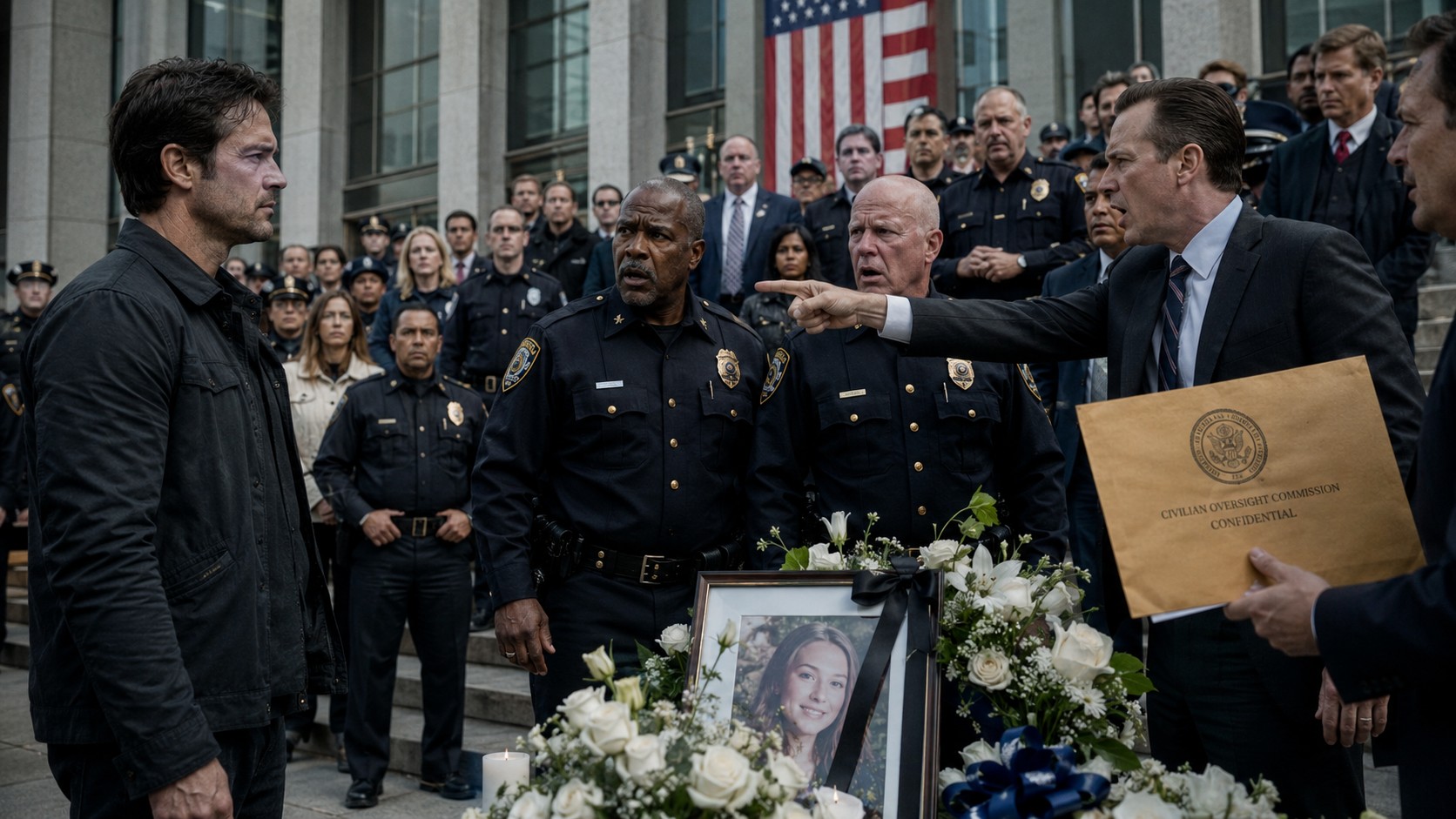
They Laughed After the Raid
### Part 1
The security alert hit my phone at 9:17 p.m., just as I was rinsing coffee grounds out of a chipped blue mug.
My little sister had called me paranoid when I installed the cameras around her house.
“Eli,” June had said, standing in her doorway in fuzzy socks with cartoon bees on them, “I teach first graders. Nobody is storming my castle.”
“Humor your grumpy brother,” I told her.
She rolled her eyes, but she let me mount one camera over the porch, one inside the living room, and one near the back hall. She even named the system “Fort Bumblebee” because she thought everything needed to sound less serious than it was.
That night, Fort Bumblebee screamed.
Motion detected.
Then glass broke.
I tapped the notification, expecting maybe a raccoon, a drunk neighbor, a package thief. The screen loaded, stuttered, and showed June’s living room in grainy color. Her yellow reading lamp was still on. A stack of children’s books sat on the coffee table. Her sneakers were by the couch. The quilt our mother made before she died was folded over the armchair.
Then the front door exploded inward.
Men in black tactical gear poured into the room like shadows with guns.
A flash of white swallowed the camera. The audio crackled so violently I jerked the phone away from my ear. When the image cleared, June was on her knees beside the couch, wearing pink pajama pants and one of my old Army sweatshirts.
Her hands were raised.
Her mouth was open, but I couldn’t hear her through the shouting.
“Please,” I read from her lips. “Please, I’m alone.”
The first man stepped toward her. Broad shoulders. Dark visor. A patch on his sleeve. His rifle aimed straight at my sister’s chest.
June didn’t move.
Not an inch.
The muzzle flashed.
My world ended without sound.
She fell sideways against the quilt, and for three seconds I couldn’t understand what my eyes had shown me. My mind rejected it the way a body rejects poison. The room tilted. The mug slipped from my hand and shattered in the sink.
Then the audio came back.
Someone laughed.
Not nervous laughter. Not shock. Not regret.
A short, ugly laugh.
Another voice said, “She didn’t even know what hit her.”
More laughter.
Then the feed went black.
I stood there in my kitchen, one hand braced on the counter, staring at my reflection in the dark window. I saw a man with gray at his temples, a scar under his left eye, and nothing human behind his face.
June was twenty-four.
She kept emergency granola bars in her purse because one of her students never had breakfast. She cried during dog food commercials. She once drove forty minutes in a thunderstorm to bring me soup because I told her I had a headache.
And four men had walked into her house and laughed over her body.
My hands shook for maybe five seconds.
Then they stopped.
That scared me more than the shaking.
The old part of me woke up. The part the Army had built and buried. The part that could take panic, grief, rage, and fear, pack them into a locked box, and leave only silence.
I grabbed my keys.
The drive to June’s neighborhood was a smear of traffic lights and wet pavement. I don’t remember changing lanes. I don’t remember breathing. I remember the smell of burned coffee on my sleeve and the cold bite of the steering wheel under my fingers.
Her street was packed with cruisers.
Red and blue lights washed over the little ranch houses. Neighbors stood barefoot on lawns, whispering under porch lights. Police tape cut across June’s yard, tied to the maple tree she decorated every Halloween with paper bats from her classroom.
A uniformed officer stepped in front of me before I reached the sidewalk.
“Sir, you need to stay back.”
“That’s my sister’s house,” I said.
His expression shifted. Not much. Just enough.
Pity.
I hated him for it.
“Are you Elijah Hart?”
I turned toward the voice.
A detective in a gray coat walked across the lawn. He had tired eyes, polished shoes, and the practiced softness of a man who had delivered bad news so many times he knew exactly how to stand.
“I’m Detective Sam Carver,” he said. “I’m sorry for your loss.”
Loss.
As if June had misplaced herself.
“What happened?” I asked.
Carver glanced toward the house, then back at me. “There was a warrant service. High-risk entry. The team believed this address was connected to a violent suspect.”
“That’s impossible.”
“There may have been an address error.”
“She was on her knees.”
His eyes sharpened.
I had said too much.
“Excuse me?”
I looked past him.
Four SWAT officers stood near an armored truck. Helmets off. Gloves hanging from their belts. One had a shaved head and a thick neck. One was younger, chewing gum like he was waiting outside a movie theater. One had a long scar beside his mouth. The fourth stood slightly apart, calm and still, like the others orbited around him.
He looked familiar.
The point man from the camera feed.
The man who fired.
He turned, sensing my stare.
Even from thirty yards away, I saw him smile.
Detective Carver stepped closer. “Mr. Hart, I know this is painful, but the officers reported that your sister reached for a weapon.”
I looked at him slowly.
“A weapon.”
“Yes.”
“June screamed when a June bug flew into her kitchen last summer.”
“I understand your reaction.”
“No,” I said. “You don’t.”
The young SWAT officer laughed at something the shaved-head one said. The sound came across the yard, small and casual, and my vision narrowed until all I saw were their faces.
Carver lowered his voice.
“Go home, Mr. Hart. Come to the station tomorrow. We’ll explain what we can.”
Behind him, the man who killed my sister lifted a bottle of water to his mouth.
He drank like he had earned it.
I wanted to tell Carver about the recording. I wanted to shove my phone in his face and make the entire street watch what I had watched.
But the old part of me kept my mouth closed.
If they knew I had the truth, they would come for it.
And maybe they would come for me.
So I swallowed the fire in my throat and nodded once.
Carver seemed relieved.
I turned away from the house, from the lights, from the men laughing beside the armored truck.
At my truck, I looked down at my phone.
The live feed was gone.
But the backup had uploaded before the camera died.
I had three seconds of truth.
And three seconds was enough to burn a city down.
### Part 2
The morgue smelled like bleach, cold metal, and something sweet underneath that no cleaning product could hide.
A woman in navy scrubs led me down a hallway that seemed too bright for a place where people came to meet the worst day of their lives. Her shoes squeaked softly. A vending machine hummed in the corner. Somewhere behind a wall, a phone rang twice and stopped.
June lay beneath a white sheet.
I had seen death before. More than I ever told her. More than I ever told anyone. But the battlefield gives you distance. Sand. Smoke. Noise. Orders. Men shouting. The strange mercy of chaos.
This was different.
This was my baby sister on a steel table with her hair brushed neatly behind her ear by a stranger.
I touched her hand.
It was cold in a way that made no sense. June had always been warm. She ran warm, laughed warm, hugged warm. When we were kids and the heat went out in our apartment, she would crawl into my bed and press her freezing toes against my legs until I yelled, and then she’d giggle into my pillow.
I bent my head.
“I’m sorry,” I whispered.
The woman in scrubs looked away.
I didn’t cry.
That felt like a betrayal, but the tears had gone somewhere too deep to reach. They sat inside me like stones.
After the morgue, I drove to a law office above a bakery downtown. The stairwell smelled like cinnamon rolls and floor wax. The name on the frosted glass door read Mara Keene, Civil Rights Attorney.
Mara was younger than I expected, maybe late thirties, with sharp eyes and a coffee stain on the sleeve of her white blouse. Her office was cramped, warm, and crowded with case boxes. Newspaper clippings covered one wall. Families smiling beside courthouse steps. Headlines about settlements, misconduct, wrongful raids.
She didn’t offer me false comfort.
I respected that.
“Show me,” she said.
I placed my tablet on her desk and played the video.
She watched without blinking.
When the shot came, her face changed. Not shock. Not surprise. Recognition.
As if she had been waiting years for a video this clear and this terrible.
When the laughter came through the speakers, she reached out and paused it.
Her fingers stayed on the tablet for a moment.
“That,” she said quietly, “is not confusion.”
“No.”
“That is not a bad angle.”
“No.”
She sat back, her jaw tight. “Did anyone else see this?”
“Not yet.”
“Good.” She stood and closed the blinds, though we were on the second floor and no one was across from us. “Listen to me carefully, Elijah. The department has already released a statement.”
“I saw the headline.”
“They’re saying your sister threatened officers during a lawful warrant service. They’re saying a firearm was recovered.”
I laughed once.
It sounded wrong in the small room.
Mara didn’t smile. “I believe you. But belief is not enough. They will attack the video. They will say the camera didn’t show her hands clearly. They will say the officer perceived a threat. They will say the sound was distorted. They will say whatever they need to say.”
“She was on her knees.”
“I know.”
“She was begging.”
“I know.”
“Then we make them watch it.”
“We will,” Mara said. “But not today. Not while they control the first story.”
I stared at the paused frame on the tablet. June’s hands were still raised. Her face was turned toward the man with the rifle.
Mara lowered her voice. “I’ve fought this department before. They don’t just deny. They bury. Files vanish. Witnesses change their minds. Good officers suddenly remember nothing. Families get tired, scared, broke, or all three.”
“I’m not tired.”
“No,” she said, studying me. “You’re angry.”
“Wouldn’t you be?”
“Yes. But anger is useful only if you don’t let it drive.”
I almost told her what anger had driven me through in other countries. I almost told her there were parts of the world where men like Mason Creed—the name I’d found on the officer roster before dawn—didn’t get press conferences and paid leave.
Instead, I asked, “What happens if we do this right?”
Mara exhaled. “A lawsuit. Public pressure. Maybe federal attention. Maybe criminal charges if we’re lucky and loud and careful.”
“Maybe.”
“That’s the honest answer.”
“And if the system protects them?”
She looked at the tablet again. “Then we keep pushing.”
The bakery downstairs slid a tray into an oven. A warm wave of sugar and butter drifted up through the floorboards. It made me think of June burning cookies every Christmas and pretending the black edges were “caramelized.”
My chest clenched.
Mara saw it.
“Don’t be alone tonight,” she said.
“I don’t have anyone else.”
Her expression softened, but only for a second. “Then don’t be around anything you can’t take back.”
I didn’t answer.
She knew.
Maybe not the details, but she knew the shape of it. Men like me always carried invisible rooms inside us. Rooms full of locked cabinets, old maps, bad memories, and tools we prayed never to use again.
I left her office with a copy of her card and the tablet under my jacket.
I didn’t drive home.
I drove west, past the warehouses and the discount furniture outlets, until the city thinned into storage lots and chain-link fences. Rain tapped the windshield. A freight train moved in the distance, slow and mournful.
Unit 318 sat at the back of a self-storage facility beside a drainage ditch.
I hadn’t opened it in five years.
The key stuck at first. Then the lock gave.
The rolling door screamed upward.
Inside were boxes from another life. Field jackets. Old boots. A cracked helmet. A green case under a tarp.
I stood over it for a long time.
Mara’s warning echoed in my head.
Don’t be around anything you can’t take back.
I pulled off the tarp.
The case looked exactly as I remembered. Hard, heavy, sealed against dust and water. I knelt, opened the latches, and breathed in the smell of oil, canvas, and memory.
I expected to feel rage.
Instead, I felt June’s cold hand in mine.
At the bottom of the case, tucked beside my old field notebook, was a photograph I had forgotten. June at sixteen, grinning in my oversized Army cap, saluting badly with a spatula in her hand.
On the back, in purple marker, she had written:
Come home human, Eli.
I sat there on the concrete floor until the rain stopped.
Then my phone buzzed.
Unknown number.
I answered without speaking.
A man breathed on the other end for two seconds.
Then he said, “You should’ve stayed behind the tape.”
The line went dead.
And I realized June’s killers already knew I was not going to disappear quietly.
### Part 3
June’s funeral was on a Friday morning under a sky the color of wet cement.
The cemetery sat on a hill outside town, bordered by bare oaks and a two-lane road that curved past a gas station, a church, and a diner where June used to order pancakes shaped like Mickey Mouse even after she was old enough to be embarrassed by it.
The funeral director gave me a black umbrella.
I didn’t open it.
Rain collected in my hair and ran down the back of my collar. The cold helped. It kept the world sharp.
People came.
More than I expected.
Teachers from June’s school. Parents holding children by the hand. Mrs. Alvarez from next door, who brought casseroles when our mother died. A boy with red glasses sobbed into his father’s coat because Miss Hart had taught him how to read the word “brave.”
That almost broke me.
Not the coffin. Not the flowers. Not the pastor saying gentle things about heaven.
The boy.
June would have crouched beside him and told him brave didn’t mean you weren’t scared. Brave meant you did the right thing while scared.
I wondered what brave meant for me now.
Mara stood near the back, black coat buttoned to her throat. She didn’t approach. She just gave me a small nod that said, I’m here, and I’m watching.
So was someone else.
A black sedan idled across the road beneath the oaks.
No funeral flag. No headlights. No reason to be there.
I shifted slightly, letting my umbrella block the view of my face even though it wasn’t open. Old habits. Use what you have. Glass, rain, shadows, distance.
The passenger window was cracked.
Inside sat the young SWAT officer from the night June died.
I had learned his name from a public award photo online.
Cal Redding.
Twenty-seven. Department golden boy. Two commendations. One excessive force complaint quietly dismissed. He had a gym smile and the bored eyes of a man who had never believed consequences were real.
He was eating from a paper bag.
At my sister’s funeral.
The driver was Detective Carver.
That was the first real crack.
Until then, Carver could have been just another detective protecting the department line. But sitting beside Cal, watching mourners bury a woman Cal helped kill, turned him into something else.
A guard.
Or a handler.
The pastor finished. The coffin lowered. Dirt hit wood with soft, final thuds.
I walked away before anyone could touch my arm.
Mara caught up near the cemetery gate.
“Elijah.”
“Not here.”
She glanced across the road. Her eyes found the sedan. “I know.”
We walked toward my truck through the rain.
“They’re watching you,” she said.
“I noticed.”
“Do not engage.”
“I wasn’t planning to.”
She gave me a look that said she didn’t believe me.
I almost smiled.
“June had enemies?” she asked.
“June thought a parking ticket was organized crime.”
“Then why monitor the funeral?”
“Because they’re scared.”
“Of the video?”
“Maybe.”
Mara opened her mouth, then closed it. She looked tired, and for the first time I noticed the shadows under her eyes.
“I filed preservation letters this morning,” she said. “Body cameras, dispatch audio, warrant applications, radio logs, all of it. If anything disappears now, it becomes part of the case.”
“And if everything disappears anyway?”
“Then we prove that too.”
I wanted her certainty. I wanted to borrow it, wear it, let it hold me upright.
Instead, I looked back at the sedan.
Cal Redding was laughing at something on his phone.
My phone vibrated.
Another unknown number.
A text this time.
Let the dead stay dead.
Beneath it was a photo of me leaving the storage unit.
My skin went cold.
Mara saw my face. “What is it?”
I turned the screen toward her.
She read it, and the color drained from her cheeks.
“Eli,” she said, very softly, “what was in that storage unit?”
“Memories.”
“That’s not an answer.”
“It’s the safest one.”
Her mouth tightened. “If they can track you, they can track me.”
“Yes.”
“Then stop keeping me in the dark.”
I looked at the children across the cemetery, their small shoes sinking into wet grass, their parents guiding them away from the grave. One girl held a handmade card wrapped in plastic. Bright crayon letters read: We love you, Miss Hart.
I made a decision.
Not the decision the old part of me wanted.
A different one.
“I need proof they can’t explain away,” I said. “Not just the shooting. Why they were there.”
Mara nodded slowly. “You think there’s a reason.”
“I know there is.”
“How?”
“Because guilty men don’t watch funerals unless they’re afraid the dead left something behind.”
That afternoon, I followed Cal Redding.
Not close. Never close.
He drove a silver Charger with tinted windows and a police union sticker on the bumper. He stopped at a gym, a liquor store, and a pawn shop where he left with a brown envelope tucked inside his jacket. Then, after sunset, he headed toward the industrial district.
The city changed out there.
Streetlights thinned. Buildings grew windowless. Roads cracked under old truck routes. Steam curled from vents behind chain-link fences. It smelled like diesel, river mud, and rust.
Cal parked on the upper level of an empty garage beside an old printing plant.
A black SUV arrived ten minutes later.
Cal got out first, restless, pacing, gum moving in his jaw. The SUV door opened. A man stepped out wearing a wool coat and no visible badge.
Detective Carver.
I watched from the dark second floor of the printing plant across the street, camera braced against a broken window frame.
Carver handed Cal something.
Cal shoved it into his pocket.
They argued.
I couldn’t hear every word over the wind, but the camera caught enough.
“Creed said lay low,” Carver snapped.
“I’m not taking the fall,” Cal said. “Not for her.”
Her.
My finger tightened around the camera.
Carver stepped closer. “Keep your mouth shut, and everyone walks away.”
Cal laughed, but it shook at the edges. “You didn’t hear the brother’s name? Hart. Elijah Hart. You know what he used to be?”
Carver grabbed Cal by the jacket.
That was when a third sound cut through the night.
A sharp crack from somewhere above the wind.
Cal jerked backward and dropped out of frame.
For half a second, Detective Carver froze.
Then he ran.
I stayed still, heart hammering, camera still recording.
Below, Cal Redding lay motionless beside his open car door.
I had come to hunt the truth.
Someone else had come to erase it.
And from the angle of Carver’s terrified face as he looked toward the rooftops, I knew exactly who they were going to blame.
### Part 4
By sunrise, every news station in the city had my shape without my name.
Former military specialist questioned in connection with officer’s death.
Sources say slain SWAT officer was involved in recent tragic raid.
Police exploring retaliation motive.
They didn’t have my picture yet, but they were warming the public for it. That was how these things worked. First came the fog. Then the face.
I sat in a laundromat three neighborhoods over, wearing a ball cap and an old denim jacket I’d bought with cash from a thrift store that smelled like mothballs and lemon cleaner. Machines churned around me. A toddler watched cartoons on a cracked tablet. A woman folded towels with slow, exhausted precision.
Normal life kept moving.
That offended me somehow.
June was dead. Cal Redding was dead. Men in expensive coats were rewriting both of them into whatever story protected the powerful.
And someone had just turned me into a convenient ghost.
On the TV mounted in the corner, Police Chief Dennis Rourke stood at a podium outside headquarters. He had silver hair, broad shoulders, and the kind of voice voters trusted.
“We will not rest,” he said, “until the coward responsible for this ambush is brought to justice.”
Coward.
I almost laughed.
My phone buzzed once. Not my regular phone. The cheap one I had bought after the funeral.
Mara.
Where are you?
I typed back: Safe.
That is not an answer.
It’s the safest one.
Three dots appeared. Disappeared. Appeared again.
They searched your apartment.
I stared at the message.
Then another came.
They had a warrant.
Of course they did.
I called her from a pay phone outside the laundromat, one of the last functioning ones in the city. The receiver smelled like rainwater and old cigarettes.
Mara answered on the first ring.
“Tell me you didn’t do it,” she said.
“I didn’t do it.”
She exhaled, and the breath cracked. “Okay.”
“You believed me?”
“I asked because I needed to hear your voice when you said it.”
“What did they take?”
“Everything obvious. Your computer. Some clothes. Papers. They broke the lock on a closet.”
“The tablet?”
“Not there. I have the copy you gave me.”
“Good.”
“Eli, listen. They’re pushing hard. A source leaked your service record. They’re saying you had the skills, the motive, and unstable grief.”
“Unstable grief,” I repeated.
“I’m filing an emergency motion. But you need to come in through counsel.”
“No.”
“Eli.”
“Someone killed Cal in front of me. Carver was there. He ran.”
Silence.
Then Mara said, “You saw Detective Carver meet him?”
“I recorded it.”
“Send it.”
“I will.”
“Right now.”
“Mara, if I send it from this phone, they’ll trace it.”
“You’re not helping yourself by disappearing.”
“I’m alive because I disappeared.”
A delivery truck rattled past, spraying dirty water across the curb.
Mara lowered her voice. “Then tell me what you need.”
I looked across the street at a school bus stopping at a corner. Children climbed in with backpacks bouncing. One girl wore a yellow raincoat like June’s favorite classroom poster.
“I need to know what June saw before they came for her.”
“I checked her phone records,” Mara said. “Nothing obvious.”
“Cloud accounts?”
“I have someone looking.”
“Look harder.”
“Elijah, there are legal ways to—”
“They don’t care about legal.”
“But I do,” she snapped. “And June did.”
That landed.
Harder than I wanted it to.
June did care. She believed rules were just promises people made to each other so the world wouldn’t become teeth and knives.
I closed my eyes.
“Cal said he wasn’t taking the fall,” I told Mara. “Carver told him to keep quiet and everyone walks. That means the raid wasn’t just a mistake. It was cleanup.”
“Cleanup for what?”
“I don’t know yet.”
After we hung up, I returned to June’s house.
Not through the front. Police still had tape across the door, though the scene techs were long gone. I came through Mrs. Alvarez’s backyard after she let me in without a word. She pressed a rosary into my hand before I climbed the fence.
“For your sister,” she whispered.
Inside, June’s house felt wrong.
Not empty. Violated.
Cabinet doors hung open. Cushions were sliced. Books lay face down like broken birds. The quilt was gone. So was the rug. Her classroom tote had been dumped across the kitchen floor. Crayons, stickers, glue sticks, tiny reward certificates.
I stood in the living room where she had died and forced myself to breathe.
Goal, conflict, information, reversal.
That was how you survived a scene. Not emotionally. Practically.
My goal was June’s hidden truth.
The conflict was that professionals had searched the house before me.
The information would be whatever they missed because they didn’t love her.
The reversal would come when grief stopped blinding me.
I searched like a brother first, then like a soldier.
The first search found nothing.
The second found something.
Under her desk, taped behind the drawer, was a plastic sleeve full of memory cards. June had labeled them in her looping teacher handwriting.
Class videos. Backup. Do not erase, Eli, I mean it.
My throat tightened.
I pocketed the sleeve and kept looking.
Behind a row of picture books, I found her old purple camera. The one she used for classroom projects. Its battery was dead. I found the charger in a drawer full of glitter, rubber bands, and cough drops.
While it charged, I sat on her kitchen floor and read the sticky notes on her fridge.
Buy apples.
Call Eli Sunday.
Ask Principal Dunn about field trip forms.
Dog video for weather lesson?
Dog video.
June didn’t have a dog.
My pulse changed.
The camera blinked to life after nine minutes.
I opened the most recent file.
The video began with June’s voice, bright and silly.
“Okay, my little weather watchers, today Miss Hart is showing you how fog looks near the river, because fog is just a cloud that got tired and sat down.”
The camera showed an alley near the waterfront. Gray morning. Damp brick. A stray dog nosing a trash bag.
Then voices.
Men in tactical pants beside an unmarked van.
June whispered, “Oops. Grown-up stuff. We’ll turn around.”
But she didn’t turn fast enough.
The camera caught Mason Creed, Cal Redding, and two others opening the trunk of a parked sedan. One man placed something inside. Another checked the street. Detective Carver stood near the van, speaking to a man whose face was half hidden by the door.
The hidden man turned slightly.
Police Chief Rourke.
The video shook as June hurried away, unaware she had recorded enough to destroy them all.
I sat there in my dead sister’s kitchen with the camera in my hand.
Now I knew why they came.
And somewhere outside, a floorboard creaked.
### Part 5
I killed the kitchen light with my elbow and moved before thought could slow me down.
The creak had come from the back hall.
Not loud. Not careless. Whoever stood inside June’s house knew how to shift weight in the dark. I slipped behind the refrigerator wall, one hand around the heaviest thing within reach: a cast-iron skillet June used every Sunday because she swore pancakes tasted better from “old angry metal.”
A shadow crossed the hallway.
I raised the skillet.
“Don’t,” a voice said softly.
I knew that voice.
My arm froze.
A tall man stepped into the kitchen doorway with both hands visible. White hair cropped close. Weathered face. Navy overcoat. Eyes that had watched younger men walk into places they didn’t all walk out of.
General Robert Vance.
Retired, technically.
But men like Vance were never retired from the rooms that mattered.
He had been a colonel when I met him. He taught me patience, distance, and the terrible cost of being good at violence. He taught me how to wait three days for one clean answer. He also sat beside my hospital bed after my last deployment and told me I was allowed to come home.
I had not seen him in six years.
“You picked a bad time for a reunion,” I said.
His eyes flicked to the skillet. “I see your hospitality hasn’t softened.”
“Why are you in my sister’s house?”
“Because your apartment was searched, your storage unit was photographed, and half the city thinks you murdered a police officer.”
“Did you come to arrest me?”
“No.”
“Then why?”
“To keep you from proving them right.”
The words hit harder than I expected.
I lowered the skillet but did not put it down.
Vance stepped farther into the kitchen. He looked older than memory allowed. The hard lines were still there, but his shoulders had settled, and grief had made a home in the corners of his mouth.
“I was brought in this morning,” he said. “Unofficially at first. Now officially. Chief Rourke asked for a military assessment.”
“I bet he did.”
“He wanted me to say the shot that killed Cal Redding matched your background.”
“And did you?”
“I said lots of people can pull a trigger. Far fewer can build a frame that clean.”
I stared at him.
He nodded toward the camera in my hand. “I assume that’s why they killed her.”
I didn’t answer.
His face changed.
“June found something.”
I held the camera tight. “She filmed Rourke at the waterfront with Creed, Redding, Carver, and two others. They were planting evidence.”
Vance closed his eyes for one second.
Only one.
But that was enough to tell me he believed me.
“Where is the file?” he asked.
“With me.”
“Good. Keep it that way for now.”
“You sound like Mara.”
“Mara Keene is smart.”
“You know her?”
“I know of her. She wins cases men like Rourke prefer buried.”
I leaned against the counter. My legs had started to tremble, and I hated that he could see it.
Vance looked toward the living room.
“I’m sorry about June.”
“Don’t.”
“Elijah.”
“Don’t say her name like you knew her.”
He took the blow without flinching. “Fair.”
Rain tapped the kitchen window. Somewhere down the street, a car passed slowly, tires hissing on wet asphalt.
Vance lowered his voice.
“You need to give me the evidence.”
“No.”
“If I take it through federal channels—”
“Channels leak.”
“Some do.”
“All do when enough careers are drowning.”
He studied me. “Then what’s your plan?”
I smiled without humor. “You don’t want to know.”
“Yes,” he said. “I do. Because I know the version of you standing in this kitchen. I know what grief can convince him is justice.”
I looked at the dark stain on the floorboards where June’s rug had been.
“You trained that version.”
“I trained a soldier,” Vance said. “Not an executioner.”
“They executed my sister.”
His jaw tightened. “And if you answer by becoming exactly what Rourke wants the city to fear, June becomes a footnote in your manhunt.”
I hated him then.
Because he was right enough to hurt.
My phone buzzed.
Mara.
Call me now.
I put it on speaker.
“Eli,” she said, breathless, “tell me you’re not at June’s house.”
I looked at Vance.
He shook his head slightly.
“Why?” I asked.
“Because Carver just filed a supplemental report saying he saw you near the industrial district before Cal died. They’re getting a murder warrant.”
“Of course they are.”
“There’s more.” Her voice dropped. “One of the surviving SWAT officers, Owen Pike, just contacted my office. He says he wants protection. He says Cal wasn’t supposed to die.”
Vance stepped closer.
I gripped the phone. “Where is Pike?”
“He wouldn’t say. He told my assistant he’d call again in twenty minutes.”
“Did he mention June?”
“Yes.”
The kitchen seemed to shrink.
“What did he say?”
Mara swallowed. I heard it through the speaker.
“He said, ‘Tell Hart his sister didn’t understand what she recorded. Tell him Creed is cleaning house.’”
Vance’s eyes sharpened.
Cleaning house.
That meant Cal had not been the last witness marked for removal.
“Did Pike sound scared?” I asked.
“He sounded like a man already running.”
“Call me the second he contacts you again.”
“Eli, do not go after him alone.”
“I’m not alone.”
A pause.
“Who’s with you?”
Vance leaned toward the phone. “Robert Vance.”
Mara went silent.
Then she said, “General?”
“Ms. Keene.”
Another pause, shorter and colder.
“Well,” Mara said, “at least now there’s one adult in the room.”
I almost laughed.
Almost.
The line clicked dead.
Vance looked at me. “Pike is bait or witness. Either way, Creed will move fast.”
“So do we.”
“No weapons.”
I met his eyes.
He didn’t blink.
“No bodies,” he said. “No mistakes they can hang around June’s neck.”
Outside, another car rolled past, slower this time.
Then stopped.
Vance moved to the window and lifted the curtain a fraction.
His face went still.
“What?” I whispered.
He stepped back and turned off the charging camera.
“Back door,” he said. “Now.”
Red and blue lights flashed silently across June’s kitchen walls.
And for the second time in forty-eight hours, men with guns came through my sister’s door.
### Part 6
Vance moved like age had lied about him.
He opened the basement door without a sound and pushed me down the stairs ahead of him. The air below smelled of laundry soap, dust, and the lavender sachets June hung everywhere because she said old houses had “ghost breath.”
Above us, boots crossed the porch.
A fist hit the front door.
“Police! Open up!”
Vance closed the basement door and guided me through the dark by memory he shouldn’t have had. “Coal chute?”
“Back wall.”
“You still remember how to crawl?”
“Unfortunately.”
The front door crashed open upstairs.
Men shouted.
The basement ceiling trembled with their weight.
I found the little metal hatch behind June’s boxes of holiday decorations. It opened into a narrow crawlspace that led beneath the porch and out beside the hydrangeas. As a kid, I had used one like it in our first rental house to hide from our father when he drank. June used to crawl in after me with crackers and a flashlight.
I shoved the evidence camera inside my jacket and went first.
Wet dirt soaked through my jeans. Old spiderwebs brushed my face. Behind me, Vance breathed steadily, too big for the space but too stubborn to care.
Above, someone yelled, “Kitchen clear!”
A dog barked outside.
I froze.
Vance’s hand pressed between my shoulder blades.
Keep moving.
So I did.
We emerged behind the shrubs just as two officers moved along the driveway, flashlights sweeping the garage. Vance pointed toward Mrs. Alvarez’s fence. We crossed low and fast, slipped through her garden, and entered her back door without knocking.
She stood in the kitchen holding a rolling pin.
When she saw me, her mouth tightened.
“They came again,” she said.
“Yes, ma’am.”
She looked at Vance. “Who is this one?”
“A friend,” I said.
She sniffed. “You need better friends.”
Vance nodded. “I agree.”
Mrs. Alvarez gave us towels, coffee in travel mugs, and the keys to her late husband’s old pickup. She asked no questions until we reached the door.
Then she touched my sleeve.
“Your sister came here that morning,” she said.
I turned back.
“What morning?”
“The day before.” Her voice trembled. “Before the bad men. She was worried. She said maybe she recorded something she shouldn’t have. I told her to call you.”
My throat tightened. “She didn’t.”
“She said she didn’t want to bother you.”
That was June.
Bleeding kindness even when she was scared.
Mrs. Alvarez wiped her eyes with the heel of her hand. “She left something with me. I forgot until now. The police came, and I got frightened.”
She opened a drawer and pulled out a small envelope decorated with smiling sun stickers.
My name was on it.
Eli, just in case I’m being silly.
My hands wouldn’t open it.
Vance took one step back, giving me privacy in a room where privacy was impossible.
Inside was a key and a note.
Not dramatic. Not enough words for goodbye.
Just June’s handwriting.
If I’m overreacting, tease me forever. If I’m not, check classroom cabinet 7. The blue bin. Don’t trust anyone who says it was my fault.
I folded the note carefully.
Cabinet 7.
Her school.
Vance read my face. “That’s where the real backup is.”
“Then that’s where we’re going.”
“No,” he said. “That is where every bad decision in this city is about to meet.”
He was right.
June’s school would be watched. If Rourke’s people knew she was careful, they might search it. If Creed knew Pike had talked, he might burn every loose end before morning.
Mara called as we pulled away in Mrs. Alvarez’s pickup.
“Owen Pike called,” she said. “He’s at Saint Agnes Hospital.”
“Why?”
“He says he was hit by a car three blocks from his house. He thinks it wasn’t an accident. He’s asking for me, for you, and for federal protection.”
Vance cursed under his breath.
“He won’t last there,” he said.
Mara heard him. “I’m already driving.”
“No,” Vance and I said together.
She ignored us both. “I’m ten minutes out.”
“Mara,” I said, “Creed may be using him to draw us in.”
“Then I’ll be careful.”
“That’s not a plan.”
“No, Eli. It’s a lawyer with a bar card and a public place full of cameras. Sometimes that works better than crawling through bushes.”
She hung up.
I looked at Vance.
He looked at the road.
“She’s going to get herself killed,” I said.
“She’s going to get herself followed,” Vance replied. “Different problem.”
The hospital glowed white against the wet night. Ambulance doors opened and closed. Families clustered under the emergency entrance awning. A security guard drank coffee from a paper cup, watching rain drip off the roof.
We parked two blocks away.
Vance went in first through the main entrance. I circled to the service side and waited near a loading dock that smelled like bleach and old cardboard.
My phone vibrated.
A video from Mara.
I opened it.
Owen Pike lay in a hospital bed, face bruised, one arm bandaged. Mara held the phone low, pretending to review documents.
Pike’s voice was ragged.
“June Hart filmed us at the river. Creed said she had to vanish. Rourke signed off on the warrant after Carver promised the paperwork would hold. Cal panicked. That’s why they killed him. I’m next.”
Mara asked, “Who killed Cal?”
Pike closed his eyes.
“Not Hart.”
“Who?”
The video shook.
A loud alarm blared in the background.
Pike’s eyes opened wide.
“He’s here,” he whispered.
The video cut off.
I started running before fear could name itself.
By the time I reached the emergency entrance, people were screaming.
### Part 7
Hospitals are terrible places for panic because everything already sounds urgent.
Alarms. Wheels. Intercoms. Shoes slapping tile. Someone crying behind a curtain. Someone laughing too loudly near a vending machine because fear sometimes comes out wrong.
I pushed through the emergency doors into chaos.
A nurse shouted at me to stop. I didn’t. Security moved toward the elevators. I joined a family rushing past them, head down, shoulders hunched, just another frightened man in a crowded night.
My phone buzzed.
Mara: Stairwell B.
I found it beside a chapel no bigger than a closet. The stairwell smelled like disinfectant and wet concrete. Mara stood on the landing between the second and third floors, barefoot, shoes in one hand, blood on her cheek.
Not hers, I hoped.
“Pike?” I asked.
She shook her head.
The hope I didn’t know I had fell through me.
“He was talking,” she said. “Then the door opened. I thought it was a nurse. It was Carver.”
My fingers curled.
“Did he see you recording?”
“Yes.”
“Where is he?”
“Gone. He had help.”
Vance’s voice came from above. “Not gone.”
He descended the stairs with a hospital security radio in one hand and a grim look on his face.
“Carver left through the west ambulance bay,” he said. “Creed was waiting in a black Tahoe. Pike is dead.”
Mara covered her mouth.
For a second, she looked very young.
Then her spine straightened. “I have his statement.”
“Enough?” I asked.
“For court? Maybe. For public pressure? Yes. For Rourke to panic? Absolutely.”
“Then he’ll come for you next.”
She looked at me. “He already did.”
We left through the chapel corridor while police flooded the ER. Vance had made two calls, the kind men like him could still make. By the time we reached the parking garage, a federal sedan waited with an agent at the wheel.
Vance opened the back door.
“Get in,” he told Mara.
She didn’t move. “Where are you taking me?”
“Safe house.”
“No.”
“Mara.”
“No,” she repeated. “The evidence from June’s classroom comes first.”
I stared at her. “You nearly died ten minutes ago.”
“And Pike did die. Which means whatever is in that blue bin matters enough for them to keep killing.”
Vance rubbed a hand over his face.
It was the first time I saw him look tired instead of controlled.
“She’s right,” he said.
“I hate when people say that.”
Mara slid into the sedan. “Then drive faster.”
June’s school sat in a quiet neighborhood of maples, soccer nets, and houses with porch swings. By day, it looked like a place built from crayons and lunch boxes. At night, with the lights off and the playground chains creaking in the wind, it looked abandoned.
The sign out front read: Willow Creek Elementary.
Under it, someone had taped flowers and cards.
For Miss Hart.
I couldn’t look long.
Vance spoke to the federal agent. The agent stayed with the car and watched the street while the three of us crossed the side lawn. Mara had keys from the principal, who she had apparently bullied legally over the phone in twelve minutes flat.
Inside, the school smelled like waxed floors, pencil shavings, and cafeteria pizza.
June’s classroom was Room 12.
I stopped in the doorway.
Tiny chairs. Alphabet rug. Paper clouds hanging from string. A bulletin board covered in handprints. Her cardigan still hung behind the desk.
On the whiteboard, in purple marker, she had written:
Tomorrow: Weather words! Fog, mist, cloud, rain.
Tomorrow had never come.
Mara touched my arm once, then let go.
Cabinet 7 was locked.
The key from Mrs. Alvarez fit.
Inside were plastic bins labeled with June’s cheerful precision.
Markers.
Glue.
Emergency snacks.
Blue bin.
I pulled it out and set it on the rug.
Inside were folders, a broken stapler, stickers, and a stuffed bumblebee with one missing wing. At the bottom was a small external drive wrapped in a child’s drawing.
The drawing showed June with yellow hair, me as a tall stick figure, and a giant sun above us.
Written in uneven letters:
Miss Hart says her brother keeps monsters away.
I had to sit down.
Mara knelt beside me and carefully took the drive.
“We need a computer,” she said.
June’s classroom desktop was old and slow. It hummed awake like it resented being disturbed. Mara plugged in the drive. Folders appeared.
Class Projects.
Parent Videos.
Weather Unit.
One folder had no cute name.
Insurance.
Mara clicked it.
There were videos, scanned documents, and one audio file.
The first video was the river footage from June’s camera, but longer. Much longer. It showed Rourke’s face clearly. It caught Carver’s voice. It caught Mason Creed saying, “If this goes sideways, the teacher disappears.”
Mara’s hand flew to her mouth.
Vance leaned close to the screen.
The audio file was worse.
June had called a city tip line. She had tried to do the right thing. She gave her name. She explained what she saw.
The operator placed her on hold.
Then a male voice came on.
Detective Carver.
“Miss Hart,” he said smoothly, “why don’t you tell me exactly what you recorded?”
That was how they found her.
Not through some brilliant investigation.
Not through bad luck.
Through the system she trusted.
Behind us, the hallway floor creaked.
Mara grabbed the drive.
Vance turned off the monitor.
A voice came from outside the classroom door.
“Come on out, Eli.”
Mason Creed stood in the hallway, smiling in the dark.
And this time, he had Mara’s assistant held in front of him with a gun at her back.
### Part 8
Mara’s assistant was named Tessa.
I had met her once in Mara’s office. Twenty-two, maybe twenty-three. Round glasses. Nervous smile. She had brought me coffee I didn’t ask for and then apologized because it was “aggressively mediocre.”
Now she stood in the hallway outside June’s classroom, crying silently, Mason Creed’s arm locked around her shoulders.
Detective Carver stood behind him.
A third man I didn’t recognize covered the far exit.
No uniforms. No flashing lights. No witnesses.
Just the soft hum of the school’s night air system and the paper clouds turning slowly above our heads.
Mason Creed smiled at me through the classroom window.
He looked smaller without the tactical gear.
That surprised me.
On the camera feed, he had seemed like a machine. In the hallway, under the faint glow of emergency lights, he looked like what he was: a frightened man with a gun and no exit clean enough to save him.
“Slide the drive out,” Creed said.
Mara whispered, “Don’t.”
Carver’s face twitched. “Don’t be stupid. Give it to us, and everyone walks.”
Vance’s voice was calm. “Nobody believes that, Detective.”
Creed’s eyes moved to Vance.
Recognition hit him.
“General,” he said. “Didn’t expect you to crawl around an elementary school tonight.”
“I go where the cowards gather.”
Creed’s smile vanished.
The gun pressed harder into Tessa’s side. She gasped.
My vision tunneled.
Vance shifted half an inch, and I knew what he was telling me.
Not yet.
Mara clutched the drive in one fist.
We were trapped inside a classroom built for children, surrounded by paper suns and tiny chairs, facing men who had murdered my sister because she believed a tip line meant help.
Creed nodded toward me.
“You should’ve stayed grieving, Hart. People understand grieving. They forgive it. But this?” He gestured with the gun. “This makes you dangerous.”
“You killed June.”
“She recorded things she didn’t understand.”
“She understood enough to hide the truth from you.”
His jaw tightened.
Good.
Anger makes men sloppy.
Carver stepped forward. “Mason, take the drive. We’re out of time.”
That was the second crack.
Carver was afraid of someone else.
Not me. Not Vance. Someone above Creed.
Rourke.
Mara heard it too. I saw her eyes sharpen.
“You’re not cleaning this for Creed,” she said to Carver. “You’re cleaning it for Rourke.”
Carver’s mouth opened.
Creed snapped, “Shut up.”
Too late.
Vance spoke softly. “Chief Rourke sent you here without backup because if this goes bad, he’ll blame all of you.”
Creed laughed, but it was thin. “Nice try.”
“Ask yourself why your radios are dead.”
Creed’s eyes flicked down.
Just once.
But once was enough.
Vance had done something before we entered the school. Or maybe the federal agent outside had. Either way, Creed and Carver were cut off from the net they thought would catch them.
A phone rang.
Not mine.
Not Mara’s.
Carver’s.
The ringtone sounded absurdly cheerful in the dark hallway.
He looked at Creed.
Creed said, “Answer it.”
Carver answered with trembling fingers.
I couldn’t hear the voice on the other end, but I watched Carver’s face change from fear to panic.
“No, Chief,” he whispered. “We have it contained.”
Creed went still.
Carver listened.
His eyes moved to Tessa.
Then to me.
Then to Creed.
“No,” Carver said. “No, I’m not doing that.”
Creed lunged for the phone.
The hallway erupted.
Tessa dropped.
Mara slammed the classroom door outward with both hands. It struck Creed’s shoulder, throwing his aim wide. Vance moved faster than any old man had a right to, driving Carver into the lockers.
The third man raised his weapon.
I grabbed the nearest thing on June’s desk—a heavy glass jar full of marbles her students earned for good behavior—and threw it with everything I had.
It hit him in the face.
Marbles exploded across the tile like hail.
Tessa crawled toward the classroom. Mara pulled her inside. Creed staggered back, snarling, and fired once into the ceiling. Plaster dust rained down over paper clouds.
Children’s artwork fluttered from the walls.
Something in me broke cleanly.
Not wild.
Not loud.
Clean.
I crossed the doorway and hit Creed before he could recover. We slammed into the lockers. Pain flashed through my shoulder. His gun skidded across the floor. He swung hard. I tasted blood.
He was strong.
But strength is not the same as purpose.
He fought to escape.
I fought inside the room where my sister had taught children to spell brave.
I drove him down onto the tile and pinned his wrist until he yelled.
Vance secured Carver with plastic zip ties from June’s emergency drawer. Mara had Tessa behind the desk, whispering to her, one hand still wrapped around the drive like it was a beating heart.
Sirens rose outside.
Real ones this time.
Federal.
Creed laughed beneath me, breathless and bloody.
“You think this ends with me?” he said. “Rourke will bury you. He’ll say you attacked us. He’ll say you staged the files. He’ll say whatever he needs.”
Mara stood slowly.
Her phone was in her other hand.
The screen showed an active call.
“Who are you talking to?” Creed asked.
Mara’s voice shook, but her smile was sharp as broken glass.
“Everyone.”
Through the classroom intercom speaker, Chief Rourke’s voice suddenly filled the school.
“Carver, if the girl saw your faces, don’t leave witnesses.”
The whole building heard it.
So did the federal agents coming through the front doors.
For the first time since June died, Mason Creed looked afraid of the truth.
And I realized Mara had not just recorded him.
She had opened the line to the entire emergency response channel.
### Part 9
The arrests did not feel like victory.
They felt like weather changing.
Federal agents flooded Willow Creek Elementary in dark jackets, their radios clipped low, their faces hard. They moved Creed, Carver, and the third man into separate vehicles. Tessa sat in an ambulance with a blanket around her shoulders, staring at nothing. Mara refused medical attention twice before Vance finally handed her a paper towel and told her to wipe the blood off her cheek before she scared the paramedics.
I stood in June’s classroom while strangers photographed everything.
The bullet hole in the ceiling.
The marbles scattered under the lockers.
The paper clouds dusted with plaster.
One agent reached for the drawing wrapped around the drive, and I stepped between them before I knew I had moved.
“Careful,” I said.
He looked annoyed, then saw my face and softened. “We’ll bag it separately.”
“Not like trash.”
“No,” he said. “Not like trash.”
Mara came to stand beside me.
“You saved Tessa,” she said.
“So did you.”
“You threw marbles at a federal crime scene.”
“June would’ve given me a sticker.”
That almost made her smile.
Almost.
Vance entered with his phone pressed to his ear. He listened for a moment, said, “No, you will not speak to my witness without counsel,” then hung up like he had ended a war.
“Rourke?” I asked.
“Gone.”
My stomach dropped.
“What do you mean gone?”
“He left headquarters twenty minutes after Carver’s open line went out. Officially, no one knows where.”
Mara cursed softly.
Of course.
Chief Dennis Rourke had spent decades building a city that moved around him like furniture. Men like that always had a door hidden behind the curtain.
Creed knew it too.
As agents loaded him into a vehicle, he turned his head and found me across the parking lot.
Even cuffed, even beaten, he smiled.
He mouthed two words.
Too late.
By dawn, the city knew enough to go wild but not enough to understand.
A teacher’s hidden recording.
A corrupt raid.
A dead officer.
A murdered witness.
A missing police chief.
News vans packed the streets outside Willow Creek. Parents gathered behind barricades holding signs with June’s name. Someone had printed her school photo on poster board. Her smile looked unbearably alive.
Mara stood before the cameras at 9:00 a.m.
I stayed behind the blinds in the principal’s office, watching on a small TV beside a shelf of attendance trophies.
Mara’s voice was clear.
“June Hart was not a suspect. She was not armed. She was not a threat. She was a teacher who recorded evidence of criminal misconduct and tried to report it through proper channels. For that, she was targeted, falsely accused, and killed.”
Reporters shouted questions.
“Is Elijah Hart a suspect?”
Mara looked straight into the nearest camera.
“Elijah Hart is June’s brother. Attempts to frame him are part of the cover-up we are exposing.”
Vance stood behind her, silent but visible.
That mattered.
America trusts uniforms until uniforms break its heart. Then it looks for another one to tell it where to place the pieces.
By noon, the mayor suspended Rourke.
By one, federal warrants were announced.
By two, an anonymous police source leaked that Rourke had “served honorably for thirty-one years” and was being “scapegoated by political opportunists.”
By three, half the city was fighting online about whether June had been innocent enough to deserve sympathy.
That phrase made me put my fist through the principal’s office wall.
Innocent enough.
Mara found me staring at the dent in the drywall.
“Hand,” she said.
“It’s fine.”
“It’s bleeding.”
“So is everything.”
She wrapped it herself with gauze from the nurse’s office. Her fingers were gentle but efficient.
“You can’t read comments,” she said.
“I wasn’t.”
“Good. Don’t start.”
A federal agent knocked and entered before either of us answered.
“General Vance wants you both in the conference room.”
“Why?” Mara asked.
The agent hesitated.
That hesitation became a cold stone in my gut.
“They found Rourke’s vehicle.”
“Where?”
“Airport parking garage.”
Mara’s hand froze around the gauze.
“He fled?” I asked.
“Not exactly.”
The conference room was full of people pretending not to panic. Agents on phones. A deputy U.S. attorney with rolled-up sleeves. Vance at the head of the table, looking at a printed photo.
He slid it toward us.
Rourke’s black SUV sat in a parking garage space under fluorescent lights. Driver’s door open. No Rourke.
On the windshield, written from the inside with a fingertip through dust, were two words.
Creed knows.
Mara whispered, “Knows what?”
Vance looked at me.
“Rourke didn’t run from us,” he said. “He ran from whoever Creed is protecting.”
I thought of Cal dropping beside his car. Pike whispering, He’s here. Carver refusing an order over the phone. Creed smiling in cuffs.
The city had called Mason Creed the monster.
But maybe he was only the hand.
And the thing behind him had just reached for the police chief.
### Part 10
They moved Creed to the federal courthouse before sunset.
Not the county lockup. Not a local precinct. The courthouse downtown, all concrete teeth and mirrored glass, with bollards out front and cameras in every corner. They put him on a protected witness floor because suddenly Mason Creed, my sister’s killer, was valuable.
That sentence made me sick.
Valuable.
June had been valuable too. To children. To neighbors. To me. But the system had not protected her until her death became evidence.
Mara tried to prepare me before the meeting.
We sat in a federal conference room with no windows and bad coffee cooling between us. My bandaged hand throbbed. Somewhere down the hall, printers ran nonstop, spitting out warrants, motions, statements, lies.
“Creed wants a deal,” she said.
“No.”
“You don’t control that.”
“No.”
“Eli.”
“He killed her.”
“I know.”
“He laughed.”
Her eyes softened. “I know.”
“No, you heard it. You don’t know it.”
That was cruel.
I regretted it immediately.
Mara absorbed it anyway, the way she absorbed most blows: by turning them into posture.
“You’re right,” she said. “I didn’t watch my sister die. But I know what happens if you let anger decide strategy. Creed may be able to give prosecutors the person above Rourke. If they trade years off his sentence for that, they might.”
“He should never see daylight again.”
“I agree.”
“But?”
“But justice is not always shaped like satisfaction.”
I looked away.
Through the glass wall, I saw Vance speaking with a deputy attorney general. Vance’s face was unreadable. That bothered me. When men like him hid emotion, it meant the room was worse than it looked.
The door opened.
Vance entered alone.
“Creed is talking,” he said.
Mara stood. “About who?”
“He won’t give a name yet.”
“Of course not,” I said.
Vance ignored me. “He says Rourke was not the top. He says the waterfront operation, the false reports, the evidence planting, the raid on June—all of it protected a private network involving city contracts, seizures, and political donations.”
Mara’s eyes narrowed. “How high?”
Vance’s silence answered.
High enough that the air changed.
My phone, sealed in an evidence sleeve on the table, buzzed.
Everyone looked at it.
The number was blocked.
Vance nodded to an agent, who connected it to a recording system before answering.
A distorted voice filled the room.
“Elijah Hart.”
I said nothing.
“Elijah. You’ve been very busy.”
Mara’s hand found the back of a chair.
Vance leaned toward the speaker. “Identify yourself.”
The voice chuckled. “General Vance. Still collecting broken boys and calling it service?”
Vance went still.
He knew the voice.
That was the reversal.
Not the call. Not the threat.
The look on Vance’s face.
“Who is it?” I asked.
The voice continued, calm and smooth. “Mason Creed is a desperate man. Desperate men invent kings behind curtains. Let him talk, and you will get stories. Let him breathe, and you will get more dead witnesses.”
Mara whispered, “Is that a threat?”
“No,” the voice said. “A pattern.”
Then the call ended.
The room held its breath.
Vance turned to the agents. “Lock down Creed’s floor. Nobody in or out. Not marshals, not clerks, not janitorial staff, nobody without my approval.”
The deputy attorney general frowned. “General, this is a courthouse, not—”
“Move,” Vance snapped.
People moved.
Mara stepped close to him. “You recognized the caller.”
Vance’s eyes remained on the door.
“Robert,” she said.
He looked at me, and for the first time since he appeared in June’s kitchen, I saw fear in him.
“His name is Graham Wexler,” Vance said. “Former intelligence contractor. Political fixer. If he’s involved, Rourke wasn’t running a corruption ring. He was renting space inside one.”
“Why would he know you?” I asked.
Vance’s jaw worked.
“Because I helped put him away once.”
“Put him away?”
“For six months,” Vance said bitterly. “Then someone important needed him useful again.”
Mara closed her eyes. “So Creed isn’t the end.”
“No.”
A courthouse alarm shrieked.
Red lights flashed in the hallway.
An agent burst into the conference room.
“Protected floor reports smoke in the service corridor. Cameras just went black.”
Vance was already moving.
I followed.
Mara grabbed my arm. “Eli, don’t.”
I looked down at her hand.
Then at the hallway filling with agents.
“I’m not chasing revenge,” I said.
“Then what are you chasing?”
The alarm screamed above us.
I thought of June’s note.
Don’t trust anyone who says it was my fault.
“I’m chasing the last person alive who can say my sister’s name in court.”
We reached the stairwell door just as the lights went out.
In the sudden dark, someone above us fired two shots.
### Part 11
Darkness changes a building.
The courthouse had felt solid a minute earlier. Official. Untouchable. All marble floors, metal detectors, federal seals, and men with badges who believed walls meant control.
Then the lights died, and it became a maze.
Emergency strobes pulsed red through the stairwell. Smoke drifted down from above, bitter and chemical, making my eyes water. Agents shouted over radios that cut in and out. Somewhere on the protected floor, someone screamed for a medic.
Vance caught my jacket before I could run ahead.
“Stay behind me.”
“You’re seventy.”
“I’m also smarter.”
“Debatable.”
“Later.”
We climbed.
At the fourth-floor landing, two marshals crouched beside a wounded guard. Not dead. Thank God. Blood ran down his sleeve, but he was talking, angry and scared.
“Service elevator,” he said. “They came from the service elevator.”
“How many?” Vance asked.
“Two. Maybe three. Masks.”
“Creed?”
The marshal swallowed.
“They took him.”
Of course they did.
Mara reached the landing behind us, coughing into her sleeve.
I turned on her. “You were supposed to stay downstairs.”
“So were you.”
Vance pointed at both of us. “Fight later.”
An agent handed him a tablet showing a frozen security image. Two masked figures pushing Creed in a maintenance cart, his hands bound, head lowered. Not rescuing him.
Removing him.
Creed’s value had become a death sentence.
The service corridor smelled of smoke, hot plastic, and floor cleaner. Sprinklers had gone off in one section, turning the tiles slick. We followed the trail: a dropped zip tie, a smear of soot, one black glove.
At the freight elevator, the doors were jammed open.
Empty shaft.
“They went down,” an agent said.
Vance looked at the cables, then at the access ladder.
“No,” I said.
He gave me a flat look. “I didn’t ask.”
“You’re not climbing down an elevator shaft in dress shoes.”
“I’ve done worse in worse shoes.”
Mara cut in. “There’s a loading tunnel under the courthouse. It connects to the municipal records building.”
Everyone looked at her.
She shrugged. “Civil rights lawyers learn exits.”
We ran.
The tunnel beneath the courthouse was narrow, damp, and lined with pipes that sweated in the stale air. Fluorescent lights flickered overhead. Every sound bounced wrong—footsteps, radios, breathing.
Halfway through, we found Creed.
He was tied to a chair in a storage room, mouth taped, one eye swollen shut. Alive.
For one ugly second, I was disappointed.
I hated myself for that.
Vance pulled the tape from Creed’s mouth.
Creed sucked in air and laughed weakly. “Took you long enough.”
I stepped toward him.
Mara blocked me with one arm. “Talk.”
Creed looked at her, then at Vance. “Wexler sent them. I told Rourke I wanted out after the teacher. He said nobody gets out. Then Cal panicked. Pike panicked. Carver panicked. Everybody panicked except Wexler.”
“Where is Rourke?” Vance asked.
Creed’s face twitched.
“Dead?”
Creed smiled without humor. “Probably wishing he was.”
Mara held up her phone. “I’m recording.”
“Good,” Creed said. “Record this. June Hart died because Graham Wexler owns half the men who pretend to run this city. Rourke gave him police muscle. Carver fixed paper. I led the entry. Cal fired backup shots after I fired first. Pike wanted to confess. Owen wasn’t brave, but he wasn’t empty. That’s why he’s dead.”
My voice came out rough. “You laughed.”
Creed looked at me.
For the first time, there was no smile.
“I did.”
The storage room went silent.
“Why?” I asked.
I needed an answer I could hate.
Creed swallowed. “Because if I didn’t laugh, I would’ve had to understand what I’d done.”
Mara’s eyes glistened with disgust.
Vance looked like stone.
I wanted to hit Creed until his face no longer looked like a face. I wanted to make him feel every second June felt. But there were cameras behind me now. Agents in the hallway. Mara recording. Vance watching.
June watching, somehow.
Come home human, Eli.
I stepped back.
Creed noticed.
Something like surprise crossed his broken face.
“You’re not going to do it?” he whispered.
“No.”
“Why?”
“Because you don’t get to turn me into your excuse.”
That hurt him more than my fists would have.
Vance signaled the agents. They took Creed out alive.
Alive meant testimony.
Testimony meant Wexler.
Wexler meant the real war finally had a name.
By morning, Creed’s recorded confession was locked under federal seal. Mara filed motions to release the portions about June. Vance pushed for emergency witness protection. The city woke to another press conference and another carefully worded statement.
But Graham Wexler did not wait.
At 10:43 a.m., every major news outlet received a package.
Inside was an edited video showing me at the industrial garage the night Cal died.
No Carver.
No shooter.
Just me in the shadows.
The headline wrote itself before the truth could put on shoes.
And by noon, America thought it knew my face.
### Part 12
There is a special kind of loneliness in being recognized for a lie.
My face appeared on gas station televisions, restaurant screens, social feeds, and phones held by strangers who glanced up at me on the sidewalk and then quickly away. The photo they used was from my service days. Younger. Harder. Cropped so I looked less like a grieving brother and more like a threat.
Former sniper linked to string of police attacks.
Person of interest in officer deaths.
Hero or vigilante?
That last one made Mara throw her pen across the office.
“They’re turning murder into entertainment,” she said. “They’re making people choose teams.”
Her office had become a bunker of paper and caffeine. Boxes stacked against the walls. Two federal agents by the door. Tessa asleep on the couch under a coat. Vance near the window, phone pressed to his ear, quietly threatening someone powerful enough to deserve it.
I stood beside Mara’s desk, watching a news panel debate my soul.
One man in a blue tie said, “Even if his sister’s death was tragic, we cannot allow trained killers to take justice into their own hands.”
A woman interrupted, “There is no evidence Elijah Hart killed anyone.”
The man smiled. “Absence of evidence is not innocence.”
Mara muted the TV.
“Wexler is good,” she said.
“He knows what people fear.”
“No. He knows what they want. A simple story. Dead sister. Angry veteran. Revenge. Easy to understand. Easy to condemn. Easy to sell.”
I looked at the frozen screen. My younger face stared back.
“What beats simple?” I asked.
Mara held up June’s drive.
“The truth,” she said. “But only if people actually see it.”
That afternoon, the federal judge denied immediate full release of the evidence, citing “integrity of the ongoing investigation.” Mara read the order twice, then very calmly went to the bathroom and screamed into a towel.
When she came back, her lipstick was gone and her eyes were bright.
“City council emergency session tonight,” she said. “Public safety committee. They’re going to perform outrage on camera and pretend cooperation.”
Vance ended his call. “Bad idea.”
“Great idea,” Mara said.
“Mara.”
“Wexler is winning because sealed evidence lets him fill the silence. So we stop being silent.”
“You’ll violate a court order.”
“I won’t release sealed evidence.”
I knew that look.
Mara had found a door where everyone else saw a wall.
She turned to me. “June’s original classroom weather video is not under seal. The version before the folder labeled Insurance. It shows enough of the waterfront to prove she was there, recording innocently, before anyone knew what she had.”
Vance nodded slowly. “And Creed’s confession?”
“Can’t play it. But I can quote from our emergency filing, which is public record once docketed.”
“That’s a narrow bridge,” he said.
“I walk narrow bridges for a living.”
The city council chamber was packed by six.
Reporters lined the walls. Officers in uniform clustered near the back. Families of people who had fought the department stood on one side. Police supporters stood on the other. Outside, protesters chanted June’s name while counter-protesters shouted over them.
America in one room.
Angry, grieving, divided, exhausted.
I sat beside Mara at the witness table. Vance sat behind us. Every camera seemed pointed at my face.
Councilman Draper, who had accepted police union money for years, leaned toward his microphone.
“Mr. Hart, did you or did you not have the means to kill Officer Redding?”
Mara pressed her hand over her microphone and whispered, “Don’t answer emotion.”
I leaned forward.
“I had the means to do many things,” I said. “That is not proof I did them.”
Murmurs.
Draper frowned. “That sounds evasive.”
“No,” I said. “It sounds like the truth is harder than your question.”
Someone clapped. Someone else booed.
Mara took over before the room could spiral.
“My client is not on trial here. June Hart is not on trial here. The question before this city is whether its police leadership murdered a teacher, framed her after death, and then tried to frame her brother when the cover-up failed.”
Draper banged his gavel. “Ms. Keene, you will moderate your language.”
Mara smiled.
That was when I knew someone was about to bleed legally.
“With respect, Councilman, I am quoting from filed federal pleadings.”
She opened June’s weather video.
The chamber screen lit up with my sister’s face.
Alive.
Smiling.
“Okay, my little weather watchers…”
The room went still.
June’s voice filled the chamber, warm and sweet and unaware.
People watched her explain fog. They laughed softly when she said a cloud got tired and sat down. Then the video turned toward the waterfront.
Men appeared near the van.
Rourke’s face.
Carver’s voice.
Creed’s profile.
The chamber erupted.
Draper shouted for order. Reporters stood. Officers near the back turned to one another. Mara let the chaos rise just long enough for the cameras to capture it.
Then the rear doors opened.
Graham Wexler walked in.
I knew it was him before anyone said his name.
He wore a charcoal suit and no fear at all.
Vance stood behind me, his voice barely audible.
“Don’t move.”
Wexler looked straight at me and smiled like we were old friends.
Then he raised one hand, pointed toward the screen showing June’s face, and said loudly, “That video is fabricated.”
Every camera turned toward him.
And Mara whispered, “Got you.”
### Part 13
Graham Wexler made one mistake.
He believed every room worked like the rooms he owned.
Quiet rooms. Private rooms. Rooms where frightened men traded favors, buried files, and decided which ordinary person could be sacrificed to protect extraordinary money.
But the council chamber was not quiet.
It was packed with reporters, parents, teachers, cops, protesters, cameras, microphones, and one furious civil rights lawyer who had been waiting all day for him to step into the light.
Mara stood slowly.
“Please identify yourself for the record,” she said.
Wexler smiled. “I don’t answer to you.”
“No,” Mara said. “But you just answered to her.”
She pointed to the screen, where June’s paused face glowed above the chamber.
Wexler’s smile thinned.
Mara lifted a document. “At 4:12 this afternoon, a federal filing entered into public record stated that an unnamed political consultant was suspected of coordinating false evidence claims regarding June Hart’s video. That filing did not name you, Mr. Wexler.”
The room quieted in pieces.
Mara continued, voice steady.
“You came here and publicly called that specific video fabricated before any unsealed evidence linked you to it.”
Wexler said nothing.
Vance stepped into the aisle. “Graham always did hate silence.”
Wexler looked at him. “Robert.”
The name carried history like a loaded truck.
Federal agents moved toward the doors.
Wexler noticed.
For the first time, his confidence shifted. Not gone. Just rearranged.
He turned as if to leave.
The chamber doors closed.
A reporter shouted, “Mr. Wexler, how do you know the video is fabricated?”
Another shouted, “Do you know Chief Rourke’s location?”
Another: “Did you coordinate the raid on June Hart’s home?”
Questions hit him from every side.
He had built his life on controlling stories.
Now he was inside one he couldn’t edit.
Wexler raised both hands. “This is political theater.”
Mara leaned into her microphone.
“No,” she said. “This is what happens when a dead teacher tells the truth better than all of you.”
That line ran on every news broadcast by midnight.
The arrests took longer.
Power does not fall like a tree. It rots, cracks, leans, denies the wind, and then finally comes down with everybody pretending they never stood in its shade.
Rourke was found two days later in a private hunting cabin three counties north, alive, drunk, and surrounded by burner phones. Carver took a deal after three nights in federal custody and gave up bank records, hidden reports, and names that made the mayor stop appearing in public.
Creed testified.
I watched from the back of the courtroom months later as he described the night June died.
He did not look at me when he said she raised her hands.
He did not look at me when he admitted the weapon had been planted after she was gone.
He did not look at me when the prosecutor played the audio of the laughter.
But the jury did.
Some cried.
One man clenched his jaw so hard I saw the muscle jump from twenty feet away.
Creed got life.
Carver got twenty-eight years.
Rourke got enough time that he would leave prison, if he ever did, as an old man with no city waiting for him.
Wexler fought hardest. Men like him always do. He hired lawyers who wore watches worth more than June’s car. He claimed politics, conspiracy, selective prosecution, national security, memory loss, and finally heart trouble.
The jury gave him guilty anyway.
When the verdict came in, Mara gripped my hand under the table.
I didn’t squeeze back at first.
Not because I didn’t want to.
Because I was afraid that if I moved, everything inside me would collapse.
June’s name was cleared officially on a Thursday afternoon in spring.
The department issued an apology.
I did not attend.
Mara read it aloud to me later in her office. It used words like tragedy, failure, unacceptable, healing, and trust. It did not say what I needed it to say.
So I said it myself.
“They murdered her.”
Mara folded the paper. “Yes.”
“They lied.”
“Yes.”
“They laughed.”
Her eyes softened. “Yes.”
I waited for peace.
It did not arrive like sunlight through a window. It came smaller. Meaner. In pieces.
It came when Mrs. Alvarez planted yellow flowers beside June’s porch.
It came when Willow Creek Elementary renamed Room 12 the June Hart Learning Room.
It came when the boy with red glasses read a full paragraph at the dedication ceremony and looked up at me like he had climbed a mountain.
It came when I finally went back to the storage unit.
Vance came with me.
He didn’t speak while I opened the green case. He didn’t speak while I took out the old tools of a life I had almost let swallow me. He only watched as I cleaned everything, locked it away, and signed the transfer papers to surrender what I no longer trusted grief not to touch.
Outside, the afternoon smelled like hot asphalt and cut grass.
Vance leaned against his car. “June would be proud.”
I looked at him. “Don’t make her into a saint.”
He nodded. “Fair.”
“She was messy. Late to everything. Terrible at budgeting. She sang off-key and put too much cinnamon in chili.”
“She sounds human.”
“She was.”
That was what I wanted remembered.
Not a symbol.
Not a headline.
Not a victim clean enough for public sympathy.
My sister.
Human.
Mara and I did not fall dramatically in love. Real life is not that tidy. But she became someone I called when the house got too quiet. I became someone she trusted to tell her when she was working herself into the ground. Sometimes we ate takeout in her office at midnight and talked about June. Sometimes we said nothing at all.
I used the civil settlement to start a foundation in June’s name.
Not because money fixes murder.
It doesn’t.
But it bought cameras for families who couldn’t afford them. Lawyers for people departments tried to frighten into silence. Scholarships for kids who wanted to become teachers because Miss Hart once told them they were brave.
On the first anniversary of her death, I went to the cemetery alone.
The grass had grown thick over her grave. Someone had left crayons beside the headstone. A small bumblebee sticker clung to the polished stone, crooked and bright.
I sat there until the sun dropped behind the trees.
“I didn’t forgive them,” I told her.
The wind moved through the oaks.
“I don’t think I ever will.”
For a long time, I thought revenge meant making the people who hurt June feel my pain.
I was wrong.
Revenge was making sure they never got to write her story.
Justice was making sure the world heard her voice.
And love was coming home human, even after monsters tried to teach me otherwise.
I touched her headstone once, stood, and walked back toward the road.
For the first time since the night Fort Bumblebee screamed, I did not feel like I was leaving her behind.
I felt like I was carrying her forward.
THE END!
Disclaimer: Our stories are inspired by real-life events but are carefully rewritten for entertainment. Any resemblance to actual people or situations is purely coincidental.
