When Bia said that Don Arturo’s heart wasn’t tired, but convinced that its work was done, the room in the exclusive Hospital Ángeles sank into 1 silence much larger than fear. The bedside monitor had already screamed its flat, ruthless note 1 time, then 2 times, before the doctors dragged the old man’s body back to 1 rhythm too fragile to trust. Doña Elena, the housekeeper, cried covering her face with her 2 hands. The family lawyer stood against the wall with his mouth open, as if the whole world had just stepped outside the legal rules he charged by the hour to understand.
The 4 girls walked towards the bed holding hands like 1 single living promise. Sofía took the lead, with her jaw clenched and eyes too old for her small face. Julia clutched 1 rain-stained sketchbook against her chest. Laurita cried openly, with the kind of crying that doesn’t care who sees it, while Bia, the quietest of the 4, stared intently at the tycoon as if he were close by and not drifting away into the unreachable.
A nurse tried to stop them, but Doña Elena turned with 1 fierceness that no one in the Lomas de Chapultepec mansion had seen from her in 20 years. She told the nurse that the 4 girls were staying. She said it with the authority of someone who had spent 2 decades watching rich men make decisions about life and death. The nurse backed away, and the 4 little girls reached the bed.
Sofía spoke 1st, because she always did. She gripped the metal railing with her 2 hands. “You promised we wouldn’t be separated,” she said, and her voice only trembled on the last word. “You can’t make 1 promise like that and then disappear, not when you’re the 1st adult who said it like it really mattered.”
Julia opened her notebook with trembling fingers. Inside was 1 drawing made with colored pencils; in it, Don Arturo was sitting in the breakfast nook, wearing 1 of those ridiculous giant pajama shirts that Laurita insisted made him look “less rich and scary,” while the 4 girls ate sweet bread and atole around him.
Laurita climbed onto the chair next to the bed, ignoring the wires. She pressed her 2 palms against the old man’s arm. “You haven’t seen my room in the morning light yet,” she said through tears. “You said the pink curtains were too much, and I told you they were perfect.”
Then Bia took 1 step forward. She was the girl who had observed everything since the night Arturo’s Rolls-Royce stopped and he saw the 4 soaked little girls under the awning of 1 Polanco boutique. She placed her small hand over the old man’s. “Your heart believes its work is already done. It isn’t true.”
The monitor stuttered. 1 weak, but real, heartbeat returned. The room exploded into motion.
But 2 hours later, as Arturo was barely regaining consciousness, his lawyer brought the bad news. His nephew Víctor had filed 1 emergency injunction to block the adoption of the 4 girls. He claimed that 4 street girls had manipulated 1 dying old man to steal his fortune. Víctor demanded that child services (DIF) take them away immediately.
The social worker arrived that same afternoon with 1 yellow folder. She asked to speak alone with Arturo. When he opened the file on the 4 girls, his blood ran cold. No one in that room could imagine the storm that was about to unleash. It was absolutely incredible what was about to happen…
PARTE 2
The 4 girls weren’t just homeless orphans. They had been evading 1 system that constantly tried to separate them because placing 4 quadruplets in 1 single family was an “administrative inconvenience.” Their mother, Camila, had died 8 months earlier from untreated pneumonia, after weeks of sleeping on the streets of Mexico City and facing rejection from public shelters. But it was their father’s death that left Don Arturo breathless.
Miguel Pérez, the father of the 4 girls, had died 4 years ago in the collapse of 1 construction site for a public housing project in the State of Mexico. The social worker looked down at her notes before pronouncing the name of the responsible company. It was Grupo Garza. Don Arturo’s very own construction company.

For 1 moment, the old man only heard the hum of the oxygen machine. He had built his immense empire with steel, concrete, and public speeches about decent housing for Mexicans. His name was engraved on hospital plaques and philanthropic foundations across the country. And yet, sitting in that hospital bed, with failing lungs, he discovered that the 4 girls he had found sleeping in the rain had been orphaned because of 1 act of negligence tied to his own company.
Arturo asked for the complete file. That same night, while the 4 little ones slept in the east wing of the mansion, Doña Elena brought him the documents. Miguel was the foreman on 1 development that Víctor, Arturo’s nephew, had personally overseen during his early years in the company. The official report stated that the collapse was caused by 1 “unforeseeable” structural failure. The compensation claim was delayed, minimized, and then, quietly, closed on paper. Camila’s signature appeared on the last page as if she had received the money, but Don Arturo had spent 40 years reading desperation in people’s eyes. The woman who had supposedly signed that document never saw even 1 single peso. Víctor had forged the agreement and stolen the widow’s compensation to cover the project’s cost overruns.
By the morning of the 3rd day, Arturo wasn’t just fighting to adopt 4 girls. He was fighting to understand how his own empire of blood had abandoned them 2 times.
Doña Elena became the central pillar of the mansion as the old man tried to recover. The house, which for 15 years had been 1 mausoleum of silence after the death of Arturo’s wife, began to beat again. Sofía woke up early to check the locks on the doors, a street habit that still hadn’t left her. Julia drew on any paper she could find. Laurita filled every room with endless questions, marveling at the peacocks in the Coyoacán garden.
Bia changed the house in 1 different way. She sat next to Arturo’s wheelchair while the oxygen hummed and, when she finally spoke, her words were hauntingly clear. “Sofía sleeps facing the door because she thinks bad news has feet,” she told him 1 afternoon. “Julia draws before she cries because it makes the crying make less noise.”
Arturo understood that Bia had spent her 10 years of life translating her sisters’ fear because adults had always failed them.
The court hearing was approaching faster than the tycoon’s strength. Víctor’s lawyers insisted on 1 full psychiatric review. 2 doctors evaluated Arturo’s memory to prove he wasn’t senile. Víctor visited the mansion 1 day later. He arrived in 1 designer suit that was worth more than what the girls’ father had earned in 3 entire years. He entered the study as if the mourning already belonged to him.
He looked with disgust at 1 doll lying under the grand piano. “This has gone too far, uncle,” Víctor said, smiling the way predators do when they think compassion is 1 weakness. “You are dying. These girls showed up at the exact right time and now you want to rewrite your will and ruin our family. If this goes to court, the press will say that 1 senile old man was scammed by street girls.”
Arturo let him speak. Then, with 1 voice thin but sharp as glass, he replied: “Tell me about Miguel Pérez.”
The smile vanished from Víctor’s face in 1 second.
“Tell me about the foreman who died on your project,” Arturo continued, sliding the file across the mahogany table. “Tell me why his widow’s compensation shows as paid when the family never received 1 cent. Tell me why 4 girls ended up on the street while you used my company to steal.”
Víctor hesitated, trying to shield himself in corporate jargon, talking about subcontractors and insurance companies. “Don’t do this,” the nephew hissed. “You will expose the company to 1 massive scandal.”
“I’d rather be the laughingstock of high society for loving the wrong people, than be respected for protecting 1 monster,” Arturo declared. Víctor left furious. In the hallway, Sofía had heard everything. She was 10 years old, but she understood cruel men better than anyone. She entered the study, looked at Arturo, and said firmly: “Then, we fight.”
The hearing took place in 1 private courtroom in Mexico City. Arturo arrived in a wheelchair, connected to 1 oxygen tank. The 4 girls wore simple dresses, refusing to let go of each other’s hands. Víctor’s lawyers attacked 1st. They talked about manipulation, mental decline, and showed photos of the girls on the street as if poverty in Mexico were 1 proof of criminal sophistication.
Then, Arturo’s lawyer presented the accident file, the forged signature, and the internal emails that Víctor thought were destroyed. The judge paled as she read them. Víctor denied everything, blaming former employees.
When Arturo’s turn came, Doña Elena helped him to the stand. The judge asked him why he wanted to adopt 4 girls in the twilight of his life.
“Because they aren’t 1 charity project,” Arturo answered, his breathing ragged. “They are 4 sisters that this world tried to divide because government paperwork finds separation easier than loyalty. My company failed their father. My silence protected the machinery that failed their mother. If I have any power left, I will not use it to excuse that.”
The judge stared at him. “And if you die soon?”
“Then I will die like their father,” Arturo said. “Not like the coward who drove past in 1 luxury car.”
Víctor’s lawyers objected when Sofía asked to speak, but the judge allowed it. The 10-year-old girl stood on her tiptoes in front of the microphone. “We know he’s sick. We aren’t stupid,” she said without shedding 1 single tear. “But every place we went to wanted 1 of us, or 2, or none. He was the 1st person who said all 4. If you take us away from him because he has little time left, you are saying that people only count as family if they can promise eternity.”
The silence in the courtroom was absolute. Then Bia raised her hand. She stepped up to the microphone. “People think that being quiet means knowing nothing,” Bia said. “But the silence is where you hear the lies move. Uncle Víctor is afraid because if he can’t kick us out, then he can’t hide the truth. He thinks that dying makes Don Arturo weak. It isn’t true. It just means he knows what’s important much faster.”
The judge issued 1 emergency ruling. She granted immediate permanent guardianship to Arturo, forbade any attempt by the DIF to separate the sisters, and ordered 1 criminal investigation against Víctor for fraud and criminal negligence. Víctor didn’t lose his entire fortune that day, but he lost the presumption that his last name could buy any impunity.
In the car ride back home, Arturo collapsed. His oxygen saturation plummeted. His lungs, which had negotiated 1 truce to save the girls, now demanded their price. He ended up in the intensive care unit.
This time, the doctors were honest. The fibrosis was advancing unstoppably. He had weeks left, not months. Arturo demanded that his lawyer bring the documents to the hospital. With 1 trembling hand, he signed Víctor’s dismissal from all Grupo Garza boards of directors, modified his will, and created 1 ironclad trust.
The 4 girls visited him in shifts. Julia taped drawings onto the medical cabinets. Sofía asked questions about inheritance laws. Bia went 1 night, while the rain beat against the hospital window. She fed the old man gelatin, exactly the same as the 1st day at the mansion.
“Bia,” Arturo asked her, barely able to breathe, “why did you say that my heart believed its work was done?”
“Because adults leave in pieces before they leave in body,” the 10-year-old girl replied. “You had already started saying goodbye to the things that still needed you. Now stop doing that.”
The judge visited the hospital 11 days later. It was 1 unusual act in the Mexican justice system, but the story of the 4 sisters had struck deep chords. The full adoption was fast-tracked. Arturo signed from his bed. When they asked if he understood the commitment, he smiled: “More than anyone.”
The girls signed in their own way. Sofía pressed her name as if carving stone. Julia drew 1 little star. Laurita wrote in giant letters. Bia printed her new name: BIA GARZA. When they finished, Doña Elena cried in silence. Arturo leaned back against the pillows and thought: “Now I can die.”
But he didn’t die that day. He got 7 more weeks.
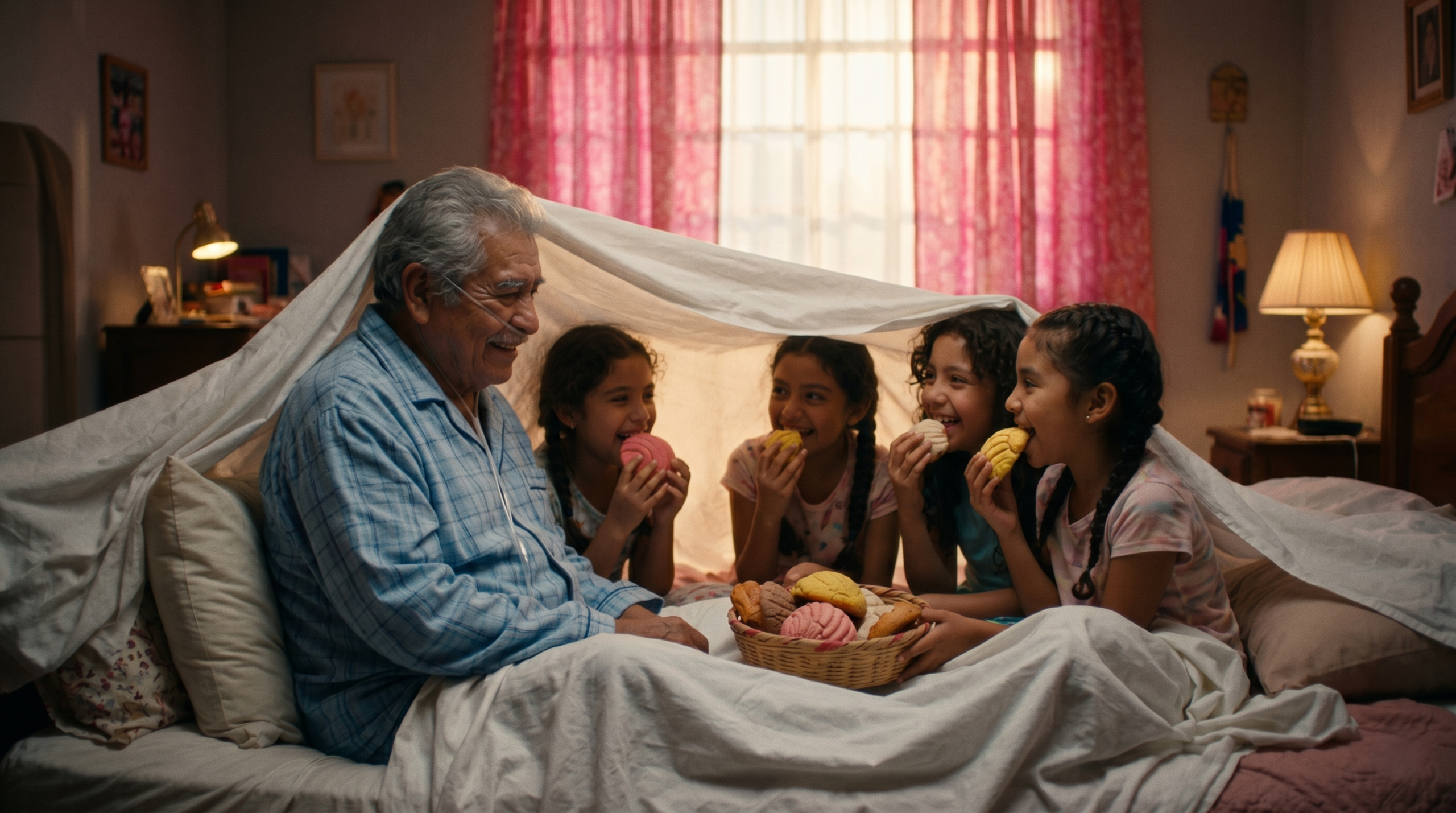
They were 7 weeks of breakfasts in his bedroom, 7 weeks of hearing laughter in the marble hallways. They built forts with sheets in the main living room. For 5 minutes 1 afternoon, Arturo sat with his oxygen inside the fort that Laurita called the “No Separation Castle”. Those 5 minutes were worth more than 40 years of corporate victories.
Víctor was arrested during week 5. The ministerial police arrived at his Polanco penthouse with arrest warrants for financial fraud and suppression of evidence in the Miguel Pérez case. The news broadcasts exploded.
On the last Sunday, the house smelled of cinnamon and sweet bread. Arturo knew the end was near. When the 4 girls climbed into his bed that night, he didn’t read them 1 story. He told them about his 1st apartment before he had money. He told each 1 what they needed to hear to survive.
Then, he asked Doña Elena to bring 1 blue box. Inside were 4 envelopes and 1 main document. The mansion would not be sold. It would become 1 residential foundation for groups of orphaned siblings, so the system would never separate them. The company would finance safe housing and support for families affected by workplace accidents.
“You turned your house into 1 place for girls like us,” Sofía said, amazed.
“No,” Arturo whispered, smiling. “For families like yours.”
Don Arturo died 2 dawns later, just before sunrise. No alarms. No panic. The 4 girls were asleep on the floor of his room. Bia was holding his hand. Sofía walked over and kissed his forehead with the firmness of someone deeply loved.
At the funeral, Mexico City’s high society arrived expecting 1 spectacle. Instead, they received 1 lesson. Doña Elena was in the 1st row with the tycoon’s 4 daughters. Sofía stood before the microphone. She unfolded 1 sheet of paper.
“People will say that 1 millionaire saved 4 poor girls,” Sofía began. “That makes 1 pretty story. But the truth is that his company failed our father and his nephew stole what belonged to us. Our father, Don Arturo, wasn’t good because he was rich. He was good because, in the end, he let love cost him something and told the truth even if it stained his own name.”
Julia unveiled 1 enormous painting. It wasn’t 1 heroic portrait. It was Arturo in pajamas, messy-haired, surrounded by the 4 girls eating sweet bread under 1 bright light. The title read: “The 1st Day It Was A Home.”
Laurita took the microphone and made the whole church laugh by telling how her father had hated the pink curtains until he admitted they “weren’t so bad.”
Finally, Bia spoke. “He thought we were what he found in the rain. But in reality, he was what we found. 1 father in the wrong place at the last possible moment. People say he gave us everything. It isn’t true. He gave us enough. And then he taught us to give the rest away.”
And they did. Years later, the old Garza mansion housed dozens of children. Doña Elena ran it with a firm hand. Sofía became 1 relentless lawyer. Julia filled the walls of orphanages with colorful murals. Laurita managed the foster homes. And Bia became the voice that boards of directors feared and respected.
Every year, the 4 returned to the street in Polanco where he found them. In place of the old boutique, there was now 1 family resource center for their foundation. Under 1 bronze plaque with their father’s name, the 4 sisters engraved 1 single phrase:
