Part 1
The first time my mother-in-law erased me, she did it with a smile so polished it looked harmless.
It was a cold Sunday in late November, one of those mornings when the air on the church path smelled like wet leaves and chimney smoke, and every breath felt thin and sharp in my throat. I had parked behind the fellowship hall, next to the rusted trailer where they stored folding tables and Christmas pageant props, and carried in a tray of spinach salad balanced against my hip because that was the kind of thing people expected from me there. Not a speech. Not a seat near the front. Salad.
Inside, the room already hummed with the soft chaos of a church event. Porcelain cups clicked against saucers. Someone in the kitchen laughed too loudly. The coffee urn hissed like an irritated radiator. The big banner stretched over the stage read VETERANS APPRECIATION LUNCHEON in blue block letters, and the gold fringe on the edges looked dusty in the morning light.
I set the tray on the side table and smoothed the napkin under the bowl. My reflection flashed at me from a stack of stainless-steel serving spoons: dark hair pinned up, navy dress, shoulders squared, face careful. I had chosen that dress because it gave nobody anything to talk about. It was plain, long-sleeved, cut just below the knee. The only thing on it that meant anything was the small silver star pinned above my heart, a quiet memorial to Lieutenant Hannah Ruiz, who had died two years earlier during a night operation that still visited me in pieces—diesel in the air, red deck lights, the slap of black water against steel.
“Clare, darling, can you move that to the back?” Eleanor called.
She stood near the front table in a bright red jacket with pearl buttons, one hand lifted as if she were directing a gala instead of a church luncheon. My mother-in-law always dressed like the room belonged to her. Her hair was a smooth pale helmet. Her lipstick never feathered. Even her perfume arrived before she did, powdery and sweet and old-fashioned, like roses trapped in a cedar drawer.
I moved the salad.
As I did, I heard her lower her voice to the women beside her. She never whispered well. Her words always carried just enough.
“She works in an office,” Eleanor said, as if she were explaining a developmental delay in a child. “You know how some people like to make things sound more dramatic. I only hope she doesn’t try to turn today into some personal show.”
The women gave the kind of laugh that never rises above politeness but lands like a slap anyway.
I kept my hands steady. That had become a skill with her—keeping my face still while something ugly slid under my skin.
In the Navy, I had spent more than twenty years learning how to keep a voice level in bad weather, how to relay coordinates while alarms were sounding, how to make a decision when there wasn’t time for panic. None of that training helped with church women and their soft little smiles.
My phone vibrated once in the pocket of my coat, still slung over the back of a chair. Standby only. If the harbor desk needed support routing a response call, I’d answer. If not, I’d stay through the luncheon and survive Eleanor the way I usually did—by going numb in strategic places.
I turned toward the seating chart taped beside the kitchen door.
My eyes went down the list once. Then again, slower.
Daniel Morgan, Table One.
Eleanor Parker, Table One.
Mr. and Mrs. Bradley, Table One.
Pastor Glenn, Table One.
Three local veterans. A county commissioner. A donor couple from Annapolis.
No Clare Morgan.
I checked the side list for volunteers. There I was, wedged between two teenage girls from the youth group and a retired dentist who sliced ham every year.
“Is there another chart?” I asked, keeping my tone light.
The event coordinator, Linda Ames, was balancing a clipboard and a tray of silverware. She was a good woman, usually calm, but that morning her face had the stretched look of someone trying not to drop too many things at once.
“Oh,” she said, glancing at the paper. “You’re near the kitchen. Easier that way.”
“Easier for what?”
“For helping,” she said quickly. “Since you know how Eleanor likes things.”
There was a smell in the hall then I always associated with old betrayals—hot coffee, lemon cleanser, and burned sugar from the apple cobbler warming in the kitchen. My stomach turned over once and settled heavy.
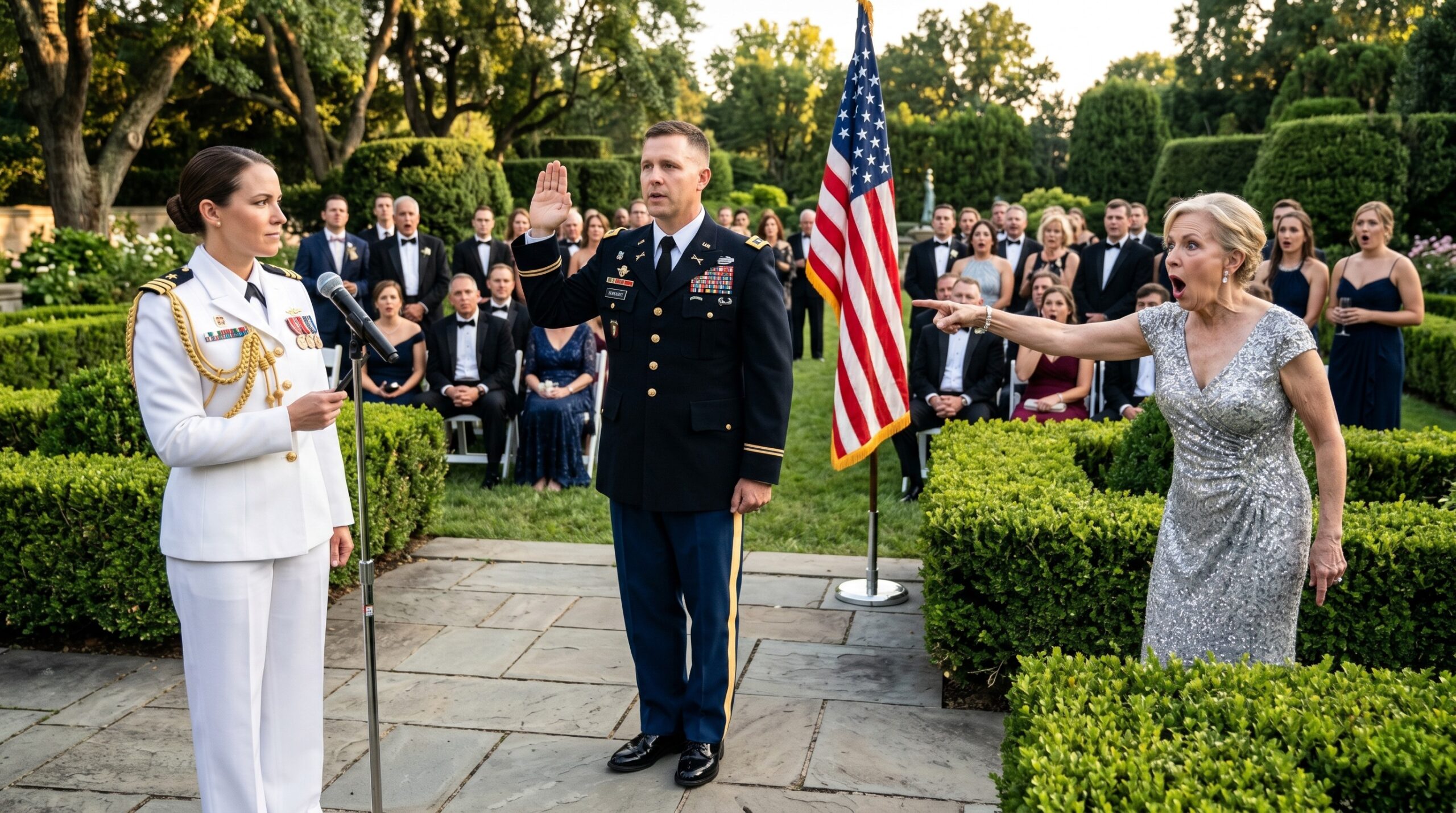
My Mother-In-Law ERASED My Name From The Program, Called Me Nothing More Than An Office Girl, And Even Silenced My Mic. But When The Admiral Walked In And Spoke My True Rank Aloud, The Entire Hall Froze—Her Face Said Everything…
Part 2
Weeks earlier, one of the planning committee members had stopped me outside church and said, We’d love to recognize your service properly this year, Clare. I’d gone home with that small embarrassed warmth I never quite knew what to do with. Recognition had never mattered much to me in uniform because rank already spoke when it had to. But being seen, clearly and without distortion, by people who only knew me as Daniel’s wife? That had mattered more than I’d wanted to admit.
And now I was standing beside the kitchen, assigned to the help.
I told myself it could be a mix-up. That was the lie I still let myself believe then.
I went to hang my coat, and as I passed the trash bin near the supply table, I saw a folded program on top of crumpled napkins and empty packing tape rolls. A draft, maybe. I almost kept walking.
Then I saw my own last name.
I pulled it free and smoothed it open with both hands.
Commander Clare Morgan, U.S. Navy.
Not volunteer. Not spouse. Not help. My name was printed in the speaker lineup, right beneath a state senator and above the closing prayer. I stared at it so hard the letters blurred.
Someone had changed the program after this was printed.
The room around me kept moving. Chairs scraped. The coffee urn burped steam. Eleanor’s laugh floated up from the front like cut glass dropped in a sink.
I folded the paper once and slid it into my purse.
That was when the side door opened and a man in a dark suit stepped in, carrying a clipboard and scanning the room with brisk purpose. He had the neat, alert posture of military support staff even in civilian clothes.
“Is Commander Morgan here?” he asked.
I started to turn.
Eleanor got there first.
“Oh, no,” she said with an airy laugh. “There’s no commander here. You must be mistaken. My daughter-in-law just helps with the church events.”
The man frowned.
I was standing no more than six feet away, and she said it as if I were a coat rack.
Something inside me, something old and patient and badly cracked, shifted under the weight of that moment. I felt my fingernails press crescents into my palm.
Enough, I thought.
And then the man looked past Eleanor, straight toward me, and opened his mouth again.
