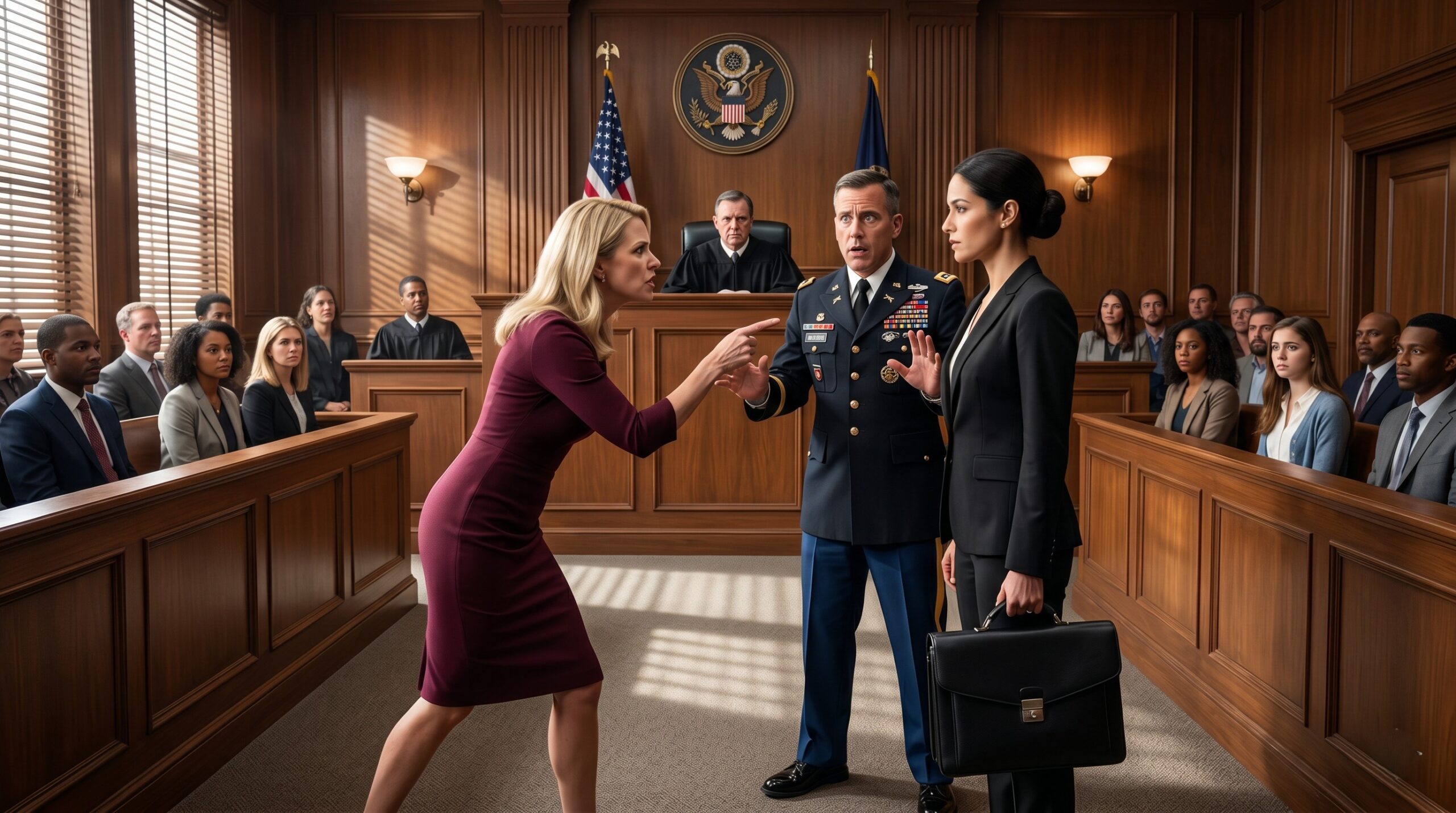
The music didn’t fade. It stopped like somebody had yanked the cord straight out of the wall.
One second, the ballroom was floating on string-quartet perfection, all polished violins and champagne laughter and women saying “Oh my God, you look beautiful” in voices bright enough to crack glass. The next second, there was nothing but the low hum of the air conditioner, the clink of a fork hitting a plate, and my own breathing.
My sister Vanessa stood in front of me in a custom ivory gown that cost more than my first car. Her hair had been pinned into soft, expensive waves, and tiny pearls were stitched into her veil like frozen drops of rain. She looked flawless.
She also looked furious.
“Stay in the back,” she snapped.
Her finger was pointed at my chest like she’d been waiting years to pull that trigger. The diamond on her hand flashed under the chandelier. Around us, guests turned in that slow, hungry way people do when they smell drama but want to pretend they don’t.
I stayed still.
That was something I was good at.
I could stand still while sand cut across my face in a desert wind. I could stay still in the blue light of a command room while three different voices shouted updates into my ear. I could keep my hands steady while everyone else panicked.
So I kept them steady now.
Vanessa leaned closer. Her perfume hit me first, something floral and sharp, like roses crushed under glass.
“You are not ruining my wedding,” she hissed. “Not with your awkward little comments. Not by hovering near important people. Not by making everyone feel sorry for you.”
I felt my mother behind me before I saw her. She had a way of standing close enough to signal disapproval without actually participating. My father was near the bar with a half-raised wine glass, staring like he had walked into the wrong room.
The groom, Mark, looked pale.
Poor Mark. He had no idea what family he’d married into yet.
I looked past Vanessa toward the double doors at the far end of the ballroom. They were painted white with gold handles, and through the narrow seam between them, I could see movement in the hallway.
Not catering staff.
Not late guests.
Military posture has a shape. Even in a tuxedo. Even in polished shoes on hotel carpet. You can spot it the way you spot lightning before thunder.
Vanessa was still talking.
“You’ve always done this,” she said, voice rising now because she had an audience. “You show up after disappearing for months, act mysterious, and expect people to care. This is my day. Not another chance for you to play some weird secretive victim.”
A few people near the dessert table shifted. Someone whispered. My cousin Ashley looked down at her phone like the marble floor had suddenly become fascinating.
I should have said something.
I had said less in rooms with more at stake.
Then the ballroom doors opened.
The air changed.
Not dramatically, not like in movies where everyone gasps at once. It was quieter than that. The room tightened. Shoulders straightened. Conversations died one by one, as if silence had moved through the crowd with a hand over every mouth.
Colonel James Marshall walked in.
He was older than I remembered, with silver threaded through his dark hair and a face cut by lines that didn’t come from smiling. He wore dress blues with ribbons across his chest, each one a tiny, careful record of places most of this room couldn’t point to on a map. Two aides followed him, both alert, both scanning without looking like they were scanning.
Vanessa turned with a bright, desperate smile.
“Colonel Marshall,” she said, suddenly sweet. “I am so sorry. Family issue.”
He didn’t answer her.
He didn’t look at the flowers, the guests, the champagne tower, or the gold-rimmed cake that had been flown in from Savannah because Vanessa said Charleston bakeries were “too expected.”
He looked straight at me.
His eyes narrowed, not with confusion, but recognition.
Then he crossed the polished floor.
Every step sounded too loud.
He stopped in front of me, close enough that I could see a tiny scar along his jaw I hadn’t noticed twelve years ago in a tent full of dust and classified maps.
For half a second, I hoped he would keep my secret.
For half a second, I wished the floor would open.
Then Colonel Marshall brought his hand up in a clean, formal salute.
“Commander Walker,” he said. “I didn’t expect to see you here.”
Vanessa’s arm dropped.
The fury drained from her face so fast it almost looked painful. Her mouth opened, but nothing came out. My mother’s wine glass tilted in her hand. Mark stared at me like I had just stepped out of a photograph he’d never been shown.
I didn’t return the salute right away.
Not because I forgot.
Because in that instant, every lie my family had built around me cracked at once, and I could hear the first pieces falling.
The colonel’s voice had made me visible. And for the first time in my life, I wasn’t sure if that was rescue or ruin.
Part 2 …
