There was one note sitting on the counter.
“WE TRAVELED ON A CRUISE. YOU TAKE CARE OF GRANDPA.”
That was it.
No explanation. No emergency number. Not even a “Merry Christmas.” Just a sentence written like my grandfather was some inconvenient chore they didn’t want to deal with anymore.
I stood there staring at the paper, trying to make sense of it. The house was dark. No Christmas lights. No tree. No music. The silence felt heavy, wrong somehow, like the walls themselves were waiting for something terrible.
Then I heard it.
A weak groan from down the hallway.
Marine training teaches you to move before fear catches up, so I ran.
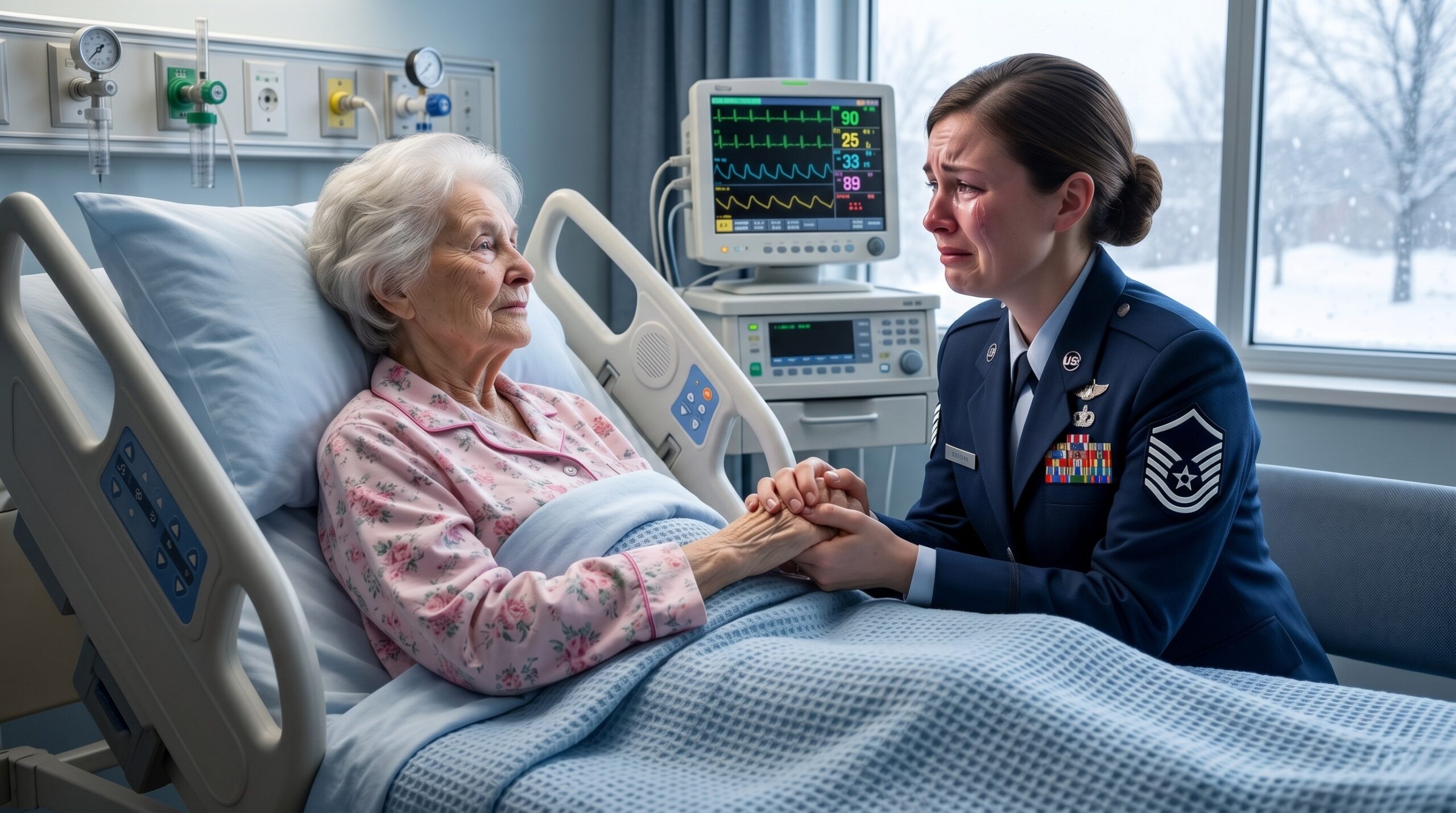
The guest room door was cracked open. The colder air hit me before I even reached the bed. When I flipped on the light, my grandfather Samuel was lying there fully dressed in his cardigan and flannel pants with no blankets over him. His hands shook so badly the mattress trembled beneath him. His skin looked pale and waxy. His lips had started turning blue.
“Grandpa… hey, it’s Maddie,” I whispered, dropping beside him.
His face felt freezing cold when I touched him.
I yanked off my winter coat and wrapped it around him, then grabbed every blanket I could find and piled them over his body like somehow enough fabric could undo what had happened.
I called 911 while trying to keep my voice steady.
The dispatcher told me to keep him warm and talking, so I talked nonstop. I told him stories about our fishing trips. About Grandma Josephine’s cinnamon rolls. About how he cried at my Marine graduation and blamed it on allergies afterward. I kept talking because the silence felt too close to giving up.
When the EMTs arrived, one of them looked at Grandpa and muttered, “Jesus… how long has he been like this?”
“I just got home,” I said. “My parents left him here.”
Inside the ambulance, warm IV fluids dripped into Grandpa’s arm while the medic quietly explained that elderly people can slip into hypothermia frighteningly fast. Another couple of hours and things might have ended very differently.
At the hospital, the fluorescent lights swallowed the night whole. Heated blankets. Oxygen tubes. Heart monitors.
One nurse looked at me and said softly, “He’s lucky you found him.”
The hospital social worker was even more direct.
“This could qualify as elder neglect,” she said. “Possibly abandonment.”
My parents hadn’t forgotten him.
They chose to leave him.
They had already disconnected his phone months earlier because it was “too expensive,” lowered the heat to save money, then boarded a cruise ship like escaping responsibility was some kind of vacation package.
When Grandpa finally stabilized, he slept hard, his body exhausted from fighting its way back from the edge. I stayed beside him all night replaying that note in my head over and over like a blade twisting deeper every time I read it.
The next afternoon he woke long enough to squeeze my hand.
“They don’t know about…” he whispered weakly.
“About what?” I asked, leaning closer.
He swallowed hard before forcing out the words.
“Help me… get revenge.”
I froze.
My grandfather was the gentlest man I had ever known. Hearing that word from him felt unreal.
I thought maybe the medication was talking until he whispered one more thing.
“Documents.”
The following morning he was more alert.
“Your grandmother hid copies,” he told me quietly. “Letters. Deeds. Wills. Your parents think I signed everything over to them already. They think I’m helpless.”
“Where are they?”
“In the house,” he said. “Look where your grandmother used to pray.”
I knew exactly where he meant.
Grandma Josephine’s little den.
The tiny room filled with photo albums, Bibles, and old wooden shelves my father never entered unless he needed a pen or wanted to complain about dust. It was the last place he would ever think to search for anything valuable.
After the nurses assured me Grandpa was stable, I drove back to the house alone.
From outside, it still looked normal.
Inside, it still felt abandoned.
The note remained on the counter exactly where they’d left it.
I turned the thermostat up and walked straight into Grandma’s den. I pulled her old brown leather Bible from the shelf, and halfway through Psalms my fingers hit an envelope hidden between the pages.
MADISON.
Written in Grandma Josephine’s careful handwriting.
My chest tightened as I opened it.
“Dear Maddie, it has begun.”
Behind the Bible, hidden inside her old desk drawer, I found a dented metal tin tucked beneath a deck of cards. Inside were stacks of folded papers held together with an old rubber band.
The first document was the deed to the house.
Still in Grandpa’s name.
The next pages were bank statements.
Transfer after transfer after transfer.
Money moving from Grandpa’s accounts directly into my father’s for years.
I didn’t even need a calculator to understand what I was seeing.
This wasn’t just neglect.
It was exploitation.
Grandma had also left behind a phone number.
I stood there in the freezing den with my breath visible in the air and dialed it immediately. The receptionist’s tone changed the second I mentioned my grandparents’ names, like she had been expecting this call for a very long time.
I drove back to the hospital with the documents locked in my trunk.
When I told Grandpa what I had found, his tired eyes sharpened instantly.
He didn’t smile.
He simply closed his eyes and whispered, “Good. Now we do this properly.”
That was the moment I realized the note on the counter wasn’t the beginning of the story.
It was simply the moment my parents finally became careless enough to get caught.
I came back home for Christmas in my dress blues expecting warmth, noise, maybe my mom’s cinnamon casserole baking in the kitchen. Instead, I stepped into a house that felt colder than the snow piling up outside.
Part 2
The ballroom went so silent that even the orchestra stopped playing.
Crystal glasses hovered midair. Conversations died in unfinished whispers. Every eye turned toward the military police officer standing beside Sybil, his face suddenly drained of color as he stared at the identification card in his gloved hand.
Then he snapped to attention.
“Yes, ma’am.”
The words struck the room harder than a gunshot.
Sybil blinked. “What?”
The officer didn’t answer her. His posture stiffened as he returned my ID with both hands like it carried far more weight than plastic and ink.
“Apologies, Commander Hale.”
The title spread through the ballroom in ripples.
Commander.
Not clerk. Not assistant. Not “Preston’s wife.”
Commander.
Across the room, I saw several officers exchange looks. One older admiral near the stage slowly lowered his champagne flute, recognition dawning across his face.
Preston’s face turned ghost white.
And Sybil…
Sybil laughed nervously.
“Oh, don’t be ridiculous,” she said, waving a jeweled hand. “There’s obviously some confusion here. My daughter-in-law works in administration.”
The MP didn’t move.
“With respect, ma’am,” he said carefully, “Commander Evelyn Hale currently oversees joint operational intelligence coordination for Pacific fleet deployments.”
The silence deepened.
I could practically hear Sybil’s pulse cracking.
“No,” she whispered.
But the officer continued because protocol demanded it.
“She also received the Distinguished Service Medal last spring.”
A man near the bar choked on his drink.
Someone else murmured, “That was her?”
And suddenly the room changed.
Not gradually.
Instantly.
Because people in rooms like this worship power the moment they recognize it.
The same civilians who barely acknowledged me all evening now stared with sharpened interest. Officers who had politely tolerated me suddenly stood straighter. Wives who had spent years orbiting Sybil’s approval looked between us like spectators realizing they’d backed the wrong side of a war.
Sybil’s smile began slipping.
“You’re exaggerating,” she snapped. “There must be dozens of women with that name.”
“There are not, ma’am.”
The MP’s voice stayed respectful.
But final.
Preston finally stepped forward. “Mom, stop.”
“No.” She pointed directly at me again. “She lied to us for years.”
I almost laughed.
Lied?
