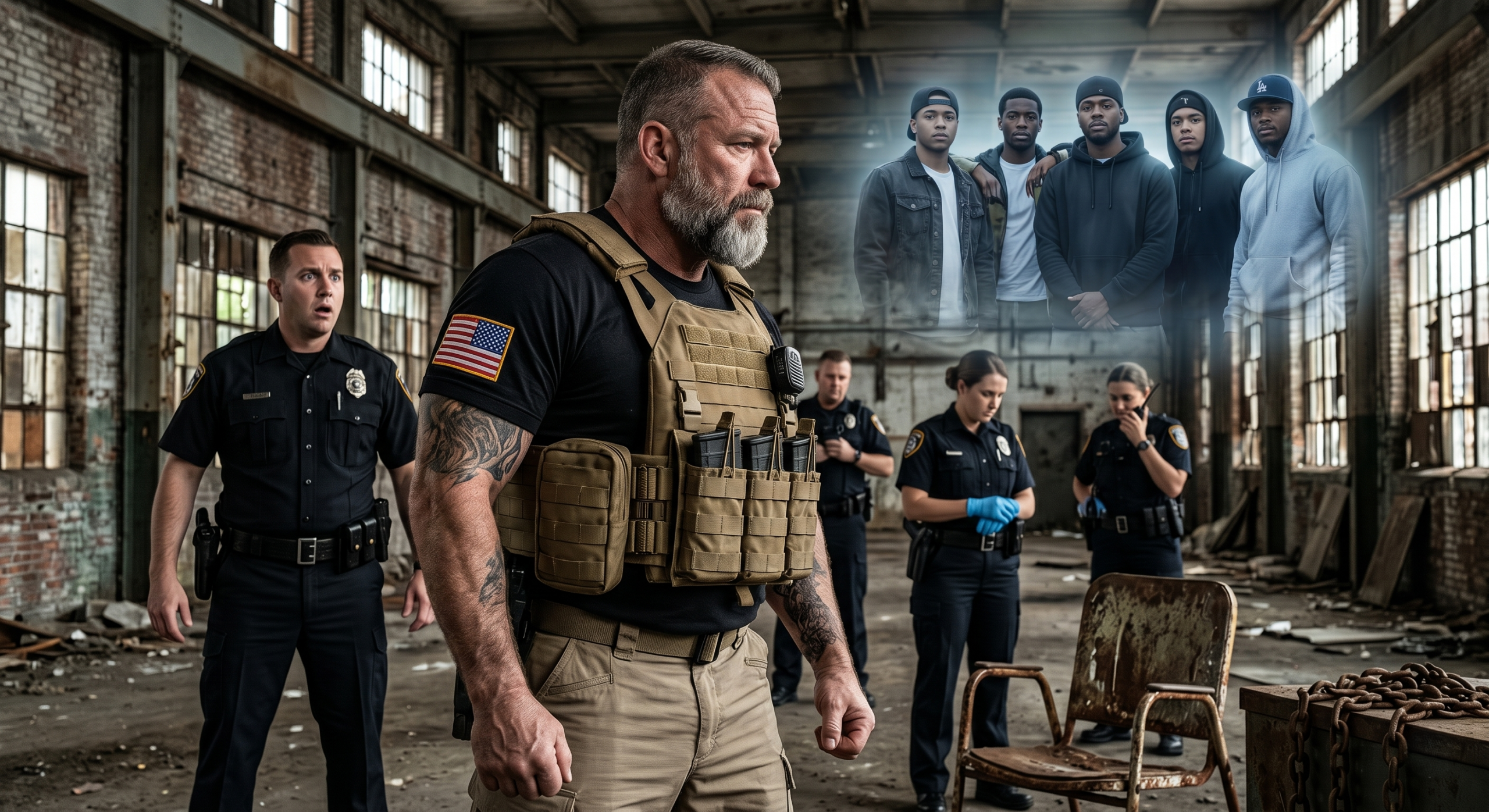
My 16-Year-Old Son Was Found By Police, Chained To A Rusty Metal Chair In A Dark Warehouse For “Seven Brutal Hours,” While Fifteen Laughing Monsters Took Turns Beating Him Bloody Just For Sport. I Arrived Too Late—Only “His Dying Scream” Echoing Through Empty Halls And Concrete Walls Carved With His Final Plea: “Daddy, Where Are You?”. The Father They Mocked Is Gone. Now The “Navy SEAL Devil” They Created “Will Hunt Every Name.” No Mercy. No Escape. “Fifteen Monsters. One Father’s Endless War.”
### Part 1
I was halfway up a ladder, one hand around a porch bulb and the other holding a screwdriver between my teeth, when my phone started vibrating on the railing.
Rain had been hanging over our street all evening, not falling hard yet, just breathing that wet-metal smell into everything. The porch wood was slick under my boots. A moth kept throwing itself at the dead light like it had a death wish.
Logan was supposed to be home by nine.
Basketball practice, then pizza with two boys I had checked out twice because old habits don’t retire just because you do. He was sixteen, tall as a fence post, with his mother’s eyes and my stubbornness. He had texted me at 8:41.
Be home soon, Dad. Don’t eat my leftover wings.
I still had the message open when the phone rang.
Unknown number.
I almost ignored it. Then something in my chest tightened. I pulled the screwdriver from my mouth and answered.
“Logan?”
For half a second, there was only a scrape of metal on concrete. Then breathing. Fast, wet, panicked.
“Dad!”
The word cracked through me.
Behind him, somebody laughed.
Not loud. Not movie-villain loud. Worse. Casual. Bored. Like a man waiting in line for coffee.
“Logan, where are you?”
“Dad, they—”
His scream cut the night in two.
I dropped the bulb. It burst on the porch boards, little glass teeth flashing around my boots. Every SEAL instinct I had buried under grocery lists, school pickup, and backyard repairs came awake at once.
“Logan! Talk to me!”
There was a thud. A dragging sound. Someone said, “Seven hours, soldier.”
Then the line went dead.
I don’t remember getting off the ladder. I remember rain finally breaking loose and my hand shaking so hard I could barely dial 911. I called his friends. His coach. Every hospital within fifty miles. I drove to the gym and found only dark glass doors and a janitor who smelled like cigarettes and floor wax.
At 3:07 in the morning, two officers came to my door.
I knew before they spoke.
People think bad news announces itself with crying. It doesn’t. It arrives wearing a careful face.
Detective Amelia Brooks stood behind them in a navy raincoat, water dripping from her hair. I knew her from a neighborhood safety meeting, one of those nights Logan made fun of me for standing too close to the exits.
“Victor,” she said.
One word. My name. And I stopped being a father standing in his hallway.
I became a hollow thing.
They found him in an abandoned warehouse outside the old rail yard. I followed the cruisers because nobody was going to tell me to stay home and wait. The place smelled like wet rust, old oil, and burned rope. Blue lights washed over broken windows. Men who had seen homicides for twenty years looked away when I walked past.
A coroner tried to block me.
I moved him aside.
My boy lay under a sheet that couldn’t hide what had been done. His hand was closed so tightly the medic had to ease it open. Inside was my dog tag, the one he wore under his hoodie because he said it made him feel “bulletproof.”
It had left an imprint in his palm.
Amelia stood beside me, silent.
“Who?” I asked.
She swallowed. “We think Ryder Cole’s crew. The Serpents.”
I knew the name. Everybody in East Harbor did. Ryder Cole sold poison out of clean cars, smiled in charity photos, and kept fourteen loyal men around him like teeth in a jaw.
I looked at my son’s face one last time.
Something inside me did not break.
It went quiet.
At dawn, I went home. The porch light still hung open. Rain had blown glass across the boards. Logan’s sneakers sat by the door, one tipped sideways like he had just kicked them off.
I walked to the basement and opened a footlocker I had promised never to touch again.
Inside were my service pistol, old mission notebooks, burner phones, foreign cash, and a black body cam wrapped in oilcloth.
I placed Logan’s picture on the lid.
Then my phone rang again.
Unknown number.
I answered without breathing.
The same distorted voice whispered, “Seven hours, soldier. We gave your boy seven hours. How long will you last?”
Static swallowed the line.
I clipped the body cam to my jacket and looked at my son’s smile in the photograph.
“Mission start,” I said. “Recover truth. Extract justice.”
And for the first time since Logan was born, I let the dark remember my name.
### Part 2
The morning after the funeral, the house smelled like burnt coffee and lilies.
People had brought enough casseroles to feed a church basement, but I had not eaten. Aluminum pans crowded the kitchen counter. Logan’s basketball sat under a chair, still scuffed from the last game he played. Every time I passed it, my mind tried to do something merciful and failed.
At 6:12 a.m., Amelia called.
“Victor, come to the precinct. Alone.”
Her voice had that tight edge cops use when the walls have ears.
I drove through a gray morning, wipers ticking like a metronome. At the station, nobody joked. Nobody offered condolences. Amelia led me to an interview room, shut the blinds, and locked the door.
Then she slid a memory card across the table.
“This came from an anonymous source.”
“What is it?”
Her eyes flicked toward the camera in the ceiling. “Proof. Maybe.”
She had already disabled the room recorder. That told me more than any warning.
The first file opened on a laptop. I saw concrete. A swinging work light. Boots moving around a chair. I heard Logan breathe.
I did not let myself close my eyes.
Fifteen men were there. Some wore Serpent tattoos openly, green snakes curling around wrists and necks. Some kept their faces turned. One stood near the back, still as a post, boots too polished for street work.
“Freeze,” I said.
Amelia paused the frame.
A reflection shimmered on a metal tool cabinet behind Logan. A square jaw. A buzz cut. Posture like a man who had drilled with a rifle until it became part of his spine.
“Who is that?”
Amelia rubbed her thumb against the edge of the table. “Colin Briggs. DEA liaison. Supposedly undercover.”
“Supposedly.”
“There’s more.”
She opened a folder thick with bank printouts, shell-company diagrams, and names circled in red. One logo kept appearing.
Prescott Industries.
Grant Prescott was the kind of rich man who got streets renamed after his father. Real estate, shipping, veteran charities, political dinners where steaks cost more than rent. I had worked one security detail for him years ago. He had offered me a private contract after.
I turned him down.
“He bankrolls Ryder?” I asked.
“We think so. But every time we get close, evidence disappears.”
The fluorescent lights hummed overhead. I watched that frozen reflection on the screen. Briggs looked bored.
That was what nearly undid me.
Not rage. Not grief.
Boredom.
“What did Logan find?” I asked.
Amelia hesitated too long.
“His laptop is missing,” she said. “But his teacher told us he was asking questions about dock shipments. Missing cargo. Serpent markings on containers that never went through customs.”
My son, who still left cereal bowls in the sink, had been chasing something grown men were afraid to name.
I stood.
“Victor, wait. We need warrants. Chain of custody. If you move alone, they’ll bury you.”
“They buried my son.”
She stepped in front of the door. “I’m trying to keep you alive.”
“No,” I said. “You’re trying to keep the case alive. I understand. But there’s a difference.”
Outside, rain slapped the windshield as I drove to the steel yard where Felix Marrow worked nights. Felix was Ryder’s errand boy, a skinny thief with nervous hands and a habit of talking too much when scared. I waited until dark across from the gates, listening to cranes groan over the river.
At 11:48, Felix slipped out beside Warehouse C to smoke.
I took him before he got the lighter sparked.
One hand over his mouth. One arm across his throat. Quiet, clean, controlled.
Inside a shipping container, I snapped on a flashlight.
His face went white.
“You’re Logan’s dad.”
“Start talking.”
“I didn’t touch him,” he whispered. “I swear. Ryder said we only had to stand there.”
“Stand there while what?”
His eyes filled with tears. Not remorse. Fear.
“It was for the video. Prescott’s people paid double if the kid said your name. Briggs kept the real copy. Ryder’s got backups at the old canal substation.”
A soft click sounded outside.
My body moved before my mind did.
I hit the floor as the container blew open in a ball of orange fire.
Heat punched my back. Metal screamed. Felix’s words vanished into smoke.
Through the ringing in my ears, I saw a black SUV peel away from the fence.
In the passenger window, under the flare of burning steel, was a vest marked DEA.
They had been watching me.
And now they knew I was watching back.
### Part 3
Burning paint has a sweet, ugly smell.
It clung to my jacket as I drove toward the canals with the windows down and rain needling my face. My left shoulder throbbed from where the blast had thrown me against concrete. A thin line of blood had dried along my jaw. None of it mattered.
Felix was dead.
But dead men still talk if you listen carefully enough.
Old canal substation.
Ryder kept backups there.
The building sat three blocks from the river, a red-brick box behind chain-link fencing and waist-high weeds. Serpent graffiti crawled across one wall. The air smelled of mud and algae. Somewhere nearby, a loose sheet of metal banged in the wind.
I killed the Jeep half a block away and watched.
One light glowed inside.
Too easy.
I circled the fence, found a camera tucked under a broken gutter, and smiled without humor. Not street trash. Professionals. The camera cable ran down the wall into a junction box. I cut the feed, then waited.
Nothing.
That was the part I didn’t like.
Men who expect trouble check when cameras die. Men who want you inside let silence invite you.
I slipped through a gap in the fence and crossed the yard low, counting windows, shadows, reflection angles. Inside, the substation smelled like dust, rat droppings, and old electricity. A security monitor glowed in the center office, showing a dead feed from the camera I had cut.
“Victor Hail.”
Ryder Cole stepped from behind a concrete pillar.
He was younger than I remembered. Early thirties, slick dark hair, snake tattoo climbing his throat. A leather jacket hung off him like he had dressed for a nightclub instead of a murder scene. Two guards flanked him with rifles too clean for gang hands.
“You killed my son,” I said.
Ryder tilted his head. “Killed? No. We used him.”
The room tightened around that sentence.
“Used him for what?”
“Message delivery. Prescott wanted you reminded that old soldiers should stay retired.”
One of the guards laughed.
I looked up at the corner. Another camera. Still active.
“Smile,” I said. “Somebody else is watching too.”
Ryder’s grin flickered.
That half-second told me there was a crack between him and whoever held his leash.
A shot cracked from outside. One guard dropped behind a generator, rifle clattering. The other swung toward the window. I moved into him, took the rifle off his hands, and put him into the floor hard enough to empty his lungs.
Ryder bolted.
I caught his jacket, but he twisted free and threw something at my feet.
Flashbang.
The world went white.
Sound became pressure. My eyes burned. When vision returned, Ryder was already outside, tail lights bouncing down the canal road.
I could have chased him.
Instead, I went to the office.
A metal drive cage sat under the desk, one blue light blinking. Whoever had set the trap had not expected me to survive long enough to notice it. I ripped the drive free and left through the back before sirens could find me.
At a diner off Route 7, I sat in the last booth, soaked to the skin, with the drive connected to a field laptop under the table. The waitress brought coffee and did not ask why my hands were black with soot.
The folders loaded slowly.
Operation Hydra.
Shipping manifests. Weapon serial numbers. Dock maps. Drone footage. And one file titled:
7hours_final.mp4
I did not open it.
I read the metadata first.
Edited by C. Briggs.
Transferred through Prescott Industries servers.
Tagged from Steel Yard 16A.
I wrapped the drive in electrical tape and hid it beneath the seat of my Jeep. My coffee had gone cold by the time Amelia slid into the booth across from me.
“You look like hell,” she said.
“You traced me.”
“I followed the smoke.”
She placed a small recorder on the table. “The blast at the steel yard is already being called a gas leak. DEA got there before arson. Briggs signed the scene report.”
I looked past her shoulder.
A black sedan rolled slowly by the diner window, then stopped.
Amelia saw my face change.
“Friend of yours?” she asked.
“No.”
The sedan door opened.
A man in a dark coat stepped out holding a phone to his ear. He didn’t look toward us. He didn’t have to.
On Amelia’s recorder, a new message crackled to life by itself.
A distorted voice said, “You found one copy, sailor. Now come find the war.”
Then an address appeared on the laptop screen.
Prescott Refinery, midnight.
### Part 4
The refinery district looked abandoned from the highway.
That was the trick of it.
Rust gave everything a dead face. Pipes sagged. Tanks leaned under old warning signs. Grass grew through cracked asphalt. But when lightning flashed, I saw movement between the storage towers—clean formations, staggered patrols, men who held rifles like paychecks depended on discipline.
Contractors.
Not Serpents.
Prescott had upgraded.
Rain misted cold against my cheeks as I cut through the north fence. Every breath was measured. Thirty seconds in. Thirty seconds out. Calm heart, clear hands. A man can be drowning in grief and still move like water if training cut deep enough.
I dropped the first guard under a pipe bridge and bound him with zip ties. The second saw a shadow and raised his rifle. I closed the distance before his finger made a decision.
No shots.
Shots invite questions, and I needed answers.
Inside the pump house, machines groaned like animals behind walls. Maps covered a small office. Red strings connected East Harbor to Atlanta, Phoenix, St. Louis, and a private airfield in Nevada. Containers were marked with fake medical labels. Prescott Supply Logistics appeared again and again.
A floorboard creaked behind me.
I turned with my pistol up.
Amelia raised both hands.
“Don’t shoot the only honest cop you have.”
“You shouldn’t be here.”
“Neither should nerve agent.”
She pointed to a crate manifest on the desk. One code made my stomach ice over.
VXD-2.
I had seen it once overseas, sealed inside a case nobody wanted to stand near. Chemical-grade death disguised as military inventory.
“How did Logan get near this?” I asked.
Amelia’s face changed.
She took out her phone and played a voicemail.
At first, there was static. Then Logan.
“Detective Brooks, this is Logan Hail. I think the dock shipments are connected to Prescott. If something happens, tell my dad I’m sorry. I just wanted to prove he wasn’t crazy about the Serpents. Please don’t let them erase—”
The message ended.
My legs almost failed.
He had called for help.
He had sounded scared, but not broken. My boy had stood in the dark with giants moving around him and still tried to leave a light on.
“I didn’t hear it until after,” Amelia said, voice tight. “It got buried in an old tip line.”
A truck engine started outside.
We moved.
In the core lot, men loaded sealed crates onto a flatbed. One crate slipped and cracked open. Under splintered wood, metal canisters gleamed with Navy inventory stamps.
My past life had been shipped home in boxes and handed to monsters.
Across the yard, Ryder argued with a man in a DEA tactical jacket.
Colin Briggs.
I filmed them through rain.
Ryder jabbed a finger into Briggs’s chest. Briggs slapped it away, then handed him a folder. Behind them, Prescott’s private security watched without curiosity.
Amelia whispered, “That’s enough to reopen everything.”
“No,” I said. “Enough to make them burn everything.”
A guard spotted us.
“Freeze!”
Bullets chewed the crate beside my head. I pulled Amelia behind a concrete barrier. Sparks jumped where rounds hit metal. A vapor line ruptured with a shriek, spilling a pale cloud across the lot.
Men yelled.
Someone fired blind.
The vapor caught.
Blue flame rolled low across the ground, not a Hollywood explosion, but worse because it was hungry and quiet before the blast punched the roof panels loose.
In the chaos, Briggs and Ryder ran in opposite directions.
DEA SUVs screamed through the refinery gates five minutes later. For one stupid second, I felt relief.
Then I saw them confiscate crates without photographing them. I saw agents strip cameras from walls. I saw Briggs point toward the office where we had been, and two men moved to sanitize it.
“They’re erasing the scene,” Amelia said.
“Like Logan.”
We crawled through a drainage ditch until refinery lights blurred behind us. Mud filled my sleeves. Rain washed blood from a scrape along Amelia’s temple.
At my Jeep, she uploaded the footage to an encrypted server while I watched the road.
The progress bar hit complete.
Then her phone buzzed.
She read the message, and all the color drained from her face.
“Federal judge just sealed Hydra under national security privilege.”
I stared through the windshield at the empty road.
In the reflection, behind my own face, I saw another memory: my wife Morgan taking late calls in the laundry room, whispering like walls could testify.
And suddenly the war felt much closer to home.
### Part 5
I got home before dawn and found Morgan awake in the kitchen.
She had made coffee she wasn’t drinking. The mug trembled between both hands. Her robe was tied too tight at the waist, and her eyes kept moving from me to the pistol on my hip.
“What happened to you?” she asked.
“Work.”
“You’re retired.”
“So are a lot of dead men.”
She flinched.
Once, I would have softened at that. I would have crossed the room, kissed her forehead, told her I had it handled. But the last two days had turned every familiar thing into evidence. The detergent smell in the air. Her phone facedown by the sink. The envelope of bank statements half-hidden under a grocery flyer.
“Did anyone call here tonight?” I asked.
“No.”
Too fast.
I looked at the phone. She saw me look.
“Victor, don’t do this.”
“Do what?”
“Turn this house into one of your missions.”
I wanted to tell her the mission had started when our son screamed into my ear. Instead, I went downstairs and mapped everything we had.
Steel yard. Substation. Refinery. Prescott corporate routes. DEA cleanup. Logan’s missing laptop.
Every point formed a triangle around Prescott Industries’ private compound twenty miles north, hidden behind old oil fields and fake environmental fences. Ryder would run there if he believed the refinery evidence survived. Briggs would too.
At 9:00 p.m., I left without saying goodbye.
Halfway out of town, headlights held my rearview mirror for ten miles. Same distance. Same speed.
At an old bridge, I braked hard and stepped out with my pistol raised.
The trailing car stopped.
Amelia emerged holding a flash drive above her head.
“Don’t shoot. I brought insurance.”
“You always tail grieving fathers?”
“Only the ones about to invade private fortresses.”
She handed me the drive. “Backup footage, Logan’s voicemail, financial trails. If I disappear, it posts to three journalists.”
“FBI?”
“Compromised. At least partly. Prescott’s donors have friends.”
We drove separately to the compound.
Past midnight, fog swallowed the oil fields. The facility glowed in patches—orange security lights, white camera domes, blue electrical fences. I entered through an old drainage culvert, belly against cold slime, crawling until the tunnel opened beneath a grated floor.
Boots passed overhead.
“Ryder says move product by morning,” one voice said.
“Prescott flying in at seven?”
“Junior is. Senior doesn’t leave Nevada.”
Senior.
New name. New layer.
I waited until the voices faded, then lifted the grate and slipped into a storage wing stacked with Navy-marked crates. The air stank of oil, cordite, and money.
A metallic click sounded behind me.
“Should’ve stayed retired, sailor.”
Colin Briggs stepped from behind a pillar, rifle steady. His eyes were flat, the color of dirty glass.
“You played hero long enough,” he said. “Drive. Now.”
“You work fast for a government employee.”
“Government’s just branding.”
He nodded toward a camera. “Prescott’s watching. Give me the evidence, maybe he lets your wife keep the house.”
That sentence landed exactly where he aimed it.
My wife.
I let anger show on my face because men like Briggs trust anger. They mistake it for losing control.
Then the southern gate exploded.
Amelia’s distraction rolled through the compound as smoke and sirens. Briggs fired. I dropped behind a column, came up inside his rifle line, and slammed him into the railing.
He fought well.
Not street well. Trained well.
His elbow split my lip. I broke his nose. He drew a knife from his vest, and I trapped his wrist until the blade hit the floor. For one breath, we were two soldiers in a narrow world, one who remembered why rules existed and one who had sold that memory.
“My son begged,” I said.
Briggs grinned through blood. “Everybody begs.”
I drove him into the steel so hard his knees folded.
I wanted to end him.
Instead, I zip-tied his wrists.
“Daylight,” I told him. “You’re going to meet it.”
The central office tower overlooked the storage yard. Through bulletproof glass, I saw Grant Prescott Junior shouting into a phone while Ryder paced beside him.
I crawled through a maintenance vent and listened.
“The DEA will clean it,” Prescott snapped. “Hail’s one man.”
Ryder slammed both hands on the desk. “His kid was one kid, and look what happened.”
“Then handle the father.”
I kicked the vent cover out and dropped into the office.
Glass shattered. Prescott screamed. Ryder drew fast, but I shot the CCTV console first. Monitors burst into sparks, throwing the room into flickering dark.
“No more screens,” I said.
Ryder charged.
We hit the wall hard enough to crack framed photographs. His fist caught my ribs. I drove my shoulder under his chest and put him through a side table. Prescott crawled for a gold-plated pistol under the desk. I kicked it away.
Outside, real FBI convoy lights climbed the hill.
Amelia had found someone clean enough to answer.
I bound Prescott and Ryder both, then opened every file cabinet before the agents breached the building.
Ryder looked up at me, bleeding and smiling.
“You think this is the top?”
“No,” I said. “But it’s the first floor.”
My phone buzzed as helicopters thumped overhead.
Amelia’s voice came through, shaking.
“Victor, we need to meet. There’s something about Logan you don’t know.”
Behind Ryder’s smile, I saw fear for the first time.
And I realized the thing coming next was worse than the thing I had survived.
### Part 6
The pier at Birch Point smelled like brine, diesel, and dead fish.
Mist slid over the black water in slow sheets. Fishing boats knocked softly against their ropes. The whole world felt held together by damp wood and tired nails.
Amelia waited in her car with the engine off.
She looked older than she had twelve hours ago.
When I got in, she handed me a manila envelope.
“Logan’s school files,” she said.
I opened it under the weak dome light.
Emails. Notes. Photos of containers. A student press badge. Messages between Logan and Paige Heller, his journalism teacher.
Ms. Heller, I think the Serpent tag is being used to mark real shipments.
Ms. Heller, my dad knew some of these routes from military work.
Ms. Heller, if I’m wrong, please don’t tell him. He already worries enough.
I laughed once, but it came out broken.
“My kid thought he was protecting me.”
“He was building a story,” Amelia said. “School paper at first. Then something bigger. Heller says he wanted to prove Ryder’s gang was tied to Prescott.”
“Where’s Heller?”
“Gone. Her apartment was empty by the time officers got there. Could be scared. Could be bought.”
Red herring or witness. I filed her under both.
Amelia pointed to one page. “A part-time IT aide accessed Logan’s account the day before he vanished.”
“Felix Marrow.”
“Yes. Before the steel yard, Felix forwarded Logan’s files to Briggs. Briggs forwarded them to Prescott.”
The water slapped the pylons, steady as a clock.
“So Logan wasn’t grabbed because of me,” I said.
Amelia didn’t answer.
That was answer enough.
I had spent days believing my past killed my son. Now I understood the truth had sharper teeth. Logan had found the monster first.
A crunch of gravel snapped both our heads toward the road.
Dark SUV. No headlights.
“Down,” I said.
Gunfire ripped through the windshield.
I pulled Amelia to the floorboards as glass rained over us. Returned two shots through the broken side window. The SUV skidded into a rail, and men spilled out firing.
I moved along the pier’s crane tower, boots sliding on wet planks. Muzzle flashes strobed between nets and rusted hooks. One attacker dropped behind a bait freezer. Another ran when he saw me coming.
Then Ryder’s voice cut through the rain.
“You don’t quit, do you, Hail?”
He stood twenty yards away, one arm wrapped in a bloody bandage, leather jacket torn, grin alive and ugly.
“You were in custody,” I said.
“Prescott’s people have keys.”
He backed toward a speedboat tied at the far end of the pier.
“You think you won because Junior got cuffed? That boy’s a spoiled cashier. Hydra has roots. Ask about Project Sentinel.”
“What is Sentinel?”
Ryder laughed. “Ask your wife.”
For one beat, the rain stopped being rain.
Morgan.
Ryder saw the hesitation and threw a flash grenade. White light swallowed the pier. By the time I could see, the boat was roaring into the mist.
Amelia came up beside me, breathing hard.
“He’s trying to split us,” she said.
“Maybe.”
On the wet planks near where Ryder had stood, something blinked.
A phone.
Not his main one. A cheap burner, screen cracked, recording app still open. I played the newest file.
Static.
Then Ryder’s voice.
“Say it again, Mrs. Hail.”
A woman whispered, “I can get Victor’s old files, but you promised Logan stays out of this.”
My hand closed around the phone until plastic cracked.
It was Morgan’s voice.
And in that moment, the last safe room in my life burned down.
### Part 7
Our kitchen looked exactly the same when I got home.
That made it worse.
The magnet from Myrtle Beach still held Logan’s school lunch calendar to the fridge. A dish towel with little blue anchors hung from the oven handle. Coffee perked on the counter like mornings still belonged to ordinary people.
Morgan stood by the sink.
She knew before I spoke.
Maybe it was my face. Maybe guilt has ears.
“Sit down,” I said.
She didn’t.
Amelia stayed near the doorway, rainwater dripping from her coat onto the tile.
I placed the burner phone on the table and played the recording.
Morgan’s voice filled the room.
I can get Victor’s old files, but you promised Logan stays out of this.
The color left her face.
“Victor—”
“Don’t.”
She reached for the chair and missed it the first time. When she finally sat, her hands folded so tightly the knuckles whitened.
“They blackmailed me,” she said.
“With what?”
Her lips trembled. “Debts. A man. Years ago, when you were deployed. I thought you were dead half the time. I was lonely and stupid and—”
“Stop making this smaller.”
She flinched as if slapped.
Good.
“Ryder called,” she whispered. “He had pictures. Bank records. He said Prescott could make Logan’s college money vanish, make you look like you sold military secrets. He said all he needed was old names from your files. Contacts. Routes. Nothing active.”
“And Logan?”
“I made him promise Logan was untouchable.”
I stared at her.
The rain tapped the window softly, almost polite.
“You made a promise with the man who killed our son.”
She began to cry. I had seen Morgan cry before. At her mother’s funeral. When Logan broke his wrist in seventh grade. When I came home from deployment with stitches under my ribs and no explanation.
This time, her tears landed nowhere.
“Did you give them his schedule?”
She closed her eyes.
I had my answer.
“They said they needed to know when he wouldn’t be with you. Just to scare him if he had copied anything. I thought—”
“You thought fear was a plan.”
“I thought I was saving us.”
“You saved them.”
Amelia’s phone buzzed. She stepped into the hall, answered, listened, then looked back at me.
“Ryder surrendered to federal marshals twenty minutes ago.”
I turned slowly.
“Why?”
“He wants immunity. Says he has proof Morgan wasn’t the only family link. He asked for you.”
Morgan stood. “I’ll go. I’ll tell them everything.”
“No,” I said.
“Victor, please.”
“You don’t get to be brave after the grave is full.”
The federal holding facility smelled of bleach, old coffee, and fear hidden under paperwork. Ryder sat shackled behind a steel table, one eye swollen from our last meeting.
He smiled when I entered.
“Family night.”
I sat across from him.
“Talk.”
He leaned forward. “Your wife opened the door, but she didn’t build the house. Prescott Senior did. Not Junior. The old man. He’s alive, living behind shell companies in Nevada.”
“Proof.”
Ryder slid a smudged envelope across the table. “Emails. Call logs. Payment records. Schedules.”
I did not touch it.
He lowered his voice. “Here’s the part that hurts. Logan found the exchange. Tried to stop it. Wrong place, wrong hour.”
The guard behind me shifted.
Ryder’s smile thinned. “Question is, soldier, do you bury your wife with the rest of us or keep lying for love?”
Outside, I handed the envelope to Amelia because I couldn’t trust my hands.
In the parking lot, floodlights buzzed overhead. Mist silvered the asphalt.
She opened the first page.
Her face hardened.
“To Morgan Hail,” she read softly. “From Grant Prescott Senior.”
A Suburban screamed around the corner.
Four men jumped out in black tactical gear, DEA patches half peeled from their sleeves.
“Get down!” Amelia yelled.
Bullets shattered the facility windows behind us.
I hit the ground behind a concrete pillar, the envelope pressed under my chest.
One bullet tore through the top page.
But not before I saw the attachment name.
Logan_Hail_PracticeSchedule.pdf
### Part 8
They moved us to a hospital because people trust hospitals.
That always struck me as optimistic.
The room they put Morgan in smelled like antiseptic, plastic tubing, and old panic. A federal marshal stood outside the door pretending not to watch me through the glass. Morgan sat on the bed wrapped in a gray blanket, face pale from shock after the parking lot ambush.
I stood by the window.
Amelia leaned against the wall, one hand near her sidearm.
The envelope lay open on the rolling tray between us.
Morgan stared at it like it might grow teeth.
“I didn’t know,” she whispered.
I turned.
“That sentence is finished. You said it already.”
“They said they only wanted to scare him. They said if Logan gave up the files, no one would touch him.”
“You gave them his practice schedule.”
She pressed a hand over her mouth.
“I gave them a window,” she said. “I know that now.”
“You gave them my son.”
Her sob was small. Barely a sound. The kind people make when they finally run out of ways to defend themselves.
Once, that would have pulled me across the room.
Not anymore.
“You want forgiveness,” I said. “I don’t have it. Maybe God does. Ask Him.”
She looked at me as if I had raised a weapon.
“I loved him.”
“I know. That’s what makes this unforgivable.”
Amelia’s phone rang. She listened, then motioned me outside.
In the corridor, nurses moved around us with carts and tired eyes. Somewhere a child laughed at a cartoon too loud for the hour.
“Ryder gave up a roster,” Amelia said. “Fifteen names. Ryder plus fourteen Serpent members who were in that room with Logan. Payments, timestamps, video markers. He says each man was made to participate so Prescott could own them forever.”
“Blackmail by blood.”
“Exactly.”
She handed me a printout. Names crawled down the page.
Ryder Cole.
Felix Marrow.
Tate Kincaid.
Mason Crowe.
Julio Reyes.
Benny Vale.
Otis Lane.
Deacon Fry.
Samuel Voss.
Aaron Miller.
Roman Pike.
Caleb Rusk.
Lenny Sarlo.
Deke Malone.
Ira Nix.
Fifteen.
My vision narrowed until the paper became a target wall.
“Where are they?”
“Scattering. Marshals picked up two at a bus depot. Felix is dead. Ryder is being transferred to a safer site.”
“No site is safe if Hydra owns the locks.”
As if the building heard me, the lights flickered.
Then died.
Emergency red washed the hallway. A nurse screamed near the stairwell. The marshal outside Morgan’s door grabbed his radio.
Static answered.
Amelia drew her weapon. “Victor.”
The first attacker came through the service door wearing hospital scrubs over body armor. He raised a suppressed pistol. Amelia fired twice. He folded into a linen cart.
More footsteps pounded up the stairs.
I pulled the marshal’s spare cuffs and shoved them at Amelia. “Get Morgan moving.”
“And you?”
“I’m going to ask directions.”
Smoke seeped under the stairwell door. Sprinklers kicked on, cold water turning the red emergency light into blood-colored rain. I took the dead attacker’s radio.
A voice crackled through.
“Find the father. Find the laptop key. Kill the witness if needed.”
Laptop key.
Logan again.
I dragged one attacker into a supply room and pinned him against shelves of gauze and saline.
“Where is the key?”
He spat blood onto his chin. “House network. Kid mirrored the upload through the breaker circuit. Ryder knew. That’s why he gave us the address.”
The hospital shook with a distant blast from the parking garage.
Amelia burst in. “Ryder’s transfer convoy was hit.”
“Alive?”
“Unknown.”
I looked toward the wet window, toward the city lights beyond it.
Hydra wasn’t coming for evidence anymore.
They were going to my home.
And whatever Logan had hidden there was the only thing they still feared.
### Part 9
The drive to my house was a blur of rain, sirens, and red lights bleeding across the windshield.
Amelia drove. I sat beside her with a rifle across my knees and Logan’s roster folded in my pocket. Morgan was in the back seat, silent except for the small, broken breaths she kept trying to hide.
None of us spoke.
There are silences that comfort.
This one accused.
We cut the engine a block away. My street glowed blue and white, but the cars were wrong. Not patrol cruisers. Dark SUVs. No plates. Men moved inside my house behind curtained windows, flashlight beams sweeping through the rooms where Logan once left socks, homework, and half-finished bowls of cereal.
“They beat us here,” Amelia whispered.
“Then they’re in a hurry.”
We moved through backyards, under dripping hedges, past a neighbor’s plastic flamingo bent sideways by storm wind. The old storm cellar behind my shed still opened with the hidden latch Logan and I had built when he was ten and obsessed with secret tunnels.
“Zombie-proof,” he had declared back then.
I crawled through first.
The passage smelled of wet soil and old wood. At the end, a hatch opened beneath the kitchen pantry. Voices moved above us.
“Check the kid’s desk,” a man said. “Boss says the mirror runs through the house.”
“They find the breaker?”
“Not yet.”
I smiled in the dark.
Logan had been listening all those years when I taught him redundancy. Never trust one route. Never store one copy. Never hide the key where the lock lives.
I pushed open the hatch.
The kitchen erupted.
One man turned with a rifle. I broke his arm against the counter and drove him into the refrigerator. Amelia came up behind me and dropped the second before he got a shot off. Burned coffee filled the air from a shattered pot. Rain hissed through a broken window.
Upstairs, glass broke.
Then Morgan screamed.
I hated my body for moving toward the sound before I made a decision.
She was still Logan’s mother.
That did not make her forgiven.
It made her alive.
I ran up the stairs. The hallway smelled of plaster dust and gun oil. Morgan stood outside Logan’s room with a kitchen knife shaking in her hand. Behind her, a man in black armor searched Logan’s desk, tearing open drawers, throwing baseball cards and old math tests onto the floor.
“Drop it, Hail,” he called.
I flicked the hallway light switch.
The house went dark.
In the basement, the breaker relay tripped exactly the way Logan had wired it. For half a second there was only silence.
Then his old laptop chimed from under the bed.
Upload complete.
The armored man lunged for it.
I hit him shoulder-first, driving him through Logan’s closet door. We crashed through hanging jerseys that still smelled faintly of detergent and teenage sweat. He reached for a knife. I grabbed his wrist and slammed it against the bedframe until metal clattered loose.
Downstairs, Amelia shouted, “Convoy incoming!”
Through Logan’s broken window, headlights swept the lawn.
A black SUV rolled up like it owned the street.
Grant Prescott Senior stepped out under an umbrella held by another man.
He looked nothing like the monster I had built in my mind. Older. Trim. Silver hair. Cashmere coat. The kind of face banks trusted.
He looked up at me through rain.
“You’re a difficult man to bury, Commander Hail.”
I climbed out onto the porch roof and dropped to the lawn.
“You killed my son.”
“No,” Prescott said. “Your son found a door. I merely closed it.”
His guards raised weapons.
Prescott lifted one hand, stopping them.
“You think a list changes anything? The public forgets. Courts seal. Reporters get tired. Men like me endure.”
Behind him, over the hill, came the real sirens.
Amelia had been broadcasting our coordinates.
FBI vehicles flooded the street. Agents poured out with rifles and shouted commands. Prescott’s guards hesitated, calculating survival against loyalty.
Prescott drew a small pistol from inside his coat.
Amelia fired from the porch.
The round hit his shoulder. He spun into the SUV and slid down, gray coat blooming dark.
Cuffs clicked. Agents swarmed. Floodlights pinned the house in hard white.
Amelia ran across the yard holding Logan’s laptop.
“All fifteen names went live,” she said, breathless. “Every outlet. Full roster. Payment records. Footage markers.”
I looked toward Logan’s window.
The laptop screen still glowed.
Even dead, my son had hit send.
Then Amelia’s smile faded.
“There’s another file,” she said. “One Logan labeled Sentinel.”
And suddenly every captured man in the yard felt like the beginning, not the end.
### Part 10
By morning, the country knew my son’s name.
That should have felt like justice.
It didn’t.
News anchors stood outside courthouses and spoke in clean voices about Hydra, Prescott Industries, and a murdered student journalist. They said “alleged” like a prayer. They blurred Logan’s face, then showed the warehouse from far away. They ran photos of Ryder Cole, Grant Prescott Senior, and the fourteen Serpent members named in the leak.
People online called Logan brave.
They were right.
They were also late.
The leak broke the gang open, but it scattered the pieces. Five members vanished before sunrise. Three had police cousins. Two had passports under fake names. One had already crossed state lines in a refrigerated truck full of produce.
I sat in Amelia’s borrowed office with the roster on the wall.
“You can’t go after them alone,” she said.
“I’m not going after them alone.”
She exhaled, relieved.
“I’m going first.”
“That is not better.”
I pointed to the names. “Every one of those men stood in that room. Every one saw my son. Every one decided breathing was more important than mercy.”
“And you want to kill them.”
I looked at her.
“I want them found.”
That was true.
Mostly.
The first three were at a highway motel outside Dover, hiding under stolen names. The place smelled like bleach, cigarettes, and old carpet. A vending machine buzzed outside room 112. I watched through rain-specked glass as Tate Kincaid counted cash on the bed while Mason Crowe argued with Julio Reyes over a burner phone.
I cut the power to their room.
When Tate opened the door to complain, I pulled him into the dark.
Crowe went for a shotgun. Amelia’s task-force team, waiting two doors down, hit the room with flash shields and commands. Nobody died. Not because they deserved that mercy, but because Logan deserved courts full of their names.
Tate broke first.
“Ryder made us do it,” he sobbed on the curb, face pressed to wet asphalt. “Briggs said if we didn’t, Hydra would feed our families to prison crews.”
“Did Logan say anything?” I asked.
Amelia shot me a warning look.
Tate shook. “He kept asking for you.”
I walked away before my discipline cracked.
Two more were caught at a bus depot before noon. Benny Vale had shaved his head. Otis Lane had dyed his beard orange, like stupidity could pass for strategy. They carried Prescott cash and fake passports.
By sunset, seven of the fifteen were down.
Felix dead.
Ryder in custody.
Prescott wounded under guard.
Six Serpents arrested.
Still, Logan’s Sentinel file stayed locked behind encryption even federal techs couldn’t crack. The only preview was a thumbnail: a Navy coin resting on a desk beside an old photograph.
I knew that coin.
Admiral Harris Keane had given it to me after my last deployment. Heavy brass. Eagle on one side. Anchor on the other. I kept mine in a drawer. Logan used to flip it across his knuckles when he thought I wasn’t watching.
“Victor?” Amelia said.
I zoomed in.
The photograph showed a man in white Navy dress uniform, face blurred by motion.
Beside him stood Ryder Cole, younger, smiling like a recruit.
“Ryder wasn’t just gang,” I said.
Amelia leaned over my shoulder.
“What was he?”
I stared at the coin on the screen.
“Someone trained him.”
The phone on the desk rang.
Amelia answered, listened, then closed her eyes.
“Ryder’s being moved. He says he’ll talk only if you come.”
I looked back at the Sentinel thumbnail.
The brass coin caught the light like an eye opening.
### Part 11
Ryder sat in a federal interview room with both wrists cuffed to the table and still managed to look like he owned the building.
His leather jacket was gone. So was the grin, mostly. Without them, he looked smaller. Not harmless. Never harmless. Just human enough to hate properly.
I entered alone.
He studied me through swollen eyes.
“You got my boys.”
“Seven of them.”
“Nine by morning,” he said. “Deacon Fry’s at a church shelter on Calhoun. Sam Voss is with a cousin near the freight tunnels. Aaron Miller runs when he hears train brakes. Always did.”
“Why give them up?”
“Because they were never loyal. They were scared. Same as me.”
I sat across from him.
“What is Sentinel?”
His face changed.
Not fear. Calculation.
“You really don’t know.”
“I know Logan found it.”
“Logan found the old chain. Hydra wasn’t born in East Harbor. It started with people who needed dirty distribution without dirty fingerprints. Defense contractors. Naval intelligence. DEA channels. Gang muscle for domestic routes.”
“And you?”
Ryder smiled without humor. “I was a dog they trained in prison. Gave me protection, money, purpose. Told me I was serving something bigger.”
“You tortured a child.”
His jaw tightened.
For the first time, shame crossed his face and died there.
“I did what monsters do when cowards hand them permission.”
I wanted to reach across the table.
Instead, I opened Logan’s roster.
“There are still names.”
Ryder tapped one cuffed finger beside Caleb Rusk.
“Not a soldier. Chaplain. Prison pastor. He carried messages between me and Keane.”
The name hit the room softly.
Keane.
I heard the ocean. Helicopters. A medal ceremony. Admiral Harris Keane’s hand on my shoulder, calling me the best man he had ever sent into darkness.
Ryder watched recognition land.
“There it is,” he said. “That old hero pain.”
I stood.
“You’re lying.”
“Am I?”
By midnight, Caleb Rusk was arrested outside a church kitchen with two phones taped under a soup warmer. Deacon Fry surrendered after Amelia’s team found him hiding in a baptismal storage closet. Sam Voss ran through freight tunnels until train brakes screamed and he froze exactly as Ryder said he would.
Aaron “Hatch” Miller barricaded himself in a boxing gym, crying behind a heavy bag while negotiators talked him down.
Four more down.
Thirteen of fifteen.
Roman Pike was harder.
He had worked demolition at the steel yard, and he knew how to disappear inside broken places. I found him at a salvage yard before dawn, trying to burn a duffel of Serpent masks and payment slips in a barrel.
The fire painted his face orange.
“You don’t want me,” he said when he saw me.
“You were there.”
“I never touched him.”
I stepped closer.
Rain hissed into the barrel. Burned paper curled like black leaves.
“You watched.”
He swung a tire iron. I took the hit on my forearm, felt bone sing, then put him into the mud. Not hard enough to kill. Hard enough to make him listen.
“What did Logan say?”
Roman Pike cried into the gravel.
“He said his dad would come.”
That one nearly broke me.
Amelia’s team cuffed him while I stood beside the burning barrel and watched the last payment slip turn to ash.
By noon, only two names remained free.
Lenny Sarlo and Ira Nix.
They were caught together at the airport in cheap suits, carrying preacher passports and thirty thousand dollars in Prescott cash. Ira tried to swallow a memory card. A deputy stopped him.
Fourteen of fifteen.
Only Ryder Cole remained.
Then the call came.
His transport convoy had been hit on Route 18.
Three marshals wounded.
Ryder gone.
At the crash site, rain washed blood and oil into the ditch. On the inside wall of the overturned van, someone had written with a broken fingertip:
ASK KEANE WHY LOGAN KNEW.
Ryder was no longer running from me.
He was leading me toward the man behind the door.
### Part 12
Ryder called from Logan’s phone.
I knew it was impossible. The phone had been missing since the warehouse. Still, when the old ringtone sounded from Amelia’s desk, every person in the room went still.
I answered.
For three seconds, there was only wind.
Then Ryder said, “He kept this in his shoe.”
I closed my eyes.
“You want me angry.”
“I want you honest.”
“Where?”
“East Harbor High. Gymnasium. Come alone, or the woman who sold him dies.”
Morgan.
Amelia heard enough from my face.
“No,” she said before I spoke.
“He’ll kill her.”
“You said you don’t forgive her.”
“I don’t.”
“Then why go?”
I picked up my jacket. “Because Logan loved her.”
The high school gym smelled like old varnish, rubber mats, and dust. Banners hung from the rafters. Logan’s team photo was still taped outside the locker room, his grin wide, one arm around a teammate half his size.
I found Morgan tied to a chair at center court.
Ryder stood beneath the scoreboard with a pistol in one hand and Logan’s phone in the other.
“No weapons?” he called.
I opened my jacket and showed empty hands.
He laughed. “You’re either honorable or stupid.”
“Depends who writes the report.”
Morgan’s face was bruised. She tried to speak through the tape over her mouth.
I did not look at her long.
Ryder noticed.
“Cold. I expected tears.”
“You don’t get to expect anything.”
He tossed Logan’s phone across the floor. It slid to my feet. The screen was cracked, but a video file was queued.
“Before he died, your kid recorded us. Not the big video. His own. Audio only. He asked questions.”
I picked it up.
Logan’s voice filled the gym, small through the damaged speaker.
“Why do you keep saying Sentinel? Is that a person?”
Then Ryder, younger by days but already damned, answered in the recording.
“Sentinel is who your dad used to salute.”
My hand tightened around the phone.
Ryder watched me. “Keane wanted your old files because Logan used them to connect Navy ghost shipments to Hydra. Your wife opened the cabinet. Your kid opened the lock. I was told to make an example.”
“You chose how.”
“Yes.”
The word hung there. No excuse wrapped around it. No coward’s decoration.
“Yes,” he repeated. “I chose.”
He raised the pistol toward Morgan.
I moved.
Not forward.
Down.
A basketball cart sat near the wall. I kicked it with everything I had. Balls exploded across the polished floor. Ryder fired, missed, slipped as one rolled beneath his foot. I crossed the court in three strides and hit him at the waist.
We crashed into the scorer’s table. Plastic numbers scattered. He clawed for the gun. I pinned his wrist and drove my forearm under his jaw.
For seven hours, my son had been powerless.
For seven seconds, Ryder understood the edge of that.
I could have broken his neck.
I wanted to.
Logan’s phone lay near my knee, still playing faint static.
Dad would come, his recorded voice said. He always comes.
I let go.
Ryder sucked air, stunned.
“No,” I said. “You don’t get death from me. You get courtrooms. You get lights. You get every mother in America knowing your face.”
Police stormed the gym doors. Amelia’s team flooded the court. Ryder did not fight when they cuffed him. He only looked at me with something close to hatred and relief.
All fifteen were down.
Morgan wept when I cut her loose.
“Victor,” she said. “Please.”
I stepped back before she could touch me.
“I’ll make sure you’re safe,” I told her. “That’s all I have left for you.”
Amelia approached holding Ryder’s seized phone.
“Sentinel file unlocked,” she said. “It points to a decommissioned naval base outside Virginia Beach.”
On the screen was a clear photograph now.
Admiral Harris Keane.
My mentor.
My father in uniform.
And the last monster wearing a human face.
### Part 13
The road to Virginia Beach ran under a sky the color of old steel.
I rode with Amelia in an unmarked car, both of us quiet. The FBI had granted me “civilian consultant” status, which meant they wanted my knowledge but not my hands. No weapon. No badge. No authority.
They forgot grief doesn’t need a badge.
The decommissioned naval base sat beyond a chain-link fence salted white by ocean wind. Hangars slumped beside cracked runways. Weeds grew through old parade grounds where young men once learned to march straight before being sent into crooked wars.
I had trained there once.
Keane had watched from a tower with sunglasses on, arms folded, judging which of us could survive pressure and which would become pressure.
The main hangar smelled of salt, dust, and machine oil.
FBI teams moved around the perimeter. Amelia whispered into her radio. I walked ahead before anyone decided to stop me.
Keane stood near a rusted drone console, looking out through open hangar doors at the sea.
He wore civilian clothes, but his posture was still Navy. Straight spine. Hands clasped behind his back. A man pretending history was a uniform he could never remove.
“Victor,” he said without turning. “I wondered when my best ghost would arrive.”
“Logan was sixteen.”
Now he turned.
He looked older than memory but not weaker. His eyes were pale and clear, which offended me. I wanted madness. Trembling. A villain’s twitch. Instead, I saw the same calm that had once guided missions where maps were redacted and nobody asked what happened after extraction.
“Your son was brilliant,” Keane said.
“Don’t.”
“He followed patterns trained men missed. Container timing. Navy ghost inventory. DEA diversions. He had your mind without your obedience.”
“He had a heart.”
Keane looked toward the sea. “That made him dangerous.”
Something hot moved up my throat.
“You ordered Ryder to torture him.”
“I ordered pressure. Ryder chose theater.”
“Pressure?” I stepped closer. “He was a child.”
“Innocence is not armor, Victor. You know that better than most.”
FBI voices crackled outside.
Keane reached toward the console. I moved with him. Under his palm was a dead-man switch wired to a drive stack.
“Another leak?” I asked.
“A purge. If I press this, Hydra records vanish from three offshore servers.”
“Then take your hand off.”
He smiled sadly. “Still commanding rooms you don’t own.”
“You taught me.”
“Yes. That is my sin and my pride.”
I saw it then. The same trap Ryder had set in the gym, only polished. Keane wanted me close. Wanted my rage to write the ending. If I killed him, Hydra’s defenders could call the entire leak revenge fiction. A broken father. A rogue SEAL. Evidence tainted by blood.
He needed me to become the monster in his report.
I stepped back.
Keane’s smile faded.
“No,” I said. “You don’t get my hands either.”
Amelia entered behind me, weapon raised.
“Harris Keane,” she said, voice steady. “You’re under arrest for conspiracy, murder, trafficking of restricted military weapons, and acts against the United States.”
For the first time, Keane looked tired.
He pressed the switch.
Nothing happened.
Amelia lifted a small black transmitter. “We cut the relay ten minutes ago.”
I almost smiled.
Keane looked at me. “You trusted someone.”
“I learned late.”
Agents cuffed him as waves crashed beyond the runway. He did not resist. Men like Keane rarely do once the stage is gone.
As they led him past, he stopped beside me.
“History will not remember your son kindly. It will use him.”
“No,” I said. “It will speak his name because you were afraid of it.”
Keane’s eyes hardened.
Then he was gone.
Outside, the ocean wind hit my face, sharp and clean. For a moment, I thought I heard Logan laughing at some crooked shadow I cast on the concrete.
Amelia stood beside me.
“It’s over,” she said.
I looked at the hangar, the sea, the tire tracks from federal vehicles carrying away the last ghost.
“Not until the sentences,” I said.
Because monsters in cuffs are still monsters until the doors close behind them.
### Part 14
The trial lasted eleven months.
America has a way of turning pain into paperwork. Motions, hearings, sealed exhibits, expert testimony, news panels, courthouse sketches. Men who had moved nerve agent through my city sat in suits and pretended to be misunderstood administrators. Gang members cried when their mothers appeared. Briggs claimed classified obedience. Prescott Senior claimed failing health. Keane claimed necessity.
Logan’s audio played on the fourth week.
The courtroom changed after that.
Not dramatically. No shouting. No thunder. Just a quiet shift, like every person listening had moved one inch closer to the truth.
Ryder Cole stared at the table while my son’s voice asked, “Is Sentinel a person?”
Morgan sat two rows behind me. She cried silently into a tissue. I did not turn around.
The fifteen attackers were convicted first.
Ryder Cole received life without parole.
The fourteen Serpents received sentences long enough to make freedom a rumor. Felix Marrow was named in the findings, dead but not erased. Colin Briggs went down next, then Prescott Senior, then the judges, donors, contractors, and officers Hydra had fed for years.
Admiral Harris Keane was the last.
He stood when the sentence came. No tremor. No apology. The judge spoke for a long time about betrayal of office, betrayal of country, betrayal of public trust.
I heard only one word.
Guilty.
Afterward, reporters crowded the courthouse steps. Cameras flashed against the winter air. Somebody shouted my name. Somebody asked if justice had healed me.
I kept walking.
Healing is not a switch. It is a room you rebuild after the fire, board by board, knowing smoke will always live in the walls.
Morgan found me near the parking garage.
She wore a dark coat and no makeup. Her hair had gone thinner at the temples. Grief had not spared her just because guilt lived there too.
“Victor,” she said.
I stopped.
“I signed the papers,” she continued. “Your lawyer has them.”
Divorce papers. I had filed three months after Keane’s arrest.
“Thank you.”
Her face crumpled. “Is that all?”
I looked at the woman I had loved through deployments, nightmares, cheap apartments, hospital bills, and the first time Logan called me Dad instead of Dada. I looked at the woman who had let fear use her hands.
“I hope you spend the rest of your life doing good,” I said. “I hope you help people. I hope you tell the truth every day until your voice gives out.”
She waited, trembling.
“But I don’t forgive you.”
The words did not come from rage.
That surprised me.
They came from peace.
“Victor, please.”
“Love that arrives after the coffin is lowered is not love I can live on.”
She covered her mouth.
I walked away.
A year later, I taught navigation to children of veterans at a camp near the Blue Ridge. Nothing fancy. Compass work. Fire safety. How to read clouds. How to stay calm when the trail disappears.
Kids ask direct questions adults are too polite to touch.
“Were you really a Navy SEAL?”
“Yes.”
“Did you fight bad guys?”
“Yes.”
“Did you win?”
I looked across the field where afternoon light lay gold on the grass. A boy with messy brown hair was helping a smaller kid adjust a backpack strap. For half a second, he moved like Logan.
“No,” I said. “But I learned what winning should have meant.”
On Logan’s birthday, I drove to his grave with a folding chair, two root beers, and the dog tag he had held until the end. The cemetery smelled of cut grass and sun-warmed stone. A cardinal hopped along the fence, bright as a dropped ember.
I told him everything.
About the convictions. About the camp. About how Amelia still called once a month to check whether I was eating real meals. About how Morgan had started a foundation for families of coerced witnesses, and how I hoped it helped someone, even if it did not change us.
Then I sat quietly until the sky turned pink.
For a long time, revenge had been the only language my grief understood. Hunt the men. Find the names. Drag every shadow into light.
I did that.
All fifteen went down.
So did the men above them.
But the last mission was not killing Ryder, or exposing Keane, or refusing Morgan the forgiveness she wanted.
The last mission was walking out of the dark without letting it keep my son’s father too.
I placed the dog tag against Logan’s stone.
“You brought light, kid,” I whispered. “I just followed it home.”
Then I stood, brushed grass from my knees, and left before sunset.
Not healed.
Not whole.
But alive.
And for the seconds Logan never got, I decided that would have to be enough.
THE END!
Disclaimer: Our stories are inspired by real-life events but are carefully rewritten for entertainment. Any resemblance to actual people or situations is purely coincidental.
