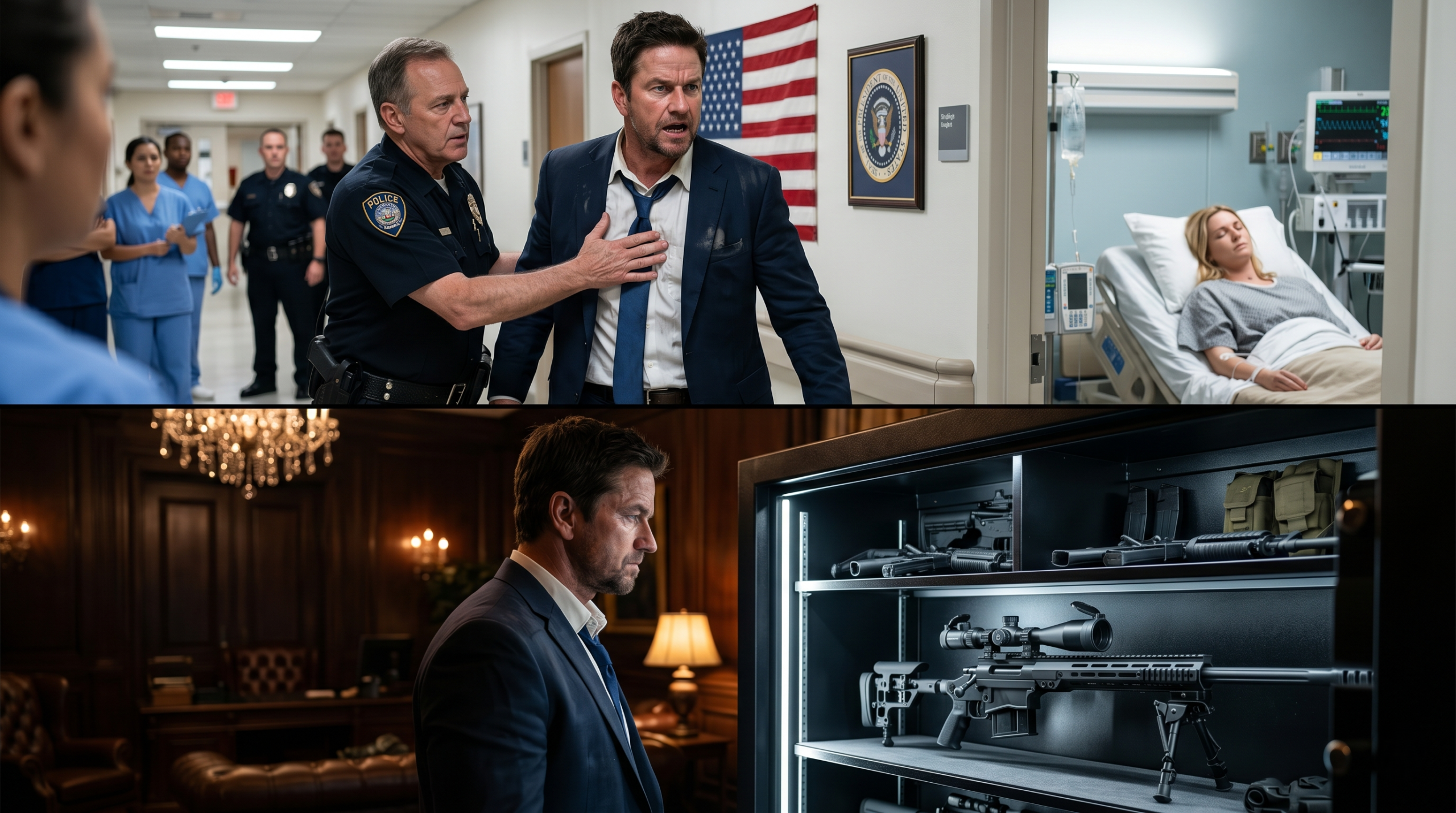
I Was In A Boardroom Meeting When The ER Doctor Called. “Your Daughter Is In Critical Condition!” I Rushed To The Hospital To Find Her Battered And Bruised.
The Police Captain Blocked The Door And Whispered: “The Boys Who Did This Are Senators’ Sons. The DA Won’t Touch Them. Evidence Is Already Disappearing!”
I Looked At My Daughter’s Shattered Face And Realized My Billions Couldn’t Fix This. But My Old Skill Set Could. I Went Home, Unlocked My Biometric Safe, And Dusted Off My McMillan TAC-50.
“They Thought Money Would Save Them.”
### Part 1
The most expensive sound in the world is not a sports car wrapping itself around a palm tree or a private jet losing an engine over the Atlantic.
It is a phone vibrating once on a mahogany table while twelve powerful men wait for you to keep talking.
I was standing at the head of that table, holding a glass of old scotch I had not earned by being gentle. Outside the glass wall, New York glittered like jewelry. Inside, men who owned banks, ports, and senators stared at me like schoolboys waiting for a principal to decide their fate.
Then my phone buzzed.
I never answered during meetings. Everybody knew that. But the caller ID said Mercy Hospital ER.
The room seemed to tilt.
I picked up.
A woman’s voice came through, thin and shaking. “Mr. Julian? Please come now. It’s your daughter.”
My hand opened. The glass dropped onto the carpet, rolled under the table, and bumped softly against somebody’s shoe.
No one spoke.
I do not remember leaving the building. I remember the elevator doors closing too slowly. I remember slamming my palm against the button like that could make steel move faster. I remember the cold night air hitting my face when I reached the street, and the valet shouting behind me as I took my Aston Martin without waiting for him to open the door.
I ran every red light between Midtown and Mercy.
I am a billionaire. I have owned companies before breakfast and destroyed men before lunch. I have sat across from generals, governors, killers in silk ties, and smiled. Before all that, before the suits and the clean hands, I spent twelve years as a Marine sniper. I have watched bad men stop breathing through a scope.
But on that drive, I was not a soldier or a CEO.
I was a father.
The emergency room smelled like bleach, wet coats, and fear. A nurse with tired eyes recognized me before I gave my name. She stepped into my path and lifted both hands, like she was stopping traffic.
“Mr. Julian, you need to prepare yourself.”
That phrase should be illegal.
“Where is she?” I asked.
“Trauma four.”
I walked in and forgot how to breathe.
Lila was twenty-four, but she looked six years old in that bed. One eye swollen. Lip split. Bruises around her neck in the shape of fingers. Machines beeped around her like they were counting down to something I could not stop.
My daughter had always smelled like vanilla lotion and peppermint gum. That night, under the hospital lights, she smelled like iodine and blood.
A doctor came in with a clipboard held against his chest. His name tag said Evans. His mouth moved before sound came out.
“Your daughter will survive,” he said.
I closed my eyes. “And the baby?”
He looked down.
The world went very quiet.
“I’m sorry.”
Lila had painted the nursery yellow because she wanted the baby to wake up in sunlight. She had sent me pictures of tiny socks and laughed when I bought a crib so expensive she called me ridiculous.
My grandson had never taken one breath.
“Who did this?” I asked.
The doctor swallowed. “The police are outside.”
Detective Miller was leaning by the vending machines, chewing gum like he was waiting for his oil change. He saw my suit, my watch, and stood straighter.
“Mr. Julian. Rough night.”
Something ancient and cold lifted its head inside me.
“My daughter was attacked. Her child is dead. Give me names.”
He scratched his jaw. “We’re still sorting out statements. Party at the St. Regis penthouse. Alcohol, drugs, rich kids being stupid. You know how it goes.”
“She was pregnant. She did not drink.”
“Witnesses say she was acting erratic.”
“What witnesses?”
Miller hesitated just long enough.
“Blake Thorne. Preston Kincaid. Kyle Bain was there too.”
I knew the names. Everyone knew the names. Senator Thorne’s son. The Kincaid Tech heir. Kyle Bain, whose father owned half the private prisons in three states.
“You arrested them?”
Miller gave me a look that almost passed for pity. “We need evidence. No cameras in the VIP room. Right now, it’s messy.”
Messy.
He called my daughter’s destroyed body messy.
I went back to Lila’s room and sat beside her until my spine ached. Near dawn, her hand twitched. Her eye opened, wild and unfocused.
“Dad?” she whispered.
“I’m here.”
Her fingers dug into my wrist. “They laughed.”
My throat closed.
She stared past me at something only she could see. “Blake said nobody would believe me.”
I leaned closer, tears burning so hot they felt like anger.
“I believe you.”
Her cracked lips trembled. “The door was locked, Dad.”
I went still.
She gripped me harder.
“Someone gave them the code.”
And suddenly the room was not cold anymore. It was burning.
### Part 2
I stayed with Lila until sunrise painted the blinds gray.
Every time a nurse entered, she flinched. Every cart wheel in the hallway made her shoulders tighten. She kept one hand on her stomach, even half-asleep, as if she still expected to protect what had already been taken from her.
I wanted to hunt that same hour.
That is what the old version of me would have done. Find the names. Find the breathing bodies attached to them. End the problem.
But I had spent twenty years teaching myself to be civilized. I had built towers instead of graves. I had bought art. I had funded hospitals. I had smiled at charity dinners beside men I knew were snakes because that was how polite society worked.
So I called my lawyer first.
Marcus Sterling had been with me since I was worth ten million instead of ten billion. His office sat on the seventy-first floor of a glass tower downtown. Usually, he greeted me with coffee, sarcasm, and a folder full of solutions.
That morning, he did not sit behind his desk.
He stood by the window with his hands in his pockets, looking at the city like he was about to jump.
“We file today,” I said, tossing a folder onto his desk. “Civil suit, criminal pressure, media strategy. I want them cornered by dinner.”
He did not turn around.
“Julian,” he said softly, “I can’t take this case.”
I stared at his back. “You’re joking.”
“I wish I were.”
“I pay your firm five million dollars a year.”
“And Senator Thorne can make sure I never practice law again.”
The room smelled like espresso and expensive leather. I had always liked that smell. That morning, it made me sick.
Marcus finally faced me. His skin looked waxy.
“I got a call at six,” he said. “Not from Thorne directly. Never directly. But the message was clear. If I represent you, every client I have gets audited, investigated, frozen, destroyed. They’ll bury my firm under paperwork until there’s nothing left.”
“My daughter was assaulted.”
“I know.”
“My grandchild is dead.”
His eyes shone, but he did not look away. “And they will put Lila on trial instead of those boys. They will say she wanted attention. They will say pregnancy made her unstable. They will leak anything they can find. Every text, every photo, every breakup, every college party. They won’t defend their sons by proving innocence. They’ll defend them by killing her reputation.”
I wanted to hate Marcus. It would have been easier.
But he was not lying.
I left without shaking his hand.
At the police station, a captain with a thick neck and dead eyes gave me the second lesson of the morning. He invited me into his office, shut the blinds, and offered coffee as if this were a business negotiation.
“Mr. Julian, we all want what’s best for your daughter,” he said.
“No, you don’t.”
His smile stayed in place.
“There are inconsistencies. Her medication. Her emotional state. Witness accounts.”
“Witnesses from the families you’re afraid of?”
His smile thinned. “Careful.”
I leaned forward. “No. You be careful.”
He folded his hands. “These are young men with futures. Sometimes parties get out of control. Sometimes regret becomes accusation.”
For one second, I was back in Afghanistan, looking through dust at a man carrying a rifle near a schoolyard. My finger had known what to do then. My body remembered.
But I only stood.
“Thank you for confirming what you are,” I said.
His mouth opened, but I was already leaving.
Outside, the morning sun had turned the city cruel and bright. People bought coffee, argued with cab drivers, dragged rolling suitcases over cracked sidewalks. The world had not stopped. That offended me more than I expected.
In the car, I opened my phone and searched Blake Thorne.
His profile was public because boys like him think privacy is for people with something to lose. The newest post was from two hours earlier.
A yacht. Champagne. Music. Blake wearing sunglasses though the sky was cloudy. Preston behind him, grinning with both middle fingers raised. Kyle half-hidden near the rail, pale and nervous.
The caption read: Untouchable weekend.
I zoomed in on Blake’s face until the pixels broke apart.
He was smiling.
My daughter was lying in a hospital bed with stitches under her ribs, and he was smiling.
Then I noticed something in the background of the photo, reflected in the yacht’s black window.
A fourth man.
Not clear enough to identify. Just a shoulder, a jawline, a silver watch I had seen somewhere before.
My stomach tightened.
The boys were not alone.
And whoever stood behind them knew exactly where to hide.
### Part 3
I went home to the estate on the cliff because grief needs space, and my penthouse had too many mirrors.
The house was all glass, steel, and angles, the kind of place magazines described as “a modern sanctuary.” That had always made Lila laugh.
“Dad, it looks like a villain lives here,” she used to say.
That night, she was right.
Rain moved across the windows in silver lines. The ocean below the cliff struck the rocks with slow, heavy blows. I walked past the kitchen where Lila had once made pancakes at midnight, past the living room where she told me she was pregnant and cried because she was afraid I would be disappointed.
I had cried harder than she did.
In the basement wine cellar, I stopped before a rack of Bordeaux. Behind a dusty bottle I had never intended to drink, I pressed the hidden panel.
Stone sighed open.
Cold air touched my face.
The room behind the wall did not exist on any blueprint. It smelled like metal, oil, old rubber, and a life I had buried. Monitors slept along one wall. Locked cases lined another. On the center table sat a black biometric case big enough to hold a coffin for a very thin man.
I placed my palm on the scanner.
Green light.
The latches opened.
Inside lay my old rifle, disassembled and wrapped in black foam.
I did not touch it right away.
For fifteen years, I had told myself that weapon belonged to a dead man. The man who could wait three days in mud without moving. The man who could slow his heart until the whole world narrowed into breath, glass, and trigger. The man who came home and promised his little girl he would never bring the war inside our house.
But the war had come anyway.
I assembled the rifle slowly. Not because I needed practice. Because ceremony matters.
Click. Slide. Lock.
Each sound removed a layer of civilization.
Then I powered up the monitors.
My company had contracts in defense, telecom, logistics, cybersecurity. I knew doors in systems most people did not know existed. I had never used them for personal revenge before. That used to be a line.
Lines are easy to respect until someone drags your child across one.
I started with public data. Cars. Apartments. Favorite clubs. Security vendors. Flight records. Then private data. Burner numbers. Payment trails. Encrypted chats that were not as encrypted as rich boys believed.
By midnight, Blake Thorne’s life sat open in front of me like a file on a dead target.
Preston Kincaid was worse. He had enough money to buy silence and enough stupidity to keep receipts. Kyle Bain was the weak one. Search history full of panic. “Can deleted texts be recovered.” “Can police prove room access.” “How long does DNA evidence last.”
Room access.
I wrote that down.
At 2:13 a.m., Blake called Preston.
I listened through a cloned feed, headphones pressing hard against my ears.
“Relax,” Blake said. His voice was lazy, bored. “My dad handled it. Miller’s on leash. The hospital report will get cleaned up.”
Preston breathed too fast. “Julian’s not normal, man. My dad said he used to be military.”
Blake laughed. “Everybody’s military now. He’s a businessman. He’ll sue somebody and cry on television.”
“What about the code?”
Silence.
Then Blake said, colder, “Don’t talk about that.”
My pencil stopped moving.
Preston lowered his voice. “I’m just saying, if the person who gave it to us talks—”
“He won’t.”
“He might.”
“He won’t,” Blake repeated. “He needs us more than we need him.”
I leaned back in my chair.
Him.
Not one of the boys. Someone else. Someone close enough to Lila to get a changing VIP code. Someone desperate enough to sell it.
My phone buzzed.
For one stupid second, I thought it might be Lila.
It was Evan.
Lila’s fiancé.
He had been at the hospital all day, eyes red, voice broken. He had held my shoulder and whispered, “We’ll get through this together.”
His text said: I’m at your gate. I couldn’t sleep. Can I stay here tonight?
On one monitor, Blake’s yacht photo still showed that blurred fourth reflection.
A shoulder. A jaw. A flash of silver at the wrist.
Evan always wore a silver watch.
I stared at his message while the rain tapped against the bunker door like fingernails.
And for the first time that night, the hunter in me looked back toward my own house.
### Part 4
I let Evan in.
That sounds insane now, but war is not won by shooting the first shadow that moves. War is patience. War is letting the snake crawl close enough that you can see the pattern on its back.
He came through the front door soaked from rain, carrying a small overnight bag. His hair stuck to his forehead. His eyes were red. He looked like grief wearing a navy peacoat.
“Julian,” he said, and hugged me.
I let him.
He smelled like rain, peppermint, and something expensive underneath. A sharp cologne I could not place until later.
“Any change?” he asked.
“She woke for a few minutes.”
His face twisted. “Did she say anything?”
That was the first crack.
Not How is she? Not Can I see her? Just: Did she say anything?
“Fragments,” I said. “Fear. Pain. Nothing useful.”
Relief moved across his face so fast most men would have missed it. I was not most men.
I gave him the guest room. He thanked me twice. At three in the morning, he was still awake. I watched from the bunker as his phone lit under the blanket. The cameras I had installed years ago for security were good. The new ones I placed that night were better.
I could not read his screen from the angle.
Not yet.
So I turned to Blake and Preston.
Fear works best when it arrives without a face.
The next afternoon, Blake found a cream-colored envelope inside his penthouse door. No stamp. No return address. Inside was a photo of him on the yacht, laughing, with a red circle drawn around his forehead.
Preston received a different photo. His Lamborghini outside a gala. On the back, I wrote one time in red ink.
11:40 p.m.
The time the VIP door opened.
Kyle got no photo. He got a heartbeat audio file, followed by the flat tone of a hospital monitor.
By sunset, all three were calling each other.
“He knows,” Kyle sobbed. “He knows about the baby.”
“Shut up,” Blake snapped.
“I’m going to tell somebody.”
“You tell anybody, my father buries you.”
“Your father can’t stop a ghost!”
There it was. The word I wanted.
Ghost.
Once a man believes he is haunted, every shadow becomes evidence.
I touched Blake’s smart-home system first. Dropped his temperature to forty-eight degrees. Turned every light in his apartment blue. Played a lullaby through his ceiling speakers, one I pulled from Lila’s old cloud videos. Her voice filled his rooms, soft and young.
Hush, little baby.
He screamed until his throat cracked.
Preston loved his cars, so I took one away without touching him. From a rooftop far enough to vanish into traffic afterward, I disabled his Lamborghini while paparazzi waited outside a charity gala. No blood. No bodies. Just a million-dollar machine coughing smoke onto a red carpet while Preston dropped to his knees in front of fifty cameras.
The text I sent him said: Next time, don’t stand so close.
He vomited into a planter.
Kyle broke first.
At 11:08 p.m., he called Blake again. I recorded every word.
“It was your idea,” Kyle cried. “You said she thought she was too good for us. You said Evan had the code. You said—”
Blake’s voice turned venomous. “Say his name again and I will personally put you in the ground.”
I sat very still.
Evan.
My daughter’s fiancé. The father of the child she lost. The man sleeping under my roof.
A minute later, a new call came in on Blake’s phone.
Evan’s voice.
“You idiots are falling apart,” he said.
Blake sounded drunk and terrified. “He’s in my walls, man.”
“He’s grieving. Grieving men make noise. Let me handle him.”
“You said he was soft.”
“He is soft with her,” Evan said. “That’s why I’m useful. I’m inside the house.”
I removed the headphones.
For a second, the bunker blurred. The monitors, the weapon cases, the maps. All of it went watery around the edges.
I had expected monsters outside the gate.
I had not expected Judas in the guest room.
Then Evan said something through the speaker that cooled every drop of blood in my body.
“Don’t worry. By tomorrow, I’ll know where he keeps the rifle.”
### Part 5
I did not kick in Evan’s door.
That would have been satisfying, which made it stupid.
Instead, I went upstairs, showered, shaved, and put on a dark sweater Lila had bought me last Christmas. It still had a loose thread near the cuff because she had tried to wrap it herself and snagged it on the tape dispenser.
At breakfast, Evan sat at my kitchen island eating toast he had not made, drinking coffee from a mug that said World’s Okayest Dad.
Lila had given me that mug as a joke.
“You look better,” he said.
“I slept.”
“Good. You need rest.”
He looked me in the eye when he lied. I almost respected that.
“I’m going to the hospital in an hour,” I said. “Will you come?”
His spoon paused against the ceramic bowl. “Of course.”
“But before that, I need help with something.”
“Anything.”
I led him to the library.
The room smelled like old paper and rain-soaked cedar. No fire. No staff. No cameras visible. Two glasses of scotch waited on the table, amber under the gray morning light.
Evan glanced at them. “Little early.”
“Long night.”
He gave a weak laugh and picked up a glass.
I sat across from him.
“I keep thinking about the code,” I said.
His face did nothing. That was his mistake. Innocent men react with confusion. Guilty men freeze.
“What code?” he asked.
“The St. Regis VIP suite. It changed hourly. Lila had it. Security had it. The person who rented the room had it.”
“Maybe the boys forced someone.”
“Maybe.”
I took out my phone and placed it on the table.
Evan’s recorded voice filled the library.
I’m inside the house.
His hand tightened around the glass.
Then another line.
By tomorrow, I’ll know where he keeps the rifle.
The scotch glass slipped from his fingers and shattered across the floor.
“You don’t understand,” he said.
That was when I knew he was done pretending.
“Make me understand.”
He stood too fast, chair legs scraping wood. “I owed money. Bad money. Vegas money. Blake found out. He said all I had to do was give them the room code. They were just going to scare her.”
“Scare my pregnant daughter.”
“I didn’t know they’d go that far.”
I looked at him, and something in me became perfectly empty.
“You knew enough to take the money.”
He started crying then. Not with grief. With self-pity.
“I loved her.”
“No,” I said. “You loved being near her. You loved what my name did for you. There is a difference.”
He moved toward the door.
I lifted the pistol from under the armchair cushion.
He stopped.
“Sit down.”
“Julian, don’t.”
“You are going to record a confession.”
His mouth twisted. “And if I don’t?”
I looked at the broken glass near his shoes. “Then you will learn how many parts of a man can break before he dies.”
He believed me because I meant it.
For twenty minutes, Evan spoke into my phone. He named Blake. Preston. Kyle. Judge Felix, who promised warrants would disappear. Senator Thorne, who paid police and prosecutors through shell charities. He named a private security firm used for intimidation. He named a fixer named Silas Cross.
At the end, his voice cracked.
“I gave them the code,” he whispered. “Lila trusted me, and I sold her.”
The room felt colder after that.
“Please,” he said. “Don’t tell her.”
That was the closest I came to killing him.
Not when he admitted the money. Not when he admitted the code. When he asked for her ignorance as his final comfort.
“You will never speak to my daughter again,” I said.
He nodded quickly. “Yes. Fine. Whatever you want.”
“No. Listen carefully. You will live long enough to watch her heal without you. You will watch her become someone you cannot touch, cannot call, cannot explain yourself to. And one day, when you are old and alone, you will understand that being unforgiven is not a punishment I gave you. It is the only honest thing you earned.”
His face collapsed.
I opened the front door and made him walk out into the rain without his coat.
At the gate, he turned back once, drenched and shaking.
My phone buzzed before he disappeared down the drive.
Unknown number.
The message said: You should have killed him.
Then another.
Now we know you’re coming.
Through the window, beyond the black iron gate, three SUVs appeared at the bottom of my driveway.
Their headlights rose through the rain like predators’ eyes.
### Part 6
I had bought the estate for its view.
I kept it because it could be defended.
The driveway climbed half a mile through dense pine before reaching the house. The cliff dropped sheer on the west side. The eastern approach looked open, but beneath the lawn were drainage trenches, stone walls, and landscape lighting placed exactly where a man running at night would look away from the dark.
I did not build a home.
I built a beautiful trap.
The SUVs smashed through the gate at 10:42 p.m.
By then, I was not in the house.
I lay belly-down beneath wet pine needles on the ridge above the driveway, wrapped in a dark rain shell, looking through night glass. Gregori, my head of security, waited with his team beyond the south wall. Men I trusted. Men who knew enough not to ask questions.
“Boss,” Gregori said through the earpiece, “we can take them.”
“Not yet.”
“They’re armed.”
“So am I.”
The SUVs stopped near the front steps. Twelve men got out in tactical gear with no markings. Not police. Not federal. Expensive ghosts paid by cowards.
They moved toward my front door.
One placed a charge.
The blast punched inward, sending oak and glass across the entryway. They flooded my house with lights and rifles, shouting like they had already won.
The house gave them silence.
I tapped into their comms.
“Where is he?” one voice snapped.
“Office clear.”
“Library clear.”
“Thermal showed heat inside.”
Of course it had. I had turned every fireplace and heating vent on full blast. They had attacked a warm empty shell.
I keyed my mic.
“You are trespassing.”
The men froze.
“Julian,” their leader said. “Come out and we can talk.”
I aimed at the engine of the first SUV and fired.
The vehicle bucked. Steam burst from under the hood.
Before they understood, I took the second engine. Then the third.
No escape.
“Last offer,” I said. “Drop your weapons and lie face down.”
Their leader cursed. “Spread out. Find him.”
Three men moved toward the trees.
I fired into the ground close enough to spray mud across their boots. The sound cracked through the rain and rolled over the ocean.
They dropped flat.
Good men learn fast under fire. Bad men learn faster.
One by one, they threw rifles onto the driveway.
Gregori’s team emerged from the dark like wolves with zip ties. Within ninety seconds, the hit squad was facedown in rainwater, stripped of weapons, phones, knives, and pride.
I came down from the ridge only after they were secured.
The leader looked up at me with mud on his cheek. He had a broken nose and dead eyes.
“Silas sent you?” I asked.
He said nothing.
I crouched beside him. “Blink once for yes.”
He spat at my boot.
Gregori moved, but I lifted one hand.
“Professional loyalty,” I said. “Rare these days.”
Then my phone rang.
Hospital.
My chest tightened so hard I almost dropped it.
“Mr. Julian?” A federal agent’s voice. Not a nurse. “There was an attempted unauthorized access to your daughter’s floor. A man with judicial credentials. He was stopped before entering her room.”
“Name.”
“Judge Felix Halloway.”
The rain seemed to stop midair.
Judge Felix was not hiding behind paperwork anymore. He was reaching for Lila directly.
“Where is he now?” I asked.
“He left before we could detain him.”
Of course he had.
Men like Felix did not run until they had somewhere prepared to run to.
I turned toward the city lights beyond the trees.
The hit squad had been noise. A distraction. The judge was the key.
And if he had risked showing his face at Mercy, then he was afraid of something in his own house.
### Part 7
Judge Felix lived in Silverleaf, a gated community where the hedges were trimmed by men who earned less in a year than the residents spent on wine.
His house was white stone, copper gutters, blue-gray slate roof, American flag over the front door. The sort of place that told you its owner believed in law, order, and tax fraud.
I parked a delivery van two streets away and walked through the drainage channel behind the property. Rainwater soaked my boots. Mud climbed my pants. Somewhere nearby, sprinklers clicked on because rich neighborhoods water grass even in storms.
The judge’s study light burned on the second floor.
Guilty men do not sleep well.
I entered through the balcony. The lock was expensive and useless.
Felix sat at his desk in a robe, drinking brandy. His right hand shook as he held the glass. He was on the phone.
“No, Senator, listen to me,” he said. “The team at the estate went dark. We need to move everything. Tonight.”
I stepped inside.
“Moving is stressful at your age.”
The glass slipped from his hand and shattered.
He reached for a drawer.
I crossed the room and shut it on his fingers.
His scream was small, almost childish.
“Sit down,” I said.
He sat.
Up close, he smelled like sweat, brandy, and panic hidden under aftershave.
“You tried to reach my daughter.”
“I had court business.”
“You’re going to have trouble holding a gavel with that hand.”
His face twisted. “You think you’re righteous? You’re a criminal.”
“Yes,” I said. “That is what happens when criminals own the courthouse.”
I placed Evan’s confession on the desk and played enough for him to understand.
The judge’s eyes moved toward the painting behind him.
A ship at sea. Dark waves. Lightning.
I smiled.
“Behind the painting?”
He said nothing.
I moved it aside and found the safe.
“Code.”
He stared at me.
I took out my phone and showed him a live feed of the captured men at my estate, each one guarded by my security team.
“Your cleanup crew is tired,” I said. “Do not make me tired too.”
“1984,” he whispered.
Cute.
The safe opened.
Inside were cash bundles, passports, three hard drives, and a red folder labeled Lazarus. I took everything.
Felix breathed hard through his nose. “You can’t use any of that. Chain of custody. Illegal entry. Poisoned evidence.”
“You still think this is court.”
“I can help you,” he said quickly. “I can sign warrants. Blake, Preston, Kyle, even Evan. I’ll make it official.”
“You will.”
His mouth opened.
“Right now.”
He signed with his left hand. It looked like a child’s handwriting. Arrest warrants. Emergency protective orders. A statement naming the senator’s interference. Enough official paper to slow their machine.
Not stop it.
Slow it.
I uploaded copies before leaving his study. Evidence packages went to three federal inboxes, two national reporters, and one retired Marine who owed me a favor and hated corrupt judges even more than I did.
As I climbed back over the balcony, Felix laughed.
It was wet and ugly.
“You don’t know what Lazarus is,” he said.
I stopped.
He smiled with brandy on his teeth. “Some things rise after you kill them.”
I wanted to go back inside and pull the truth from him piece by piece.
Instead, I left.
At dawn, the city woke to the first leak: Senator Thorne taking cash in a hotel room. By noon, the second: Judge Felix’s offshore account. By evening, every local channel had the story.
Blake’s phone lit up.
Private airfield. Now, his father texted. No phones after this.
Preston and Kyle received the same instruction.
I tracked them moving out of the city in separate cars, converging on a private runway near the marshlands.
Running meant fear.
Fear meant mistakes.
But as I loaded my rifle case into the van, I opened the red Lazarus folder on my passenger seat.
The first page had Lila’s name on it.
Not as a victim.
As a target.
### Part 8
The private airfield sat beyond the last warehouses, where the city dissolved into marsh and low black water.
No streetlights. No neighbors. Just runway lamps glowing through mist and a Gulfstream waiting with its engines whining.
I arrived first.
That mattered.
I set up in the wet grass beyond the service road, far enough to see the whole runway, close enough to hear the faint metallic scream of the jet turbines. Mud soaked through my sleeves. Mosquitoes found the back of my neck. The night smelled of salt, fuel, and rotten reeds.
My phone screen showed movement.
Blake first. Then Preston. Then Kyle.
They spilled from an SUV carrying duffel bags and terror. Blake kept looking behind him. Preston had lost one shoe. Kyle looked like he had been crying for hours.
Senator Thorne arrived in a second vehicle with Kincaid beside him. Their fathers did not hug them. They shoved them toward the plane.
Love, among people like that, is just ownership with better lighting.
I tapped the airfield frequency.
“Kill the engines,” I said.
The pilot jerked in the cockpit.
Senator Thorne grabbed the headset. “Whoever this is, you are interfering with federal movement.”
“No,” I said. “I’m interfering with rats leaving a burning house.”
He scanned the darkness.
“You want money? Name it.”
“My grandson had no price.”
Silence.
Then Thorne shouted at the pilot, “Go!”
The jet began to roll.
I fired once.
The front landing gear failed in a burst of sparks. The plane’s nose slammed down and scraped across the tarmac, screaming metal into the night. It skidded sideways and stopped hard enough to throw everyone inside against the cabin walls.
The boys crawled out coughing.
I disabled the lead SUV next. Then the second.
Now they had no plane and no cars.
Just flat ground and guilt.
I keyed the radio again. “Federal agents are on their way. Sit down, hands visible, and maybe you survive long enough for prison.”
Blake screamed into the darkness, “You’re dead! You hear me?”
“Yes,” I said. “I heard that from your friend Evan too.”
That shut him up.
For one fragile second, I thought it was done.
Then a police cruiser came through the far gate.
Not local police. One car. No lights.
Judge Felix stepped out.
He was not alone.
He dragged Lila from the back seat.
My heart stopped.
She wore a hospital gown under a coat too large for her. Her hair hung loose around her bruised face. She could barely stand. Felix had a gun pressed under her jaw.
“Julian!” he shouted through a handheld speaker. “Come out or she dies.”
The world narrowed so violently I lost sound.
My daughter was alive because I had guarded everything except the one door a judge’s badge could open.
“Dad!” Lila shouted. Her voice cracked but did not break. “Don’t!”
Felix hit her.
Every cell in my body wanted to pull the trigger.
But he held her too close. Too much movement. Too much risk. I had made impossible shots in war, but no shot is worth your child’s life.
I stood from the grass and raised my hands.
“I’m here!”
Felix turned toward my voice, dragging her backward toward the damaged jet. “Walk!”
I walked.
Step by step over wet ground, rifle hanging from its strap, hands open. Blake and Preston watched from behind the SUV, suddenly silent. Even they understood they had invited something worse than themselves.
Felix kept backing toward the plane. “We’re leaving!”
“That plane won’t fly,” I shouted.
“It only has to lift once!”
He was insane enough to try.
Fuel leaked beneath the wing, spreading black and shining across the concrete.
I dropped to one knee.
Felix screamed, “Put it down!”
I did not aim at him.
I aimed at the fuel-slicked ground between him and the plane.
The shot sparked.
Fire rose in a sudden wall, bright orange and roaring. Heat rolled across the tarmac. Felix flinched, throwing his gun hand up. Lila fell sideways away from him.
There.
One clean second.
I fired again.
The gun flew from Felix’s hand. He collapsed screaming, clutching his arm.
Lila crawled across the concrete, away from him, away from the flames.
Then the sirens arrived.
Federal vehicles smashed through the gate. Agents poured onto the runway. Senator Thorne dropped to his knees. Kincaid tried to run and fell. Blake, Preston, and Kyle were tackled so hard their faces hit the tarmac.
I stayed in the grass until medics reached Lila.
Through the scope, I saw her lift her head.
She looked straight toward my hiding place.
She could not see me.
But she knew.
Then Judge Felix, bleeding and handcuffed, turned toward the news helicopter lights already circling above.
He smiled.
His lips formed one word.
Lazarus.
And I realized the worst part of his plan had not happened yet.
### Part 9
Lazarus was not a file.
It was a promise.
I learned that in a motel room three hours north of the city, under a buzzing fluorescent light that turned my skin the color of old paper. I had changed vehicles twice, burned my clothes in a drainage ditch, and bought a prepaid laptop from a truck stop clerk who did not look up from his phone.
The red folder contained names, account numbers, shell companies, and instructions written with the calm cruelty of men who outsource murder like lawn care.
If Felix was arrested, a signal went out.
If Senator Thorne was arrested, a second payment released.
If both happened within the same twenty-four hours, priority target changed from evidence suppression to witness removal.
Primary witness: Lila Julian.
My hands went numb.
The page did not say daughter. It did not say mother. It did not say woman who had already lost everything.
Target.
That was what they had made her.
I called Marcus from a burner.
He answered with a whisper. “Julian? Every agency in the country wants you.”
“Listen. Lazarus is active. They’re going after Lila at the hospital.”
“She’s under federal protection.”
“Not enough.”
“Julian—”
“Call the agent in charge. Tell him roof, service elevators, oxygen delivery, laundry carts, doctors with new badges. Tell him nobody enters that floor unless their mother can identify them.”
“You sound paranoid.”
“I am alive because I’m paranoid.”
I hung up before he could argue.
By 4:17 a.m., I was on the roof of the parking garage across from Mercy Hospital, lying behind a concrete barrier with the city waking below me. Delivery trucks groaned in alleys. Steam rose from manholes. Somewhere, a siren wailed and faded.
The hospital’s fourth floor east wing glowed pale yellow.
Lila’s room had two agents outside, one inside, blinds half-closed.
I scanned the roof.
Nothing.
Then one shadow moved.
Not walking. Dropping.
A black-clad figure rappelled over the edge, smooth as water down glass. Then a second. Then a third.
They had skipped the lobby, the badges, the checkpoints.
Professional.
I had seconds.
The first assassin reached Lila’s window and set a tool against the glass. I fired at the wall beside him, close enough to shower him with concrete. He swung wildly on the rope.
Inside the room, the agent moved. Good man. Fast man. He grabbed Lila from the bed and pulled her low.
The second attacker cut through another pane.
I fired again and struck the metal frame above him. Glass burst inward. The assassin dropped his tool and clung to the rope.
Now the hospital erupted.
Alarms. Lights. Agents shouting. Muzzle flashes flickered behind curtains like lightning trapped in a box.
I could not shoot into that room. Not with Lila inside.
So I worked the roofline.
One rope snapped under a shot. One attacker slammed against the building and fell onto a lower balcony. Another tried to climb back up and found federal agents waiting above him.
By the time SWAT reached the fourth floor, the attack had failed.
But failed was not enough.
Failed meant they could try again.
I watched Lila through a gap in the blinds. She was on the floor, wrapped in an agent’s coat, hair across her face. She looked smaller than I had ever seen her, but she did not look broken.
She looked angry.
That gave me air.
My phone buzzed.
A message from Marcus.
You were right. They found explosives in a medical supply cart. Who are these people?
I looked at the hospital, then at the skyline beyond it, where Kincaid Tech’s black tower rose like a blade.
People?
No.
Systems.
Money had hired the judge. Money had bought the cops. Money had paid Evan. Money had activated Lazarus.
I could keep killing shadows forever, or I could turn off the light that cast them.
I packed the rifle.
At the bottom of the garage, as dawn bled pink across the city, I looked once more toward Lila’s window.
“I’m sorry, sweetheart,” I whispered. “I’m done defending.”
Then I drove toward Kincaid Tower with the red folder on the seat beside me.
By sunrise, their money was going to learn fear.
### Part 10
Kincaid Tower had sixty floors, four restaurants, three rooftop gardens, and a private vault under the basement that officially stored intellectual-property backups.
Unofficially, according to Lazarus, it stored cash, bearer bonds, hard drives, passports, and enough dirty accounting to make half the city pretend blindness for another decade.
I did not plan to steal it.
Theft is ownership changing hands.
I planned cremation.
The tower’s loading dock smelled like diesel, wet cardboard, and hot grease from the breakfast place next door. Men in uniforms moved carts through security with the dead-eyed rhythm of people whose badges were checked a hundred times a week by guards who stopped caring after the third.
I wore gray coveralls and carried a maintenance case.
Nobody looks at maintenance if the building is expensive enough. They just pray you are there to fix whatever makes their lives inconvenient.
The first checkpoint waved me through.
The second scanned my badge.
The third guard glanced at my face for half a second too long.
“You new?” he asked.
“Boiler sensor issue,” I said. “Basement three. If I’m late, your boss gets cold coffee and starts using words like unacceptable.”
He sighed and opened the gate.
Men like that have saved more spies than forged passports ever did.
The vault entrance sat behind two fire doors, a camera grid, and a palm scanner. I did not have Kincaid’s palm.
I had his fear.
At 6:03 a.m., I sent him a photo of Lila’s hospital window, taken after the attack, with one line: Your cleaners failed.
At 6:04, he called Silas Cross.
I listened.
“The vault,” Kincaid snapped. “Move everything.”
“Now?” Silas said.
“Now.”
At 6:22, Silas arrived with four men and the access codes I needed.
I let them open the vault.
Then I killed the lights.
Not all the lights. Just enough.
Emergency red washed the corridor. Alarms chirped. One of Silas’s men cursed. Another lifted a rifle.
I stepped from behind the server cabinet and struck the nearest man in the throat with the butt of my weapon. He went down choking. The second swung toward me. I took his knee, then his wrist. The third fired into darkness and hit a pipe. Steam screamed from the wall, filling the hallway.
Silas ran.
They always do.
I caught him at the vault door and drove him into the steel hard enough to empty his lungs.
“Combination,” I said.
He laughed through blood. “You think burning cash kills men like Kincaid?”
“No,” I said. “But it makes them call the people they owe.”
His smile died.
The vault opened.
Inside were shelves of money wrapped in plastic, gold bars in gray cases, hard drives labeled with initials, and passports for men who smiled at charity galas.
I photographed everything.
Then I uploaded everything.
The full accounting. The Lazarus contracts. The payoff ledgers. Names, dates, transfers. Not to one reporter. To hundreds. Newsrooms, federal agencies, foreign regulators, activist groups, rival politicians, tax authorities, union lawyers, insurance investigators.
If one inbox buried it, ninety-nine would not.
Only then did I set the fire.
Not a movie explosion. Not a fireball. A controlled burn, hot enough to ruin paper, melt drives, trigger sprinklers, and turn hidden wealth into sludge while leaving the structure standing.
Silas watched from the floor, coughing.
“You’re dead,” he rasped.
“I keep hearing that.”
“You can’t fight all of them.”
I crouched in front of him. “I don’t need to. I only need them to fight each other.”
His eyes shifted.
There it was.
Men tied together by secrets do not stay loyal when the secrets become public. They cut ropes. They point fingers. They sell friends to buy minutes.
As I left through the service tunnel, my phone exploded with alerts.
Kincaid Tech stock halted.
Senator Thorne conspiracy expands.
Federal raid at police headquarters.
Private prison magnate questioned.
Then one message from an unknown number.
Not a threat this time.
A video.
Lila, awake in her hospital bed, looking bruised and furious. A federal agent stood beside her. Marcus must have gotten her the phone.
“Dad,” she said, voice rough, “I know what you’re doing. I know why. But don’t disappear before I get to tell you something.”
The video cut off.
I stood in the tunnel with smoke alarms echoing behind me.
All night I had moved like a weapon.
Now I felt like a father again.
And that scared me more.
### Part 11
The arraignment was scheduled for nine.
By eight, the courthouse looked like the city had spilled its conscience onto the steps. Reporters packed the sidewalks. Protesters held signs with Lila’s name. News helicopters circled so low the flags snapped in their wind.
I watched from the bell tower of an old cathedral three blocks away.
It smelled like dust, pigeon feathers, and candle wax that had soaked into stone for a hundred years. Below me, people prayed in the chapel. Above me, a bronze bell hung silent, green with age.
I had no intention of killing anyone there.
That would have been easy to misunderstand, and I was tired of letting powerful men control the story.
The target was not flesh.
It was theater.
I knew the secure transfer route. Underground garage. Armored van. Six-second open-air walk between the vehicle and the elevator. Enough time for cameras to catch orange jumpsuits and frightened faces before federal marshals pulled them inside.
The fathers thought the courthouse would protect them.
They still believed buildings meant power.
At 8:59, the van arrived.
Senator Thorne stepped out first. Even in cuffs, he tried to look bored. Kincaid followed, pale and stiff. Then Blake, Preston, Kyle.
Blake’s hair was uncombed. Preston’s lip trembled. Kyle stared at the ground like he expected it to open.
A lawyer hurried beside them holding a black briefcase.
That briefcase was the key.
I had placed it in his office the night before, replacing the original with an identical case after copying every file inside. His arrogance made it simple. Lawyers trust locks and assistants. They never suspect the janitor.
The case he now carried was packed with printed evidence.
Lazarus contracts. Transfer records. Photos. Judge Felix’s notes. Evan’s signed confession. The kind of paper people can hold up to a camera when officials say “ongoing investigation” and “no comment.”
I steadied the rifle.
One shot.
The briefcase burst open in the lawyer’s hand.
White pages exploded into the air.
For a second, everyone froze beneath a storm of paper.
Then the crowd surged.
Reporters grabbed sheets. Protesters grabbed sheets. A marshal tried to gather them and gave up when the wind lifted another hundred pages down the courthouse steps.
I fired once more into the engine block of the empty transport van so it could not be used to hide them away quickly.
No blood.
No bodies.
Only truth, raining over marble.
A speaker I had planted near the media barricade came alive with my distorted voice.
“Read what they buried.”
The words echoed across the courthouse plaza.
“Read what they paid for. Read who protected them. Read who they tried to silence.”
Cameras turned everywhere at once. Senator Thorne looked up toward the cathedral.
For the first time, I saw him understand.
Not fear of prison. Men like him expect appeals, deals, comfortable cells.
No. He feared humiliation.
He feared being seen.
I dismantled the rifle and left before the first tactical team reached the block. Downstairs, an old woman in a blue coat was lighting a candle near the Virgin Mary statue. She did not look at me as I passed.
“Your hands are shaking,” she said.
I stopped.
“So are yours,” I replied.
She smiled sadly. “Mine are old.”
“Mine too.”
Outside, I blended into commuters and crossed the street with a crowd. On a billboard above the avenue, breaking news flashed before I reached the corner.
Evidence rains on courthouse in Thorne-Kincaid scandal.
No casualties.
Public outrage grows.
My phone buzzed.
Marcus.
Federal grand jury convened. Lila is safe. Evan arrested. Felix in surgery. DOJ taking everything.
Then another message appeared.
From Lila.
I watched the video. Call me when you can. Not as your mission. As your daughter.
I stood on the sidewalk while taxis screamed past and people shoved around me.
The city was finally awake.
But I had become the kind of man who did not know how to come home.
### Part 12
I called Lila from a pay phone in Queens because I no longer trusted anything with a battery I had not bought myself.
The booth smelled like old urine, rain, and metal. Someone had scratched a heart into the plastic beside the keypad. Lila answered on the second ring.
“Dad?”
The word nearly took me apart.
“I’m here.”
She breathed in once, sharply. “Are you hurt?”
“No.”
“That means yes, but not enough to admit it.”
I laughed. It came out broken.
For a moment, neither of us spoke. In the silence, I heard hospital machines behind her and the faint murmur of agents outside her room.
“I saw the courthouse,” she said.
“I didn’t hurt anyone.”
“I know.”
“I wanted to.”
“I know that too.”
A bus hissed at the curb behind me. People passed with umbrellas. A man yelled into his phone about rent. Life kept moving, rude and ordinary.
“Evan confessed,” she said.
I closed my eyes.
“I’m sorry.”
“Don’t be sorry for what he did.”
“He gave them the code.”
“I know.”
I pressed my forehead against the cold glass. “Lila—”
“No,” she said. “Let me say it. He came to my room with flowers two weeks ago. He held my stomach and talked to the baby. He asked what kind of father I thought he’d be.”
Her voice shook, but it did not collapse.
“I told him he’d be better than he thought.”
I said nothing because there was nothing large enough to say.
“He wants to see me,” she continued. “His lawyer asked. Said he needs closure.”
My hand tightened around the receiver.
“What did you say?”
“I said he can find closure in prison.”
I breathed again.
“Good.”
“I don’t forgive him,” she said. “I don’t forgive Blake, Preston, Kyle, their fathers, the judge, the cops, any of them. Maybe someday I won’t feel this burning in my chest every minute. Maybe someday I’ll sleep without lights on. But forgiveness? No. People act like forgiveness is the rent victims pay to keep everybody else comfortable.”
“That’s exactly what they do.”
“I’m not paying it.”
For the first time since Mercy Hospital, I smiled.
“That’s my girl.”
She was quiet a moment. “Dad, what happens to you?”
I looked at my reflection in the scratched plastic. Gray hair. Tired eyes. A face that had moved too easily between boardrooms and battlefields.
“I don’t know.”
“Come in.”
“I can’t.”
“Yes, you can.”
“If I come in, this becomes about me. Vigilante billionaire. Sniper father. Cable news will chew on it for months. Your case gets buried under my shadow.”
“I don’t care about cable news. I care that you’re my dad.”
That one hurt.
“I know.”
“Do you?” she asked.
Rain slid down the booth in crooked lines.
“I failed you once,” I said. “I won’t fail you again by letting them turn your pain into my trial.”
“They already failed me. You didn’t.”
I wanted to believe that.
Maybe someday I would.
“Lila, listen. The DOJ has everything now. Not local police. Not Felix. Federal. International, even. Kincaid’s accounts crossed borders. Thorne’s donors are running scared. Men like that start saving themselves by sacrificing others.”
“They’ll go to prison?”
“Yes.”
“All of them?”
“Yes.”
“And Evan?”
“He’ll ask for a deal.”
“Will he get one?”
“Probably.”
Her silence sharpened.
“But not freedom,” I said. “Not a life near you. Not a second chance. I made sure the financial crimes stick even if he cries his way through the assault charges. He stole from your trust. He conspired. He helped cover it up.”
“Good,” she whispered.
A siren passed near the booth.
“Dad?”
“Yes?”
“I loved the baby.”
My eyes burned.
“I did too.”
“I don’t want him to become just evidence.”
“He won’t.”
“I named him Noah,” she said. “I hadn’t told anyone yet.”
I covered my mouth with my hand.
Noah.
A whole life folded into one small name.
“I’ll remember,” I said.
“You better.”
Then, softly, “I love you.”
“I love you too, Lila.”
“Call again.”
“I will.”
But when I hung up, a black sedan slowed across the street.
Not federal plates.
Not local.
Private.
The passenger window lowered just enough for me to see a camera lens.
The system was wounded, not dead.
And something out there had just found my pay phone.
### Part 13
The sedan followed me for twelve blocks.
I walked, not ran. Running tells hunters they have chosen correctly. I moved through a bodega, out the back, over a low fence into an alley that smelled like spoiled fruit and wet brick. The sedan turned late. Amateur tail, or arrogant professional.
Either way, I was tired of being followed.
I waited beside a dumpster until the passenger stepped into the alley with a suppressed pistol low at his thigh.
He was young. Too young. Clean haircut. Good shoes. Not a street killer. Corporate security with combat training and a mortgage.
“Don’t,” I said from behind him.
He froze.
“Drop it.”
He did.
I took his weapon and phone. The phone unlocked with his face because fear makes men obedient.
His last incoming message was from Silas Cross.
Confirm visual on Julian. Do not engage unless necessary. Buyer wants him alive.
Buyer.
Not Thorne. Not Kincaid. They were in federal custody, bleeding lawyers.
Somebody else wanted me.
I looked at the young man. “Who hired Silas?”
“I don’t know.”
I believed him. The small ones rarely do.
“Walk away,” I said. “Change careers.”
He ran so fast he almost slipped.
Silas was cleaning loose ends for a buyer. The kind of buyer who did not want evidence exposed, not because he loved Thorne, but because his own name might be buried in the ash.
I checked the data again. There were initials repeated in Lazarus that I had not identified.
R.M.
Not a politician. Not a judge.
I found it two hours later in the Kincaid vault backups.
Rhett Mallory.
Old money. Real old. Railroads, oil, shipping, defense. He did not attend galas because galas attended him. His family foundation funded hospitals, universities, police training programs, and private “youth leadership retreats” for sons of powerful men.
The St. Regis party had been one of those retreats in everything but name.
Blake, Preston, Kyle.
And before them, others.
Lila had not been the first. That was the final horror.
There were sealed settlements. Missing complaints. Girls paid, threatened, smeared, forgotten. Some had overdosed. Some had left the country. One had died in a car accident three days before testimony.
Rhett Mallory was not protecting the boys.
He had built the culture that made boys like them possible.
I found him at his country estate in Connecticut, where the driveway was longer than most streets and the lawn looked fake in the moonlight. But I did not take a rifle. I took a thumb drive, a recorder, and the names of every woman his machine had buried.
His library made mine look humble. Dark wood, green lamps, leather chairs, portraits of dead men who had stolen things legally.
Mallory sat behind his desk as if he had expected me.
“You’re difficult to kill,” he said.
“You’re difficult to find.”
He smiled. “That is the point of wealth, Mr. Julian.”
His voice was dry, almost friendly. A grandfather voice. That made it worse.
“I don’t want you dead,” he said. “Dead men become symbols. I want you tired. I want you to understand that you cannot shoot a culture.”
“No,” I said. “But you can expose one.”
He laughed softly. “People forget. They always forget. Give them a war, an election, a celebrity divorce. Outrage has a short shelf life.”
I placed the recorder on his desk.
Then I placed the list of names beside it.
For the first time, his eyes moved.
Not much.
Enough.
“You remember them,” I said.
He said nothing.
“You remember every girl.”
His face hardened. “Careful.”
“No. You be careful. Because I’m not here to kill you.”
That disappointed him. Men like Mallory understand bullets better than consequences.
“I’m here to offer you what you offered them,” I said. “A choice that isn’t really a choice.”
I slid the thumb drive forward.
“On this is everything. Your payments. Your retreats. Your security footage. Your dead witness problem. It goes public in one hour unless you record a statement naming every judge, donor, officer, fixer, and family involved.”
He leaned back. “And if I refuse?”
“Then you die rich and remembered honestly.”
His hand trembled near the paper.
That tiny tremor felt like a building cracking.
He recorded for forty-three minutes.
When I left, federal agents were already at the gate. Not because I trusted them blindly. Because Lila’s new attorney, a woman named Dana Price who had once taken down a governor, had arranged the handoff.
By morning, Rhett Mallory was the headline.
By noon, victims from ten states were calling.
By evening, the story no longer belonged to me.
It belonged to all of them.
And that was when I finally understood what Lila meant.
Justice was not me in the dark with a rifle.
Justice was every buried voice learning it could still shake the earth.
### Part 14
Six months later, I saw my daughter in person.
Not in a hospital. Not through a scope. Not on a news screen.
In a small rented house near the coast of Maine, where the air smelled like pine smoke and salt, and the neighbors minded their own business because winter had trained them well.
Lila chose the place. Federal protection hated it. Her lawyer hated it. Marcus hated it most of all, which is how I knew it was perfect.
I arrived before dawn and waited on the porch with coffee growing cold in my hands.
When she opened the door, I forgot every speech I had prepared.
Her hair was shorter. A thin scar crossed her lip. She wore an oversized sweater and wool socks, and for one impossible second, she was twelve again, sleepy and annoyed that I had woken her early for a fishing trip.
Then she stepped forward and wrapped her arms around me.
I held her like the world might try to take her again.
“I’m okay,” she whispered.
“You don’t have to be.”
“I know.”
We stood there until the coffee went fully cold.
Inside, the house was warm and messy in a way my estate had never been. Blankets on the couch. Books stacked by the fireplace. A chipped blue bowl full of oranges on the table. A dog I did not know lifted its head, judged me, and went back to sleep.
“His name is Rocket,” Lila said. “He bites men with expensive shoes.”
“I’ll remove mine.”
“Smart.”
We sat by the kitchen window while snow moved sideways beyond the glass.
She told me about therapy. About nightmares. About the days she hated everyone who told her she was strong. About the first morning she woke up and realized she had slept four straight hours. About Noah’s memorial, a small private service under a maple tree, where she placed yellow flowers because the nursery had been yellow.
I listened.
That was harder than killing.
Blake Thorne had taken a plea after Kyle testified. Preston Kincaid tried to blame drugs, parenting, society, anybody but himself. The judge gave him thirty-eight years. Blake got forty-two. Kyle got twenty after cooperation. Evan got twenty-five for conspiracy, fraud, and accessory charges. Senator Thorne and Kincaid would die in federal prison unless their bodies outlived their appeals.
Rhett Mallory did not make it to trial. His heart failed in custody.
Lila did not cry when she heard.
“I thought I’d feel more,” she said.
“What did you feel?”
“Hungry. I made pasta.”
I smiled.
“That’s good.”
She looked out at the snow. “People keep asking if I forgive them.”
“What do you say?”
“I say no.”
The word sat between us, clean and solid.
“Sometimes they act disappointed,” she said. “Like healing only counts if I hand out absolution like party favors.”
“They can be disappointed somewhere else.”
That made her laugh.
God, I had missed that sound.
In the afternoon, Dana Price arrived with Marcus. They brought documents. The government had a proposal. My cooperation in remaining hidden during ongoing prosecutions. Immunity was impossible, but discretion was possible. A sealed arrangement. Testimony through counsel. Assets redirected into a victims’ fund. My companies managed by a board until the storm passed.
Marcus looked older.
“I was a coward,” he said when Lila left the room.
“Yes.”
He nodded. “I’m trying not to be.”
“Keep trying.”
That was all the forgiveness I had in me for him.
At sunset, Lila and I walked down to the beach. The ocean was iron gray. Snow melted the second it touched the water. Rocket ran ahead, barking at gulls like he had personal history with them.
Lila tucked her hands into her coat pockets.
“Are you leaving again?” she asked.
“Yes.”
Her jaw tightened.
“But not disappearing,” I said. “There’s a difference.”
She looked at me.
“I can’t live next door. I can’t come for Sunday dinners. Not yet. Maybe not ever. But you’ll know how to reach me. Always.”
“That’s not enough.”
“No.”
“At least you admit it.”
“I learned from you.”
She leaned against my shoulder. “I hate what happened to us.”
“Me too.”
“I hate that Noah isn’t here.”
The wind cut across the beach, sharp and clean.
“Me too.”
“But I’m still here,” she said.
I looked at her then. Really looked. Not as a mission. Not as someone to protect from a rooftop. As my daughter. Hurt, breathing, angry, alive.
“Yes,” I said. “You are.”
She took a small silver locket from her pocket and pressed it into my hand. The one I had given her when she was ten. Inside, she had placed a tiny folded paper.
Noah, written in her hand.
“Carry him for me when you go,” she said.
My fingers closed around it.
“I will.”
She turned back toward the house, then stopped.
“Dad?”
“Yes?”
“You didn’t save me because you hurt them.”
I looked at her, unsure if I was ready for the rest.
“You saved me because you believed me first.”
Then she walked up the dunes with Rocket bounding beside her, leaving footprints that filled slowly with snow.
I stayed by the water until dark.
The world would never be clean. There would always be locked rooms, bought badges, smiling monsters, and boys raised to believe money made them gods.
But Lila was alive.
Noah had a name.
The men who hurt them were gone from the world that mattered.
And I did not forgive.
I did not forget.
I simply kept watch from the dark, where wolves learn too late that some fathers never stop hunting.
THE END!
Disclaimer: Our stories are inspired by real-life events but are carefully rewritten for entertainment. Any resemblance to actual people or situations is purely coincidental.
