### Part 1
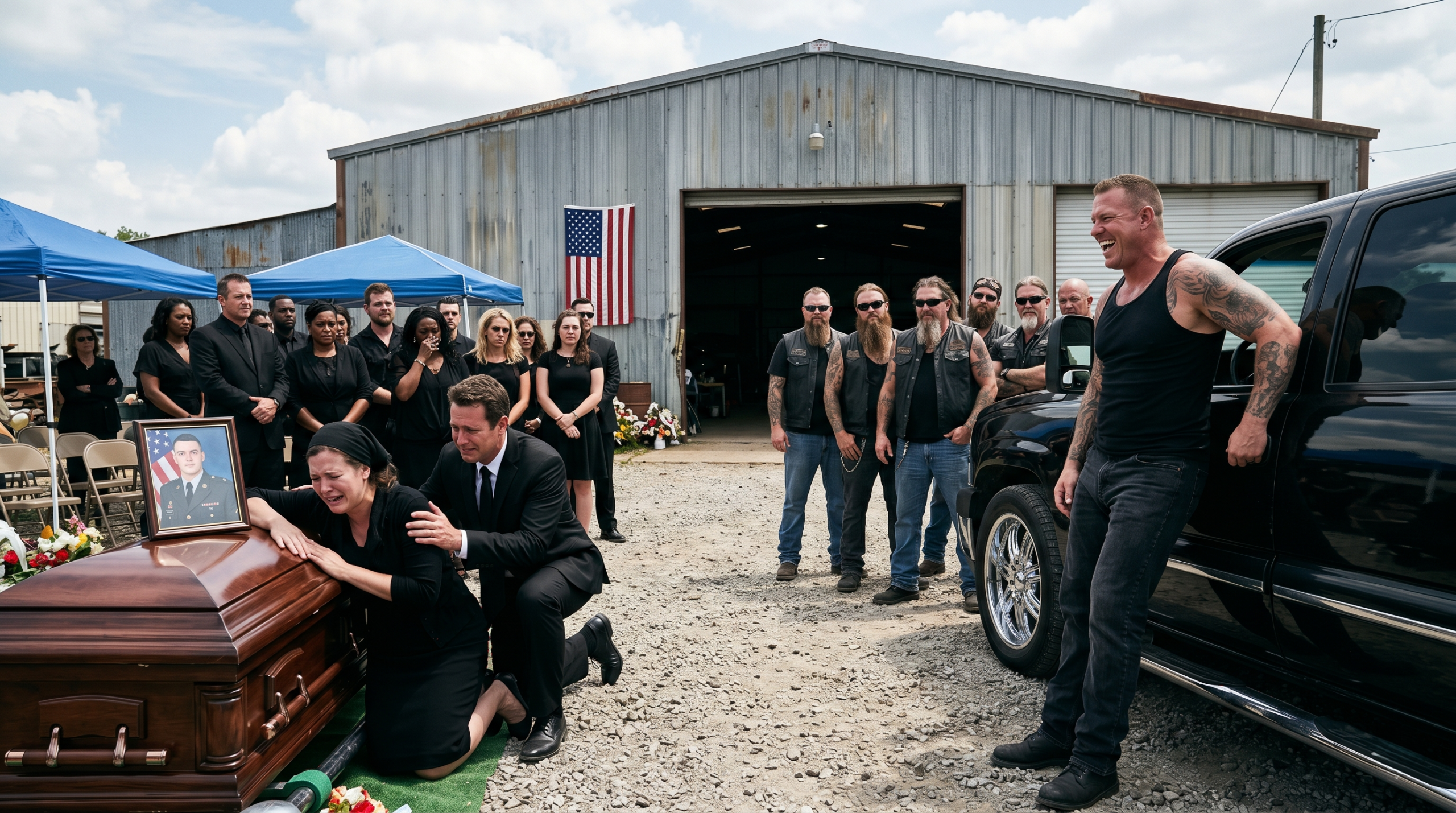
They buried my brother on a Tuesday so cold the grass snapped under people’s shoes.
Logan would’ve hated that. He always said funerals made everybody lie better, made men talk soft and women cry into tissues like the person in the box had been some polished saint instead of somebody who ate cold pizza over the sink and stole your hoodie without asking. He would’ve made a joke about the weather, probably something dumb like, “Even hell didn’t want to warm up for me.”
But Logan wasn’t there to say anything.
He was inside the coffin under a flag he never got to earn, because he’d been shot two weeks before his Army processing date. The recruiter still came to the funeral. He stood near the back with his cap in both hands, jaw working like he wanted to apologize but didn’t know who to apologize to.
My mother held my arm so tight her nails dug through my coat.
My father stood beside the coffin like a stone statue.
Grant Miller was not a big man. He had a farmer’s shoulders, gray hair cut short, and the kind of quiet that made strangers underestimate him. In our town, people knew him as the guy who fixed generators, sharpened mower blades, and never raised his voice in line at the grocery store. They called him polite. They called him steady.
Some called him weak.
Ryder was one of them.
He stood across the cemetery road, leaning against a black truck shiny enough to show the clouds moving across its hood. Two of his men smoked beside him, laughing too loud for a funeral. Ryder wore a leather jacket and a grin that made my stomach turn. Everyone in town knew he’d killed Logan, but knowing and proving were different things, especially when the sheriff looked at Ryder like a man checking the weather, not like a murderer.
The preacher was halfway through dust and resurrection when Ryder cupped his hands around his mouth.
“Guess the old man ran out of bullets.”
The words rolled over the graves and hit us harder than the wind.
My mother made this small wounded sound. I turned toward Dad, waiting for him to move, to shout, to cross that road and become the father I wanted him to be.
He didn’t.
He just rested one hand on Logan’s coffin. His fingers were bare, red from the cold. His dark glasses hid his eyes, but I saw the muscle in his cheek shift once.
Once.
Then he leaned down and whispered something into the polished wood.
I was close enough to hear his breath, not the words.
Ryder laughed again. One of his men joined him, then stopped when no one else did.
The cemetery smelled like wet dirt, carnations, and exhaust from the funeral cars idling along the road. Somewhere behind us, a child cried because children don’t know when silence matters.
Dad straightened, turned away from the coffin, and walked toward our old pickup.
No speech. No threat. No goodbye.
That scared me more than Ryder’s gun ever could have.
That night our house felt too big. Mom stayed in her bedroom with the curtains shut. I sat at the kitchen table, still wearing my funeral coat, watching the porch light flicker on and off like it was trying to send a message.
Dad didn’t come home until after midnight.
The back door opened softly. Cold air moved through the kitchen before he did.
He wore an old field jacket I hadn’t seen since I was a kid. It had faded patches removed from the sleeves, little squares of darker fabric where something official used to be. His boots were muddy. Not cemetery mud, either. This was red clay, riverbank dirt.
He stopped when he saw me awake.
“Go to bed, Evan.”
His voice wasn’t angry. It was worse than angry. It was empty.
“Where were you?” I asked.
For a second, he looked at me like he didn’t recognize me. Not as his son. Not as the kid he taught to bait hooks and change oil. Like I was a civilian standing too close to a closed door.
“Bed,” he said again.
I should’ve pushed. I should’ve asked him what he whispered to Logan, why Ryder was still breathing, why our family had become something people pitied from safe distances.
But my throat closed.
So I went upstairs.
In the morning, Dad was gone.
So were his boots, the old field jacket, the cheap watch he wore every day, and the small gray safe from the bottom drawer of his desk. The one he told us had tax papers and old discharge forms.
Mom stood in the kitchen making coffee she never drank.
“He needed air,” she said.
But the kitchen window was cracked open from the outside, and on the sill sat one tiny curl of black rubber, like someone had cut through the screen and changed their mind.
By afternoon, I went out back to the shed.
The lock was open.
Inside, under a tarp behind rusted paint cans, I found metal cases stacked in perfect rows. No dust on them. No labels either, except serial numbers that had been scratched away. I opened the first case and stared at tactical gear packed like surgical tools.
Not hunting stuff.
Not Dad stuff.
Body armor. A suppressed pistol broken into parts. Coiled wire. Burn phones sealed in plastic. Maps with red circles around roads Ryder’s trucks used at night.
At the bottom sat a black notebook.
I opened it with fingers that suddenly didn’t feel like mine.
The first page had one name written at the top.
Ryder.
Underlined twice.
Below it were initials. Dates. Locations. One line of writing in Dad’s blocky hand:
He came back for blood.
I heard something snap outside.
A branch, maybe.
Or a boot.
I turned toward the shed door, notebook clutched in my hand, and saw a shadow slip past the crack in the wall.
Someone had been watching me discover my father’s war.
And I had no idea if it was Ryder’s man—or my father himself.
### Part 2
I didn’t move for a full minute.
The shed smelled like old gasoline, mouse droppings, and cold metal. Dust floated in the thin beam of sunlight cutting through the wall crack, and every speck seemed too loud. I listened until my ears hurt.
Nothing.
Then a crow screamed from the oak tree, and I nearly dropped the notebook.
I slid it under my jacket and stepped outside.
Our yard looked normal in the cruelest possible way. The garden beds were dead for winter. Mom’s wind chimes tapped softly on the porch. Across the field, the fence leaned where Logan hit it with Dad’s truck years ago and blamed the dog.
But the shed door had fresh scratches around the lock.
Not from me.
I walked the property line with my hands in my pockets, pretending to check fence posts, and found boot prints near the creek. Wide tread. Not Dad’s. Not mine. The tracks came from the woods, stopped behind the shed, then circled toward the road.
Someone had gotten close enough to hear me breathing.
I wanted to call the sheriff. My thumb even hovered over the number.
Then I remembered Dad’s face at midnight.
No warmth. No fear. Just command.
So I didn’t call.
That evening, Mom made soup and forgot to turn on the stove. She stood in front of it, wooden spoon in hand, staring into the pot like the answer to everything was floating in cold broth.
“Your father will come home,” she said.
I didn’t tell her about the shed.
“Did Dad ever talk about someone named Ryder?” I asked.
The spoon slipped from her hand and clattered against the tile.
That was answer enough.
She bent too fast to pick it up. “Small town, Evan. Everybody knows everybody.”
“Not like that.”
Her shoulders tightened.
“Your father had a life before us.”
“What kind of life?”
“A life he left behind.”
She turned on the burner and acted like the conversation had ended, but her hand shook when she reached for the salt. I had grown up watching her handle bad news like laundry—fold it clean, put it away, don’t let it show. That night she couldn’t fold anything.
At 2:13 a.m., something tapped my bedroom window.
I sat up, heart slamming.
Tap.
Then again.
My room was on the second floor.
I grabbed Logan’s old baseball bat from beside the dresser and eased toward the glass. Outside, the yard was washed blue by moonlight. The oak tree moved in the wind, branches scraping the gutter.
A small folded paper was taped to the outside of the window.
I opened it with shaking hands.
Dad’s handwriting.
Do not call the police. Stay away from anyone asking about me.
That was all.
No “I’m okay.” No “protect your mother.” No “I love you.”
Just an order.
By sunrise, the town had started whispering.
Ryder’s cousin Dale was found out by Highway 18 with all four tires cut, his phone smashed, and his gun unloaded and placed neatly on the hood of his car. No fingerprints. No witnesses. Dale told people a rival crew jumped him, but nobody believed that. Dale had a face like wet paper and wouldn’t look at shadows.
Two days later, another of Ryder’s men disappeared for six hours. He came back walking barefoot through town, white as flour, with duct tape around one wrist and no memory he’d admit to.
Ryder stopped laughing in public.
I saw him outside the gas station on Friday. He stood beside his truck, talking low into a phone. His right hand stayed near his jacket pocket. When a delivery truck backfired, Ryder ducked.
I should’ve felt satisfied.
Instead, I felt sick.
Because Dad wasn’t just scaring them. He was testing them.
That afternoon, a package waited for me at the post office. No return address. My name typed on a label.
Inside was a bronze coin with an eagle stamped on one side and a flash drive wrapped in black tape.
The woman behind the counter said an older man dropped it off.
“What older man?”
She shrugged. “Ball cap. Gray beard. Paid cash.”
Dad.
Or someone pretending to be him.
I waited until Mom fell asleep before plugging the drive into Logan’s old laptop. The screen blinked, then filled with folders labeled in numbers. Most wouldn’t open. One did.
Ryder_Classified_Debrief.
My breath went cold.
There were scanned documents. Photos. Names blacked out with thick digital bars. One image showed Ryder twenty years younger in desert gear, standing beside men I didn’t know.
And there, half turned from the camera, was my father.
Not smiling.
Not weak.
Under the photo was a single line:
Asset transfer failed. Handler: G. Miller. Field designation: SPECTRE.
I stared until the letters blurred.
Spectre.
When I was ten, I found that word carved into the handle of Dad’s old knife. He told me it was just something soldiers said to sound tough. I believed him because kids believe their fathers until the world makes them stop.
The file ended with an incident report.
Operation Silence Protocol compromised.
Casualties undisclosed.
Asset Ryder: unconfirmed.
Handler Spectre: retired under sealed authority.
At 1:08 a.m., my phone rang.
No caller ID.
I answered before I could think.
For three seconds, there was only static. Then a man’s voice, low and clean.
“Your father’s file just went active again.”
“Who is this?”
The line clicked dead.
I sat there with the phone in my hand, listening to the house settle around me. The refrigerator hummed. Mom coughed once down the hall. Somewhere outside, a car rolled slowly past without headlights.
When I looked back at the laptop, a new file had appeared on the drive.
It hadn’t been there before.
AUDIO_LOG_17.
I clicked it.
Dad’s voice filled the room, rough with distance.
“Evan, if you’re hearing this, they came back. Don’t follow me. Don’t trust badges. Don’t trust old friends. You’ll know when it’s time.”
The recording ended.
I played it again.
Then again.
Don’t trust old friends.
A floorboard creaked behind me.
I turned.
Mom stood in the doorway, pale and barefoot, staring at the screen like she had seen a ghost.
And the worst part was, I think she recognized that voice—not as my father’s, but as the man he used to be.
### Part 3
Mom didn’t ask what I had found.
That was how I knew she already knew more than she’d ever admitted.
She crossed the room slowly, her robe tied wrong, one sleeve hanging loose off her shoulder. In the laptop glow, she looked older than she had at the funeral. Not grief-old. Fear-old. Like the years had been hiding behind her skin, waiting for the right secret to come out.
“Where did you get that?” she asked.
“At the post office.”
Her eyes closed.
“Mom.”
“Turn it off.”
“No.”
Her face hardened in a way I’d only seen twice in my life: once when Logan got arrested for fighting outside a bar, and once when Dad came home from a “contract job” with stitches under his ribs and told us not to ask.
“You don’t understand what you’re touching,” she said.
“Then explain it.”
She looked toward the kitchen window. Out past the glass, darkness pressed against the house like a living thing.
“Your father was supposed to be dead before I met him.”
The room seemed to tilt.
“What does that mean?”
“It means the man I married was already a buried file.” Her voice cracked, but she kept going. “Grant Miller was the name they gave him after everything overseas collapsed. I was told enough to know never to ask for the rest.”
I stood so fast the chair scraped the floor.
“You knew Ryder?”
“I knew the name.”
“You knew this could come back?”
“No.” Her eyes flashed. “I feared it. That is different.”
Before I could answer, headlights swept across the wall.
Both of us froze.
A vehicle slowed outside. Big engine. Tires crunching gravel. It stopped in front of our house and idled there, low and patient.
Mom whispered, “Turn off the light.”
I shut the laptop.
The kitchen went black except for the porch light flickering through the curtains.
Three knocks came at the front door.
Slow.
Measured.
Not Ryder. He would’ve kicked it in.
Mom gripped my wrist. Her nails were cold.
A woman’s voice called from outside. “Evan Miller? I need to speak with you about your father.”
No one in town called him father. They said dad, old man, Grant.
I looked through the peephole.
A woman stood under the porch light in a gray coat, hair pinned tight, expression calm enough to be fake. She held up a badge.
“Agent Daphne Cole,” she said. “Defense Intelligence Bureau.”
I opened the door with the chain still on.
Her badge looked real. That made me trust it less.
“Your father has reactivated a classified operational identity,” she said. “If he contacts you, you need to tell me immediately.”
“Why?”
“Because men like Grant Miller don’t disappear unless someone is about to die.”
Mom stepped behind me.
Daphne’s gaze moved to her, and something passed between them. Recognition, maybe. Or guilt.
“You told us he was safe,” Mom said.
Daphne’s mouth tightened. “I was told the same thing.”
That sentence stayed with me.
I let her in, against every instinct I had.
She moved through our house like she was counting exits. Her eyes paused on the family photos, on Logan’s football trophy, on Dad’s empty chair. She didn’t sit until Mom did.
“Ryder is not just a gang leader,” Daphne said. “He was once attached to a deniable arms recovery program. Your father handled him.”
“That file said Silence Protocol.”
Her eyes cut to me.
“You opened the drive.”
“Dad sent it.”
“No,” she said quietly. “Your father doesn’t send evidence unless he wants someone to move.”
“Move where?”
She didn’t answer.
Outside, wind rattled the porch screen. The whole house seemed to listen.
Daphne placed a thin folder on the table. Inside were photos of Ryder with men in suits, convoy manifests, offshore accounts, warehouse maps. One photo showed Logan outside a mechanic shop three days before he died, talking to someone in a hoodie.
I leaned closer.
The hoodie guy wasn’t Ryder.
“Who is that?” I asked.
Daphne slid the photo back before I could memorize the face.
“A courier.”
“For Ryder?”
“For whoever Ryder answers to.”
Mom whispered Logan’s name like a prayer.
Daphne said, “Your brother’s death was a pressure tactic. Your father had started asking questions again. They killed Logan to make him stop.”
The words landed, but they didn’t make sound. Not inside me. Not yet.
I thought about Logan laughing too loud in the kitchen. Logan stealing my fries. Logan saying Dad was softer than he used to be, but in a good way. Logan dying on wet pavement behind a pawn shop while people pretended it was a local gang dispute.
My hands curled into fists.
“Where is Dad?”
Daphne glanced toward the window.
“Close.”
A phone vibrated in her coat.
She checked it and went still.
“What?” I asked.
“Ryder’s men just abandoned their east warehouse.”
“Why?”
Her face changed.
“Because your father found them first.”
A deep boom rolled across town.
Not thunder.
The windows trembled. Mom cried out. Somewhere in the distance, sirens began rising, thin and panicked.
Daphne stood, pulling a gun from under her coat.
“Get away from the windows.”
I looked outside and saw an orange glow pulsing beyond the trees, lighting the low clouds like the sky had caught fire.
Then my phone buzzed.
A text from an unknown number.
Do not trust Daphne.
I looked up at her, gun in hand, standing in my kitchen like she belonged in the middle of every nightmare.
And for the first time, I understood Dad’s warning had not been about Ryder alone.
### Part 4
I hid the phone before Daphne could see it.
That was the first smart thing I did.
The second was pretending I was more scared than suspicious.
“What was that explosion?” Mom asked, her voice thin.
Daphne kept her gun low but ready. “Old feed mill by Route 6.”
“Ryder’s warehouse?”
“One of them.”
“You said Dad found them,” I said.
“I said it looks that way.”
The orange glow flickered through the curtains. It painted Daphne’s face in pieces—cheekbone, eye, mouth, shadow. She didn’t look like a liar. That was the problem. Good liars rarely do.
My phone felt hot in my pocket.
Do not trust Daphne.
Mom clutched Logan’s old hoodie to her chest. She had taken to carrying it around the house, folding and refolding the sleeves until the cuffs looked worn from her grief alone.
Daphne turned to me. “Where is the drive?”
I stared at her.
“The one your father sent,” she said. “You mentioned it.”
“I didn’t say he sent a drive.”
Her eyes narrowed by half an inch.
Small mistake.
Enough.
“I need to secure it,” she said. “If Ryder’s people get it—”
“You mean if your people get it?”
For a moment, nobody breathed.
Then she lowered the gun completely.
“Evan, I’m not your enemy.”
“That’s exactly what an enemy would say.”
She looked tired then. Not offended. Tired, like she had heard the same line from better men in worse rooms.
“Your father saved my sister’s life in Kandahar,” she said. “He carried her four miles with shrapnel in his spine while command had already written her off. I owe him more than you can understand.”
“Then why are you hunting him?”
“I’m trying to reach him before the people who really are hunting him do.”
Before I could answer, something hit the kitchen window.
Not a bullet.
A stone.
It cracked the glass but didn’t break through. Tied around it was a strip of black cloth.
Daphne moved first, yanking the curtain aside just enough to look.
No one outside.
I picked up the stone. My fingers came away smelling like gasoline.
The cloth had a symbol painted in white: a blank mask with no mouth.
Daphne swore under her breath.
Mom saw her face. “What is it?”
“Private contractors,” Daphne said. “Not Ryder’s street crew. Older network.”
“What network?”
She didn’t answer fast enough.
The front door exploded inward.
The sound punched through my ribs.
Men in dark tactical gear flooded the house, faces covered, rifles raised. No badges. No shouted warrants. Just movement. Clean, fast, practiced. One kicked Daphne’s gun away before she could bring it up. Another slammed me into the refrigerator so hard magnets scattered across the floor.
Mom screamed.
“Clear left.”
“Asset not present.”
“Confirm family.”
A gloved hand shoved my face against cold tile. I smelled bleach and boot rubber. My ear rang from the impact. Across the kitchen, Daphne fought like someone trained to survive ugly rooms, but they had numbers. One pinned her wrist behind her back. Another checked her pupils with a flashlight.
“She’s active,” he said.
“Tag her.”
A man grabbed Mom by the shoulders. I bucked hard, but the rifle barrel against my spine stopped me.
“Don’t touch her!”
The man holding me leaned close. His mask smelled like wet fabric and cigarettes.
“Spectre trained you loud,” he whispered. “Not smart.”
The word cut through me.
Spectre.
They knew.
Then every man in the room froze at once.
Not because of us.
Because every phone, radio, and earpiece in the room began screeching with static.
Three sharp pulses.
A pause.
Two long tones.
The men looked at each other.
One whispered, “No.”
The porch light went out.
So did every light in the house.
Darkness swallowed us.
What happened next lasted maybe twelve seconds, but in my memory it stretches forever.
A dull thud outside. Glass breaking somewhere behind me. One man grunting. Another fired twice into the ceiling. Someone screamed, “Contact rear!” and then got cut off mid-word.
I felt the pressure lift from my back.
A shape moved through the kitchen darkness without sound.
Not fast like a movie.
Efficient.
A hand pulled me backward behind the counter just as a muzzle flashed where my head had been. Daphne rolled free and grabbed her gun from under the table. Mom sobbed once, then clamped both hands over her mouth.
The last contractor stumbled toward the door.
A shadow stepped behind him.
One sharp motion.
The man dropped.
Silence returned in pieces.
The refrigerator hummed back to life. The porch light flickered once. Twice.
Dad stood in the doorway.
He looked older than he had at Logan’s grave. His beard had grown in rough gray patches. There was blood on his sleeve, none of it obviously his. His eyes moved over Mom first, then me, then Daphne.
When he saw Daphne, his face hardened.
“You brought them here.”
She shook her head. “They tracked the drive.”
Dad looked at me.
The disappointment in his eyes hit worse than a slap.
“I told you not to open it.”
“You sent it to me.”
“No,” he said.
The room tilted.
Dad stepped over one of the fallen men and picked up the stone with the mask symbol. He turned it in his hand like he was reading a fingerprint invisible to everyone else.
“This wasn’t Ryder,” he said.
“Then who?”
He looked toward the broken door, toward the burning sky beyond town.
“The people who paid Ryder to kill your brother.”
My mouth went dry.
Dad slid a pistol from the contractor’s vest, checked the magazine, and handed it to Daphne.
“Get them out.”
“Grant—”
“Now.”
Mom reached for him. “Please come with us.”
For one second, he became my father again. His face cracked. Just a little.
Then the ghost closed over him.
“I can’t.”
He turned and walked into the dark.
I ran after him onto the porch, cold air cutting my lungs.
“Did Logan die because of you?”
Dad stopped at the bottom step.
He didn’t turn around.
That was how I got my answer.
And before I could ask the question that would destroy us both, red laser dots appeared across his chest from the tree line.
### Part 5
Dad didn’t dive.
He simply stepped sideways before the shots came.
The porch railing burst apart where his chest had been. Wood splinters sprayed my face. I dropped hard, elbows cracking against frozen boards, and heard Daphne screaming my name from inside the house.
Gunfire stitched through the yard.
Dad vanished behind the old tractor near the barn. I saw only flashes—his shoulder, the edge of his rifle, a shadow moving where no man should’ve had room to move. The shooters were hidden in the tree line, muzzle flashes blinking between trunks like fireflies from hell.
One contractor tried to rush the porch from the left.
Dad shot the porch light.
Darkness swallowed the steps.
The man stumbled blind for half a second.
That was all Dad needed.
He moved behind him, took the rifle, and dropped him without firing another shot.
I had never seen my father like that. Not angry. Not frantic. Not even brave.
He looked practiced.
That was worse.
Daphne dragged me inside by my collar. Mom was crouched behind the couch, shaking but quiet. The kitchen floor was littered with glass, bullets, spilled soup, and the refrigerator magnets Logan and I used to rearrange into stupid insults when we were kids.
“We have to move,” Daphne said.
“What about Dad?”
“He’s buying us time.”
“Buying it with what?”
She looked at the dead man by the door.
“With them.”
Outside, an engine roared. Then another. Tires tore through gravel. Someone shouted orders. Dad’s rifle cracked once, twice, then silence.
A truck exploded near the road.
The blast shook dust from the ceiling.
Mom covered her ears and whispered Logan’s name over and over.
Daphne shoved a duffel bag into my hands. “Pack anything essential.”
“Our house is surrounded.”
“Not for long.”
She was right.
Two minutes later, a black SUV came skidding across our yard backward, driver slumped over the wheel, crashing through Mom’s flower bed and into the ditch. Smoke hissed from under the hood.
Dad appeared at the back door.
“Move.”
That one word carried more authority than any badge Daphne had flashed.
We moved.
Through the cellar. Past shelves of canned peaches Mom never opened. Behind the water heater, Dad kicked loose a panel I didn’t know existed. Concrete dust fell away, revealing a narrow tunnel lined with old wooden beams.
I stared at him.
“How long has this been here?”
“Since before you were born.”
Mom made a sound that was almost a laugh but broke in the middle.
“You said it was a drainage crawlspace.”
“It is,” Dad said. “When it rains.”
We crawled through black earth and spiderwebs, the air so tight and damp I could taste rust on my tongue. Behind us, the house groaned under more gunfire. Above, footsteps pounded across floorboards.
Halfway through the tunnel, Mom slipped. I caught her elbow. Her skin felt cold through her sleeve.
“I’m okay,” she lied.
The tunnel opened in the woods behind the creek. Waiting under a camouflage tarp was Dad’s old truck, except it wasn’t old anymore. Not underneath. The engine turned over with a low, hungry growl.
Dad drove without headlights.
Trees whipped past us in ghostly shapes. Mom sat in front, clutching the dashboard. Daphne and I crouched in the truck bed under a tarp that smelled like mildew and gun oil.
“Where are we going?” I asked.
Daphne’s face was barely visible in the dark.
“To whatever your father planned before we knew we needed it.”
“You trust him?”
She looked toward the cab.
“I trust Spectre to survive.”
“That’s not what I asked.”
“No,” she said. “It isn’t.”
We drove until dawn blurred the horizon purple. By then, my whole body hurt from cold and fear. Dad finally pulled off an abandoned county road and stopped beside a collapsed hunting cabin hidden under pine trees.
He got out first, checked the woods, then motioned us inside.
The cabin looked rotten from outside. Inside, it was a command post.
Maps covered one wall. Radios blinked softly. Metal cases stood stacked by the stove. On the table sat photos of Ryder, contractors, men in suits, shipping containers, bank transfers. At the center was Logan’s picture, taped down carefully.
Under it, Dad had written:
Final debt.
Mom saw it and broke.
Not crying. Breaking.
She slapped him across the face so hard the room went still.
“You don’t get to turn our son into a mission.”
Dad accepted the hit without moving.
“He was never supposed to be in it.”
“But he is dead inside it.”
Dad looked down.
For the first time since the funeral, I saw his hands tremble.
“Ryder pulled the trigger,” he said. “But Ryder didn’t give the order.”
Daphne stepped closer. “Who did?”
Dad looked at her with something like regret.
“You already know.”
Her face drained.
“No.”
Dad nodded once.
“The order came from inside the Pentagon.”
The fire in the small stove popped. Outside, wind moved through the pines.
I looked at Logan’s photo, at Dad’s maps, at my mother’s ruined face, and suddenly revenge felt too small for what had happened to us.
Then one of the radios crackled.
A man’s voice filled the cabin.
“Spectre, you still have my property.”
Ryder.
Dad went completely still.
Ryder laughed softly through the static.
“And if you want the woman alive, you’ll come to the quarry alone.”
Mom turned toward the corner.
That was when we realized Daphne was gone.
### Part 6
Daphne’s coat was still hanging over the back of a chair.
Her gun was gone.
So was one of Dad’s maps.
Dad crossed the cabin in three strides and checked the door, then the snow outside. He crouched near the threshold, touched two fingers to a boot print, and stared into the trees.
“She left on foot,” he said.
“Ryder took her,” I said.
“No.” His jaw tightened. “She went to him.”
Mom looked up, eyes red. “Why would she do that?”
Daphne’s voice came from the radio before Dad could answer.
“Because he has my sister.”
The room froze.
Static hissed. Then Daphne spoke again, breathless, like she was walking fast.
“Grant, I’m sorry. Ryder sent proof. He’s had her protected witness location for years. If I didn’t come, he’d burn her alive.”
Dad grabbed the radio. “Daphne, stop moving.”
“I can’t.”
“You know what this is.”
“A trap,” she said. “Of course it is. But it’s not just for you.”
The signal cracked.
Dad’s eyes narrowed.
“What did you take?”
Silence.
Then Daphne whispered, “The Houseian access key.”
Dad closed his eyes.
I had never seen dread on his face before. Not fear. Dread.
“What’s Houseian?” I asked.
He didn’t answer me. He pressed the transmit button.
“Daphne, listen carefully. Ryder doesn’t want the key to open files. He wants to sell the buyers a way to erase themselves.”
“I know.”
“Then why—”
“Because my sister is all I have left.”
The radio went dead.
Dad stood there with the receiver in his hand, staring at nothing.
Mom wiped her face. “Go get her.”
He looked at her.
“I thought you hated the mission.”
“I hate that it keeps taking people.” Her voice hardened. “So stop letting it choose.”
Something shifted in Dad then. Not softer. Clearer.
He began packing gear.
I grabbed my jacket.
“No,” he said.
“Don’t start.”
“Evan.”
“She came to protect us. Logan died because everybody kept secrets and made choices for everyone else. I’m done being protected into the dark.”
Dad’s eyes flashed. For a second I thought he’d order me again.
Instead, he looked away.
That was permission enough.
We left Mom in the cabin with two radios, a pistol, and instructions she listened to without blinking. Before we stepped outside, she caught Dad’s sleeve.
“If you die,” she said, “I won’t forgive you.”
He touched her hand once.
“You shouldn’t.”
The quarry sat ten miles north of town, an old gravel pit with rusted equipment and water collected black at the bottom. Logan and I used to sneak there in high school to drink cheap beer and throw rocks off the ledge. At night, it looked like a crater carved out of the world.
Dad parked half a mile away.
“No hero moves,” he told me.
“I’m not a hero.”
“Good. Heroes die loud.”
We moved through scrub and frozen mud. Dad seemed to know where every branch would snap before it did. I followed badly, but I followed.
At the rim of the quarry, we dropped behind a broken conveyor belt.
Below us, Ryder’s trucks formed a half circle around the old loading bay. Men with rifles stood near burn barrels, their faces orange in the flames. Daphne was tied to a chair in the center, blood on her mouth but head upright.
Ryder paced in front of her.
He looked different from the funeral. Thinner. Meaner. The smirk was there, but it twitched now, like it took effort to hold.
On a crate beside him sat a steel case.
“The key,” Dad whispered.
A black SUV rolled into the quarry.
Four men stepped out wearing suits under tactical vests. Not gang members. Not contractors either. They carried themselves like men who signed papers that killed people they never had to see.
One older man stepped into the firelight.
Silver hair. Clean coat. Calm face.
Dad inhaled once.
I barely heard it, but it was the sound of a wound reopening.
“Who is that?” I whispered.
“Nathaniel Vale.”
“The Pentagon guy?”
Dad’s stare never left the man.
“My commanding officer.”
Below, Ryder spread his arms like he was hosting a reunion.
“Look at this,” he called into the darkness. “The family’s almost back together.”
Nathaniel Vale looked bored.
“Where is Spectre?”
Ryder grinned. “Close. He can’t resist guilt.”
Vale turned slowly, eyes scanning the quarry shadows.
Then he spoke, not loudly, but the whole pit seemed to hear.
“Grant, if your son is with you, make him listen. Logan died because you forgot your place.”
Dad’s hand tightened around his rifle.
I felt something inside me go still.
Vale continued, “Come down. Bring the remaining drive. Or I explain to Evan what his brother was really doing the night he died.”
I looked at Dad.
His face told me there was still one secret left.
And it might be the one that broke me.
### Part 7
I almost stood up.
Dad caught my sleeve before I could move.
His grip hurt. Not because he meant it to, but because he was holding me back from a truth that had teeth.
“What does he mean?” I whispered.
Below us, Nathaniel Vale waited like a man used to rooms bending around him. Ryder looked up into the quarry shadows, smiling because he knew the blade had found skin.
Dad didn’t answer.
That silence did more damage than any lie.
“What was Logan doing?”
Dad’s eyes stayed on Vale. “Trying to help me.”
“You said he wasn’t supposed to be in it.”
“He wasn’t.”
“That’s not an answer.”
Gunfire cracked from the far side of the quarry.
Not at us.
One of Ryder’s men dropped beside a burn barrel. The others scattered, shouting. The fire threw huge moving shadows against the rock walls. Daphne tipped her chair over and rolled behind a stack of tires just as bullets chopped through the air where her head had been.
Dad moved instantly.
No more explaining. No more hesitation.
He slid down the gravel slope like the dark had hands, firing only when someone was about to see him. I followed because stupidity and loyalty feel the same when you’re scared enough.
The quarry became chaos.
Ryder’s gang fired at shadows. Vale’s men fired at Ryder’s men. Somebody had betrayed somebody, though I couldn’t tell who. The whole place smelled like diesel smoke, wet stone, and hot metal. I crouched behind an engine block, hands shaking so badly I could barely hold the pistol Daphne had shoved into my jacket earlier.
Dad reached Daphne first.
He cut her loose and pulled her behind cover. She spat blood into the dirt.
“Vale brought a kill team,” she said.
“I noticed.”
“He’s not here to buy the key.”
“No,” Dad said. “He’s here to erase witnesses.”
A bullet hit the engine block beside me. I flinched hard enough to slam my head against metal.
Dad looked back. “Evan!”
“I’m good!” I shouted, which was a lie so obvious even God probably rolled His eyes.
Ryder appeared through the smoke, dragging the steel case with one hand, pistol in the other. He was trying to reach his truck.
Vale saw him.
“Mr. Ryder,” he called, almost politely. “Leave the case.”
Ryder laughed, wild and breathless. “You first.”
Vale raised two fingers.
One of his men shot Ryder in the leg.
Ryder went down screaming, the case skidding across gravel.
Dad moved for it.
So did Vale.
For one second, all the shooting around me faded, and I saw the shape of it clearly: two old men racing toward the same buried sin, one trying to destroy it, one trying to own it.
I ran too.
Not smart. Not planned. Just ran.
I reached the case first because nobody expected the scared son to sprint straight into the middle of a gunfight. My fingers closed around the handle.
It was heavier than I expected.
A shot cracked.
Pain burned across my shoulder.
I dropped to one knee, more shocked than hurt.
Dad’s face changed completely.
The ghost vanished.
My father came out.
He crossed the open ground with no cover, no caution, nothing but rage controlled so tightly it looked calm. He fired once, dropped the shooter, and slid beside me.
“You hit?”
“Shoulder,” I gasped.
“Through?”
“I don’t know.”
He checked fast. “Graze.”
Only my father could make getting shot sound like a weather report.
Vale stood twenty yards away, gun pointed at us.
“Still making children carry your crimes, Grant.”
Dad rose slowly, placing himself between Vale and me.
“Logan made his own choice,” he said.
I stared at his back.
Vale smiled. “Did you tell Evan what that choice was?”
Dad said nothing.
So Vale told me.
“Your brother found me first. Clever boy. He traced payments from Ryder’s crew to a defense shell account. He contacted me, thinking I would help expose corruption.”
My chest tightened.
“No.”
“Oh yes,” Vale said softly. “He was brave. Very brave. Also very naive.”
Dad’s voice dropped. “Shut up.”
“Logan offered me evidence in exchange for immunity for his father. He tried to save you, Grant.”
I couldn’t breathe.
Ryder groaned from the dirt, laughing through pain. “Kid walked right into the wolf’s mouth.”
Vale continued like he was reading minutes from a meeting.
“I gave Ryder the location. Ryder handled it messily, but adequately.”
The quarry tilted around me.
Logan hadn’t died because he was in the wrong place.
He died because he loved Dad enough to trust the wrong man.
Dad turned his head slightly.
“Evan—”
“Don’t.”
The word came out broken.
Daphne fired from behind the tires, forcing Vale back. Dad grabbed the case and hauled me toward cover as bullets tore through the smoke.
Ryder, bleeding and half-mad, crawled toward a dropped detonator near the burn barrels.
I saw it before Dad did.
“Bomb!”
Dad turned.
Too late.
Ryder pressed the switch.
The loading bay erupted in white fire.
Heat slammed into me. The ground disappeared. I remember Dad’s arms around me, the case crushing between us, Daphne screaming somewhere far away.
Then black.
When sound returned, it came underwater.
I opened my eyes to ash falling like snow.
Dad was kneeling over me, face streaked with blood.
Behind him, Ryder’s body lay twisted near the blast crater.
Vale was gone.
And the steel case had split open beside me, spilling files across the dirt.
On top was a photo of Logan.
Stamped in red across his face were three words:
Voluntary intelligence asset.
### Part 8
I carried that photo all the way back to the cabin.
Not because I wanted to.
Because my hand wouldn’t let it go.
Dad drove while Daphne pressed a towel against my shoulder. Every bump sent pain hot down my arm, but I barely felt it. I stared at Logan’s face under the red stamp, at the smudged ink turning my brother into a file category.
Voluntary intelligence asset.
It sounded clean.
It sounded official.
It didn’t sound like Logan sitting on my bed eating cereal from the box, telling me I worried too much. It didn’t sound like him racing me barefoot across summer grass or teaching me how to throw a punch without breaking my thumb.
It sounded like men like Vale had already killed him before Ryder pulled the trigger.
At the cabin, Mom saw the blood and almost collapsed.
“I’m fine,” I said.
She looked at Dad. “You said you would keep him behind you.”
Dad didn’t defend himself.
That made me angrier.
Daphne stitched my shoulder with supplies from Dad’s kit. I bit down on a towel and stared at the stove until the black iron blurred. Mom sat across from me, holding Logan’s photo, reading the stamp again and again like the words might change if she hated them enough.
Dad stood near the window, watching the trees.
Always watching.
Finally, I said, “When were you going to tell us?”
He didn’t turn.
“I wasn’t.”
I laughed once. It came out ugly.
“At least you’re honest now.”
Mom whispered, “Grant.”
He looked older than ever when he faced us.
“Logan found one of my old caches last year,” he said. “I don’t know how. Maybe I got careless. Maybe he was smarter than I wanted to admit.”
“He was smart,” I said.
“Yes.”
Dad swallowed.
“He asked questions. I told him to forget what he saw. He didn’t. He started digging into Ryder because he thought Ryder was just local rot. Then he found money trails tied to defense contractors. He thought if he exposed it, he could clear my name.”
“Clear your name from what?”
Dad looked at Daphne.
She answered instead.
“Operation Houseian. A black logistics program built to move weapons through unlisted routes. Grant was one of its field commanders before he realized the routes were being used off-book.”
“By our own people?”
“By contractors protected by our own people,” she said. “There’s a difference legally. Morally, not much.”
Dad’s voice was rough. “I tried to expose them. Vale buried the operation and made me disappear. I thought staying dead would keep you safe.”
Mom stood.
“You thought?” she said. “You built tunnels under our house, hid guns in our shed, kept war maps beside our family, and you thought that was safety?”
“I thought it was distance.”
“No,” she said. “It was cowardice wearing discipline.”
That hit him.
Good.
He deserved something to hit him.
For years, I had believed Dad’s quiet meant weakness. Then I learned it meant danger. Now I realized it also meant avoidance. He hadn’t just protected us from the truth. He had protected himself from watching us hate him for it.
I held up Logan’s photo.
“He died trying to save you.”
Dad’s eyes glistened, but no tears fell.
“I know.”
“And you let us think Ryder just murdered him to make a point.”
“I didn’t know Logan had gone to Vale until after he died.”
“But you knew enough.”
“Yes.”
That one word cracked the room open.
Mom walked to the door, opened it, and let winter air flood in.
“I loved the man who fixed porch lights and made pancakes on Sundays,” she said. “I don’t know what to do with the rest of you.”
Dad looked at the floor.
“There may not be a rest of me left.”
Daphne’s radio crackled before anyone could answer.
A woman’s voice came through, faint but urgent.
“Daphne? If you can hear me, they moved me. East service road. White van. Please—”
Daphne lunged for the radio.
“Clara?”
The signal broke into static.
Dad’s head snapped up.
“That was live.”
Daphne grabbed her gun. “Then I’m going.”
Dad blocked the door.
“You run blind, Vale gets exactly what he wants.”
“My sister is alive.”
“And being used.”
“I know what being used feels like, Grant.”
He stepped aside.
But before Daphne could leave, the second radio activated.
Vale’s voice filled the cabin, smooth as polished marble.
“Bring me the Houseian case, Grant. Bring Evan too. The boy has become inconveniently informed.”
Mom’s face went white.
Vale continued, “You have until sunrise. After that, I start mailing Agent Cole’s sister back in pieces.”
The radio clicked dead.
The cabin was silent except for the wind and Mom’s broken breathing.
Dad looked at me.
For once, there was no command in his eyes.
Only a question.
And that was when I understood the worst truth of all: he needed me now, not as a son to protect, but as bait.
### Part 9
I said yes before Dad could ask.
Not because I was brave.
Because I was tired of being the person other people moved around the board.
Mom said no. She said it once, then again, then louder, like volume could change what the world had become. Daphne didn’t argue. She just stood by the table with both hands flat against the map, staring at the east service road where her sister might be dying.
Dad said nothing for a long time.
Then he looked at me.
“You do exactly what I say.”
“No.”
His expression hardened.
“I’m serious.”
“So am I. Logan did exactly what he thought would save you. Daphne did exactly what would save Clara. You did exactly what would keep us safe. Everybody keeps doing exactly one thing, and people keep dying anyway.”
Mom covered her mouth.
I stepped closer to Dad.
“We do this together, or I walk out and make enough noise for Vale to find me himself.”
Daphne glanced at me like she wasn’t sure whether to respect me or slap me.
Dad rubbed a hand over his face.
“You have your brother’s stubbornness.”
“Good.”
“It got him killed.”
The room went still.
I looked him in the eye.
“No. Vale got him killed. Ryder helped. Your silence gave them room.”
Dad took that like a sentence.
He nodded once.
“Then no more silence.”
For the first time, he told us the whole plan.
Not all the truth. I knew better than to believe any person ever owns all of that. But enough.
Vale wanted the case because inside it was an access key tied to physical Houseian archives stored in an old federal data vault in Virginia. Digital copies could be denied, leaked, labeled fake. Physical authorizations with signatures, money trails, and handwritten directives were harder to erase.
Ryder had been the local blade.
Vale was the hand.
The vault was the heart.
“If Vale gets the key,” Dad said, “he scrubs the archive and kills anyone attached. If we get there first, we expose him or destroy his leverage.”
“Expose,” I said.
Dad looked at me.
“Destroying secrets is how men like Vale survive. They just call it cleanup. Logan wanted sunlight.”
Pain moved across Dad’s face.
“Then sunlight.”
We left before dawn.
Mom stayed behind because someone had to live if we failed. She hated that sentence. I hated it too. But she kissed my forehead at the door like I was six years old and told me not to become my father unless I understood the cost.
Dad heard her.
He said nothing.
We took two vehicles. Daphne drove an old service van with the damaged case in the back. Dad and I followed in Ryder’s stolen truck. The roads were empty, black ice shining under the headlights. Every mile felt like a countdown.
Just before sunrise, we found the white van on the east service road.
Abandoned.
The doors hung open.
Inside, on the floor, was a woman’s scarf, a blood smear, and a phone taped to the wall.
Daphne ran to it.
Dad grabbed her arm. “Wait.”
Too late.
The phone lit up.
Vale appeared on the screen from some clean, bright room that looked nothing like the nightmare he’d made.
“Agent Cole,” he said. “Predictable loyalty. Useful, but predictable.”
Daphne’s face twisted. “Where is she?”
“Alive, depending on the next hour.”
“Let me talk to her.”
“In time.”
Vale’s gaze shifted, somehow looking straight through the camera at me.
“Evan Miller. You’re taller than Logan.”
My blood went cold.
Dad took one step forward.
Vale smiled. “Easy, Spectre. I’m giving the boy context. His brother sat across from me with shaking hands and still tried to negotiate like a man. I respected that.”
“You murdered him,” I said.
“No. I authorized a correction.”
The calmness of it nearly broke me.
A correction.
That was what Logan’s life was to him.
Vale continued, “Bring the key to Fairfax Storage Annex by noon. No police. No press. No clever ghosts.”
The screen went black.
Daphne punched the van wall so hard I heard bone crack.
Dad checked the phone, then the van, then the road.
“Tracker,” he said. “They wanted us to find this.”
“So they know where we are?”
He looked toward the tree line.
“They’ve known for ten minutes.”
A bullet hit the van window.
Glass burst inward.
We ran.
Dad shoved me behind the engine block as rounds tore into the road. Daphne fired toward the trees, face blank with fury. The attackers weren’t Ryder’s men. These were Vale’s private ghosts—quiet, trained, patient.
And for the first time, there were too many even for Dad.
He knew it too.
I saw it in the way he scanned the road, calculating losses.
Then he looked at me.
“Take the case.”
“No.”
“Evan.”
“No more splitting up.”
His hand closed around my shoulder, right where the bullet had grazed me, and pain flashed white.
“Listen to me. Not as a soldier. As your father. Run.”
Daphne threw smoke canisters across the road. Gray clouds swallowed everything.
Dad pushed the case into my arms and shoved me toward a drainage ditch.
I stumbled, looked back, and saw him step into the smoke, rifle raised, disappearing into the same kind of silence that had haunted our family for years.
Then Daphne dropped into the ditch beside me, bleeding from her temple.
“Move,” she hissed.
We crawled through mud under the road while gunfire thundered above us.
When we came out on the other side, Dad was gone.
So were the attackers.
On the road behind us, written in blood across the van’s side panel, were three words.
Bring the son.
### Part 10
We reached Fairfax half-frozen, filthy, and running on fear.
Daphne stole another car from a commuter lot with the efficiency of a woman who had stopped caring about laws several betrayals ago. My shoulder throbbed. My ribs ached from crawling through the drainage tunnel. The Houseian case sat in the back seat between us like a bomb that hadn’t decided whether to explode outward or inward.
Dad didn’t call.
No radio pulse. No coded static. Nothing.
Daphne kept checking the rearview mirror.
“He’s alive,” she said.
“You don’t know that.”
“No. But if he were dead, Vale would’ve sent proof.”
That was not comforting, but I took it anyway.
The Fairfax Storage Annex didn’t look like a place where history got buried. It looked like any other federal overflow facility: beige concrete, tinted windows, chain-link fences, security cameras turning lazily under gray sky. A flag snapped in the cold wind out front, clean and bright, like the building wasn’t full of rot.
Daphne parked three blocks away behind a closed tire shop.
“We don’t walk in through the front.”
“No kidding.”
She gave me a look. “Sarcasm means you’re scared but functional. Good.”
“Is Clara inside?”
“Probably.”
“And Dad?”
She didn’t answer.
We entered through a storm drain behind the facility. Daphne had memorized old infrastructure maps; Dad had marked the route on the inside lining of the case, because apparently my family communicated best through hidden instructions and emotional damage.
The tunnel smelled like mold, iron, and standing water. My flashlight beam caught old graffiti, rat tracks, and cables running newer than the concrete around them.
At the end was a maintenance hatch.
Daphne listened against it, then opened the panel with a stolen keycard and a piece of wire.
We climbed into a basement corridor washed in fluorescent light.
No alarms.
That worried her.
“That’s bad?” I whispered.
“That’s invitation.”
We moved fast.
Past server cages. Past shelves of boxed records. Past doors with numbers instead of names. The deeper we went, the colder it became. Not winter cold. Preservation cold. The kind used for dead things people still want intact.
Daphne stopped at a steel door marked ARCHIVE B-7.
The key from the case fit.
Inside, rows of physical files stretched into darkness.
Houseian wasn’t a folder.
It was a cemetery.
Boxes carried dates, operation names, initials, and red tags that said discontinued, inactive, resolved. I wondered how many families out there had been told accidents, gang disputes, suicides, fires, when really their grief sat here in cardboard, alphabetized.
Daphne found the cabinet for Spectre.
Grant Miller. Sealed authority.
Her hands shook as she opened it.
Inside were documents bearing Dad’s old signatures, mission approvals, refusal memos, disciplinary notices, death orders for assets who “threatened structural integrity.” Logan’s name appeared near the back.
Not as an asset this time.
As leverage.
I read one line and nearly dropped the paper.
Subject Logan Miller may be utilized to compel Spectre compliance.
Approved: N. Vale.
There it was.
No mystery. No fog. No red herring left to hide behind.
A sentence killed my brother.
Daphne found Clara’s file two cabinets over.
Her sister had been moved through a witness program that Vale controlled. There was an address, then a transfer note stamped that morning.
On-site holding. Level 3.
Daphne’s face became stone.
We ran.
Level 3 was above us, but getting there meant crossing the central records hall. Halfway across, the lights died.
Emergency red strips flickered on.
A voice came through the speakers.
“Evan, stop.”
Dad.
I froze.
Daphne grabbed my arm.
“Could be a recording.”
“Evan,” the voice said again, rougher. Closer. “Down.”
I dropped.
Gunfire ripped through the records hall, shredding boxes above my head.
Dad emerged from between two rows, tackling the shooter into a shelf. They crashed down hard. The man fought well. Dad fought like ending the fight had already happened in his mind. Three moves later, the shooter was unconscious.
Dad looked at us.
Blood ran from a cut above his eye. His left arm hung stiff.
“You’re late,” Daphne said.
“I was detained.”
“By Vale?”
“By his ego.”
I wanted to hug him. I wanted to hit him. There was no time for either.
“We found the order,” I said. “Logan’s.”
Dad’s face changed.
“I’m sorry.”
It wasn’t enough.
But it was real.
An elevator dinged at the end of the hall.
Vale stepped out with two armed men and a woman bound beside him.
Clara.
Daphne made a sound that wasn’t a word.
Vale held a pistol lightly against Clara’s side.
“Beautiful,” he said. “Everyone important in one room.”
Dad raised his weapon.
Vale smiled. “Still thinking tactically, Grant? I always admired that. Even when you confused conscience for strategy.”
“You killed my son,” Dad said.
“I killed an exposure point.”
I felt Dad go still beside me.
Vale looked at me. “You see? That is the difference between your father and me. He insists on making ghosts personal.”
“No,” I said, stepping forward before Dad could stop me. “You made it personal when you used a kid to punish his father.”
Vale sighed. “Logan was not a kid.”
“He was my brother.”
“And now he is history.”
Dad fired.
Vale pulled Clara in front of him.
Daphne screamed.
The shot struck Vale’s hand instead of his head. His pistol clattered away. Clara dropped. Daphne ran for her sister.
Then the ceiling vents burst open.
Gas poured into the hall.
Dad shoved a mask into my hands. “Put it on!”
“What about you?”
He smiled then.
Small. Sad.
“Still arguing.”
The gas burned my eyes. Sirens wailed. Through the haze, Vale stumbled toward the archive door, clutching his bleeding hand. Dad went after him.
I tried to follow, but Daphne pulled me back.
“Evan, no!”
The last thing I saw before the gas swallowed the hallway was Dad and Vale disappearing into Archive B-7 together.
Then the door sealed behind them.
And the lock turned red.
### Part 11
The gas took my legs first.
My knees hit the floor, and the whole hallway tilted sideways. Daphne dragged me by the back of my jacket while Clara coughed beside us, half-conscious, her wrists still zip-tied. My mask was crooked. I fixed it with shaking hands and sucked in air that tasted like plastic and panic.
Behind us, Archive B-7 stayed sealed.
Red light above the door.
Locked.
Dad was inside with Vale.
I slammed my palm against the panel. “Open it!”
Daphne grabbed my shoulder. “It’s on emergency lockdown.”
“Then unlock it.”
“I can’t from here.”
I hit the door again. “Dad!”
No answer.
Only sirens and the hiss of gas.
Clara coughed hard. Daphne snapped the zip tie with a small blade and pulled her sister upright. Seeing them together did something strange to me. Clara was thinner than Daphne, eyes sunken, hair chopped short. She looked terrified, but when Daphne touched her face, both women broke into the same silent relief.
A family still able to get one person back.
I hated myself for envying it.
“We have to move,” Daphne said.
“I’m not leaving him.”
She grabbed my face in both hands, forcing me to look at her.
“Then help me open it from the control room. Standing here dying won’t save him.”
That got through.
We ran through the red-lit corridor, dragging Clara between us. Security shutters dropped behind us one by one, each crash cutting off another route. The building was sealing itself like a tomb.
In the control room, monitors showed every hallway. Daphne shoved a dead guard aside and started typing. Clara sat on the floor, shaking, whispering numbers to herself. Later I learned they were addresses of safe houses she’d been moved through. Fear had turned them into prayer beads.
One monitor showed Archive B-7.
The image flickered, but I saw them.
Dad and Vale stood between rows of files. Vale held one hand to his bleeding wrist. Dad’s rifle was gone. So was Vale’s smile.
There was no audio.
That made it worse.
Vale said something.
Dad answered.
Vale laughed.
Then he pointed toward a cabinet at the back of the archive.
Daphne typed faster. “Come on, come on.”
“What’s he doing?” I asked.
“Probably trying to trigger incineration.”
“Incineration?”
“These vaults have fire purge systems. Officially for contamination.”
“Unofficially?”
“To erase paper faster than courts can subpoena it.”
On the screen, Vale opened the cabinet and pulled out a thick red folder.
Dad lunged.
They collided, knocking files across the floor.
Daphne cursed. “I can open the door, but it’ll also release the purge lock.”
“Meaning?”
“Meaning if Vale already armed it, oxygen feeds the burn.”
I looked at the monitor.
Dad had Vale pinned against a shelf. Vale slammed his wounded hand into Dad’s injured arm. Dad staggered. Vale reached for something on the wall.
A manual switch.
“Open it,” I said.
“Evan—”
“Open it!”
She did.
The red light turned green.
I ran before Daphne could stop me.
The archive door opened with a heavy metal groan.
Heat breathed out.
Not flames yet. Just the promise of them.
Dad turned when he saw me, and pure fear crossed his face.
“Get out!”
Vale smiled through blood.
“You raised an obedient one.”
He pulled the switch.
Fire erupted from vents along the ceiling.
Files caught like dry leaves.
Dad tackled Vale away from the first burst. I ran to the red folder lying near the cabinet. Smoke filled the room fast. My eyes burned. Paper ash spun in the air like black snow.
The folder was labeled:
HOUSEIAN EXECUTIVE AUTHORITY — ORIGINAL SIGNATURE SET.
I shoved it under my jacket.
Vale saw.
His face finally lost its polish.
“No.”
He came at me.
Dad intercepted him.
They went down hard beside a burning shelf. Vale clawed at Dad’s face, desperate now, not dignified, not powerful. Just a man terrified of the truth outliving him.
Daphne appeared in the doorway, firing into the ceiling vent controls. Foam burst from one side, slowing the flames but not stopping them.
“Move!” she shouted.
Dad looked at me. “Take it and go.”
“No.”
“Evan.”
“I said no.”
The fire crawled across the floor between us.
Vale laughed from under Dad’s grip. “He won’t leave you. That’s the family weakness, isn’t it? Love.”
Dad looked down at him.
“No,” he said. “Love is why men like you lose.”
Then he did something I didn’t expect.
He let Vale go.
Vale scrambled toward the exit, coughing. Daphne aimed at him, but Clara screamed from behind her. More guards were coming through the corridor.
Dad grabbed a burning metal bar and jammed it through the archive door mechanism.
“What are you doing?” I shouted.
“Making sure he doesn’t leave.”
Vale turned.
For the first time, he understood.
“No,” he whispered.
Dad shoved me toward Daphne.
I fought him. I fought hard. But he was still stronger, or maybe I was still too much his son to win against him.
He pushed me through the doorway.
Daphne caught me.
Dad stood inside the burning archive with Vale trapped behind him.
His face was streaked with soot. His eyes were clear.
“Live clean, Evan.”
The door slammed.
The lock melted under heat.
I screamed until my throat tore.
Behind the small wired glass window, flames swallowed the room.
Vale hammered once against the door.
Then no more.
Dad never did.
The facility shook as the purge system overloaded. Daphne dragged me away while I clawed at walls, at floor, at anything.
We escaped through the loading dock as explosions rolled beneath us. Outside, cold air hit my lungs like punishment. Clara sobbed into Daphne’s shoulder. Smoke poured from the annex roof, black and thick against the noon sky.
In my jacket, the red folder had survived.
Dad had not.
At least, that’s what I believed until I opened the folder that night and found a final note in his handwriting tucked between the signatures.
Evan, if I don’t come out, don’t bury me yet.
### Part 12
I read the note six times before I understood it was real.
Not a hallucination. Not grief playing tricks. Dad’s handwriting was unmistakable—block letters pressed hard into the paper, the same way he labeled breaker switches and fishing tackle and birthday cards when he remembered to buy them.
Evan, if I don’t come out, don’t bury me yet.
Below it was a set of coordinates and one more line:
Ghosts need exits too.
I started laughing.
It wasn’t joy. It was exhaustion cracking open.
Daphne took the note from me, read it once, then looked toward the burning glow still pulsing miles behind us.
“That impossible son of a—”
“Is he alive?”
She didn’t answer fast enough.
“Daphne.”
“If he planted this note before going in, he had an exit planned. That doesn’t mean he reached it.”
“But it means he could have.”
“It means we go.”
Clara was asleep in the back seat, wrapped in a blanket, breathing like every inhale had to be negotiated. Daphne drove. I sat beside her holding the red folder and watching the sky turn bruised over Virginia.
Inside the folder were original signatures. Vale’s. Others too. Senators. Contractors. Deputy directors. Men and women whose names appeared on buildings, scholarships, patriotic speeches. Every page smelled like smoke.
My brother’s death was in there, reduced to authorization language.
So was my father’s execution order.
So were dozens of other names I didn’t know but suddenly felt responsible for.
The coordinates led us to an old rail maintenance tunnel outside the city, sealed behind a chain-link gate and warnings about federal property. Daphne cut through the lock with bolt cutters from the trunk. We went in with flashlights and guns and the kind of hope that feels dangerous because losing it might finish you.
The tunnel was damp and narrow. Water dripped from overhead pipes. Rats moved in the dark. After half a mile, we found blood on the concrete.
Fresh.
I knelt beside it.
Daphne touched two fingers to the stain.
“Moving blood,” she said. “Not pooling.”
“He walked?”
“Or crawled.”
That was enough.
We followed the trail to a side chamber hidden behind a rusted maintenance panel. Inside was a cot, medical kit, radio equipment, and a field stove still warm.
On the cot lay Dad’s old watch.
But no Dad.
I picked it up.
The glass was cracked. The second hand still moved.
A radio on the table crackled.
Three short pulses.
A pause.
Two long.
My knees weakened.
Then Dad’s voice came through, faint and rough.
“Stop following.”
I grabbed the radio. “Where are you?”
Static.
“Dad.”
More static. Then, “You have the signatures?”
“Yes.”
“Release them.”
“You’re hurt.”
“I’ve been hurt before.”
“Where are you?”
The pause stretched so long I thought we’d lost him.
Then he said, “Proud of you.”
The signal died.
I stared at the radio until Daphne gently took it from my hand.
“He’s moving,” she said.
“Why won’t he let us find him?”
“Because the men behind Vale won’t stop with Vale. If they think Grant survived, they hunt him. If they think he died, he becomes useful.”
“Useful to who?”
“To you.”
We leaked the folder that night.
Not to one reporter. Dad would’ve hated that. Too easy to kill one story. Daphne knew channels—foreign outlets, independent archives, legal watchdogs, veteran networks, encrypted public drops. We scanned every page, every signature, every memo. Clara, weak but awake, helped verify dates. I uploaded Logan’s authorization myself.
My hands shook when I clicked send.
By morning, the world caught fire.
Not the clean fire of evidence changing everything at once. That only happens in movies. Real truth spreads messy. First denial. Then outrage. Then people saying the documents looked fake. Then experts saying they didn’t. Then names trending. Then resignations. Then one private defense contractor’s stock collapsed before lunch. Then a senator disappeared from a hearing. Then families started coming forward with dates that matched the files.
The official statement called it a malicious fabrication.
The second statement called it an unauthorized breach.
The third called it a matter of national security.
Nobody said Logan’s name.
So I did.
I recorded a video in a motel bathroom because the light was good and the fan covered the tremble in my breathing. I told the world my brother had been killed as leverage. I told them my father had been used, buried, and hunted. I didn’t tell them he might be alive.
Some truths deserve sunlight.
Some deserve shelter.
Mom watched the video from a safe house in Maine. She called me afterward and cried for the first time since the funeral. Not the quiet grief she carried around the house. Real crying. Angry crying. Logan deserved that.
“What about your father?” she asked.
“I don’t know.”
She was silent.
Then she said, “When you find him, don’t let him come home thinking sacrifice fixes everything.”
“I won’t.”
“And Evan?”
“Yeah?”
“I’m proud of you too.”
That almost broke me worse than anything.
Three weeks later, Ryder’s remaining network collapsed. Some were arrested. Some ran. Some vanished into the same dark they had used on others. Vale’s body was officially identified from the archive fire. Dad’s was not.
The government called him deceased anyway.
They held a closed hearing. Released a carefully worded apology without admitting liability. Promised reforms. People clapped for themselves on television.
I didn’t forgive them.
Not Vale. Not Ryder. Not the men who signed papers. Not the institutions that turned sons into leverage and fathers into ghosts.
Forgiveness, I learned, is not rent the living owe the dead.
I chose something else.
Memory.
Months later, I moved to the coast under a different name. I fixed radios for fishing boats and kept Logan’s photo above my workbench—not the stamped one, the real one, where he was sunburned and grinning with ketchup on his shirt.
Daphne retired somewhere in Colorado with Clara. She sent postcards with no return address. Mom bought a little house near the water and planted flowers that could survive salt wind.
As for Dad, I heard him before I saw any proof.
One stormy night, near 3 a.m., my receiver picked up static on an unused military band.
Three short pulses.
A pause.
Two long.
Then his voice, barely there.
“Clean signal, kid.”
I closed my eyes.
“You alive?”
A soft breath crossed the frequency. Maybe a laugh. Maybe just interference.
“Enough.”
I wanted to ask where he was. I wanted to tell him Mom still hated him and missed him in the same breath. I wanted to tell him Logan would’ve called him dramatic for faking death twice.
But I knew the rules now.
Ghosts survive by not being found.
So I said the only thing that mattered.
“It’s done.”
Static whispered.
“No,” Dad said. “It’s yours now. Make it better.”
The signal faded before I could answer.
Outside, waves hit the rocks below my window. The first gray hint of dawn spread across the ocean, soft and cold, like the morning we buried my brother. But this time, no one was laughing across the road. No one owned our silence.
Ryder was dead.
Vale was exposed.
Logan’s truth was public.
Dad was somewhere between myth and man, carrying his ghosts where they could no longer hurt us.
And me?
I stopped waiting for peace to feel like forgetting.
Peace, I learned, is hearing the static and knowing you don’t have to chase it.
Some men become ghosts because the world gives them no other way to survive.
But the people they love?
We become the echo.
And echoes, if they are loud enough, can turn secrets into thunder.
THE END!
Disclaimer: Our stories are inspired by real-life events but are carefully rewritten for entertainment. Any resemblance to actual people or situations is purely coincidental.
