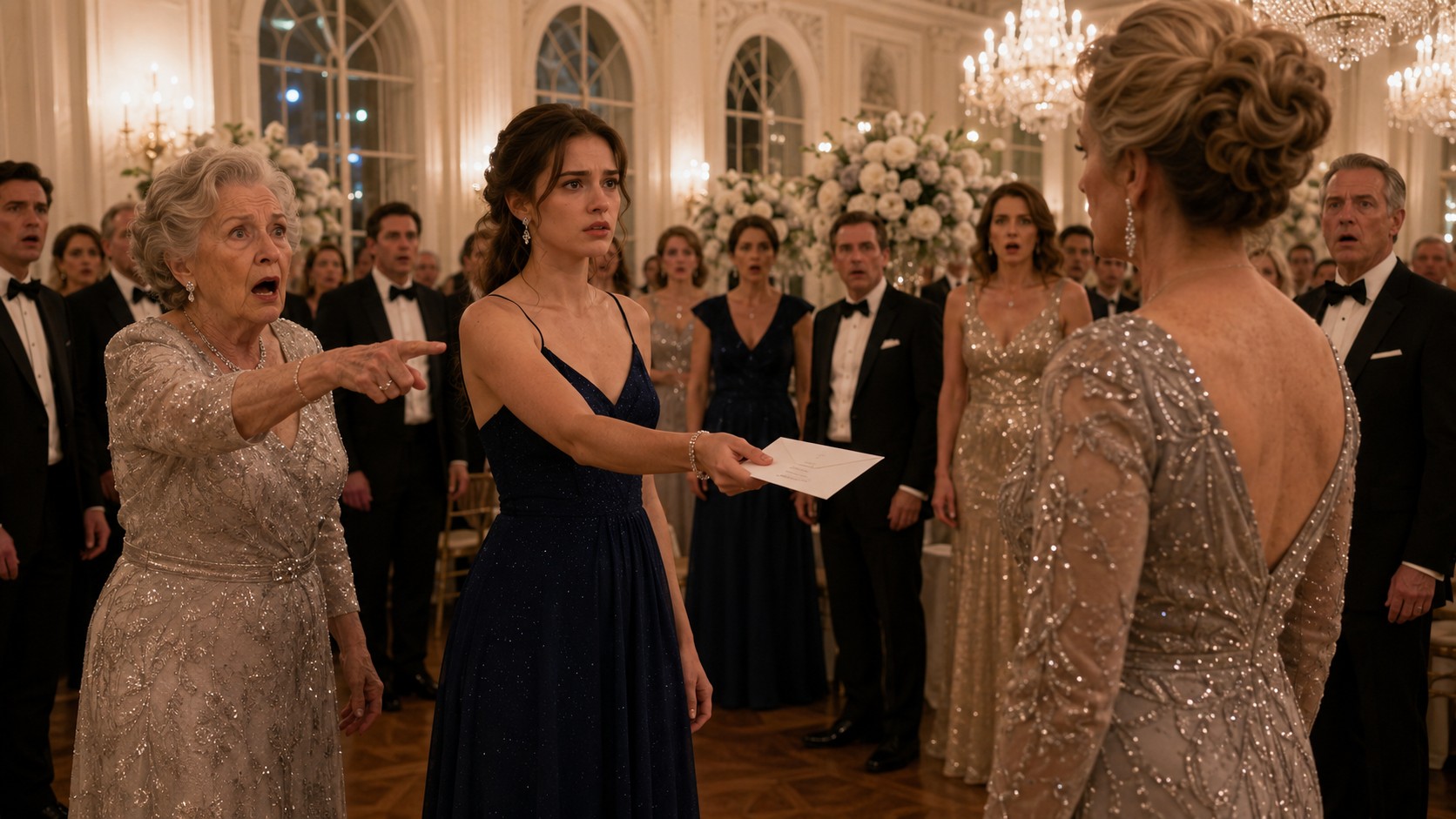

For 32 Years, My Family Called Me “The Failure.” At Our Anniversary Gala, My Grandmother Introduced Me To An Elite Guest: “This Is The One Who Brought Shame To Our Name.” I Remained Silent. But The Guest Stepped Forward, Handed Me A Document, And Said: “Actually, I’m Here To Salute Her. She Just…”
### Part 1
The ballroom at the St. Regis Atlanta smelled like gardenias, champagne, and expensive perfume—the kind of scent that clings to your throat and makes every breath feel rehearsed.
My parents had rented the entire grand room for their thirty-fifth wedding anniversary. Crystal chandeliers hung above us like frozen rain. A jazz trio played near the windows. Fifty guests in dark suits and satin dresses laughed softly over plates of sea bass, pretending not to watch the Thompson family perform its favorite ritual.
Humiliation with candles on the table.
I stood near the edge of the dance floor in my dress uniform, hands relaxed at my sides, shoulders back because the Army had taught me what my family never could: how to occupy space without apologizing for it.
Across the room, my sister Marissa glowed under the lights in a silver dress that looked designed to catch attention from every angle. My brother Trevor stood beside her in a navy tuxedo, one hand in his pocket, smiling like he owned the oxygen. My mother sat at the head table with her chin tilted high, her pearls arranged perfectly around her throat.
Then Grandma Ruth rose from her chair.
Her gold bracelet slid down her wrist as she lifted her champagne glass. She was eighty-two, sharp-eyed, powdered, and mean in that old Southern way people tried to call “honest.” Conversations quieted one table at a time.
“To family,” she said.
Everyone smiled.
“To legacy.”
My mother placed a hand over her heart.
Grandma Ruth’s eyes drifted over Marissa, softened, then moved to Trevor with approval. Finally, they landed on me. The softness left her face like a curtain being pulled.
“And to reminders,” she said, louder now, pointing her glass straight at me, “that every family has one child who brings shame to the name.”
A nervous laugh broke from somewhere near the bar. Then silence swallowed it.
“This is the one,” Grandma Ruth continued, her finger still aimed at my chest, “who brought shame to our name.”
My mother did not look surprised. She nodded once, like someone agreeing with a weather report.
Marissa smirked behind her champagne flute.
Trevor lowered his head, hiding a grin.
I felt every old version of myself rise inside me at once. The six-year-old in a stained yellow dress. The eighteen-year-old with a duffel bag and seventy-five dollars. The captain who had rebuilt bridges in floodwater while my family called my career “a steady paycheck.”
For one second, the room blurred around the edges.
Then a woman near the entrance moved.
She had been standing there quietly all evening in a dark suit, almost too still for a guest. I had noticed her earlier because she didn’t laugh at Trevor’s jokes and didn’t touch the wine. A small pin gleamed on her lapel whenever the chandelier light struck it.
She crossed the ballroom with calm, measured steps.
My grandmother frowned. “Excuse me, dear, are you staff?”
The woman stopped beside the head table and placed a thick leather portfolio on the white tablecloth. The sound it made was soft but final, like a door closing.
“No, ma’am,” she said.
Her voice was clear enough to cut through the jazz music.
“My name is Dana Mills.”
I saw my father, seated at the far end of the table, go still. His hand tightened around his water glass.
Dana opened the portfolio, but she did not look at my grandmother first. She looked directly at me.
“Actually,” she said, “I’m here from the Pentagon.”
The whole ballroom changed temperature.
Marissa’s smile slipped. Trevor’s eyebrows pulled together. My mother’s hand froze on her pearls.
Dana turned the first page.
“I’m here on official business,” she continued. “And I’m here to salute Captain Kendra Thompson for what she just accomplished.”
The room went so quiet I could hear the ice shifting in my grandmother’s glass.
I knew what was inside that portfolio.
But I also knew the truth did not begin in that ballroom.
It began twenty-six years earlier, in a backyard outside Atlanta, with a lavender dress, a gravy stain, and the first time I learned my family had already decided what I was worth.
And as Dana’s fingers rested on the page, I realized something colder than fear.
My family had no idea the woman at their table was not there for a ceremony. She was there because someone in that room had tried to bury my name one last time.
### Part 2
When I was six, I believed light was something other people could own.
That summer, our house outside Atlanta hummed with heat. The cicadas screamed in the oak trees from morning until dark, and Mom kept the curtains half-closed to protect the furniture from fading. The living room smelled like lemon polish, warm carpet, and the hot metal scent of her sewing machine.
She sat at the dining table, guiding lavender fabric beneath the needle with both hands. The machine rattled so fast it sounded angry. On the chair beside her lay pearl buttons, white lace, and a satin ribbon folded like a secret.
Marissa stood barefoot on the rug, already practicing her twirl.
She was nine then, all shiny hair and dimples. Everyone said she looked like Mom before disappointment got to her. I didn’t understand that phrase yet. I only knew that when adults looked at Marissa, their faces opened.
When they looked at me, something closed.
“Hold still,” Mom said, smiling as she pinned the lace collar against Marissa’s neck. “Perfect girls don’t wiggle.”
Marissa giggled. “Am I perfect?”
Mom kissed her forehead. “Of course you are.”
I stood in the doorway, pressing my toes into the wood floor. My own dress was not on the table. No fabric, no ribbon, no buttons. I waited until the sewing machine stopped.
“What about mine?” I asked.
Mom didn’t turn around. “Your what?”
“My dress. For the party.”
She sighed through her nose, the way she did when I made a room less pleasant. Then she walked to the laundry area, pulled open the donation bin, and dug through old clothes until she found a yellow dress crushed into a ball.
She shook it once.
A brown stain marked the collar, faded but still there.
“Wear this,” she said, dropping it at my feet. “You won’t be in the center of the shots anyway.”
The dress smelled like cardboard, old detergent, and somebody else’s closet. I picked it up and rubbed the stiff collar between my fingers. The stain looked like a thumbprint.
By afternoon, the backyard was full of neighbors. Folding chairs lined the grass. A long table held lemonade, deviled eggs, ham biscuits, and a white cake with sugared roses. Someone had turned on a sprinkler for the younger kids, and the wet grass stuck to my ankles.
Grandma Ruth arrived late, wearing white linen and carrying a gin and tonic like it was part of her body.
“Where is my little star?” she called.
Marissa ran to her. Grandma Ruth grabbed her by the shoulders, spun her toward the other women, and announced, “Look at this child. She’s going to break hearts all over Georgia.”
Everyone laughed and agreed.
Then Grandma Ruth’s eyes slid to me.
I still remember the exact way she tilted her head, as if I were a crooked picture frame.
“And then there’s Kendra,” she said. “Poor thing got the family nose and the family luck.”
A few adults chuckled.
Grandma Ruth leaned closer, but her voice got louder. “Life is going to be a long, hard road for a girl with a face like that.”
I looked at Mom.
She stood three feet away holding a glass of wine. For one bright second, I expected her to pull me against her skirt, to say, “Don’t talk about my daughter that way.”
Instead, she laughed.
“She’s sturdy,” Mom said. “Built for the background.”
The words settled over me heavier than the summer heat.
Later, when the photographer arranged everyone by the rose bushes, I tried to stand beside Marissa. Mom’s hand pressed against my chest and moved me back.
“Behind your cousin,” she whispered. “You’re blocking the light on your sister.”
I stepped back until the rose thorns brushed my arm.
The camera flashed.
In the printed photo, Marissa stood glowing at the center in lavender. I was a yellow blur behind a shoulder, my stained collar barely visible, my face cut in half by a spray of roses.
That picture stayed on our mantel for twelve years.
Every visitor saw it. Every holiday, every birthday, every family dinner, there I was—proof that I had been placed exactly where they wanted me.
Not gone.
Just reduced.
That night, I lay in bed scratching at the place where the collar had rubbed my neck raw. From Marissa’s room came the soft sound of Mom brushing her hair, counting strokes, murmuring praise.
No one came into my room.
I did not cry because I had already learned something important. Tears made adults impatient. Silence made them comfortable.
So I practiced silence.
I practiced becoming small.
But under the blanket, my hand closed around a thorn that had snagged in my dress. I had carried it inside without knowing.
The point pressed into my palm, sharp and real.
I should have thrown it away.
Instead, I hid it in my nightstand drawer, because some childish part of me understood that if my family wanted me behind the roses, I needed to remember how thorns felt.
Years later, when someone broke into that same drawer and took what was hidden there, I would finally understand my family had been afraid of more than my face.
They had been afraid of what I might remember.
### Part 3
By the time I reached middle school, I had become useful in the quiet ways nobody praised.
I fixed the garage door sensor by watching a video twice and testing the wires with a borrowed meter. I balanced Dad’s old ladder on uneven ground so he could clear the gutters. I built a bookcase for Marissa out of scrap plywood because she wanted something “vintage” for her room, then listened while Mom told guests Trevor had helped.
Trevor had held a flashlight for three minutes and complained about splinters.
“That boy has practical hands,” Grandma Ruth said at dinner.
I looked down at my own hands, still marked with dried wood glue.
No one noticed.
School was different. Numbers behaved. Angles made sense. A bridge either held weight or it didn’t. A beam either bent under pressure or it carried the load. There was honesty in that.
My geometry teacher, Mr. Alvarez, was the first adult who ever looked at my work and paused for a good reason.
“This model is yours?” he asked.
It was a truss bridge made of balsa wood and fishing line. I had stayed up until two in the morning building it on my bedroom floor, using canned beans as test weights because Mom said she was not buying supplies for “another little phase.”
“Yes, sir.”
He lifted it carefully. “Kendra, this is excellent.”
Excellent.
Not sturdy. Not background. Not useful.
Excellent.
I carried that word home like a lit match cupped between my hands.
At dinner, Marissa was explaining that her drama teacher said she had “screen presence.” Mom leaned forward, shining.
“I always knew you were meant for something big,” she said.
Trevor announced he had made varsity baseball because the coach liked his attitude. Dad clapped him on the shoulder.
I waited for a gap in the conversation.
“I won the regional engineering challenge,” I said. “Mr. Alvarez said my bridge held more weight than any model in the county.”
Marissa blinked. “A toy bridge?”
“It’s not a toy.”
Trevor snorted. “Did it come with little cars?”
Mom cut a piece of chicken with careful pressure. “That’s nice, Kendra. But don’t interrupt your sister.”
The match went out.
The following week, Mr. Alvarez called the house. I was in the hallway when Mom answered the kitchen phone.
“Yes, she’s here,” Mom said, glancing at me.
Then she listened.
Her face changed.
Not pride. Not surprise.
Something tighter.
“I see,” she said. “Well, Kendra has chores after school. We’re not sure she has time for extra programs.”
My stomach turned.
She hung up and wiped the counter even though it was already clean.
“What did he want?”
“Nothing important.”
“Was it about the summer engineering camp?”
Her hand stopped moving.
“So you knew?”
“He gave me a form.”
Mom folded the dish towel once, twice, three times. “Those camps cost money.”
“He said there were scholarships.”
“Scholarships still require transportation. Supplies. Clothes. And we already have Marissa’s acting workshop.”
Marissa’s acting workshop was at a community theater fifteen minutes away. She had quit after four classes because the director gave the lead to another girl.
“I can ride with Mr. Alvarez’s group,” I said.
Mom turned then. The look on her face made me step back.
“You are not going off with strangers to fill your head with ideas.”
“What ideas?”
“That you’re special.”
The kitchen fan hummed above us.
Mom’s voice softened, which was always worse. “Kendra, some children need encouragement. Some need reality. You are a practical girl. Practical girls survive by knowing their lane.”
My lane.
For years, she had been painting it around me. Narrower at every turn.
That night, I waited until everyone slept and slipped into the garage. The air smelled like motor oil, sawdust, and rain blowing in under the door. My bridge model sat on the workbench, where I had left it so Dad could see.
Someone had snapped it in half.
Not dropped. Not bumped.
Snapped.
The clean break ran through the center support.
For a moment, I could not breathe. I picked up one half, then the other. Fishing line dangled loose like torn veins.
On the floor beside the bench lay a silver charm from Marissa’s bracelet.
I stared at it, anger rising hot and simple.
The obvious answer was Marissa. She had broken things before when attention shifted away from her. A missing ribbon. A cracked trophy. A homework folder “accidentally” thrown out.
I carried the charm upstairs and stood outside her bedroom door.
Inside, she was asleep beneath a canopy of pink fabric, one arm over her face. Her bracelet lay on the nightstand.
No missing charm.
I looked down at the silver piece in my palm.
It wasn’t from her bracelet.
It was older, scratched, shaped like a tiny drafting compass.
I had seen it before on a chain in Mom’s jewelry box.
The next morning, my bridge model was gone from the garage, swept away before breakfast. Mom served pancakes as if nothing had happened. Marissa complained about the syrup. Trevor kicked my chair under the table.
I said nothing.
But that broken bridge had given me new information.
My sister enjoyed seeing me small.
My mother needed me that way.
And for the first time, I wondered what dream she had buried so deep that even a child’s balsa-wood bridge could make her afraid.
### Part 4
I found the answer when I was eighteen, sweating through my T-shirt in the attic.
August in Georgia does not warm a house. It attacks it. The air upstairs pressed against my face like a wet towel, and every breath tasted like dust, insulation, and old cardboard.
Mom had sent me up for Christmas lights.
Not asked. Sent.
Marissa was downstairs on the couch, scrolling through casting calls and complaining that the air conditioning was too cold. Trevor was outside washing his truck with Dad. I was the one trusted with heat, spiders, and boxes that scraped my forearms raw.
The attic bulb swung from a chain, making shadows tilt over stacks of old decorations. I crawled past a plastic Santa and a broken baby gate until my knee hit a heavy cardboard box sealed with silver duct tape.
The side read Janet College in faded marker.
Janet was my mother’s name.
I do not know why I opened it. Maybe because the tape had already curled at one corner. Maybe because I had spent my whole life being told not to touch certain things, and graduation had made me reckless.
Inside were rolls of vellum paper.
I uncurled one and saw precise black lines spread across the page. Columns. Load paths. Elevations. Notes written in my mother’s handwriting.
Not grocery lists. Not birthday reminders.
Structural calculations.
Beneath the drawings lay a Georgia Tech transcript. Janet Ruth Thompson. Architecture. All A’s. Dean’s list. Scholarships. A letter praising her design portfolio.
At the bottom of the box was a withdrawal form dated one month before Marissa was born.
My hands left damp marks on the paper.
I sat back on my heels as the attic spun slowly around me.
My mother had not always been the woman polishing silver and managing Marissa’s dreams. She had once drawn buildings. Bridges. Public spaces. She had once calculated load-bearing walls and imagined things that could stand after she left the room.
Then she got pregnant.
Then she quit.
Then I came along three years later with my math awards and model bridges and hands that liked tools, and suddenly I was not just an unwanted second daughter.
I was evidence.
I was a mirror she hated.
The ceiling below me thumped with music from Marissa’s phone. A laugh rose through the vent. Mom’s voice followed, sweet and indulgent.
I looked at the drawings again. They were good. Even at eighteen, I knew they were good.
For one dangerous second, I felt sorry for her.
Then I remembered the yellow dress.
The broken bridge.
The summer camp form disappearing from the kitchen drawer.
Pity folded into something harder.
A few days later, my acceptance letter arrived.
Full scholarship. United States Military Academy prep program leading into an engineering track. Combat engineering. Discipline, structure, service. A way out with a uniform and a purpose.
I slid the envelope across the kitchen table after dinner.
Mom picked it up with two fingers.
“What is this?”
“Acceptance letter,” I said. “Full ride.”
Dad looked up from the sink.
Marissa leaned over Mom’s shoulder. “Military?”
Trevor laughed. “You?”
Mom read silently. Her mouth tightened when she reached the words combat engineer.
Then she dropped the letter like it had left dirt on her hands.
“That is not a place for someone like you.”
The old me would have stared at the floor.
I stared at her.
“Someone like me?”
“You think because you’re sturdy, because you can carry heavy things and fix broken shelves, you can build something real?” Her voice sharpened. “You’re looking for an excuse to hide in a uniform.”
Marissa smiled. “Maybe they need people for sandbags.”
Trevor raised his soda. “Good luck fitting in with real soldiers.”
Dad turned off the faucet. “Enough.”
The room went quiet.
It was the first time I could remember him saying that word for me.
Mom looked at him like he had spoken in church.
Dad dried his hands slowly. “She earned it.”
Mom’s face changed, not into shame but betrayal. As if my leaving were something we had done to her.
Nobody spoke for the rest of dinner.
The next morning, I packed my canvas duffel before sunrise. Two pairs of jeans. Three shirts. A folder of school records. Seventy-five dollars in cash. In the side pocket, I tucked one piece of vellum from Mom’s attic box—not a full design, just a torn corner with a bridge support sketched in her hand.
I told myself I took it as proof.
Maybe I took it as warning.
Dad drove me three hours to the induction center in his old truck. The cab smelled like coffee, vinyl, and the peppermint gum he chewed when nervous. He did not talk much. Neither did I.
At the gate, he kept the engine running.
Beyond the fence, young people with duffels moved in lines. Instructors barked names. The morning sun flashed against razor wire.
Dad stared straight ahead.
“Kendra,” he said at last, voice rough, “go out there and build something they can’t ignore.”
I waited for more. An apology. An explanation. A promise that home would be different.
He only gripped the steering wheel.
So I got out.
The duffel strap bit into my shoulder as I walked toward the gate. I did not turn around until I heard the truck pull away.
When I finally looked back, all I saw was exhaust fading over the road.
And folded in my pocket, against my thigh, was my mother’s stolen sketch—proof that the life I was chasing had once belonged to the woman most determined to stop me.
I thought leaving would end the war.
I did not yet understand that my family would keep fighting me from a distance, using love as the weapon and money as the chain.
### Part 5
The Army did not call me pretty, special, or difficult.
It called me Thompson.
At first, that was enough.
Training stripped my life down to sweat, boots, alarms, and orders shouted before sunrise. My body hurt in places I did not have names for. My palms blistered, split, healed, and hardened. I learned how to read terrain in rain, how to calculate temporary load capacity under pressure, how to build a crossing where water wanted to erase the road.
There is a strange comfort in exhaustion. When every muscle aches, old insults have less room to move around.
Still, they found me.
They came in letters from home with Marissa’s headshots tucked inside. They came in phone calls where Mom spoke for twenty minutes about Trevor’s business classes and ended with, “Are you eating enough? You always did get broad if you weren’t careful.” They came during holidays when I returned to Atlanta and watched my uniform become invisible the second I walked through the door.
At twenty-two, I came home after earning my first major commendation.
It was not glamorous. No cameras. No parade. My unit had stabilized a rural access bridge after a storm, keeping emergency vehicles connected to three communities. I had been awake for thirty-six hours, soaked to the bone, mud inside my boots, my hands shaking from cold and adrenaline.
My commander shook my hand and said, “You held the line, Thompson.”
I carried that sentence home.
Mom had decorated the dining room for Thanksgiving with orange candles and a centerpiece of fake leaves. Marissa arrived late wearing sunglasses indoors and announced she had almost been chosen for a commercial.
“Almost means they saw something,” Mom said, squeezing her hand.
Trevor talked about an internship his professor “basically promised” him. Grandma Ruth said the Thompson men always rose.
I waited until dessert.
“I got commended last month,” I said. “For the bridge response after the flood.”
Grandma Ruth lifted her coffee cup. “Still playing with bridges?”
Marissa laughed. “Kendra likes mud. Let her have mud.”
Mom smiled without warmth. “Service is noble, sweetheart. Just don’t make the whole table about it.”
The pecan pie tasted suddenly like cardboard.
Dad looked at me from the other end of the table. His eyes flicked to my uniform jacket hanging over the chair. He opened his mouth, then closed it again.
That was Dad’s gift: almost.
Almost defending me. Almost telling the truth. Almost being brave.
After dinner, I found him in his office, pretending to sort receipts. His desk was old mahogany, scratched near the drawer pull. The room smelled like paper, dust, and the pipe tobacco he had quit years ago but still kept in a tin.
“You heard them,” I said.
He did not look up. “Your mother gets emotional around the holidays.”
“That was Grandma.”
“Ruth says things.”
“And Marissa?”
He rubbed his forehead. “Your sister is insecure.”
I laughed once. “That must be exhausting for her, needing my whole life lowered so she can feel tall.”
Dad flinched.
“Why don’t you say anything?” I asked.
He stared at the receipts.
Finally, he opened the bottom drawer and pulled out a newspaper clipping. It was folded into a square, edges soft from handling. The headline mentioned my unit. There was a small photo of me in a hard hat beside a temporary bridge.
“I saw it,” he said.
My anger stumbled.
“You kept this?”
He nodded. “I keep all of them.”
“All?”
Instead of answering, he slid the clipping back into the drawer and closed it.
The click sounded too much like a lock.
“Why hide them?”
His jaw worked. “Some peace is expensive.”
I looked at the closed drawer.
“No,” I said quietly. “Silence is expensive. Peace is just what you call it when I’m the one paying.”
He did not answer.
I left the next morning before breakfast. Mom sent me with leftover rolls wrapped in foil and a list of things Marissa needed help paying for if I “had anything extra.” Acting workshops. Rent. Car repairs. A new laptop because “creative people can’t work on old machines.”
At first, I sent money because saying no felt like kicking a dog everyone insisted was starving.
Two hundred dollars. Then five hundred. Then a thousand for Trevor’s certification course because “he was finally serious.” Another three thousand when Marissa claimed a showcase director had personally invited her to Los Angeles.
Each payment came with praise just warm enough to keep me reaching.
“You’re such a good sister.”
“We knew we could count on you.”
“See, Kendra? You do have a role in this family.”
A role.
Not a place.
By thirty, I had medals in a drawer, savings that never grew as fast as they should, and a family who called only when dreams needed funding.
Then the flood came.
Not a family crisis. A real one.
Rivers rose across Georgia after five days of brutal rain. Roads washed out. Old bridges groaned under water carrying branches, trash cans, and whole sections of fence. My team was sent to assess emergency infrastructure near a historic district most people had forgotten until it was almost gone.
I remember standing in brown water up to my thighs, rain hammering my helmet, while an elderly man on the far bank clutched a plastic grocery bag full of medicine and shouted that his wife could not get to the hospital.
We built through the night.
Portable lights turned the rain silver. Generators coughed. Wet rope burned my palms. Someone played gospel from a phone until the battery died. By dawn, the crossing held.
The first ambulance rolled over it at 6:17 a.m.
I cried behind a supply truck where nobody could see.
Two weeks later, I received notice that our work had triggered a larger federal review and preservation grant. My designs, my field decisions, my team’s execution—everything had been documented.
A woman named Dana Mills called from Washington.
Her voice was professional, calm, and careful.
“Captain Thompson,” she said, “there are details we need to discuss in person.”
“What kind of details?”
A pause.
“The kind that may involve your family before they involve you.”
I stood in the motor pool with my phone pressed to my ear, diesel fumes thick around me.
My first thought was Marissa.
My second was Mom.
My third was the locked drawer in Dad’s office.
And for reasons I could not explain, I remembered the torn bridge sketch still folded in an envelope at the bottom of my footlocker.
### Part 6
Dana Mills did not look like trouble when I first met her.
That was what made her dangerous.
She arrived at Fort Moore on a gray Tuesday in a black government sedan with tinted windows and no wasted movement. Her suit was charcoal, her hair pinned low, her shoes practical enough for a construction site but polished enough for a hearing room. She carried a leather portfolio under one arm.
We met in a conference room that smelled like burned coffee and dry erase markers. A map of recent flood damage covered one wall. Red pins marked compromised roads. Blue pins marked restored crossings. My name appeared on three project summaries clipped to the side.
Dana shook my hand.
“Captain Thompson, thank you for making time.”
“When someone from the Pentagon asks, people usually do.”
The corner of her mouth moved, almost a smile. “Fair.”
She asked about the bridges first. Not the award version. The real version. What we saw. What failed. Which local contractors had been cleared. Who had access to the initial design documents. Whether anyone outside my chain of command had contacted me about grant allocations.
The questions were too specific.
Halfway through, I leaned back. “Ma’am, am I being investigated?”
“No.”
“Is my unit?”
“No.”
“Then what is this?”
Dana folded her hands on the table.
“Your emergency restoration work prevented significant loss of life. That part is simple. The complicated part is that your name was removed from several preliminary recognition packets before they reached state and federal review.”
The room went flat around me.
“Removed by who?”
“We’re still confirming.”
“Why would the Pentagon care about an award packet?”
“We don’t care about trophies, Captain. We care when federal infrastructure reports are altered, especially when those reports connect to emergency preparedness funding.”
I looked at the map. Red pins. Blue pins. Washed-out roads. Families trapped behind water.
“That doesn’t sound like family drama.”
“No,” Dana said. “It sounds like paperwork. Paperwork is where many people hide knives.”
I thought of Mom’s careful hands folding dish towels. Dad’s drawer closing. Marissa’s invoices. Trevor’s “business contacts.”
Dana opened the portfolio and slid a copy of a document toward me.
My project summary.
The paragraph describing my role had been replaced with generic language: field team support.
Below it, a handwritten note appeared in the margin.
Do not overstate KT involvement. Family has concerns.
My throat tightened.
“Family?”
“That note was scanned with the packet sent to a state liaison,” Dana said. “We are tracing the source.”
The handwriting was not Mom’s.
It was not Marissa’s looping script or Trevor’s slanted scrawl.
It looked like Dad’s.
For a moment, the room lost sound. Dana kept talking, but I heard only the fluorescent lights buzzing overhead.
Dad had saved my clippings. Dad had told me to build something they couldn’t ignore. Dad had almost defended me for years.
Had almost been the act?
Dana watched my face without pity.
“I understand this may be personal.”
“You don’t understand anything personal about my family.”
“No,” she said. “But I understand suppression. I’ve seen careers damaged by people who smile in photographs.”
I pushed the paper back.
“What do you need from me?”
“Documentation. Original copies of commendations, letters, project notes, anything showing authorship and command acknowledgment. We also need to know whether anyone in your family had access to your records.”
I laughed, but there was no humor in it.
“My family had access to my money, my time, and every weak spot they installed in me. Records? Probably. I used to bring things home hoping someone would care.”
Dana nodded once, not writing that down.
“The governor’s office is planning a public recognition event tied to the restored historic bridge and community center. Your name has been recommended for federal commendation as part of a broader emergency infrastructure initiative.”
“Recommended by who?”
“Several people,” she said. “Including me.”
Something in my chest pulled tight.
“Why?”
She looked at the map again. “Because the work holds.”
The work holds.
Not you’re sturdy.
Not built for the background.
The work holds.
After Dana left, I sat alone in the conference room until the coffee in my paper cup went cold. Outside, soldiers moved across the parking lot in the damp afternoon light. Boots on pavement. Engines turning. A normal day, except the floor of my life had shifted.
That evening, I drove to Atlanta for family dinner with the governor’s award letter folded in my pocket.
I told myself I was going because I needed to observe. That was the word Dana used. Observe who asked about what. Observe who mentioned the bridge. Observe who knew too much.
Really, I went because a childish part of me still wanted someone at that table to look up and say, “We were wrong.”
The dining room was already lit when I arrived. Candles burned in brass holders. The mahogany table shone like dark water. Marissa sat in my usual chair, telling a story with both hands.
“This time is different,” she said. “The agent said I have real star potential. Not local potential. Real potential.”
Mom looked transported.
Trevor nodded like an investor. “You have to spend money to make money.”
Dad sat at the far end of the table, quiet.
I watched his hands.
They were folded beside his plate, but his right thumb rubbed the knuckle of his left hand. Nervous.
I waited until Marissa paused to sip wine.
“My team received the Governor’s Award for the bridge project,” I said. “There will be a ceremony in two weeks.”
Three seconds of silence.
Mom tapped one nail against her glass. “That’s nice, Kendra. Pass the potatoes.”
Marissa tilted her head. “Is that the muddy bridge thing?”
Trevor laughed. “Do they give medals for concrete now?”
Dad did not laugh.
He stared at my pocket.
Not my face.
My pocket.
As if he knew exactly what letter was folded inside.
Then Marissa leaned forward, all brightness and teeth.
“Anyway,” she said, “about the twenty-five thousand.”
My stomach sank.
Not because of the amount.
Because across the table, Dad closed his eyes like a man hearing a sentence he had already read.
### Part 7
Twenty-five thousand dollars can sound almost reasonable when someone says it beside candlelight.
Marissa had always understood staging. She waited until Mom had refilled everyone’s wine, until Grandma Ruth had settled into her chair with that queenly lean, until Trevor had finished explaining how “strategic risk” separated winners from ordinary people.
Then she placed a glossy folder on the table.
Headshots. A program description. A typed budget. Los Angeles showcase. Industry access. Limited slots. Urgent deadline.
The paper smelled freshly printed, sharp with ink.
“I’ve already been accepted,” she said.
Mom gasped softly. “Marissa.”
“I didn’t want to say anything until it was real.”
Trevor lifted a page. “This is legit.”
He said it too fast.
I watched Dad. His eyes stayed on the folder, not reading, not reacting. His shoulders seemed lower than usual.
Marissa turned to me with the smile she used when cameras came out.
“Kendra, you have always been the practical one. And I appreciate that. I really do.”
That was how she sharpened the knife: with compliments she did not believe.
“I need twenty-five thousand,” she continued. “Not forever. Just until I book something. Once I’m working, I’ll pay you back.”
I picked up my water glass. Condensation wet my fingertips.
Mom leaned in. “Your sister has real talent.”
“You said that about the Atlanta workshop.”
“She outgrew it.”
“And the commercial coaching.”
“She needed better representation.”
“And the New York audition package Trevor found online?”
Trevor’s fork stopped halfway to his mouth.
Marissa’s cheeks pinked. “Why are you keeping score?”
Because someone had to.
Instead, I said, “I don’t have twenty-five thousand to give you.”
Mom’s face hardened. “Don’t be dramatic. You have an Army paycheck and no children.”
There it was. My life reduced to available funds.
“I have rent. Insurance. Retirement. A truck payment.”
Trevor snorted. “Everyone has bills.”
“And savings,” I said. “For a down payment.”
Marissa blinked like I had spoken another language. “A house?”
“An apartment near base. Maybe a small place with a workshop.”
Mom gave a short laugh. “For what? More little bridge projects?”
The fork in my hand pressed into my palm.
I had come to observe. Dana’s voice echoed in my head. Watch who knows what. Watch who pushes.
Marissa pushed her folder closer to me. “Kendra, I don’t think you understand. This could change my life.”
I looked at the glossy headshot on top. Smooth hair. Perfect lighting. A face my family had worshiped since childhood.
“And if I give you the money,” I asked, “what changes in mine?”
The table went silent.
Grandma Ruth set down her glass. “What a selfish question.”
Mom pointed at me with her knife. “We supported you when you ran off to play soldier.”
I stared at her. “You didn’t pay a dollar for my education.”
“You left this family.”
“I left a house.”
Marissa’s eyes filled with tears. They arrived on command, shining but not falling.
“I knew you’d do this,” she whispered. “I knew you’d punish me for having dreams.”
For years, that sentence would have worked. I would have felt cruel. Ungrateful. Sturdy enough to carry the cost.
But that night, I smelled the ink on her folder and noticed something odd.
The program name at the top was slightly different from the name on the payment instructions. One said West Coast Talent Collective. The other said WCTC Holdings.
I slid the page toward me.
Trevor reached for it. “It’s just processing.”
I moved it out of his reach.
“Why does the payment go to a holding company?”
Marissa’s tears vanished for half a second.
Mom snapped, “Because that’s how business works. Don’t embarrass your sister.”
Dad stood abruptly.
His chair legs scraped the hardwood loud enough to make everyone jump.
“I need air,” he said.
He left through the back door.
For the first time all evening, Grandma Ruth looked uncertain.
I folded the payment page and placed it back on the table.
“I’m going to think about it,” I said.
Marissa exhaled like victory had only been delayed. Mom patted her hand. Trevor leaned back and checked his phone.
I helped clear dishes because old habits do not die when truth arrives. In the kitchen, the sink steamed, and lemon soap stung a small cut near my thumb. Through the swinging door, I heard Marissa whispering.
“She’ll pay. She always does.”
Trevor answered, too low for me to catch every word.
Then I heard one phrase clearly.
“After the gala, it won’t matter.”
I turned off the faucet.
Water dripped from my hands onto the tile.
After the gala.
My parents’ anniversary gala was one week away. Mom had been planning it for months, polishing the guest list like silver. State people. Business friends. Old church families. Anyone whose opinion mattered in her world.
I dried my hands slowly.
When I stepped outside, Dad was standing near the driveway under the porch light. Moths battered themselves against the bulb above his head.
“You heard,” he said.
“Enough.”
He looked older than he had at dinner. The lines beside his mouth seemed carved in.
“I need to show you something.”
He led me into his office and closed the door.
For a second, I thought of Dana’s document. The note in handwriting that looked like his. Do not overstate KT involvement. Family has concerns.
My pulse climbed.
Dad reached under his desk and pulled out a thick manila folder.
“I kept the receipts, Kendra,” he said.
When he opened it, I saw fourteen years of my life printed in cheap black ink.
And beneath the clippings, half-hidden under a tax envelope, was a copy of the altered federal packet with my name crossed out in blue.
### Part 8
Dad’s office had always felt smaller at night.
The bookshelves leaned under old tax binders, insurance papers, and photo albums Mom never opened unless guests came over. The desk lamp threw a yellow circle over the folder between us. Everything outside that circle looked shadowed and uncertain.
I reached for the altered packet.
Dad put his hand over it.
“Let me explain.”
That sentence is usually a warning.
I pulled my hand back. “Start with why you have it.”
He sat down slowly, as if his knees had become unreliable.
“Because it came through my office.”
I stared at him.
Dad had spent most of his career as a municipal procurement consultant. Boring work, he always called it. Contracts, vendors, compliance reviews. Nothing dramatic. Nothing connected to me.
At least, that was what I had believed.
“The state liaison asked me to review a local vendor attachment tied to the restoration grant,” he said. “I saw your project name. Then I saw the packet had been changed.”
“The note looked like your handwriting.”
His face tightened.
“I know.”
“Did you write it?”
“No.”
I wanted to believe him so badly it made me angry.
He opened the folder and took out another sheet. Same sentence. Same margin note. But this version had a sticky flag attached.
“That handwriting belongs to your brother.”
“Trevor?”
Dad nodded.
The room tilted in a different direction.
“Why would Trevor care about my recognition packet?”
Dad rubbed both hands over his face. “Because one of the contractors tied to Marissa’s showcase payments is connected to a vendor trying to get emergency infrastructure work.”
The words arrived one at a time, too strange to assemble.
“Marissa’s acting money?”
“I think Trevor has been moving money through fake programs,” Dad said. “Maybe not at first. Maybe he told himself it was temporary. But the WCTC account is connected to a consulting group bidding on state disaster contracts. Your name on those reports made you a problem.”
I sat very still.
The house hummed around us. Air conditioning. Distant laughter from the dining room. A pipe ticking in the wall.
My family had called me a failure for thirty-two years.
Now my success was inconvenient enough to erase.
“Why didn’t you tell me?” I asked.
Dad looked toward the closed door.
“I was trying to confirm it.”
“No. Try again.”
His eyes closed.
“Because I was afraid.”
It was the first honest answer he had given me in years, and it was not enough.
“Afraid of Mom?”
“Yes.”
“Afraid of Grandma?”
“Yes.”
“Afraid of losing the family?”
He opened his eyes. “Afraid of admitting I let it get this far.”
That landed harder than I expected.
He slid the folder toward me. Inside were clippings I had never seen saved. Photos from field ceremonies. Printed articles. Copies of emails from people thanking my unit. A program from a military engineering conference where my name was spelled correctly in small type.
He had kept all of it.
Hidden.
Like contraband.
“You were proud in private,” I said.
His eyes filled. “I was proud.”
“In private.”
He did not defend himself.
I hated him less for that.
I hated him more, too.
On the bottom of the folder lay an envelope addressed to Dana Mills. It was already stamped but not mailed.
“What is this?”
“I was going to send copies.”
“When?”
He looked down.
After the gala, I thought.
The phrase Trevor had whispered burned through the room.
I stood and gathered the documents. “I’m taking these.”
“Kendra—”
“No. You don’t get to hold the proof anymore.”
He nodded once.
At the door, he said, “The gala is going to be rough.”
I turned.
“Why?”
His face went pale under the desk lamp.
“Your mother is planning a toast.”
“About Marissa?”
“No.”
The silence after that answered for him.
I looked toward the hallway, where Mom’s laugh floated past like cold perfume.
“She’s planning to use me.”
Dad swallowed. “Ruth suggested it. Janet agreed. They think if they frame your career as unstable, dramatic, unfeminine—if they make people laugh—you won’t be taken seriously if questions come up later.”
I felt something inside me go quiet.
Not calm.
Quiet.
Like a bridge after the last bolt locks into place.
“And Trevor?”
“He thinks once the room sees you as the family problem, anything you say about the paperwork will look like resentment.”
Of course.
The old family photograph, recreated for adults.
Marissa in the light. Trevor at the center. Me behind the thorns, only this time the thorns were legal documents and public shame.
Dad stood. “Don’t come alone.”
“I won’t.”
His brows lifted.
I tucked the folder under my arm. “Dana Mills already called me.”
For the first time that night, Dad looked relieved.
Then ashamed of his relief.
I walked out of his office and passed the dining room. Marissa was showing Grandma Ruth something on her phone. Mom was laughing with one hand on Trevor’s shoulder.
None of them looked up.
In my truck, I set Dad’s folder on the passenger seat and locked the doors. The windshield reflected my face back at me, dark eyes, tight mouth, uniform collar open at the throat.
My phone buzzed.
A text from Marissa.
Need your answer before gala. Don’t make this awkward.
I typed back one sentence.
I’ll be there, but I won’t bring my checkbook.
Three dots appeared, vanished, appeared again.
Then nothing.
I drove back to Fort Moore under a moon blurred by cloud cover. The folder on the seat shifted every time I turned, paper whispering against paper.
Halfway down the interstate, Dana called.
“Kendra,” she said, skipping my rank for the first time, “we found the source of the alteration.”
My hands tightened on the wheel.
“It wasn’t only Trevor,” she said.
Ahead of me, red taillights smeared in the humid dark, and suddenly the gala was no longer just a family ambush.
It was evidence waiting for witnesses.
### Part 9
The week before the gala moved like a storm you could smell before the rain arrived.
Every phone call from home had a polished edge. Mom left voicemails reminding me of dress code, arrival time, seating arrangements, as if I had not spent fourteen years following orders more complicated than where to stand for cocktails.
Marissa sent three messages.
First: I’m hurt you’re making money weird.
Then: Mom says you’re under stress and we forgive you.
Finally: Please don’t wear your uniform. It makes the vibe heavy.
That last one made me laugh out loud in my apartment kitchen.
The apartment was half-packed, because I had signed the paperwork for a small townhouse near base. Two bedrooms, a cracked patio, a garage wide enough for tools, and a front window that caught morning light. It was not grand. It was not in a neighborhood Mom would brag about.
It was mine.
On Wednesday night, I stood barefoot on the tile, eating cereal from a mug because most of my bowls were boxed, and reread Marissa’s message.
Don’t wear your uniform.
I looked at the garment bag hanging from the closet door.
Then I texted Dana.
Will uniform be appropriate Saturday?
Her answer came two minutes later.
Very.
The next day, Dana met me at the restored bridge site.
The floodwater had receded, leaving mud lines on tree trunks and debris tangled in low branches. The bridge itself stood clean and solid over the river, new steel worked into old stone in a way that respected what had survived and strengthened what had not.
Morning sun flashed on the water. The air smelled like wet earth and cut lumber.
Dana walked the length of the bridge slowly, reading plaques not yet installed, inspecting the temporary access road, watching local workers bolt railing sections into place.
“You did this under emergency conditions?” she asked.
“My team did.”
“But you designed the stabilization plan.”
“I led it.”
She stopped at the center and looked over the side. “Do you always correct credit away from yourself?”
I leaned on the railing. “Habit.”
“Break it.”
The words were not gentle, but they were clean.
I told her about the gala plan. The toast. Trevor’s documents. Mom’s lifelong campaign. Dad’s folder. I left out the yellow dress, then found myself adding it anyway because some details explain more than dates can.
Dana listened without interrupting.
When I finished, she said, “Your mother did not alter federal records.”
“I know.”
“But she created the environment where everyone believed erasing you would be easy.”
The river moved below us, brown and steady.
“That sounds personal.”
“It is. It is also relevant.”
She opened her portfolio and removed a page sealed in a plastic sleeve.
“Trevor’s consulting partner submitted a vendor packet for upcoming emergency infrastructure contracts. Their application used experience summaries lifted from your team’s work.”
I turned sharply.
“My work?”
“Not by name. That was the point. Your name was removed, the work remained, and their group positioned itself as having local strategic insight.”
I read the page. Phrases from my reports stared back at me, rearranged into corporate language.
Rapid-load assessment.
Historic-structure stabilization.
Community access continuity.
My words with the blood drained out.
“Marissa’s showcase program?”
“A pass-through account. Some payments appear to have been routed there before moving elsewhere.”
The bridge beneath my boots felt suddenly too narrow.
“All those checks I sent her…”
“We’re still tracing funds. I can’t discuss every detail.”
“Did my money help them do this?”
Dana’s expression softened, but only slightly. “You were deceived.”
That was not an answer.
It was mercy wearing a suit.
On Friday, Dad called.
“I told your mother you weren’t paying Marissa.”
I waited.
“She said you were jealous.”
“Of course she did.”
“She said the gala toast needs to be stronger now. Ruth wants to make it funny.”
Funny.
I imagined fifty guests laughing politely while Grandma Ruth carved me open with a butter knife.
“Dad, why are you still in that house?”
The line crackled with his breathing.
“I don’t know how to leave something I helped build.”
I looked around my apartment. Boxes. Bare walls. A stack of commendations Dana had asked me to organize. A life in transition, but not ruins.
“Maybe you didn’t build a family,” I said. “Maybe you maintained a stage.”
He did not answer.
Before hanging up, he whispered, “Be ready when Dana opens the portfolio.”
“What’s in the final section?”
A long pause.
“Kendra, I’m sorry.”
The call ended.
I stared at my phone until the screen went dark.
Sorry for what?
Saturday arrived hot and bright.
I dressed with care. White shirt. Dark jacket. Polished shoes. Ribbons aligned. Hair pinned tight. Every button fastened like a decision.
In the mirror, I looked like someone my six-year-old self would have hidden behind a curtain to watch.
Not because I was perfect.
Because I was standing in the center of my own frame.
At the hotel, valet attendants moved between black cars and SUVs. Through the glass doors, I saw chandeliers, flowers, and the first wave of guests drifting toward the ballroom.
Then I saw Trevor near the entrance, speaking quickly into his phone.
“No, she’s coming,” he said. “Uniform and everything. Mom will handle it.”
He turned and saw me.
His face changed.
Not guilt.
Calculation.
He smiled and ended the call.
“Kendra,” he said, spreading his arms. “Please don’t make tonight difficult.”
Behind him, in the reflection of the hotel glass, a dark-suited woman stepped from a black sedan.
Dana Mills had arrived.
And tucked beneath her arm was not one portfolio, but two.
### Part 10
Inside the ballroom, my mother had arranged beauty like a defense strategy.
White roses towered in glass vases. Gold chargers flashed beneath each plate. Tiny candles floated in bowls of water, their flames trembling whenever someone passed. A string quartet had replaced the jazz trio for cocktails, making the room feel more expensive and less alive.
Mom saw me from across the room.
Her smile held for the guests around her, but her eyes sharpened.
“You wore it,” she said when I reached her.
“My uniform?”
“This is an anniversary gala, Kendra. Not a recruitment poster.”
“It’s a formal uniform.”
“It draws attention.”
I let my gaze move over Marissa’s silver dress, Trevor’s tuxedo, Grandma Ruth’s diamond brooch large enough to signal aircraft.
“Wouldn’t want that,” I said.
Mom’s nostrils flared.
Marissa swept over with perfume arriving before she did. Vanilla, amber, something sweet enough to hurt.
“You look intense,” she said, air-kissing near my cheek. “Very government.”
Trevor appeared at my other side. “Let’s all be normal tonight.”
Normal meant I swallowed.
Normal meant they cut.
Normal meant I paid afterward.
Across the room, Dana stood near the entrance speaking with a hotel manager. She did not look at me. That was deliberate. We had agreed: no contact until the toast.
Still, her presence steadied me.
Dinner began with speeches.
A church friend praised my parents’ commitment. A business associate called Dad dependable and Mom gracious. Someone told a story about their first house, how Mom had “made it beautiful with nothing but taste and determination.”
I watched Mom accept the compliment with lowered lashes.
Taste and determination.
Not architecture. Not talent. Not the life in the attic box.
Dad sat beside her, pale and quiet. Once, his eyes met mine. He gave the smallest nod.
Then Grandma Ruth stood.
The room settled.
Here it comes, I thought.
She lifted her champagne glass. Her rings glittered under the chandelier.
“When my daughter Janet married Harold Thompson, I knew this family would build something lasting,” she began. “And looking around this room, I see proof.”
Guests smiled.
“Marissa, our beautiful star.”
Marissa dipped her head.
“Trevor, our ambitious heir.”
Trevor raised his glass.
Grandma Ruth’s gaze moved toward me.
“And Kendra.”
The air shifted.
“She chose a different path,” Grandma Ruth said. “A hard path. Some might say a strange one for a woman from a good family.”
A few guests chuckled softly, unsure if they were allowed.
My mother’s smile stayed fixed.
Grandma Ruth continued, encouraged. “Now, every family has its mystery. Every family has its challenge. Kendra has always been ours.”
Heat climbed the back of my neck, but my hands stayed still.
“She was never delicate like Marissa. Never charming like Trevor. She was…” Grandma Ruth paused, pretending to search for kindness. “Sturdy.”
The word landed exactly where she aimed it.
I saw Dana’s head turn.
Grandma Ruth lifted her glass higher.
“And tonight, on this beautiful occasion, I want to say we love even the difficult ones. Even the ones who bring shame to the name.”
The room froze.
She pointed her glass at me.
“This is the one who brought shame to our name.”
There it was.
The old photograph. The stained collar. The rose thorns.
Only this time, I did not step back.
I stood.
Chair legs scraped behind me. Conversations died mid-breath. Marissa’s lips curved. Trevor watched Dana from the corner of his eye. Mom’s expression held triumph so faint most people would miss it.
I did not.
Before I could speak, Dana moved.
Her heels made soft, even sounds across the ballroom floor.
Grandma Ruth frowned. “Excuse me, dear, this is a private family moment.”
Dana stopped beside her.
“No, ma’am,” she said. “It is now part of an official record.”
The sentence hit the table harder than any shout.
She placed the first leather portfolio beside Grandma Ruth’s champagne glass.
“Dana Mills,” she said. “Office of the Under Secretary of Defense. I’m here regarding Captain Kendra Thompson.”
A man near the back whispered, “Pentagon?”
Trevor’s face drained.
Marissa sat up straight.
Mom’s hand went to her pearls.
Dana opened the portfolio.
“For the past several months, Captain Thompson’s emergency infrastructure work has been under federal review. Her leadership during the recent flood response restored access to isolated communities, protected historic structures, and prevented extended disruption to critical services.”
She turned the first page.
Photographs appeared. The bridge at dawn. My team in rain gear. A temporary crossing under portable lights. My name printed beneath an engineering plan.
Guests leaned forward.
Dana’s voice remained calm.
“Captain Thompson has been selected for federal commendation tied to emergency preparedness and historic infrastructure preservation.”
Grandma Ruth’s glass trembled.
Marissa whispered, “What?”
Dana turned another page.
“Additionally, the governor’s office has requested that her name be included on the dedication plaque for the restored community center.”
My mother stared at the documents as if they were insects crawling over the tablecloth.
Dana looked at me.
“Captain Thompson,” she said, “your work held when thousands of people needed it to hold.”
The room did not clap.
Not yet.
They were too busy recalculating.
Then Dana placed the second portfolio on the table.
Trevor pushed back his chair.
Dana did not look at him.
“This portfolio concerns a separate matter,” she said. “Altered reports, misattributed project language, and vendor submissions now under review.”
A champagne flute slipped from someone’s hand and shattered near the head table.
Mom stood so fast her chair hit the wall behind her.
“That is enough,” she said.
Dana turned one page.
“No, Mrs. Thompson,” she replied. “It appears it is not.”
And when I saw the document on top, my anger went cold.
Because the handwriting in the margin was Trevor’s.
But the signature beneath the vendor recommendation belonged to my mother.
### Part 11
My mother had always been careful with ink.
Birthday cards in blue fountain pen. Grocery lists in black felt tip. Thank-you notes slanted just enough to look elegant but never messy. Her handwriting was part of her performance, as polished as her pearls and as controlled as her smile.
So when I saw her signature at the bottom of the vendor recommendation, I knew before my mind accepted it.
Janet Thompson.
Not forged.
Not mistaken.
Hers.
The ballroom seemed to stretch around me. Fifty guests. White roses. Candle flames trembling in glass bowls. My grandmother’s mouth opening and closing without sound.
Dana continued speaking, but my eyes stayed on that signature.
“The matter is under formal review,” she said. “No conclusions will be announced in this room. However, given the public statements just made about Captain Thompson’s character and credibility, it is necessary to correct the record immediately.”
Trevor stood. “This is inappropriate.”
Dana looked at him. “Sit down, Mr. Thompson.”
He sat.
Not because he respected her.
Because everyone watched him obey.
Marissa grabbed Mom’s wrist. “What is she talking about?”
Mom did not answer.
Dad lowered his head.
That hurt more than I expected. Not because he was surprised. Because he wasn’t.
“You knew,” I said.
My voice was quiet, but it carried.
Dad looked up.
“I found out too late.”
“Too late for what?”
He swallowed.
Mom snapped, “Harold, don’t.”
The command cracked through the room.
Dad’s face changed. Something tired and trapped broke open.
“Too late to stop the submission,” he said. “Not too late to save the proof.”
Mom’s eyes burned.
Dana closed the second portfolio. “This is no longer a family discussion. Captain Thompson, you are not required to remain.”
Not required.
For thirty-two years, requirement had worn many costumes.
Smile for the picture.
Stand behind your cousin.
Help your sister.
Respect your grandmother.
Don’t embarrass your mother.
Be family.
For once, someone stated the opposite.
I was not required to stay.
But I did.
I turned to Grandma Ruth.
She still held her glass, though most of the champagne had spilled down her hand.
“You called me shame,” I said. “In front of all these people.”
Her chin lifted by habit. “I said what everyone—”
“No,” I said.
The word stopped her.
“I need you to hear this while your audience is still here. You do not get to dress cruelty up as honesty anymore. You do not get to call me sturdy because you are too small to call me strong. You do not get to point at me like I’m a stain on this family when the stain is sitting at this table.”
No one breathed.
Then I looked at Marissa.
Her eyes were wet now, but I had seen her tears arrive too many times to trust them.
“Kendra, I didn’t know about any of this,” she whispered.
“Maybe not the paperwork. But you knew enough. You knew the programs weren’t real enough to earn the money honestly. You knew every dream got more urgent when my savings got close to becoming mine.”
“That’s not fair.”
“Neither was six years old in a stained dress while everyone laughed.”
Her mouth trembled. “You’re really bringing up childhood?”
“Yes,” I said. “Because all of you never stopped living there.”
Trevor tried to stand again. “This is insane. We can talk privately.”
I almost laughed.
“Privately is where you people thrive.”
A murmur moved through the room.
Mom stepped toward me. Her face had shifted from outrage to something more dangerous—wounded motherhood, polished for witnesses.
“Kendra,” she said softly, “you are upset. I understand. But this is still your family.”
There it was. The oldest trap.
Family.
A word they used like a locked door.
I looked at her signature through the clear sleeve.
“You signed a recommendation tied to stolen work.”
Her eyes flashed. “I signed what Trevor put in front of me.”
“Without reading?”
“I trusted my son.”
The room heard it.
So did I.
Trusted my son.
Not my child.
Not my children.
My son.
Something inside me finally stopped reaching.
Dana touched the portfolio lightly. “Mrs. Thompson, this conversation should continue with counsel present.”
Mom ignored her.
“You have no idea what I sacrificed,” she hissed at me. “No idea what I gave up to raise this family.”
I felt the attic heat again. Dust on my arms. Vellum paper unrolling under my hands.
“I know exactly what you gave up.”
Mom froze.
The guests watched, hungry and horrified.
“You were brilliant,” I said. “Georgia Tech. Architecture. All A’s. Bridges and buildings and designs good enough that I understood them before I understood you.”
Her face went white.
Marissa looked between us. “Mom?”
I kept my eyes on my mother.
“You quit before Marissa was born. Maybe you had no choice. Maybe someone made you feel like motherhood was the only door left open. Maybe that grief was real.”
For a second, her expression cracked.
Then I said the rest.
“But you took that grief and fed it to me for thirty-two years. You saw me building the kind of life you lost, and instead of loving me, you punished me for surviving your regret.”
The room seemed to tilt.
Mom whispered, “How dare you.”
“No,” I said. “How dare you sign my work away to protect the children you chose to be proud of.”
Her hand moved before I realized what she meant to do.
Not a slap. She reached for the portfolio.
Dana caught it first.
“Do not touch federal documents,” she said.
The authority in her voice snapped something shut.
Mom stepped back.
In the silence, a man at table six began clapping.
One clap. Then another.
His wife joined. Then a retired colonel Dad knew. Then the hotel manager near the door. The sound spread unevenly, awkward at first, then firm.
Applause filled the ballroom.
Not for the Thompson family.
For me.
I stood in the center of it and felt no triumph. Only grief moving through me like floodwater, carrying away furniture, photographs, lies.
Dana leaned closer.
“Captain Thompson, we should leave.”
I nodded.
As I turned, Mom grabbed my sleeve.
Her fingers dug into the fabric of my uniform.
“You walk out that door,” she whispered, “don’t expect to come back.”
I looked at her hand until she let go.
Then I said the cleanest sentence of my life.
“I wasn’t coming back.”
And when I walked out of that ballroom, the applause faded behind me—but the sound of my mother screaming my name followed me all the way to the kitchen corridor.
### Part 12
The hotel kitchen smelled like butter, garlic, steam, and panic.
Servers moved around us with trays held high, pretending not to stare. A dishwasher roared behind a swinging metal door. Somewhere, plates clattered in a bus tub, sharp as breaking glass.
I stopped beside a stainless-steel prep table and put both hands on its cold edge.
For fourteen years, I had handled emergencies with checklists. Assess damage. Secure site. Protect civilians. Stabilize structure. Report accurately.
No checklist existed for leaving your family in a ballroom full of witnesses.
Dana stood a few feet away, giving me space without abandoning me. That was a skill my own mother had never learned.
“You did well,” she said.
“I don’t feel well.”
“That is different.”
I laughed once, breathless.
The kitchen door burst open.
Mom came in first, face flushed beneath perfect makeup. Marissa followed, crying now in full performance. Trevor came behind them, jaw tight, phone in hand. Dad entered last and closed the door.
For one strange second, we looked like a family again, gathered in a bright room after a party.
Then Mom spoke.
“How dare you expose private matters in public?”
I stared at her.
“You toasted my shame in public.”
“That was different.”
“Because you were the one holding the knife?”
Marissa sobbed. “Kendra, please. This is going to ruin me.”
I turned to her. “No. For once, consequences are arriving with the correct address.”
Trevor stepped forward. “You need to be careful. Government people make mistakes. You don’t want to accuse family and regret it later.”
Dana moved slightly. Not in front of me. Beside me.
“Mr. Thompson,” she said, “that sounded close to intimidation.”
He shut his mouth.
Mom pointed at Dana. “You have done enough.”
Dana’s expression did not change. “No, ma’am. The review has just begun.”
Marissa looked genuinely frightened then.
“Review?” she whispered.
Trevor shot her a look.
There. Another clue.
She knew enough to fear, but not enough to control.
Mom saw it too and turned on Trevor. “What did you tell her?”
Trevor’s composure cracked. “Don’t start with me. You signed it.”
“You said it was a character statement.”
“It was a vendor recommendation.”
“You told me it would keep Kendra from making trouble.”
The kitchen went silent.
Even the dishwasher seemed to fade.
There it was, spoken plainly.
Not an accident.
Not misunderstanding.
Mom had signed because the document hurt me.
Dad closed his eyes.
I looked at him. “You heard that.”
He nodded.
“You all heard it,” I said.
Dana removed a small notebook from her jacket. “I did.”
Mom’s face twisted. “You cannot write down everything I say.”
“Yes,” Dana said. “I can.”
Marissa sank onto a stool. Her silver dress shimmered under fluorescent light, suddenly cheap-looking in the harshness.
“Kendra,” she said, voice smaller, “I didn’t know Trevor was using your work. I swear. I just thought the accounts were… complicated.”
“Complicated,” I repeated.
“I was desperate.”
“So was I.”
She blinked.
I stepped closer. “I was desperate every time I opened my bank app and watched my savings disappear into your emergencies. I was desperate when I worked double shifts and still came home for holidays where you laughed at my life. I was desperate when I thought if I gave enough, one of you would finally love me correctly.”
Her tears spilled.
“I do love you.”
“No,” I said. “You love access to me.”
Mom made a disgusted sound. “Listen to yourself. So cold. So military.”
I turned to her.
The old wound was gone now. In its place stood a door.
“You don’t get to use that tone anymore. Not with me.”
“I am your mother.”
“You are the woman who taught me a mother can be present and still abandon her child.”
Her mouth opened.
Nothing came out.
Trevor’s phone buzzed. He glanced down, and all color left his face.
Dana noticed. “Problem?”
He slipped the phone into his pocket. “No.”
Dad spoke then, voice low. “Is it the bank?”
Trevor glared at him.
Marissa lifted her head. “What bank?”
Dad looked at me, then at Dana. “There are credit cards in Janet’s name. Business lines too. I found statements.”
Mom gripped the back of a chair.
“Harold.”
“No,” he said. “No more.”
The words shook, but they came.
Trevor’s anger snapped toward him. “You weak old man.”
I stepped between them without thinking.
Not to protect Trevor.
Not even to protect Dad.
Because my body knew escalation before my mind named it.
Dana’s voice cut through the kitchen. “Everyone stop.”
The door opened behind us, and two hotel security staff appeared. Beyond them, guests hovered in the corridor, pretending they had not followed.
Mom saw the audience and changed instantly.
Her shoulders lowered. Her face crumpled.
“Kendra,” she whispered, “please. We can fix this. We can be a family again.”
I looked at her carefully.
For years, I had dreamed of that sentence.
Now it sounded like a sales pitch from a condemned building.
“No,” I said.
Marissa made a broken sound.
“No more checks,” I continued. “No more holidays. No more emergency calls. No more being the name you erase and the wallet you open. After tonight, contact goes through my attorney or the appropriate investigator.”
Mom recoiled. “You would do that to your own blood?”
“You did worse to your own child.”
Dad took one step toward me. “Kendra—”
I turned to him, and he stopped.
“You saved proof,” I said. “Thank you for that.”
His eyes filled.
“But you also saved yourself from conflict for thirty years by letting me absorb it. I’m not carrying your cowardice out of this hotel with me.”
He nodded like every word had weight.
“I know.”
Maybe he did.
Maybe knowing was the first honest thing he had left.
I picked up my overnight bag from the hallway outside the kitchen. The strap felt familiar against my palm, like the duffel I carried at eighteen.
Dana walked with me through the service corridor.
Behind us, Mom began crying loudly enough for guests to hear.
This time, I did not turn around.
At the side exit, humid Atlanta night wrapped around me. Valet lights glowed against wet pavement. Somewhere beyond the hotel, traffic hissed over Peachtree Street.
Dana paused beside the black sedan.
“What will you do now?”
I looked at my reflection in the dark car window.
For once, no one stood in front of me.
“I’m going home,” I said.
Then I realized I did not mean my parents’ house.
I meant the townhouse with the cracked patio, empty rooms, and morning light waiting for me near base.
For the first time in my life, home was not a place I had to survive.
But as I drove away, my phone lit up with a message from an unknown number.
You think tonight made you untouchable?
Attached was a photo of my new townhouse.
Taken from across the street.
### Part 13
Fear has a smell.
Metallic. Dry. Like old pennies held too long in a closed fist.
I sat in my truck at a red light outside the hotel, staring at the photo of my townhouse until horns sounded behind me. My new place was supposed to be private. I had signed the papers through a military housing referral, kept the address out of family conversations, told only Dad after he gave me the folder.
The photo showed the front window, the cracked patio, and the small maple tree near the curb.
No people.
No threat written in full.
Just proof that someone wanted me to feel watched.
I forwarded it to Dana before the light changed.
Her reply came fast.
Do not go there. Drive to base gate. Now.
I did.
The city blurred past in streaks of white headlights and red brake lights. My uniform collar felt tight against my throat. Every few minutes, my phone buzzed with family calls.
Mom.
Marissa.
Dad.
Unknown.
Trevor did not call.
That told me enough.
At the gate, military police checked my ID, then waved me toward a secure lot Dana had arranged before I arrived. She was already there, standing under a floodlight, her dark suit jacket folded over one arm.
“You’re safe,” she said.
The sentence should have comforted me.
Instead, it made my hands shake.
“Who took the photo?”
“We’ll find out.”
“I know who sent it.”
“So do I.”
By morning, the first pieces fell into place.
Trevor had hired a private investigator weeks earlier, officially to “locate family assets” connected to Dad’s accounts. Unofficially, he had been tracking me, my property purchase, and my meetings with Dana. The unknown number belonged to a prepaid phone bought near his office.
The threat was stupid.
That was what made it useful.
Smart people hide. Panicked people reveal the door they used.
Within forty-eight hours, Trevor’s consulting partners received federal inquiries. State procurement froze the vendor review. The bank flagged accounts tied to Mom’s signatures. Marissa’s showcase program vanished from its website so quickly it might as well have never existed.
But screenshots exist.
So do wire records.
So do emails people forget they sent.
A week after the gala, Dad asked to meet me at a Waffle House off the interstate.
I almost said no.
Then I went because not every ending needs to happen in anger. Some need fluorescent lights, burnt coffee, and a table that rocks when you put your elbows on it.
Dad was already there when I arrived, sitting in a booth near the window. He looked smaller in daylight. Not weak exactly. Deflated. Like a man who had spent decades holding up scenery and finally noticed there was no house behind it.
I slid into the seat across from him.
The waitress poured coffee without asking. It smelled bitter and familiar.
Dad pushed a large envelope toward me.
“What is this?”
“Copies of everything else. Bank statements. Emails. Notes I made. And a letter.”
“I don’t need another apology.”
“I know.”
I opened the envelope anyway.
The letter was handwritten. Four pages. No excuses at the top. No “but your mother.” No “you have to understand.” Just a plain accounting of cowardice.
I read the first paragraph, then folded it.
“I’ll finish it later.”
He nodded.
“Your mother wants to see you.”
“No.”
“She says she’ll explain.”
“No.”
“Marissa says she didn’t mean—”
“No.”
He looked down at his coffee.
“I figured.”
“Did you?”
His mouth tightened.
“I hoped.”
“That’s your problem,” I said. “You keep hoping someone else will become brave so you don’t have to.”
He absorbed that.
Outside, trucks moved along the interstate, carrying lumber, produce, furniture, pieces of other people’s lives.
“I’m leaving the house,” Dad said.
I looked at him.
“For real?”
“I rented a place. Small. Not impressive.”
“Good.”
He almost smiled.
“I don’t expect you to forgive me.”
“Good,” I said again.
His eyes shone, but he did not reach for my hand. That restraint was the kindest thing he had done in years.
“I would like to earn a conversation someday,” he said.
“Someday is not a promise.”
“I know.”
I believed him that time.
Not enough to open the door.
Enough not to lock it with concrete.
Mom did not handle consequences quietly.
She called from different numbers until I changed mine. She sent letters through church friends, each one a museum of self-pity. She wrote that motherhood had trapped her, that Grandma Ruth had shaped her, that she had been afraid of my strength, that seeing me in uniform made her feel erased.
Maybe some of it was true.
Truth does not automatically become forgiveness.
I sent one response through an attorney.
Do not contact me again.
Marissa tried a different route. She posted vague messages online about “jealous relatives” and “women who tear down other women.” For two days, a few people liked them. Then someone leaked a clip from the gala—Grandma Ruth pointing her glass at me, Dana placing the portfolio on the table, Mom lunging for the documents in the kitchen corridor.
The internet did what rooms full of polite Southern guests rarely do.
It chose a side loudly.
Marissa deleted her accounts.
Trevor’s life narrowed into meetings with lawyers. I did not follow every update. Dana told me what I needed to know: the review continued, the contracts were frozen, and my work had been restored to every official record.
Three months later, the community center opened beside the restored bridge.
The morning was cold enough that everyone’s breath showed. Children ran across the new walkway in bright jackets. An old man with a cane stood near the front, the same man whose wife had needed the ambulance during the flood. He shook my hand with both of his.
“My wife’s here because that bridge held,” he said.
I had no answer big enough.
Dana stood near the podium, smiling slightly. My commander was there. My team was there, cleaned up and uncomfortable in dress uniforms. Dad came too, standing at the back, alone, hands folded in front of him.
Mom did not come.
Marissa did not come.
Trevor could not.
When the cloth came off the plaque, my name was carved in bronze beneath my unit’s.
Captain Kendra Thompson.
Not hidden in a drawer.
Not crossed out.
Not behind anyone.
After the ceremony, a little girl with braids asked if I built the whole bridge myself.
I crouched so we were eye level.
“No,” I said. “Nobody builds anything strong alone. But you should always know which part you built.”
She nodded seriously, as if I had given her a mission.
That evening, I went home to my townhouse. The maple tree had dropped red leaves across the walkway. My garage smelled like sawdust now. On the workbench sat a new model bridge made from steel rods and clean-cut wood. Not for a competition. Not for proof.
For pleasure.
I had framed the old family photograph and hung it in the garage, not the living room. In it, Marissa glowed at the center in lavender while a yellow blur stood behind the roses.
Beside it, I hung the dedication photo from the community center.
In that one, I stood in the center of the frame.
The contrast did not hurt the way I expected.
It instructed.
People like to say family is foundation. Sometimes it is. Sometimes family is the flood. Sometimes it is the weight a structure was never meant to carry.
For thirty-two years, mine called me the failure because they needed me small enough to explain their own emptiness.
They were wrong.
I was never the shame.
I was the load-bearing wall they kept trying to remove.
And when I finally walked away, the whole rotten house showed its cracks.
I did not forgive my mother. I did not rescue my sister. I did not soften the truth for my brother. I did not hand my father a clean slate because guilt made him lonely.
I built a life with doors that locked, windows that opened, and rooms where no one had to shrink to be loved.
Sometimes the sweetest revenge is not a speech, a scandal, or a room full of applause.
Sometimes it is waking up in a quiet house you paid for yourself, making coffee while sunlight hits the floor, and realizing nobody in the world has permission to call you failure anymore.
Not even the people who taught you the word.
THE END!
Disclaimer: Our stories are inspired by real-life events but are carefully rewritten for entertainment. Any resemblance to actual people or situations is purely coincidental.
