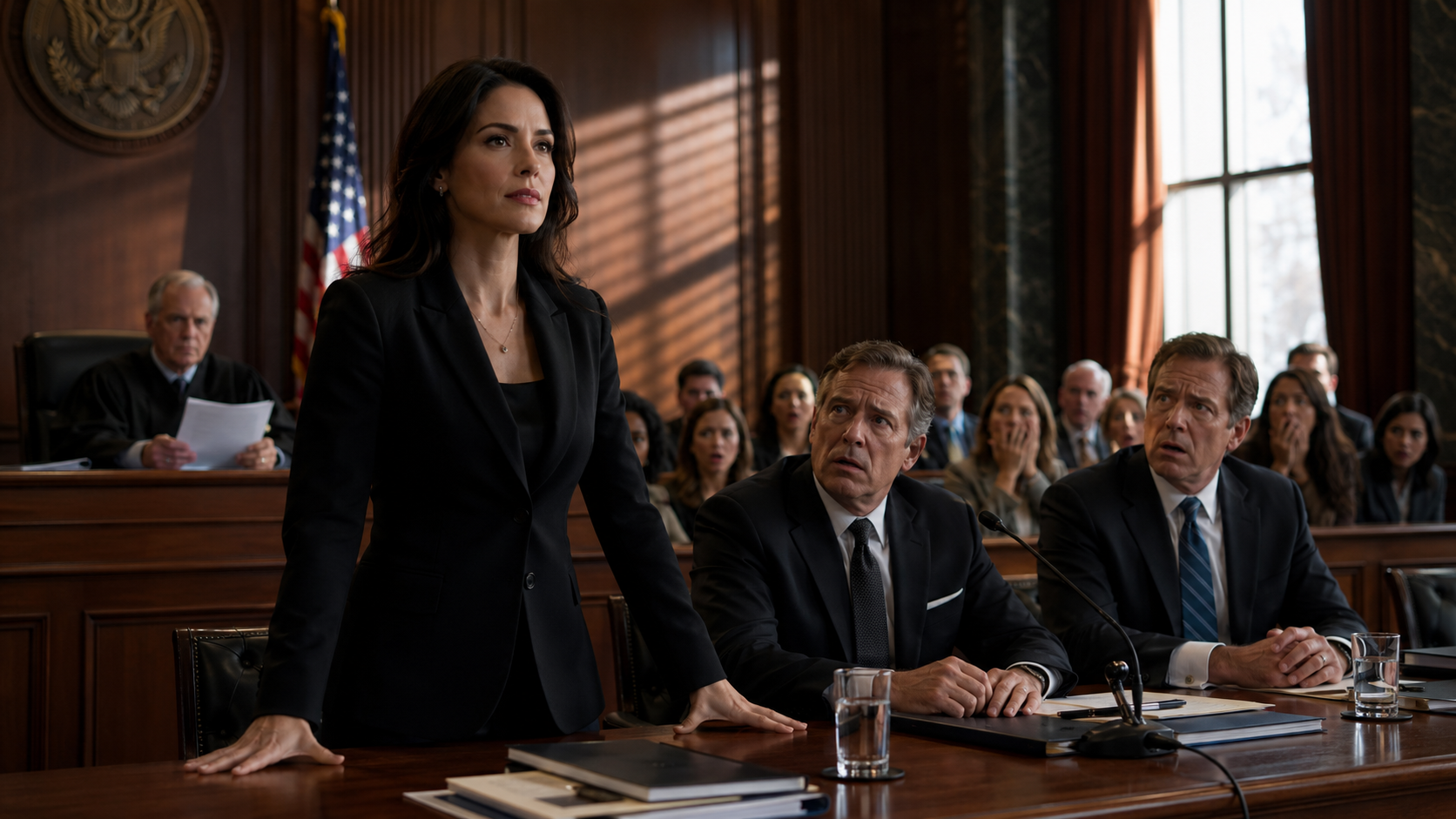

“Without Me, She’d Be Homeless,” My Father Smirked In Court. The Judge Looked At Me. “So… They Really Don’t Know?” My Father’s Lawyer Frowned. “Know What?” “Actually… She’s…” My Father Went Pale.
### Part 1
“Without me, she’d be homeless.”
My father said it loud enough for the back row to hear.
His voice rolled through Courtroom Three like a church bell with rust inside it, heavy and ugly, bouncing off the old wooden walls and the ceiling fans that never seemed to move enough air. A few people chuckled. Not many. Just enough to make the humiliation feel public.
I kept my hands folded in my lap.
My thumbs rested against each other. My nails were trimmed short. No polish. No rings except the thin gold band I still wore for Harold, even though he had been gone nearly eight years. I stared at the worn railing in front of me where generations of nervous fingers had scratched little half-moons into the varnish.
My father’s attorney, Richard Coleman, smiled like he had just delivered the final blow.
My brother Daniel sat two seats behind him, wearing a navy suit that looked expensive from far away and desperate up close. His wife Crystal had come too, of course. She loved any event where someone else might be embarrassed. She sat with her purse clutched in her lap, eyes bright, mouth pressed into a tiny line of satisfaction.
I did not look at any of them.
Judge Whitmore did.
He was an older man with silver hair, deep lines around his mouth, and the tired patience of someone who had spent thirty years listening to people lie under oath. He looked at my father for a long moment. Then he looked at me.
Not at my lawyer.
Not at the papers.
At me.
“So,” he said quietly, “they really don’t know?”
The courtroom changed.
I felt it before I heard it. The small coughs stopped. Someone’s bracelet quit jingling. Even the court reporter paused with her fingers hovering above the keys.
My father’s lawyer blinked.
“Your Honor,” Coleman said carefully, “know what?”
Judge Whitmore leaned back in his chair. His eyes stayed on me, and for one terrible second I thought he was going to say it all right there, before I had prepared myself for the sound of it.
“Actually,” he began, “she is…”
Then he stopped.
And that was when my father’s face lost every bit of color.
But that was not where the story started.
No. My life had been quietly cracking for years before my father dragged me into court and mocked me in front of half of Savannah. The truth is, my family had been living inside a story they wrote about me a long time ago, and they were too proud, too comfortable, and too selfish to notice when the story stopped being true.
My name is Margaret Hayes.
Most people call me Maggie.
I was sixty-one years old when my father tried to evict me from the house everyone in town believed belonged to him.
Hayes Manor sat just outside Savannah, tucked near Isle of Hope behind iron gates, ancient oaks, and Spanish moss that hung like gray lace from the branches. It was the kind of house tourists slowed down to admire. Wide porch. Tall windows. Brick paths cracked by roots. White columns that looked grand from the road and needed painting if you stood close enough.
My father loved that house because people thought it meant something.
Old family. Old money. Old respect.
He let them think it had belonged to the Hayes family for generations.
That was the first lie.
Not the biggest one. Just the first.
I had lived there quietly for seven years before the lawsuit. I cooked. I kept the garden alive. I paid bills nobody noticed arriving. Three days a week, I volunteered at the VA clinic downtown, where the air always smelled like burnt coffee, floor cleaner, and old paper files.
At the clinic, they knew me as Maggie.
No one asked too many questions. Veterans are good at recognizing silence. Real silence, not shyness. The kind that has weight behind it.
My father recognized nothing.
Walter Hayes was eighty-two and still walked like he expected doors to open before he touched them. He had run a construction company when Savannah was expanding, when handshakes mattered and men could build reputations out of concrete, tobacco breath, and intimidation. People said he was strong. I knew better.
Strong people do not need to make everyone else feel small.
My brother Daniel was fifty-eight and still treated like the family prince. Failed business deals. Debts. Lies dressed as opportunities. My father called him “ambitious.”
He called me “Margaret” like the name tasted sour.
The Sunday dinner that started everything smelled like pot roast, onions, and thunder coming in from the marsh.
Daniel arrived late, talking into his phone about investors I doubted existed. Crystal brought a peach pie from the grocery store and transferred it onto one of my mother’s plates as if that made it homemade. My father sat at the head of the table beneath the old chandelier, carving meat with the seriousness of a man performing surgery.
Halfway through dinner, he wiped his mouth and said, “I’ve decided to sell the property.”
Daniel stopped chewing.
Crystal’s fork froze above her plate.
I set down my glass.
My father looked directly at me. “You’ll need to make arrangements, Margaret.”
The room was quiet except for rain ticking against the windows.
I said, “You can’t sell it.”
He laughed once.
It was not amusement. It was warning.
“Excuse me?”
“You can’t sell the estate.”
His eyes narrowed, and I saw the familiar shift in him, the one I had known since childhood. That little spark of pleasure he got when he believed someone needed to be put in their place.
“I think I know what I own,” he said.
I looked at the roast cooling on everyone’s plates, at my mother’s blue china, at the candle wax sliding down the brass holders.
“No,” I said softly. “You don’t.”
Daniel muttered, “Maggie, don’t start.”
But my father was already smiling.
Not kindly.
“Seven years,” he said. “Seven years I let you live under my roof after your life fell apart. And now you’re telling me what I can do with my own house?”
I should have answered.
I should have told him everything right then.
Instead, I stood and began clearing plates.
“You should speak with a lawyer before you try anything,” I said.
Behind me, my father’s chair scraped against the floor.
And for the first time that night, I heard something in his voice besides anger.
I heard fear.
### Part 2
The eviction papers came eleven days later.
The deputy who served them looked like he wanted to apologize before he even climbed the porch steps. He held the envelope with both hands, rain dripping from the brim of his hat onto the brick path.
“Mrs. Hayes?” he asked.
“Yes.”
He glanced past me into the hallway, where afternoon light stretched across the old pine floorboards.
“I’m sorry, ma’am.”
That word.
Ma’am.
Most women my age in Georgia hear it all the time, but the way he said it had a little spine in it. A little formality. His eyes flicked once to the small framed photograph on the hall table, not of me in uniform, thank God, but of Harold and me standing beside a Navy pier years ago. Harold had his arm around my waist. I wore sunglasses and a windbreaker. Nothing obvious.
Still, the deputy noticed something.
I took the envelope.
“Thank you.”
He hesitated. “You have a good day, ma’am.”
Then he walked back through the rain, shoulders stiff.
I stood in the doorway until his cruiser disappeared beyond the gate.
The paper was thick. Expensive. Richard Coleman’s office believed in intimidation you could feel between your fingers. I opened it in the kitchen while the kettle hissed on the stove. The words were clean and cruel.
Walter Hayes, lawful owner.
Margaret Hayes, unlawful occupant.
Immediate removal requested.
I read it once, then folded it neatly and set it beside the sugar bowl.
For a long time, I listened to the old house breathe.
Houses do that. Old ones especially. Pipes tick. Wood settles. Wind rubs against windows. If you live quietly enough, a house will tell you what kind of grief it has stored.
This house had stored plenty.
My phone rang at 4:17.
Daniel.
I let it ring four times before answering.
“Maggie,” he said with a sigh, already tired of a conversation he had started. “Listen. Dad’s upset. You know how he gets.”
“I know exactly how he gets.”
“You don’t have to make this a war.”
I looked at the eviction papers. “I didn’t file anything.”
“You challenged him in his own house.”
There it was.
His own house.
I closed my eyes.
“You should tell him to stop,” I said.
Daniel let out a short laugh. “You’re not serious.”
“I am.”
“Maggie, come on. Just apologize. Say you were emotional. Maybe he’ll let you stay until Christmas.”
The kettle screamed.
I turned off the burner.
“Until Christmas,” I repeated.
“Don’t say it like that. I’m trying to help you.”
Daniel had always confused helping with managing. If he could get everyone back into their assigned roles, he felt useful. Dad commanded. Daniel inherited. Crystal smiled. I endured.
That was the family arrangement.
“I don’t need you to help me,” I said.
He went quiet.
Then his voice hardened.
“You always do this. You act calm so everyone else looks crazy.”
“No, Daniel. I act calm because someone in this family has to.”
He hung up.
That evening, I called Patricia Hail.
Patricia was seventy-three, widowed twice, and had the kind of voice that could cut paper. Her office sat above a bookstore on Broughton Street and smelled permanently of leather, dust, and peppermint tea. I had known her for fifteen years. She knew more about me than anyone living except two people in Washington who probably wished they knew less.
When I told her about the eviction, she did not gasp.
She simply said, “I wondered how long it would take.”
I smiled despite myself. “That makes one of us.”
“You want to end this quietly?”
“Yes.”
“Does he?”
I looked through the kitchen window toward the dark lawn. Rainwater slid down the glass in crooked lines.
“No.”
“Then quietly may not be available.”
The next morning, I drove downtown to meet her.
Savannah after rain smells like wet brick, river mud, magnolia leaves, and old secrets. I parked my blue pickup behind the courthouse because I hated valet stands and men who rushed to open doors only when cameras were nearby.
Patricia was waiting outside with one leather briefcase.
“You look tired,” she said.
“I am tired.”
“Good. Tired people are less dramatic.”
As we entered the courthouse lobby, an elderly bailiff glanced up from the security desk.
His eyes landed on me.
Then his posture changed.
Not much. Just enough.
His back straightened. His chin lifted. His right hand twitched like it wanted to salute but knew better.
“Good morning, ma’am,” he said.
Patricia’s eyes slid toward me.
Across the lobby, my father stood with Daniel and Coleman near the elevators.
They all saw it.
The bailiff had not said Miss Hayes.
Not Margaret.
Ma’am.
My father’s mouth tightened.
Daniel frowned like he was trying to remember where he had seen that kind of respect before.
I placed my purse on the security belt and said nothing.
The metal detector beeped for the woman behind me, and the normal courthouse noise resumed. Shoes on tile. Phones buzzing. Lawyers murmuring. Someone laughing too loudly near the clerk’s window.
But the first crack had appeared.
And once a crack appears in a lie, people cannot stop staring at it.
### Part 3
The first hearing took place on a Tuesday morning in September.
The sky was low and gray, pressing down on Savannah like a damp wool blanket. Reporters had gathered outside the courthouse by eight, even though this was supposed to be a plain property dispute. Small towns and old cities have one thing in common: they love watching respectable families bleed in public.
My father stood on the courthouse steps as if he owned those too.
He wore a charcoal suit, polished shoes, and the red tie my mother had bought him for their fortieth anniversary. Daniel hovered beside him with folders tucked under one arm. Crystal stood behind them under a black umbrella, looking mournful in a way that made sure people noticed.
I arrived alone.
Old blue pickup. Gray suit. Hair pinned back. No pearls. No performance.
My father spotted me crossing the street.
“Morning, Margaret,” he called. “Hope you brought a suitcase.”
A few people laughed.
One reporter lifted his phone.
I kept walking.
Humiliation only works if you accept delivery.
Inside, Patricia met me near the stairs.
“Any chance he wakes up decent before nine?” she asked.
“No.”
“Shame. I wore comfortable shoes for nothing.”
Courtroom Three was already half full. The air smelled like coffee, damp coats, floor wax, and old paper. Ceiling fans turned slowly above us, pushing heat from one side of the room to the other without improving anything.
I noticed the veterans immediately.
Frank Morrison sat near the aisle, his Marine Corps cap resting on his knee. Mr. Delaney from the VA clinic had come too, leaning on his cane. Benson, who rarely left his house because his lungs betrayed him on humid days, sat in the back row with an oxygen tube beneath his nose.
None of them waved.
They knew better.
But their presence warmed something in me I had not realized was cold.
Coleman approached our table before the judge entered.
“Mrs. Hayes,” he said smoothly, “my client remains willing to avoid unnecessary embarrassment if you vacate voluntarily.”
Patricia did not look up from her notes.
“My client remains unwilling to surrender property your client does not own.”
Coleman smiled wider.
Men like him smile when they smell a fee increasing.
Judge Whitmore entered at nine sharp.
Everyone rose.
The moment he saw the case file, his eyes paused on my name. It lasted less than a second, but I caught it. So did Patricia. So, I suspected, did the bailiff standing near the bench.
The hearing began with Coleman painting the picture my family preferred.
My father was generous.
I was fragile.
My divorce had broken me.
My father had allowed me to live at Hayes Manor out of pity.
I contributed nothing.
I sat still while he said it.
There is a special kind of pain in listening to strangers discuss your life as if you are a cracked chair being valued for resale. But I had sat through worse rooms than that. Rooms without windows. Rooms where men smiled before giving orders that would ruin lives. Rooms where silence mattered more than pride.
Richard Coleman was just noise in a tie.
Still, when my father nodded along to every word, something inside me folded smaller.
During recess, I stepped into the hallway.
Rain streaked the tall courthouse windows. Down below, Reynolds Square looked washed clean and tired. I stood there breathing slowly, counting sounds. Elevator bell. Shoes. Paper tearing. A woman crying softly somewhere near family court.
A younger deputy approached.
“Excuse me, ma’am.”
I turned.
He looked nervous. Former military, I guessed. It was in the shoulders.
“Judge Whitmore asked me to make sure you were comfortable.”
Across the hall, Daniel watched us.
“I’m fine,” I said.
“Yes, ma’am.”
There it was again.
Daniel’s brow furrowed.
He leaned toward Crystal, whispering.
Good, I thought. Start wondering.
At lunch, Patricia and I walked to a small diner two blocks away. No reporters followed us. They preferred my father’s booming voice and Coleman’s polished statements. Quiet women eating tomato soup did not make good footage.
Patricia stirred her soup without eating.
“You know we can still settle this before everything comes out,” she said.
I looked through the window at traffic shining on wet pavement.
“I tried settling my whole life.”
“With him?”
“With all of them.”
She nodded.
That afternoon, Daniel testified.
He looked uncomfortable on the stand, which meant he knew he was lying but intended to do it anyway.
“My sister has always depended on Dad,” he said. “Emotionally and financially.”
I almost laughed.
Fifteen years earlier, Daniel had called me from a casino parking lot near Biloxi at three in the morning, sobbing so hard I barely recognized his voice. I wired him forty thousand dollars before sunrise. No lecture. No shame. No receipt his wife would find.
Family protects family.
At least I thought so then.
When Daniel stepped down, he avoided looking at me.
Judge Whitmore reviewed the documents near the end of the hearing. Page after page. Tax receipts. Utility statements. Affidavits. Coleman looked bored, as if victory was only waiting for the judge to catch up.
Then Judge Whitmore stopped turning pages.
He adjusted his glasses.
Read one page again.
The room went quiet.
“Mr. Coleman,” he said, “there appear to be ownership records missing.”
Coleman frowned. “Your Honor, we submitted the complete chain of title.”
“No,” the judge said softly. “You submitted a convenient one.”
My father stiffened.
Patricia’s pen stopped moving.
Judge Whitmore closed the file.
“I’m scheduling a second hearing in two weeks.”
Coleman stood. “Your Honor, this is a straightforward eviction matter.”
The judge looked at me once.
Then back at him.
“No,” he said. “I don’t believe it is.”
My father left the courtroom smiling for the cameras.
But his hands shook when he buttoned his jacket.
And for the first time in years, I wondered whether the truth was not only coming.
It was hungry.
### Part 4
The town turned the case into entertainment.
At Parker’s Market, two women stopped whispering when I reached for coffee creamer. At church, Mrs. Bell from the choir looked at me with such heavy pity that I nearly asked if she needed help carrying it. Even the mailman lingered at the gate longer than usual, pretending to sort envelopes while trying to glimpse inside my life.
Poor Margaret.
That was the phrase floating around Savannah.
Poor Margaret living off her father.
Poor Margaret losing her mind over the house.
Poor Margaret too proud to move into an apartment.
I heard all of it.
And I let them talk.
People reveal their character fastest when they think you have no power.
The morning of the second hearing, rain hammered the roof before dawn. I woke at 5:10, made black coffee, and stood barefoot on the back porch. The brick paths glistened. Water dripped from Spanish moss in silver threads. Somewhere near the marsh, a bird cried once and went silent.
I had slept badly.
Not because I feared losing the estate.
Because I knew what winning would cost.
Patricia arrived at 7:30 in a cream-colored sedan with one headlight slightly dimmer than the other.
“You ready?” she asked when I climbed in.
“No.”
“Good. Overconfidence makes people stupid.”
The courthouse looked like a movie premiere for something cruel. Two local news vans. Umbrellas. Reporters. Curious neighbors. Men who had once done business with my father stood near the steps pretending they had come for other matters.
Walter Hayes arrived in a black SUV.
Daniel helped him out, and my father shrugged off his hand as if age itself offended him. Crystal emerged last, wearing sunglasses in the rain.
My father saw me.
He smiled.
Not warmly. Publicly.
That smile vanished before lunch.
Courtroom Three was full. People lined the back wall until the bailiff ordered some into the hallway. I sat beside Patricia and smelled furniture polish, damp wool, and someone’s cinnamon gum.
Coleman began immediately.
“Your Honor, this matter has become unnecessarily theatrical,” he said, somehow ignoring that he had invited reporters himself. “The facts remain simple. Mr. Walter Hayes owns Hayes Manor. His adult daughter refuses to leave.”
Judge Whitmore looked unimpressed.
Patricia stood.
“Your Honor, the facts are simple. Counsel is simply presenting the wrong ones.”
Coleman rolled his eyes.
Bad move.
Patricia slid a folder forward.
“The estate known publicly as Hayes Manor was purchased in 1998 through a private trust registered in Virginia.”
A murmur moved through the room.
My father leaned forward.
Coleman laughed. “That is absurd.”
Patricia continued. “The trust was created for security and privacy purposes. Its sole controlling beneficiary is Margaret Eleanor Hayes.”
The room went still.
Daniel whispered, “What?”
Crystal’s sunglasses came off.
My father stared at Patricia, then at me.
“That’s impossible,” he said.
His voice sounded smaller than usual.
Coleman recovered first. “Your Honor, anyone can create a trust document. That does not establish legitimate ownership.”
“No,” Patricia said. “The deed does.”
She handed another set of papers to the bailiff.
He carried them to the bench.
As he passed our table, his eyes dropped to the seal on one of the attached letters. His posture shifted again. Not dramatically. Not enough for most people.
Enough for me.
Enough for the veterans in the gallery.
Frank Morrison lowered his gaze.
Judge Whitmore read in silence.
One page.
Then another.
The clock above the door clicked so loudly it seemed rude.
Finally, the judge looked over his glasses at my father.
“Mr. Hayes,” he said, “were you aware of this trust?”
My father’s mouth opened.
Closed.
“No,” he said.
That single word carried more than confusion. It carried insult. As if reality had failed to ask his permission.
Patricia turned a page.
“Walter Hayes has never held legal title to the estate.”
Coleman stood so quickly his chair bumped the table.
“That cannot be correct.”
“It is correct,” Patricia said.
My father’s face flushed. “Margaret doesn’t have that kind of money.”
Nobody spoke.
That was when the room truly shifted. Because the question hanging there was not about deeds anymore.
It was about me.
Where had the money come from?
What had I done?
Who had I been while my family called me helpless?
Judge Whitmore’s eyes came back to mine, steady and careful.
“Mrs. Hayes,” he said, “are you comfortable proceeding?”
My throat felt dry.
I could still stop it. Let the estate ownership stand. Keep the rest buried. Allow them to wonder.
But Coleman smiled again, desperate now.
“Your Honor, unless Mrs. Hayes can explain the origin of this alleged fortune, we may be looking at fraud.”
Fraud.
After everything I had done for them.
After every silent rescue.
After every insult swallowed to preserve my father’s pride.
Something inside me went very calm.
I turned to Patricia and nodded once.
Her expression did not change, but her hand paused on the file for half a second. She knew what that nod meant.
She opened the next folder.
And my father, seeing the seal on the first page, finally understood that whatever was coming next was not something he could bully into silence.
### Part 5
Patricia did not raise her voice.
She never needed to.
“For thirty-one years,” she said, “my client served the United States Navy in intelligence and strategic operations.”
The courtroom froze.
Not dramatically at first. More like a room trying to decide whether it had heard correctly.
Daniel stared at me.
Crystal’s lips parted.
Coleman looked annoyed, which told me he still did not understand the danger.
“My client retired with the rank of Rear Admiral.”
Now the silence landed hard.
Heavy.
Physical.
I kept my eyes on the table.
There are titles you spend half your life earning and the other half trying to escape. Rear Admiral Margaret Hayes had belonged to briefing rooms, secure phones, midnight flights, and decisions that followed me into sleep. Maggie belonged to porches, coffee mugs, VA paperwork, and the sound of cicadas in August.
I had chosen Maggie.
My family had mistaken that choice for failure.
“That’s ridiculous,” my father said.
Not loudly.
That made it worse.
It came out like a prayer.
Patricia handed documentation to the court. Service records. Award confirmations. Retirement papers. Financial statements tied to pay, investments, and consulting work after retirement. Not everything. Never everything. Enough.
Judge Whitmore spoke carefully.
“Some portions of Mrs. Hayes’s career remain restricted. This court will not discuss operational details.”
Operational details.
The phrase moved through the gallery like a match touched to dry grass.
Coleman looked down at the papers, then back at me. His face had lost the slick confidence he wore when he thought he was humiliating a dependent old woman.
“Your Honor,” he said, “military service does not automatically prove property ownership.”
“No,” Judge Whitmore said. “But the deed does. The trust does. The payment records do.”
Patricia turned another page.
“In 1998, after Walter Hayes’s construction company began facing serious debt exposure, Margaret Hayes purchased the estate through a protected trust.”
My father shook his head.
“No.”
“The purpose,” Patricia continued, “was to keep the property from being absorbed into business liabilities, liens, or creditor action.”
“No,” he said again.
Daniel’s eyes moved from Patricia to me. Something like memory flickered across his face.
Patricia was not finished.
“Mortgage satisfaction. Paid by Margaret Hayes. Property tax delinquencies in 2009. Paid by Margaret Hayes. Major roof restoration after storm damage. Paid by Margaret Hayes. Utility accounts maintained under estate management funding tied to the trust.”
Every sentence struck the room like a hammer wrapped in cloth.
Quiet.
Controlled.
Devastating.
My father gripped the edge of the table.
“You let me think…”
His voice broke off.
I finally looked at him.
He looked furious, yes.
But beneath it was something more fragile.
He looked betrayed.
That almost made me laugh.
Almost.
He had dragged me into court. Called me helpless. Told strangers I would be homeless without him. Let my brother lie under oath. Let a lawyer paint me as a burden.
And now he looked betrayed because the truth embarrassed him.
Judge Whitmore looked at my father.
“Mr. Hayes, based on what I have reviewed, you had no legal standing to file this eviction.”
Coleman sat down slowly.
The chair creaked beneath him.
My father did not sit.
He kept staring at me as if I had changed shape in front of him.
“You bought this house?” he asked.
“Yes.”
“When?”
“Twenty-eight years ago.”
His mouth trembled once.
“Why?”
That question was worse than all the insults.
Because he genuinely did not know.
I thought of my mother sitting at the kitchen table in 1998, hands wrapped around a mug she had not drunk from, whispering that Walter could not survive losing the house. I thought of Daniel still young enough then to believe charm counted as a business plan. I thought of my father’s voice on the phone, proud and brittle, telling me everything was fine while creditors circled like dogs.
“Because Mom asked me to save it,” I said.
That was not the whole truth.
It was the gentlest part.
My father flinched.
Patricia’s voice softened, but only slightly.
“Additional records show Mrs. Hayes also covered medical expenses, personal debts, and family obligations over the years.”
Daniel went pale.
I saw him remembering Biloxi.
The phone call.
The money.
The lie about an anonymous investor.
Crystal turned to him slowly.
“What debts?” she whispered.
He did not answer.
The gallery was no longer enjoying a scandal. I could feel discomfort spreading through the benches. People had arrived expecting to watch a stubborn daughter get put out of a mansion.
Instead, they were watching a family discover the woman they mocked had been holding the roof over their heads for decades.
Judge Whitmore removed his glasses.
“Mr. Coleman,” he said, “I suggest you confer with your client before proceeding further.”
Coleman leaned toward my father, whispering urgently.
My father did not move.
His eyes stayed on me.
Then he said the one thing that told me everything I needed to know.
“You made me look like a fool.”
Not I’m sorry.
Not thank you.
Not I was wrong.
You made me look like a fool.
And in that moment, any small hope I had carried into that courtroom finally died.
### Part 6
The judge dismissed my father’s eviction petition before noon.
No dramatic gavel strike. No speech. Just a calm explanation that Walter Hayes had no ownership interest, no landlord authority, and no legal right to remove me from property held by my trust.
The words were plain.
Their effect was not.
My father sat very still while Judge Whitmore spoke. Daniel looked like a man watching his bank account catch fire. Crystal had gone quiet in a way I had never seen from her before. Coleman packed his papers too neatly, which is how polished men show panic.
When court adjourned, everyone rose.
No one rushed to shake my father’s hand.
That was the first punishment Savannah gave him.
Silence.
Usually Walter Hayes moved through public spaces like a parade. Men clapped his shoulder. Women asked after his health. Younger attorneys nodded respectfully. But outside Courtroom Three, people stepped aside without speaking.
Not out of reverence.
Out of embarrassment.
Reporters surged toward me.
“Admiral Hayes!”
I flinched at the title.
“Is it true you secretly purchased the estate?”
“Why did you hide your military career?”
“Did your father know?”
“Did your brother receive money from you too?”
Patricia moved beside me like a small, elderly bulldozer.
“No comment,” she said.
One young reporter tried again. “Mrs. Hayes, do you forgive your father?”
I stopped walking.
The hallway went quiet enough for the question to hang there.
My father stood fifteen feet away.
He heard it.
So did Daniel.
I looked at the reporter. She could not have been more than twenty-six. Her hair was damp from rain, and her hand trembled slightly around her phone.
“Forgiveness,” I said, “is not a public performance.”
Then I walked out.
The courthouse steps were slick. Flashbulbs popped. Someone called my name. Someone else called me “ma’am” with real respect this time, not gossip dressed up as manners.
My father followed several steps behind.
At the bottom of the stairs, he said, “Margaret.”
I turned.
Rain misted between us.
For once, he had no audience on his side. The cameras were watching, yes, but they were no longer his. That made him careful.
“How long were you planning to let this go on?” he asked.
I studied him.
His face looked older in daylight.
“I wasn’t planning anything. You sued me.”
“You could have told me.”
“I did. At dinner.”
His jaw tightened. “You said I couldn’t sell it. You didn’t say you owned it.”
“You didn’t ask why.”
He let out a bitter laugh. “You sat in my house for years letting me think—”
“My house,” I said.
The words came out quietly.
They still struck him.
His eyes hardened, and for a second I saw the father I had known my whole life. The one who could turn any truth into an attack against himself.
“You enjoyed that in there,” he said.
Something in my chest went cold.
“No.”
“You wanted to humiliate me.”
“No, Daddy. I wanted you to stop.”
He looked away at the street, where rainwater rushed along the curb carrying leaves, cigarette butts, and a white paper cup.
I had not called him Daddy in years.
The word did not soften him.
It only made him angrier because it reminded him I was still his daughter, and he had still done this to me.
Daniel approached next.
“Maggie,” he said, voice low. “We need to talk.”
Crystal stood behind him, arms crossed tightly.
“About what?”
He swallowed. “Those records. The payments. Some of that involves private family matters.”
I almost smiled.
“Funny how privacy becomes important after exposure.”
His cheeks flushed.
Crystal cut in. “Did you give Daniel money without telling me?”
I looked at my brother.
“That’s between you and your husband.”
Her eyes narrowed. “So yes.”
Daniel whispered, “Not here.”
Not here.
That had always been the family motto.
Not at dinner.
Not in front of people.
Not while your mother is sick.
Not while your father is tired.
Not while Daniel is struggling.
Not here, Maggie.
Later.
Quietly.
Never.
I walked to my truck.
Patricia climbed into the passenger seat without asking. She waited until we were three blocks away before speaking.
“You held up well.”
“I don’t feel like I did.”
“That’s usually how holding up feels.”
I drove through downtown Savannah while the city blurred beyond the windshield. Tourists crossed streets under bright umbrellas. Horses pulled carriages past old squares. Somewhere, church bells rang noon as if the world had not split open.
When I got home, I found three voicemails already waiting.
One from a reporter.
One from a retired captain I had not spoken to in years.
One from my father.
I stood in the kitchen, rain dripping from my coat onto the floor, and pressed play.
For seven seconds, there was only breathing.
Then my father’s voice came through, low and rough.
“You should have told me who you were.”
The message ended.
I stared at the phone until the screen went dark.
He still did not understand.
He thought the secret was my rank, my money, my ownership.
But the real secret was simpler and much sadder.
For forty years, I had been showing him who I was.
He just never thought I was worth seeing.
### Part 7
By sunset, Savannah knew everything it legally could.
The first article appeared online at 3:42.
Retired Navy Admiral Revealed in Family Estate Battle.
By 5:00, old photographs surfaced. Me in dress whites at a ceremony in Norfolk. Me beside officials whose names still pulled weight in certain rooms. Me standing stiffly near an aircraft carrier with wind flattening my hair against my forehead.
By 6:30, my phone would not stop buzzing.
I turned it off.
The house became too quiet after that.
I made soup because cooking gives your hands something ordinary to do when your life feels unreal. Onion, celery, chicken stock, black pepper. The kitchen windows fogged. Rain tapped the glass. The old clock above the pantry clicked like it was counting down to something.
At 7:12, headlights swept across the front windows.
Daniel.
He did not knock right away.
I watched him through the lace curtain as he stood on the porch, shoulders hunched against the rain. His Mercedes was parked crooked in the drive. Crystal was not with him.
When he finally knocked, it sounded smaller than usual.
I opened the door.
He looked past me into the hallway, as if seeing the house differently now.
“You going to invite me in?” he asked.
“No.”
His mouth tightened. “Seriously?”
“Yes.”
For a moment, anger flashed in his face. Then it faded into something more useful.
Fear.
He looked wet, tired, and ten years older than he had that morning.
“Maggie, please.”
I stepped onto the porch and closed the door behind me.
The air smelled like wet oak and river mud. Cicadas screamed from the trees even through the rain.
Daniel wiped his face with both hands.
“Crystal knows about Biloxi.”
“I assumed she would.”
“She’s furious.”
“She should be.”
He stared at me. “You’re not even going to pretend to feel bad?”
“I felt bad at three in the morning fifteen years ago when you called me crying. I felt bad when I wired money I knew you’d never repay. I felt bad when you lied to your wife and let Dad believe you had found some genius investor.”
He flinched.
“I was desperate.”
“I know.”
“Then why are you acting like this?”
“Because desperate people can still tell the truth.”
Rain fell harder, drumming on the porch roof.
Daniel paced once, then stopped.
“You don’t understand what Dad is like with me.”
I laughed then.
Not loudly.
Just enough.
Daniel looked wounded.
“I don’t understand?”
He rubbed his mouth. “That’s not what I meant.”
“Yes, it is. You think you were the only one living under him.”
His eyes dropped.
For the first time in my life, my brother had no golden light around him. He was just a man with bad habits, unpaid bills, and a lifetime of being rescued quietly enough that he mistook rescue for luck.
“I need help,” he said.
There it was.
Not an apology.
Not accountability.
A need.
I leaned against the porch railing.
“With Crystal?”
“With everything.”
He pulled a folded packet from inside his jacket. The paper had softened at the edges from rain.
Loans.
Late notices.
A second mortgage.
Business debt.
More than I expected, less than I feared.
“You came here from court to ask me for money,” I said.
His face reddened. “No. I came here to explain.”
“Explain then.”
He opened his mouth.
Nothing came out.
Thunder rolled beyond the marsh.
Finally, he whispered, “I thought I could fix it before anyone knew.”
“That sentence has ruined more families than honesty ever did.”
He sank into one of the porch chairs.
“I’m going to lose the house.”
“Yes.”
“My marriage.”
“Maybe.”
“My reputation.”
I looked at him carefully.
“Daniel, you watched Dad call me homeless in open court.”
His eyes filled suddenly.
“I know.”
“You testified that I depended on him.”
“I know.”
“You lied.”
He nodded once.
“So when you say reputation, forgive me if I don’t bleed over yours.”
He covered his face.
For a while, I let him cry.
Not because he deserved comfort.
Because I was not cruel.
There is a difference between refusing to save someone and enjoying their drowning.
When he finally looked up, his voice was hoarse.
“What am I supposed to do?”
“Tell Crystal the truth. Sell what you can. Get a real job. Go to meetings. Stop gambling with money, image, and people’s patience.”
He stared at the porch floor.
“And Dad?”
“What about him?”
“He’s not okay.”
“I know.”
“He’s humiliated.”
“He should be.”
Daniel looked at me then, really looked, and I saw the old expectation flicker.
Maggie will soften.
Maggie will fix it.
Maggie always does.
I opened the door behind me.
“I’m done being the emergency exit for this family.”
He stood slowly.
“Maggie…”
“No.”
It was a small word.
It felt enormous.
Daniel stepped back into the rain with his ruined papers held against his chest.
When his taillights disappeared beyond the gate, I went inside and locked the door.
Then I turned on my phone.
There was a new message from my father.
This one was only four words.
We need to talk.
I stared at it, and for the first time, I did not feel like a daughter waiting to be chosen.
I felt like a woman deciding whether the door should stay closed.
### Part 8
I did not answer my father that night.
Or the next morning.
By Thursday, there were eleven missed calls from him, five from Daniel, two from Crystal, and one from a Savannah morning show producer who used the phrase inspirational family healing before I deleted the message halfway through.
People love turning women’s pain into content.
I went to the VA clinic instead.
The building sat between a pharmacy and a tire shop, beige and practical, with automatic doors that sighed every time someone entered. Inside, the air smelled like disinfectant, old coffee, and copier toner. Usually that smell calmed me. That day, every head turned when I walked in.
Mr. Delaney stood.
Then Frank Morrison.
Then three others.
“Oh, sit down,” I said.
Frank grinned. “Yes, ma’am.”
“Frank.”
“What? You outrank me.”
“I outrank half the room. Sit down anyway.”
That broke the tension.
People laughed. Not cruelly. Carefully.
I spent the morning helping a Korean War widow fill out benefits forms. Her hands shook as she signed her name. She wore lavender perfume and kept apologizing for asking questions. I told her questions were cheaper than mistakes.
Near lunch, Frank cornered me by the coffee machine.
He was in his wheelchair, Marine cap tilted back, eyes sharp as fishhooks.
“You should’ve told people,” he said.
“No, hello?”
“Hello. You should’ve told people.”
I poured coffee into a paper cup. “And what? Let everybody salute me while I’m buying tomatoes?”
“Better than letting your father treat you like a stray dog.”
The cup stopped halfway to my mouth.
Frank’s face softened, which on him looked almost painful.
“Men like Walter Hayes,” he said, “don’t know what to do with daughters who become stronger than them.”
I looked toward the waiting room.
An old man argued with the receptionist about a form. A volunteer laughed near the printer. Outside, sunlight had finally broken through the clouds, turning puddles in the parking lot bright as foil.
“I spent years thinking if I made myself easier to love, he might manage it,” I said.
Frank nodded slowly.
“And?”
I sipped the coffee. It tasted burnt.
“I became very easy to use.”
Frank did not offer a comforting lie.
That was why I liked him.
When I got home, my father’s Cadillac was parked in the drive.
He stood near my mother’s garden, hat in hand.
For a moment, through the windshield, he looked like an old photograph left too long in the sun. Faded. Brittle. Familiar in a way that hurt.
I parked beside him and got out.
The garden was mostly herbs now. Rosemary. Mint. Basil. My mother had once grown roses there, but Georgia heat and neglect had taken them after she died.
My father looked at the soil, not at me.
“Your mother loved this garden,” he said.
“Yes.”
“I didn’t know you kept it going.”
“You didn’t ask.”
His mouth tightened.
There was the first little spark of anger, searching for fuel.
Then it went out.
“I don’t know how to talk to you,” he said.
“That has been clear for some time.”
He looked up, wounded.
A younger version of me would have regretted saying it.
The woman standing in that garden did not.
“I came to apologize,” he said.
I waited.
He swallowed.
“I should not have said what I said in court.”
“No.”
“I should not have filed the eviction.”
“No.”
“I didn’t know…”
He stopped.
That familiar old escape route.
I didn’t know.
As if ignorance washed clean what arrogance dirtied.
“You didn’t know because knowing required listening,” I said.
His eyes flashed. “You hid everything.”
“I hid my career. I hid the trust. I did not hide my character.”
He looked away.
A breeze moved through the oaks, stirring Spanish moss above us. Somewhere, a lawn crew buzzed in the distance. The world kept being ordinary while my father tried to find a way through the wreckage of his pride.
“I was proud,” he said finally.
I almost laughed.
“Of me?”
He flinched.
“No. Of myself. Too proud. Too…” He rubbed a hand over his face. “I don’t know.”
“That may be the first honest thing you’ve said.”
His eyes filled.
“I’m sorry, Margaret.”
There it was.
The sentence I had wanted since I was twenty-three years old, standing at a bus station with my duffel bag, waiting for my father to say he was proud before I left for my first assignment.
I had imagined those words saving something.
Instead, they arrived decades late and found nothing alive to save.
“I hear you,” I said.
He blinked. “That’s all?”
“What did you expect?”
“I’m your father.”
“Yes.”
“I said I was sorry.”
“I know.”
His face changed.
He had expected tears. A hug. A softening. The old family magic where one small apology from a man erased years of damage done to the woman expected to absorb it.
I did not move.
My father’s voice dropped.
“You won’t forgive me?”
I looked at him across my mother’s dead rose bed.
“No.”
The word struck him harder than the judge’s ruling.
He stared at me like I had become someone unrecognizable.
But I had not changed.
I had only stopped disappearing.
### Part 9
After I told my father no, Savannah became divided.
Not publicly. Publicly, everyone smiled too much and said things like family is complicated. Privately, the town chose sides.
Some people thought I was cold.
At the grocery store, a woman from church touched my arm near the bread aisle and said, “Your father is old, Maggie. You only get one.”
I looked at her hand until she removed it.
“So did he,” I said.
She had no answer for that.
Others treated me like a hero, which was almost as uncomfortable. Men who used to ignore me at civic meetings now stood when I entered. Women who had whispered poor Margaret suddenly wanted lunch. A local charity asked me to speak about resilience at a luncheon sponsored by three people who had laughed behind my back two weeks earlier.
I declined everything.
The estate gates stayed closed.
Inside the house, the old quiet returned, but it was different now. Before, the silence had been full of things unsaid. Now it was full of decisions.
I spent mornings in the office, sorting documents Patricia sent over. The trust. The estate accounts. Old transfers. Receipts from decades of family emergencies. The paper trail was a biography no one had read.
Daniel’s bailout.
My mother’s treatments.
My father’s business taxes.
The roof repair.
Crystal’s boutique loan, which she had once bragged came from “private backing.”
Every page had a date.
Every date had a memory.
Every memory had the same pattern.
Crisis.
Call Maggie.
Hide Maggie.
Praise someone else.
One afternoon, Patricia came by with sandwiches wrapped in brown paper and a legal pad tucked under her arm.
“You look terrible,” she said as she entered.
“Good to see you too.”
“You need a plan.”
“I have coffee.”
“That is not a plan. That is a symptom.”
We sat in the kitchen, where sunlight fell across the table in warm rectangles. Dust floated in the air. The house smelled like toasted bread, lemon cleaner, and old wood.
Patricia opened her pad.
“Your father may appeal.”
“He has no case.”
“That has never stopped proud men from spending money.”
“Does he have money to spend?”
She gave me a look.
“Not much.”
I leaned back.
That was new.
She slid a report across the table.
Walter’s personal accounts were thinner than I expected. His reputation had lasted longer than his finances. Credit lines. Old debts. A few assets. Nothing like the image he maintained.
“He’s been living on the illusion of ownership,” Patricia said.
I read the numbers twice.
Not because I doubted them.
Because part of me still wanted to believe my father had stood on something real when he looked down on me.
He had not.
“He may try to pressure you privately,” Patricia continued. “So may Daniel. You need boundaries in writing.”
I looked at the report.
“Do it.”
Her eyebrows rose.
“No hesitation?”
“I’m done making emotional decisions for people who make selfish ones.”
She smiled faintly. “There she is.”
Two days later, Daniel returned.
This time he came without a suit.
Jeans. Wrinkled shirt. Dark circles under his eyes. He looked less like my father’s chosen son and more like a middle-aged man who had slept badly for years.
I met him at the gate.
Not the porch.
The gate.
That mattered, and he knew it.
“Crystal left,” he said.
“I’m sorry.”
“She’s staying with her sister.”
I nodded.
He gripped the iron bars between us.
“I’ve been going to meetings.”
“Good.”
“I listed the house.”
“Good.”
“I applied for a job.”
“That’s also good.”
He waited.
I said nothing else.
His face fell.
“You’re really not going to help me.”
“I am helping you.”
“How?”
“By not saving you from consequences.”
He stepped back as if I had slapped him.
“You sound like Dad.”
“No. Dad used consequences as punishment. I’m using them as truth.”
His eyes reddened.
“I lied in court,” he whispered.
“Yes.”
“I’m sorry.”
“I believe you.”
Hope crossed his face.
I let it die honestly.
“But I am not giving you money.”
He looked down.
The wind rattled dry leaves along the driveway.
For a moment, I remembered him at eight years old, chasing fireflies in this same yard, face bright with summer. I remembered how fiercely I had loved him before the family taught him that my love required no return.
“I don’t hate you, Daniel,” I said.
He looked up.
“But you cannot come back into my life through the same door you used to rob it.”
He cried quietly then.
I let him.
When he left, he looked smaller, but straighter somehow.
That night, I slept four full hours for the first time in weeks.
At 2:03 in the morning, the phone rang.
Memorial Hospital.
My father had collapsed in a motel room off Highway 80.
And as I listened to the nurse explain, I realized the hardest boundary of my life had just arrived wearing my father’s name.
### Part 10
The hospital smelled like antiseptic, old coffee, and fear hidden under forced cheer.
I had always hated hospitals at night. Daytime hospitals bustle. Nighttime hospitals whisper. Machines beep behind curtains. Nurses move softly in rubber-soled shoes. Families sit under fluorescent lights looking stunned by how quickly life can become paperwork.
Daniel was in the emergency waiting area when I arrived.
He stood up too fast.
“Maggie.”
“What happened?”
“Minor stroke, they think. He’s stable.” His voice broke. “I found him on the floor.”
“Where?”
He looked ashamed for our father.
“A motel near Highway 80.”
The words sat between us.
Walter Hayes, who had once hosted judges, bankers, pastors, and developers under chandeliers at Hayes Manor, had been living in a motel because pride would not let him remain near the daughter he had failed to evict.
I closed my eyes briefly.
Not out of forgiveness.
Out of exhaustion.
“Has the doctor been out?”
“Once. They’re running tests.”
We sat side by side in plastic chairs.
For twenty minutes, neither of us spoke.
A vending machine hummed across from us. Somewhere down the hall, a woman laughed too loudly and then started crying. Daniel kept twisting a paper coffee cup in his hands until the rim collapsed.
Finally he whispered, “He kept saying he didn’t want charity.”
“I know.”
“He said he’d rather die than move back into your house.”
“My house.”
Daniel nodded. “Your house.”
That was something.
The doctor came out at 3:15, a tired woman with kind eyes and a badge that said Dr. Reeves. She explained the stroke had been mild, but at Walter’s age, recovery would require supervision, medication management, therapy, and reduced stress.
“Does he live alone?” she asked.
Daniel looked at me.
I said, “Yes.”
His eyes flickered.
Yes was not the whole story, but it was the legal one. The emotional one had stopped being my responsibility.
Dr. Reeves nodded. “He should not return to an isolated living situation for now.”
When I entered his room, my father looked smaller than I had ever seen him.
Tubes. Thin blanket. Gray skin. One hand resting crookedly beside the rail.
He opened his eyes.
For a moment, he seemed confused.
Then he saw me.
Tears gathered instantly.
“Margaret,” he whispered.
I stood beside the bed.
“Doctor says you were lucky.”
He swallowed. “I don’t feel lucky.”
“No.”
His fingers moved against the sheet, searching for dignity and finding cotton.
“I was wrong,” he said.
“You were.”
“I was cruel.”
“Yes.”
His mouth trembled.
“I’m sorry.”
“I know.”
“I don’t know why I treated you that way.”
I pulled the chair closer but did not take his hand.
“I think you do.”
He stared at the ceiling.
A monitor beeped steadily beside us.
Finally, he said, “You made me feel small.”
There it was.
Not an excuse.
A confession.
I sat very still.
“I did not make you feel small,” I said. “You felt small beside who I became.”
A tear slid into his hairline.
“I was your father. I was supposed to be the one who…”
He could not finish.
“The one who what?” I asked.
“Knew things. Fixed things. Protected the family.”
“You didn’t protect the family. You protected your position in it.”
His eyes closed.
The words hurt him.
They were meant to.
Not as cruelty.
As accuracy.
He turned his face toward me again.
“Can I come home?”
That question entered the room quietly and changed its temperature.
Home.
For him, it meant the estate.
The porch.
The garden.
The dining table where he had humiliated me.
The house he had claimed while I paid to preserve it.
For me, it meant something else now.
A locked door.
A boundary.
A life finally mine.
“No,” I said.
His breath caught.
Daniel, standing near the doorway, looked down.
My father’s eyes filled with panic.
“I can pay rent,” he said, though we both knew he could not.
“This isn’t about rent.”
“I’m sick.”
“I know.”
“I’m old.”
“Yes.”
“I’m your father.”
The old sentence.
The final card.
I leaned closer.
“And I was your daughter when you tried to throw me out.”
He shut his eyes like I had struck him.
I kept my voice steady.
“I will make sure you have proper care. I will help Daniel choose a facility or arrange assisted living. I will not let you be neglected. But you are not moving back into my home.”
His lips trembled.
“You hate me.”
“No.”
“Then why?”
“Because love without safety is not family. It is captivity.”
The monitor kept beeping.
Daniel wiped his face with his sleeve.
My father turned toward the window. Outside, dawn had begun paling the glass.
For years, I had imagined what it would feel like to finally say no to him. I thought it would feel powerful.
It did not.
It felt like setting down a coffin I had carried since childhood.
### Part 11
My father moved into an assisted living residence on the south side of Savannah.
It was clean, sunny, and expensive enough to irritate him. The lobby smelled like fresh paint, lemon polish, and cinnamon from a tray of cookies near the front desk. His room overlooked a courtyard where two oak trees shaded a bench and a birdbath.
He hated it immediately.
“This place is full of old people,” he muttered when Daniel and I brought his suitcase in.
Daniel looked at him. “Dad, you’re eighty-two.”
My father glared.
I almost smiled.
Almost.
We unpacked in careful silence. Shirts in the closet. Socks in the drawer. Family photographs on the dresser because Daniel insisted. My mother’s picture went by the bed.
When I placed it there, my father watched me closely.
“You still wear your wedding ring,” he said.
I looked down at my hand.
“Yes.”
“Harold was a good man.”
“He was.”
“I never told you that.”
“No.”
He sat in the armchair by the window, thinner now, cane resting against his knee.
“I suppose there’s a lot I never told you.”
I closed the drawer.
“There is.”
He waited, but I did not help him carry the sentence further.
That was new for us.
Before, I would have softened the room. Offered him a bridge. Made his regret easier to cross.
Now I let him stand on his own side.
Daniel walked me to the parking lot afterward.
“He asked if you’ll visit,” he said.
“I know.”
“Will you?”
“Sometimes.”
Daniel looked pained. “That’s all?”
“That’s more than he earned.”
He nodded slowly.
“I’m trying to understand that.”
“Good.”
He kicked a pebble across the asphalt like a boy.
“I used to think you were hard,” he said.
“I became hard where soft got bruised.”
He looked at me then, and for once there was no argument in his face.
Winter came quietly.
Savannah does not know how to do real winter, not like northern places. It gives you gray mornings, damp cold, bare branches, and people wearing heavy coats when it is fifty-two degrees. The estate looked stripped down without summer leaves. Honest, somehow.
I spent January cleaning.
Not dusting.
Purging.
I opened closets that had not been touched in years. Boxes of my father’s business records. Crystal glasses my mother saved for guests who never deserved them. Daniel’s old sports trophies. My own childhood report cards tucked behind yellowing Christmas decorations.
In the attic, beneath a cedar trunk, I found a shoebox labeled Maggie in my mother’s handwriting.
Inside were letters I had written home from my early Navy years.
Most were unopened.
At first, I thought I had misunderstood.
But no.
Envelope after envelope, still sealed.
My name in the return corner.
Postmarks from places I could barely think about without tasting dust, jet fuel, or ocean air.
I sat on the attic floor with insulation itching my wrists and read the dates.
Thanksgiving.
My birthday.
The year Harold had surgery.
The month my mother first got sick.
I had written them.
My parents had not opened them.
At the bottom of the box was a note in my mother’s hand.
Walter says not to encourage her military nonsense. I saved these. Maybe one day she’ll know I wanted to read them.
The attic tilted.
I pressed one hand against the floorboards.
All those years, I had imagined my silence growing because distance changed people. Because service required secrecy. Because my life became too complicated to explain.
But some of my loneliness had been delivered.
Refused.
Stored in a shoebox.
I do not know how long I sat there.
When I finally came downstairs, the house was dark except for the kitchen light I had left on. My phone rang as I reached the bottom step.
My father.
I let it go to voicemail.
Then I called Patricia.
“I need to change the estate plan,” I said.
She heard something in my voice and did not joke.
“What did you find?”
“Proof that I was done with this family long before I knew I was allowed to be.”
The next morning, I drove to assisted living with the shoebox on the passenger seat.
Not to forgive.
Not to accuse.
To return what had never been received.
And when my father saw the box, his hand began to shake before I said a word.
### Part 12
My father recognized the shoebox immediately.
That told me enough.
He sat by the window in his assisted living room, sunlight falling across his lap. A television murmured in the corner with the volume too low to understand. On the dresser, my mother’s photograph watched us with the soft, tired smile she wore during the years she spent keeping peace at her own expense.
I placed the box on his small round table.
“Do you know what this is?” I asked.
His throat moved.
“Where did you find it?”
“In the attic.”
He looked away.
Not confusion.
Not surprise.
Shame.
I opened the lid and took out the first unopened letter.
“Norfolk. 1988.”
He said nothing.
“Bahrain. 1991.”
His jaw tightened.
“Pearl Harbor. 1996.”
“Margaret…”
“Mom saved them.”
His eyes closed.
“She wrote a note.”
The room went still except for the television and the distant squeak of a nurse’s shoes in the hallway.
I unfolded my mother’s note and read it aloud.
Walter says not to encourage her military nonsense. I saved these. Maybe one day she’ll know I wanted to read them.
My father made a sound I had never heard from him before.
Not a sob.
Something smaller.
I set the note down.
“For years, I thought you didn’t understand my life because I couldn’t explain it.”
He stared at the floor.
“But you didn’t misunderstand me. You rejected the pieces that didn’t flatter you.”
He covered his eyes with one hand.
“I was angry,” he whispered.
“At what?”
“At you leaving. At you doing something I couldn’t control. At your mother being proud in secret.”
That struck me in a place I thought had gone numb.
“In secret,” I repeated.
He nodded.
“She’d ask about you when you called. Afterward, she’d tell me little things. Places you’d been. Promotions. I told her not to make a spectacle of it.”
“A spectacle.”
“I was wrong.”
“Yes.”
He looked up then, desperate.
“I know that now.”
I believed him.
That was the painful part.
I believed he knew.
I believed he regretted it.
I believed age, illness, humiliation, and loneliness had finally carved a hole in his pride big enough for truth to enter.
It still did not undo anything.
“I waited for you,” I said.
His face crumpled.
“When I left for my first assignment, I waited by the door with my bag because I thought you might say you were proud.”
A tear slid down his cheek.
“You went into the garage.”
“I remember.”
“I told myself you were busy.”
He shook his head.
“I was jealous.”
The word sat between us, ugly and small.
“My own father was jealous of me,” I said.
He cried then.
Openly.
An old man in a beige recliner, crying beneath a framed print of sailboats he had not chosen.
Years ago, that sight might have undone me.
Now it only made me tired.
He reached toward me.
I did not take his hand.
“I can’t fix this, can I?” he asked.
“No.”
“Can I try?”
“You can become a better man with whatever time you have left.”
His eyes searched mine.
“But not your father?”
I looked at the shoebox.
The sealed letters.
The proof of all the years I had spoken into a house that refused to hear me.
“You will always be my father,” I said. “But you are no longer my home.”
He bowed his head.
That was the last private conversation we ever had about forgiveness.
Spring arrived with yellow pollen coating every porch rail and windshield in Savannah. Daniel kept going to meetings. Crystal filed for divorce. My father adjusted slowly to assisted living, complaining less and listening more. I visited once every other Sunday, stayed exactly forty minutes, and left before old patterns could find the door.
Patricia finalized the new estate plan in April.
No inheritance to Daniel.
No ownership to Walter.
No family control.
Hayes Manor would become the Hayes House Retreat, a nonprofit residence for older veterans, widows, and women rebuilding after family financial abuse.
When Patricia slid the papers across her desk, she watched me sign every page.
“You sure?” she asked.
“Yes.”
“No sentimental loopholes?”
“No.”
She smiled. “Good. Loopholes are where relatives breed.”
By summer, the estate changed.
The dining room where my father had announced he would sell my home became a common room with soft chairs, shelves of donated books, and coffee always brewing. The upstairs bedrooms were repaired, painted, and prepared. The garden was replanted with roses for my mother, not because she had been perfect, but because she had wanted beauty and rarely gotten enough of it.
Frank Morrison became our loudest volunteer.
Daniel came on Saturdays to repair fences and fix gutters. I paid him by the hour, like everyone else. At first he looked embarrassed taking checks from me. Then, slowly, he looked grateful for honest work.
One evening, as we stacked lumber near the shed, he said, “Dad asked about coming to the opening.”
“No.”
Daniel nodded.
No argument.
Growth can be quiet too.
The opening ceremony happened in September, exactly one year after the first hearing.
No reporters were allowed beyond the gate.
No speeches from politicians.
Just folding chairs beneath the oaks, veterans in ball caps, widows holding paper cups of lemonade, neighbors who had learned to speak to me without pity, and people who needed a safe place to begin again.
I stood on the porch as the sun lowered through Spanish moss and listened to the house filled with voices that did not take from it.
For the first time, Hayes Manor did not feel like a monument to pride.
It felt useful.
Near dusk, Patricia handed me an envelope.
“From your father,” she said.
I looked at it.
My name was written in his shaky hand.
Margaret.
Inside was one page.
I will not ask you again to forgive me. You were right not to. I am proud of you. I should have said it when it mattered.
I read it twice.
Then I folded it and placed it in my pocket.
I did not cry.
Some words arrive too late to heal the wound, but not too late to confirm you deserved better.
That night, after everyone left, I sat alone on the back porch with black coffee cooling in my hands. Cicadas buzzed in the trees. The river breeze moved through the moss. The house behind me hummed with new life, new footsteps, new stories.
My father had mocked me in court because he thought I had nothing.
Then he learned I owned the estate.
But I learned something too.
Owning the house was never the victory.
The victory was finally owning myself.
THE END!
Disclaimer: Our stories are inspired by real-life events but are carefully rewritten for entertainment. Any resemblance to actual people or situations is purely coincidental.
