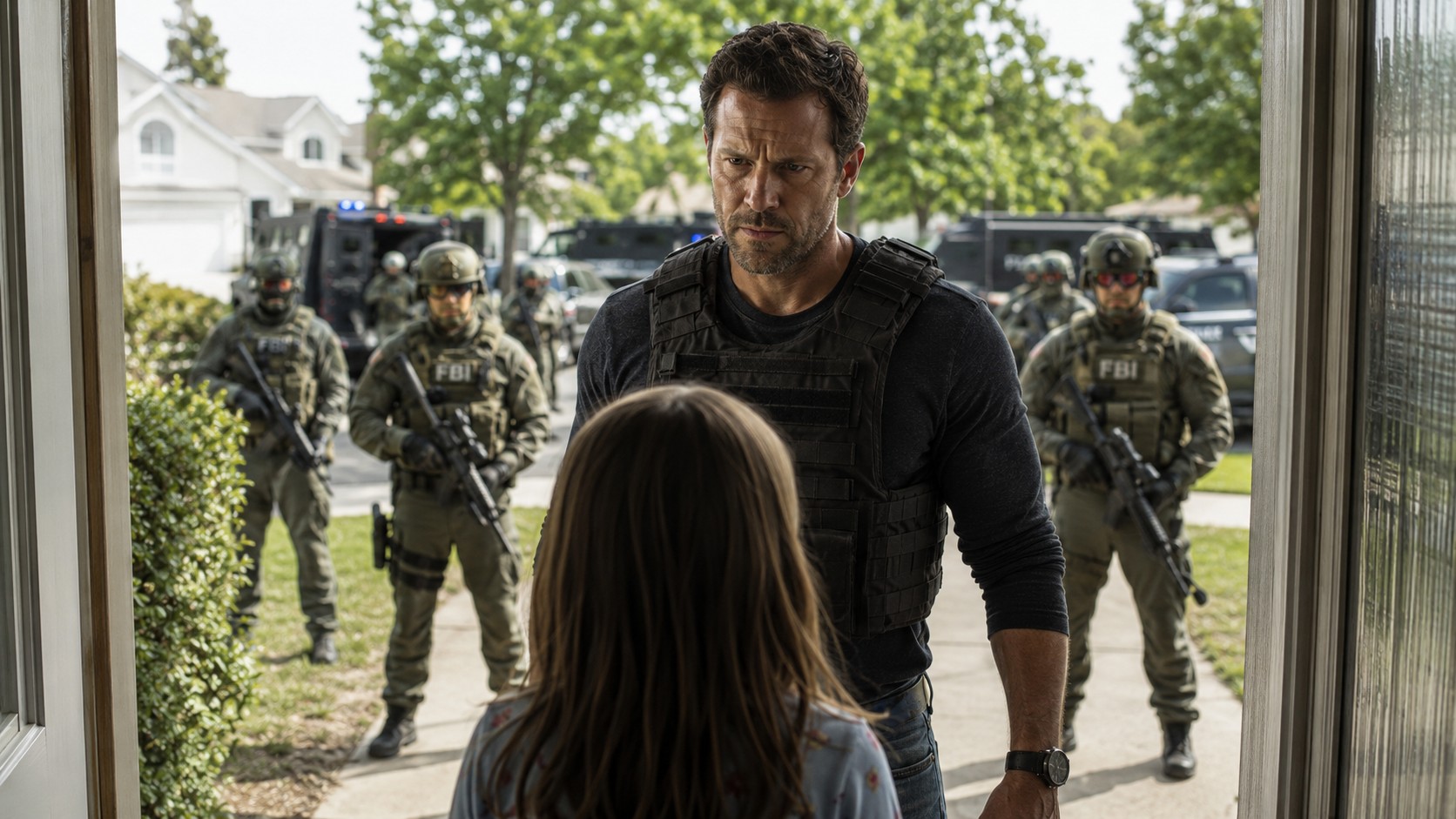

My Daughter Called Me From A Closet… “Dad… Mom Brought A Man Home… He’s Angry…” I Told Her To Stay Quiet. Then I Heard Footsteps… And A Door Slam. She Whispered, ‘He Found Me…’ The Line Went Dead. I Played It For My Commander. He Said: “Take Your Squad. Go Now.” We Landed On My Street Before Midnight… He Was Shaking When He Saw Me…
### Part 1
The night my daughter called me from inside a closet, I was sitting under a buzzing fluorescent light at Fort Irwin, staring at a report I had already read three times and still could not finish.
My boots were still on. Dust from the training range clung to the seams like tan powder. The room smelled like old coffee, floor wax, and the faint rubber stink that never really left a military building. Outside, the desert had gone dark and quiet, the kind of quiet that makes every distant engine sound sharper than it should.
My phone lit up on the desk.
Maya.
For half a second, I smiled.
My daughter was nine, but she still called me when she lost a tooth, when a lizard ran across the porch, when the neighbor’s dog wore a Halloween sweater. She was that kind of kid—serious about small things, careful with big feelings.
I answered before the second ring.
“Hey, Bug,” I said. “You should be brushing your teeth.”
Nothing.
Just breathing.
Fast breathing.
My chair scraped backward before I even knew I had stood up.
“Maya?”
“Dad,” she whispered.
One word. Thin as thread.
My hand closed around the phone until the edges bit into my palm.
“What’s wrong?”
“Mom brought a man home.”
I went still.
In training, they teach you that panic is wasted motion. Fear can be useful if you put a leash on it. I put a leash on mine.
“Where are you right now?”
“In my room.” Her voice shook. “He’s angry. He’s yelling. I heard something break.”
Then I heard it too.
A crash.
Not a plate slipping from a counter. Not a toy box knocked over. Something heavy hit hard floor, followed by the bright scatter of glass.
I was already moving, out of my room and into the hall.
“Maya, listen to me. Go to the hallway closet. The big one by the bathroom. Move now. Don’t run if it makes noise.”
“I’m scared.”
“I know. Move anyway.”
I heard tiny sounds through the phone. Her feet on carpet. A door hinge. A soft little grunt as she squeezed inside.
“I’m in.”
“Pull the door closed. Stay low. Don’t talk unless I ask you a question.”
My own voice sounded calm, almost bored. That was good. Calm was something she could hold on to.
Then came footsteps on her end of the line.
Heavy.
Slow.
Not hers.
They crossed over the floor above her hiding place. The sound changed from hollow wood to softer carpet, then stopped.
A door opened.
Not slammed. Opened.
That was worse.
There was a long silence. Long enough for me to hear the blood in my ears.
Then Maya whispered, so quietly I almost missed it.
“He found me.”
The call dropped.
For two seconds, I stared at the black screen like it was a thing I could force back to life by looking at it hard enough. Then I called her again.
Voicemail.
I called Lena.
Voicemail.
My wife’s recorded voice told me to leave a message after the tone, light and cheerful, like she had not just been inside the same house where my daughter had stopped breathing into a phone.
I did not leave a message.
I opened the call recording app I kept for work notes and played back the last three minutes. Maya’s whisper. The crash. My own instructions. The footsteps. The door. Three words at the end.
He found me.
I walked straight to Commander Reed Callaway’s office.
He was sixty-two, gray at the temples, built like an old oak desk, and he had been in uniform long enough to know when a man standing in his doorway was not there to complain.
He looked at my face and said, “Talk.”
I held out the phone.
“You need to hear this, sir.”
The recording played in his office under the steady hum of the air conditioner. He did not interrupt. He did not change expression. When Maya whispered those last three words, his jaw tightened once.
That was all.
“How old?” he asked.
“Nine.”
“Can you reach either of them?”
“No.”
He stood and took his jacket off the back of his chair.
“This is a threat to a child,” he said. “Take Trevino and Morrow. They’re still on base. Document everything. Don’t make me regret trusting your judgment.”
“You won’t, sir.”
His eyes held mine.
“Go now.”
Four minutes later, my bag was in my hand. Eight minutes after that, Trevino had a government sedan pointed toward the gate, Morrow was checking his phone for the fastest route, and I was in the passenger seat with my hands flat on my knees.
The desert highway opened in front of us, black and empty.
Three hours to Henderson.
Three hours too far.
I stared through the windshield and thought of Maya inside that closet, and for the first time in years of war zones, training accidents, roadside alarms, and bad news delivered under bad lights, I felt something colder than fear.
I felt time moving against me.
And somewhere ahead, in the house with the yellow front door, my daughter was alone with a man who had heard her hiding.
### Part 2
The street looked peaceful when we arrived.
That was the first thing I hated about it.
Porch lights glowed over trimmed lawns. Trash bins stood at the curb in neat blue rows. A sprinkler clicked somewhere in the dark, ticking in half circles over somebody’s grass. If you had driven past without knowing better, you would have thought the whole neighborhood was asleep and safe.
I had learned a long time ago not to trust things that looked safe from a distance.
Trevino killed the engine two houses down from mine. He was a stocky guy from San Antonio with calm hands and eyes that missed nothing. Morrow sat behind me, quiet as a locked door. Neither of them asked what I wanted to do. They knew why they were there.
My house sat on the corner lot, the one Maya had picked because of the big mesquite tree out front and the yellow door.
I remembered buying it during a short leave four years earlier. Lena had walked through the kitchen talking about cabinet space. Maya had run room to room deciding where her stuffed animals would live. I had checked windows, sightlines, the alley behind the fence, and whether a person could approach the back gate without being seen from the living room.
Soldier habits. Husband hopes. Father math.
The porch light was on. The living room curtains were not fully closed. Thin yellow light leaked through the gap.
I tried the front handle.
Unlocked.
That small metal click went through me like a warning.
I pushed the door open.
The smell hit first.
Wine. Broken glass. Something burnt from the kitchen, faint and bitter, like a pan left too long on the stove. Under it all was the stale, hot smell of fear after people have shouted in a closed room.
The living room was wrecked, but not completely. That mattered.
A lamp lay on its side, shade dented, bulb still glowing against the carpet. The coffee table had been shoved crooked, one leg cracked. A wine glass was shattered near the baseboard, dark red soaking into the grout between tiles. Couch cushions were half-pulled loose like somebody had been searching for something or pretending to.
Lena was on the sofa.
She had a blanket wrapped around her shoulders. Her hair was messy in a way that looked arranged by nervous hands. Her eyes were red, but her face changed the instant she saw me.
Relief first.
Then fear.
Then performance.
“Darius,” she gasped. “Oh my God. I didn’t know what to do. He just came in. The door was open, and he just came in, and he was yelling, and I tried to get Maya away, but—”
“Where is she?”
The words came out flat.
Lena blinked. Her crying slowed, like a faucet turned down.
“She’s in the basement. She ran down there when it started.”
My house had two places a frightened child might run if she did not have instructions: under her bed or behind the laundry shelves in the basement. Maya hated the basement. She hated the bare bulb and the way the water heater clicked at night.
I looked down the hallway.
The closet door by the bathroom was open.
Not just open.
Pulled wide.
A pile of towels had spilled onto the floor.
My daughter had hidden exactly where I told her to hide. Someone had opened that door.
“Who is he?” I asked.
“I don’t know,” Lena said quickly. “I swear, I’ve never seen him before. He came in like he knew the place, but I don’t know him. Maybe he followed me from the store. Maybe he—”
“Stop.”
She stopped.
For one second, the house was quiet enough that I could hear the refrigerator cycling in the kitchen.
I looked at her hands. No trembling. Not the fine, uncontrollable shaking people get after real terror. Her blanket was pulled tight, but her knuckles were not white. Her breathing was fast, but timed. Her cheek had a red mark near the jaw, too broad and even, like pressure from her own palm.
I did not accuse her.
Not yet.
I walked toward the basement door.
Trevino followed one step behind me. Morrow stayed near the front, watching the hall, the windows, and Lena.
The basement stairs creaked under my weight. One bulb swung slightly below, casting a weak circle of yellow over concrete, storage bins, Christmas decorations, old paint cans, and Maya’s pink scooter leaning against the wall.
A man stood near the far side of the room with both hands raised.
Late thirties. Thick neck. Dark shirt untucked. Face flushed. Eyes wide now that he saw me coming down those stairs in uniform pants and a field jacket with two soldiers behind me.
“I didn’t touch her,” he said immediately. “I swear to God, man. I didn’t touch the kid.”
I barely looked at him.
Maya was behind the big plastic bins in the corner.
She sat on the concrete with her knees pulled to her chest, arms locked around them, hair loose across her face. She still wore her yellow school sweatshirt with the cartoon dog on it. One sock was missing. Her cheeks were wet, but she was not crying anymore.
She had gone quiet in the way scared kids go quiet when they think sound itself can bring danger back.
Then she saw me.
Her face broke.
I crossed the basement in four strides and dropped to one knee.
“I’ve got you,” I said.
She grabbed my jacket with both hands and buried her face against me.
Her whole body shook once, hard, then went still as if even relief scared her. I put my hand on the back of her head and held her there. She smelled like dust, shampoo, and cold concrete.
Behind me, Trevino moved the man against the wall.
“What’s your name?” I asked without turning.
“Travis,” he said. “Travis Klein.”
“Why are you in my house, Travis?”
His breathing hitched.
“She told me it was fine.”
Lena’s footsteps sounded above us.
“She who?” I asked.
Travis looked toward the stairs, and his face collapsed into something ugly and frightened.
“Your wife,” he said. “Lena said you weren’t coming home.”
Maya’s fingers tightened around my jacket.
And in that basement, with my daughter trembling against my chest and a stranger staring at the floor, I understood that the danger had not broken into my house.
It had been invited.
### Part 3
Police arrived twelve minutes after Morrow called them.
Twelve minutes can feel short when you are late for work. It can feel endless when you are standing between your child and the woman who is already rewriting the night in real time.
I carried Maya upstairs myself.
She did not ask to walk. I did not ask if she could. Her arms stayed locked around my neck, one hand clutching the collar of my jacket. She was light in that terrible way children feel light when they have been scared past exhaustion.
When we reached the living room, Lena stood from the couch.
“Maya,” she said, voice cracking perfectly. “Baby, come here.”
Maya turned her face into my shoulder.
That was answer enough.
Lena saw it. For half a second, her mouth tightened, not with pain. With irritation. Then it disappeared behind tears.
“Darius, please,” she said. “You’re scaring her.”
I looked at the broken glass on the floor, the open hallway closet, the basement door, Travis at the bottom of the stairs, and my daughter shaking in my arms.
“No,” I said. “You did that.”
The first patrol car painted the front windows red and blue.
Officers came in with hands near their belts and voices controlled. I gave them names, locations, the fact that there was a child involved, and that I had a recording of the emergency call. I handed over my phone only after I backed the file up twice. Habit. Documentation matters.
One officer, a broad man named Sloan, took Travis outside first.
Another officer, younger, spoke with Lena near the kitchen island. I stood by the front door with Maya on my lap in the armchair, a blanket around her shoulders. Trevino stayed near the hallway. Morrow had already photographed the living room before anything got moved.
I listened.
Lena was good.
That was the part I hated most.
She did not overdo it now. She had adjusted. Her voice was lower, slower, broken in places. She said Travis had entered without permission. She said she had seen him once at a grocery store and maybe he had followed her. She said she panicked when he became aggressive. She said Maya ran off before she could help.
Every lie came wrapped in just enough truth to sound tired instead of rehearsed.
Then Officer Sloan brought Travis back inside to clarify something.
His face had lost color. Fear had sobered him faster than coffee ever could. His eyes went from the officer to me, then to Lena.
“Sir,” Sloan said, “Mr. Klein says he was invited here.”
Lena gave a tiny laugh, the kind people use when something is too ridiculous to insult them.
“He’s lying.”
Travis stared at her.
“Are you serious?”
“Don’t speak to me,” Lena snapped.
And there it was.
Not “Who are you?”
Not “Why are you doing this?”
Don’t speak to me.
The officer’s pen paused.
I saw it. Trevino saw it. Lena realized it a breath too late.
Travis leaned forward, hands cuffed in front of him.
“You texted me,” he said. “You told me to come through the back gate. You said he wasn’t coming home for weeks.”
Lena’s eyes flashed toward me.
Only once.
Then she cried harder.
I looked down at Maya. Her face had gone pale.
“Dad,” she whispered, “Mom told me to stay in my room tonight.”
I bent my head close to hers.
“When?”
“After dinner. She said I had to watch my tablet and not come out unless she came to get me.”
The words were soft, almost embarrassed, like she thought she had done something wrong by remembering.
A hot pressure built behind my ribs.
Not rage. Rage is messy. This was something cleaner.
Lena had not lost control of an evening.
She had planned one.
An officer asked me if I wanted medical attention for Maya. I said yes. Not because I saw injuries, but because fear leaves marks adults do not always know how to look for. A paramedic checked her on the couch, speaking gently, asking if anyone had touched her, if anything hurt, if she had hit her head.
Maya answered no to all of it, but she kept her eyes on me the whole time.
Travis was taken away first. He did not look at Lena when he left. Lena was not arrested that night. Not yet. She gave a statement. She hugged herself. She asked if she could see Maya.
Maya said no.
One small word.
Quiet.
Final.
Lena flinched like the word had slapped her.
I took Maya to my parents’ house at 2:18 in the morning. My mother opened the door before I knocked, wearing a robe and slippers, her silver hair loose around her face. My father stood behind her in a white undershirt, silent, eyes moving over Maya first, then me.
Nobody asked questions in the doorway.
My mother simply opened her arms.
Maya stepped into them and finally began to cry.
I stood there under the porch light, listening to my daughter break apart in my mother’s arms, and behind me my phone buzzed.
A message from Lena.
Darius, please don’t let one bad night destroy our family.
One bad night.
I read it twice.
Then I realized she was not begging me to understand.
She was already building her defense.
### Part 4
I did not sleep that night.
My parents’ kitchen had the same table they had owned since I was thirteen. Oak, scarred, too heavy to move without two grown men and a bad mood. I sat at it while the house settled around me, while the refrigerator hummed, while the old wall clock ticked like it was counting evidence.
Maya slept in my old room with my mother beside her.
My father sat across from me until three in the morning without asking a single question. Raymond Hale had never wasted words. When I was a kid, I mistook that for distance. When I became a man, I understood it was discipline.
At 3:07, he pushed a mug of coffee toward me.
“You going to handle it clean?” he asked.
I looked up.
“Yes, sir.”
He nodded.
That was the whole conversation.
By sunrise, I had started building the record.
Not revenge.
A record.
There is a difference.
Revenge wants someone to hurt because you hurt. A record wants the truth placed where nobody can step around it.
First came the phone records. I was the account holder. Lena and I had been on the same family plan for eleven years. I logged in from my father’s desktop computer, the one that still made a soft grinding sound when it started.
The screen filled with numbers, dates, times.
Most meant nothing.
One number meant everything.
It appeared again and again, late evenings mostly. Sometimes lunch hours. Sometimes three calls in one day. The pattern went back nearly a year. Not a mistaken grocery store encounter. Not a stranger.
Travis Klein had been in my marriage long before he stood in my basement.
I printed the records.
Then I checked the bank statements.
Joint account. Shared expenses. Mortgage, utilities, groceries, Maya’s school lunch deposits, the ordinary paperwork of a family that had looked normal from the outside.
The first charge was a restaurant in Summerlin. Two dinners, not three. I had been on a field exercise that week. The next was a boutique hotel off the Strip, hidden between gas, groceries, and a dentist co-pay. Then another restaurant. Then another hotel. Smaller charges, spaced apart, like she thought betrayal became invisible if you did not spend too much at once.
I printed those too.
By eight, my mother came into the kitchen wearing a sweatshirt and quiet anger. She set a plate of eggs in front of me. I had not asked for food. She knew I would not.
“How is she?” I asked.
“She woke up once,” my mother said. “Asked if you were still here.”
“What did you tell her?”
“That you were in the kitchen doing father work.”
For the first time all night, my throat tightened.
Father work.
That was what this was. Not husband work. That part of my life was already lying in pieces on the living room floor with the broken wine glass.
This was father work.
At 9:30, I called an attorney named Patricia Webb. I knew her through another soldier who had fought a custody battle after coming home from deployment to a house full of locked doors and lies. Patricia had a voice like a paper cut and a reputation for not wasting motions.
She told me to bring everything.
I said, “I’m not finished.”
“Then finish fast.”
I went back into the joint email account next.
Lena and I had made it years earlier for school notices, mortgage documents, utility bills, all the boring things married people share because sharing passwords seems romantic until one person starts living a second life.
At first, I found nothing.
Then I noticed a folder labeled with numbers.
Not a name. Not “receipts.” Not “school.” Just numbers. Something designed to be overlooked.
I clicked it.
Messages filled the screen.
Sent messages.
Forwarded there automatically from another account Lena must have created and misconfigured. I sat back, listening to the old computer fan whine, and felt the room narrow around me.
The emails were not graphic. They did not need to be.
They were familiar.
That was worse.
Little jokes. Complaints about me being gone. Plans. References to places I had now seen on bank statements. A relationship built in the spaces where I had thought my family was simply surviving my absence.
Then I found October 9.
4:17 p.m.
Come over tonight. She’s in her room and she won’t bother us. He is not coming back anytime soon.
6:02 p.m.
Use the back gate. I’ll leave the latch open. Don’t be loud when you come in.
I read the words until they stopped looking like language and started looking like a photograph.
Maya was not forgotten.
Maya was accounted for.
My daughter had been reduced to a detail in Lena’s plan. A room to keep closed. A small inconvenience down the hall.
I printed the messages. Then I printed them again. I saved digital copies to two drives and uploaded them to secure storage. I made a timeline with dates, calls, charges, messages, and my own duty schedule.
At noon, Maya came into the kitchen wearing one of my old Army T-shirts over her pajama pants. Her hair was messy from sleep. She stood in the doorway, looking younger than nine.
“Dad?”
I closed the folder.
“Yeah, Bug?”
“Was Mom lying?”
A child should not have to ask that question in her grandfather’s kitchen.
I wanted to soften it. I wanted to give her some adult sentence about confusion and mistakes and people under pressure.
But Maya had called me from a closet. She deserved clean truth.
“Yes,” I said. “She was.”
Maya looked at the folder under my hand.
“Are you going to prove it?”
I looked at my daughter, and in her eyes I saw something I had not expected.
Not just fear.
Expectation.
She needed to know the world could still be made straight.
“Yes,” I said. “I am.”
And that was when I remembered the security system.
Not the cameras.
Something else.
Something I had installed months earlier and almost forgotten.
### Part 5
Four months before that night, I had come home for a long weekend and spent most of Saturday in the garage with a toolbox, a ladder, and a bad attitude.
The old security system had been glitching. The front camera froze whenever the desert heat got bad. The back gate sensor sometimes sent false alerts at two in the morning, which Lena hated because the alarm app would scream on her phone until she punched in the code.
She had stood in the kitchen doorway that Saturday morning, arms folded, watching me unpack wires and small black devices from a cardboard box.
“Do we really need all that?” she asked.
“I’m gone too much not to need it.”
She rolled her eyes.
At the time, I thought she was irritated about the noise.
Now, sitting at my father’s computer, I wondered whether the system had been irritating for a different reason.
I logged into the security portal.
The account still recognized my credentials. Exterior cameras, motion alerts, back gate sensor, front door, living room alarm trigger.
The video storage had overwritten itself after thirty days.
That punched a hole through my chest for half a second.
Then I remembered the backup feature.
It was not video.
Audio.
The technician had described it as an emergency verification tool. If an alarm event triggered inside the home, the base station captured ambient sound from the main areas and stored it remotely for a limited time. Most homeowners never used it. Most forgot they had it.
I had enabled it because I enabled things.
Because a man who spends half his life away from home learns to make machines stand watch where he cannot.
My hands were steady as I opened the logs.
October 9.
There it was.
Alarm event triggered: 6:44 p.m.
Back door entry delay exceeded by twelve seconds. Disarmed manually.
Audio backup available.
My heart did not race. It slowed.
That is what happens when the thing you feared becomes the thing you can act on.
I downloaded the file.
It was several hours long. Mostly ordinary house noise. A television. Water running. Cabinets opening. Maya laughing once in the distance at something on her tablet. Lena on the phone, voice low enough that the words blurred.
Then at 6:47 p.m., clear as if she were standing beside me, Lena said, “You can come over tonight.”
I stopped the playback.
The kitchen around me seemed too bright. Sunlight came through my parents’ blinds in hard stripes across the table. Dust floated in them.
I played it again.
“You can come over tonight. She’s in her room and she won’t bother us. He is not coming back anytime soon.”
A pause.
Footsteps.
A cabinet closing.
“Just come through the back. Don’t be loud when you get to the door. I don’t want her coming out.”
There it was.
Not typed.
Spoken.
Calm.
Warm, even.
A woman making plans in the same kitchen where my daughter ate cereal before school.
I saved the file in three places.
Then I called Patricia Webb.
She listened without interrupting while I explained the security system, the alarm trigger, the remote storage, and the audio.
“Do not edit it,” she said.
“I won’t.”
“Do not send it to anyone except me and the detective until we establish chain of custody.”
“Understood.”
“Mr. Hale?”
“Yes?”
Her voice changed slightly.
“This is no longer just a divorce.”
“I know.”
“No,” she said. “I need you to hear me. Affairs are family court. Lies to responding officers are criminal. A child placed in foreseeable danger is something else. You need to move carefully now.”
Carefully was the only way I knew how to move.
That afternoon, I met Detective Anita Flores at the Clark County Sheriff’s Office. She was compact, mid-forties, with close-cut hair and eyes that had probably made a thousand liars uncomfortable. Her desk was neat except for one coffee cup and a stack of folders arranged by priority.
I set mine on top.
She opened it.
For twenty minutes, she read without speaking.
Phone records. Bank statements. Email timestamps. My duty schedule. Maya’s call recording. Security logs.
When she reached the transcript I had made from the audio file, her eyes lifted once.
“You have the original file?”
“Yes.”
“Unedited?”
“Yes.”
“Who had access to the account?”
“Me. Lena had the app for alarms but not admin access to remote storage.”
Flores leaned back.
“Her statement says she had never met Travis Klein before October 9.”
“Yes.”
“This shows eleven months of contact.”
“Yes.”
“This message says she invited him over with knowledge your daughter was present.”
“Yes.”
“And this audio appears to confirm it in her own voice.”
“Yes.”
Detective Flores closed the folder.
Some people make a lot of noise when they decide something. She did not. She placed both hands flat on the file and looked at me.
“Where is your daughter now?”
“With my parents.”
“Keep her there.”
“I planned to.”
“And Mr. Hale?”
I waited.
“Don’t contact your wife.”
I almost laughed, but there was no humor in me.
“I have nothing to say to her.”
That was true.
By then, Lena had sent eleven messages.
I know this looks bad.
You never understood how lonely I was.
Maya misunderstood what happened.
Please don’t punish me for being human.
The last one came while I was sitting in Detective Flores’s office.
I still love you.
I looked at the screen, then turned the phone face down.
Love had become just another word she was using to move furniture around in a burning house.
Detective Flores watched me do it.
“You okay?” she asked.
“No,” I said. “But I’m useful.”
She nodded like that answer made sense to her.
Outside, the afternoon sun hit the parking lot so hard the asphalt shimmered. I sat in my truck with both hands on the wheel and finally let myself breathe.
For three days, I had been gathering facts.
Now the facts were leaving my hands and entering the world.
And once truth starts moving through official channels, people who built their lives on lies usually make one mistake.
They try to stop it.
### Part 6
Lena came to my parents’ house two nights later.
Not alone.
Her sister dropped her off at the curb in a white SUV and stayed behind the wheel with the engine running. I saw the headlights through the front window before the doorbell rang.
My mother was in the living room folding laundry. Maya was asleep down the hall. My father was at the kitchen sink washing a coffee mug by hand even though the dishwasher was empty.
The bell rang again.
My mother looked at me.
“Want me to answer?”
“No.”
I walked to the door and opened it only as far as the chain allowed.
Lena stood on the porch under the yellow light, wearing jeans, a soft gray sweater, and no makeup. That was a choice. She knew I had once liked her best that way, back when no makeup meant lazy Sundays and coffee on the back patio, not strategy.
Her eyes filled as soon as she saw me.
“Darius.”
“No.”
The word stopped her.
“I just want to see my daughter.”
“She’s asleep.”
“Then wake her up.”
Behind me, my father set the mug in the sink without a sound.
I did not move.
“You are not coming inside.”
Lena’s face tightened. “I’m her mother.”
“You were her mother on October 9 too.”
The tears came then. Quick and silent. She had always been able to cry beautifully, even when we were young. Some people cry in a way that makes a room uncomfortable. Lena cried in a way that made people lean toward her.
I did not lean.
“I made a mistake,” she whispered.
“No. You made a plan.”
She glanced past me into the house.
That was when I knew this visit was not about Maya.
Her eyes were looking for something. My phone. A folder. A weakness. A witness.
“What did you give the police?” she asked.
There it was.
I almost admired how fast the mask slipped.
“Good night, Lena.”
“Darius, wait.” Her hand came up against the door. “Please. You don’t understand what it was like. You were gone. Always gone. I was alone in that house raising Maya by myself while you got to be the honorable soldier everyone respected.”
The words landed somewhere old.
Because part of them was true.
I had been gone. I had missed birthdays, parent-teacher nights, fevers, dentist appointments, broken washing machines, and ordinary Tuesdays that never come back once they pass. I had told myself sacrifice covered absence because that was the only way I knew how to stay functional.
But truth used as a weapon is still a weapon.
“You can blame me for a lonely marriage,” I said. “You don’t get to blame me for what you did to Maya.”
Her face changed again.
Softness vanished.
“You are going to ruin my life over this.”
“No,” I said. “You did that before I got home.”
She stepped closer to the door.
“If you take her from me, I’ll tell the court you’re unstable. I’ll tell them the Army changed you. I’ll tell them you came into that house ready to hurt someone.”
My father moved behind me.
I lifted one hand without looking back.
He stopped.
“You should go,” I said.
“I mean it, Darius.”
“So do I.”
For a moment, we stared at each other through six inches of open doorway and a brass chain.
I saw the woman I had married. Not as she was, but as she used to be layered under what she had chosen to become. There had been a time when her anger was bright and honest. Now it moved like smoke, looking for cracks.
Then a small voice spoke behind me.
“Dad?”
Maya stood in the hallway, barefoot, hair loose, one hand gripping the doorframe.
Lena’s whole face transformed.
“Maya, baby.”
Maya flinched.
I stepped partly between them.
Lena saw it and looked wounded, like she had not earned that reaction herself.
“Maya,” she said, “I need you to tell your dad you’re okay. Tell him this has gone too far.”
My daughter’s eyes moved from her mother to me.
I wanted to send her back to bed. I wanted to close the door before Lena put one more burden on her. But Maya had already heard the question, and some things become heavier when adults pretend they were not spoken.
Maya looked at Lena.
“You told me not to come out,” she said.
Lena swallowed.
“I was trying to protect you.”
“No,” Maya said. Her voice shook, but she did not look away. “Dad told me to hide. You didn’t.”
The porch went silent.
Even the SUV at the curb seemed too loud.
Lena’s eyes filled again, but this time the tears did not fall. She had lost control of the scene, and she knew it.
“Maya, sweetheart, you don’t understand adult things.”
Maya stepped closer to me.
“I understand closets.”
The sentence hit the porch harder than any shout could have.
Lena’s mouth opened, then closed.
My daughter looked smaller than she should have in the hallway light, but she stood straight.
I closed the door.
This time, Lena did not knock again.
Through the front window, I watched her sister’s SUV pull away.
Maya stood beside me in silence.
Then she asked, “Can she make them believe her?”
I put my hand on her shoulder.
“She can try.”
Maya looked up at me.
“What if she’s good at it?”
I thought of the audio file sitting in three secure places. I thought of Lena’s calm voice saying, She won’t bother us.
“She is,” I said.
And for the first time since the basement, I let my daughter see the edge in my eyes.
“But I’m better at keeping records.”
### Part 7
Lena was arrested before sunrise on a Thursday.
Detective Flores called me at 6:12 a.m. I was in my parents’ backyard, drinking coffee that had gone cold in the cup. The sky over Henderson was pale gray, and the air smelled like dust and wet concrete from the sprinklers.
“We picked her up at her sister’s house,” Flores said.
“How did she take it?”
A short pause.
“She performed.”
That was all she needed to say.
Travis Klein had been arrested again the same morning after giving a statement that contradicted both his first version and Lena’s. People like Travis mistake panic for strategy. He admitted enough to help himself and damaged himself more in the process.
By noon, the charges were real enough to appear in black ink.
Child endangerment. Providing false information to law enforcement. Conspiracy connected to the incident. Criminal trespass and attempted assault charges for Travis. Other counts were discussed, adjusted, filed, and argued over in language that made everything sound cleaner than it had felt.
That is one strange thing about the law.
It turns terror into numbered paragraphs.
Maya did not ask many questions that day. She sat at the kitchen table coloring a horse purple while my mother made soup. The television stayed off. My father fixed a loose cabinet hinge that had not bothered anyone for six years, because men in my family often show love by repairing things near the people they cannot repair.
At dinner, Maya finally looked at me.
“Is Mom in jail?”
I set my spoon down.
“Yes.”
“For what she did?”
“Yes.”
Maya looked into her soup.
“Good.”
My mother closed her eyes for half a second. Not in judgment. In grief. No grandmother wants to hear a child say that about her mother and know the child is right.
The next months moved slowly.
Family court began before criminal court ended. Patricia Webb filed for emergency custody, and I received temporary sole physical custody within days. Lena’s attorney objected, naturally. He painted me as rigid, military, emotionally unavailable, too willing to use one bad night as a weapon.
I sat through it in a suit that felt too tight at the shoulders and listened without moving.
Patricia did not raise her voice.
She never had to.
She presented the timeline. The police report. The call recording. The messages. The security logs. Maya’s therapist’s initial notes, limited and carefully worded. My duty record. My proposed childcare plan. My parents’ sworn statements.
The judge was a woman named Elaine Porter with silver glasses and no patience for theatrics.
She looked over the documents and asked Lena’s attorney, “Are you asking this court to return the child to the home where the alleged endangerment occurred before the criminal matter is resolved?”
He began a sentence.
She lifted one finger.
“Be careful with your answer.”
He sat down faster than he stood up.
Temporary custody remained with me.
Afterward, in the courthouse hallway, Lena’s mother approached me. Carol had never liked me much. She thought soldiers made good wedding photos and difficult husbands. She wore a cream coat and held her purse in both hands like she wanted to hit me with it but had decided cameras made that unwise.
“You’re enjoying this,” she said.
“No.”
“She made mistakes.”
“Yes.”
Carol’s eyes sharpened. “You were gone for years. You don’t get to act innocent.”
“I’m not acting innocent.”
That confused her.
I continued, “I was absent too much. I should have seen more. I should have made different choices in my marriage. I will answer for that with my daughter for the rest of my life.”
Carol’s expression softened slightly, thinking she had found an opening.
Then I said, “But I did not invite a dangerous man into a house with a child and lie to the police afterward.”
Her face closed.
“You’ll regret turning your back on family.”
I looked through the courthouse glass doors at Maya sitting beside my mother on a bench outside, eating crackers from a plastic bag, legs swinging.
“No,” I said. “I’m choosing family.”
That night, Maya and I stayed at my parents’ house again. I had not moved back into the yellow-door house. I could not ask her to sleep there. I was not sure I could either.
We built a routine out of damaged pieces.
School drop-offs. Therapy on Tuesdays. Homework at the kitchen table. Pancakes on Saturdays. My mother braided Maya’s hair while pretending not to notice when Maya watched the front window too long. My father taught her to check tire pressure, which she found boring until he told her every capable person should know how to leave safely if they needed to.
I requested reassignment considerations and temporary adjustments through command. Reed Callaway did not ask me to explain twice. Some men understand that duty to country does not erase duty to a child.
One evening in November, Maya found me in the garage packing boxes from the old house. I had gone back during the day with Morrow to collect clothes, documents, her favorite books, and the stuffed rabbit she had left on her bed.
She stood at the garage door, staring at a cardboard box marked MAYA ROOM.
“Did you see the closet?” she asked.
“Yes.”
“Did it look scary?”
I thought about the towels on the floor, the narrow darkness, the little scuff mark where her heel must have dragged against the baseboard.
“It looked small,” I said.
She nodded.
“It felt smaller.”
I stopped taping the box.
She walked over and touched the top of it.
“Do I have to tell the judge?”
“Not unless you want to. There are other ways to tell the truth.”
“What if I want to?”
“Then I’ll be right there.”
She traced the marker letters of her name.
“I don’t want her to say I made it up.”
The garage light buzzed overhead. Somewhere outside, a dog barked twice.
I knelt in front of her.
“Maya, listen to me. Adults can lie loudly. That doesn’t make them stronger than the truth.”
Her eyes searched my face.
“But what if the truth is quiet?”
“Then we stand close enough for people to hear it.”
She nodded once.
And two weeks later, when the criminal trial date was set, Maya made a decision that turned my blood cold and filled me with pride at the same time.
She wanted to be there.
### Part 8
The Clark County courthouse smelled like polished wood, old paper, and coffee from a machine that had probably disappointed people for twenty years.
Maya walked beside me through the metal detectors wearing a blue cardigan my mother had bought her and black shoes she said pinched only a little. Her hair was in two neat braids. She carried no toy, no tablet, nothing to hide behind.
“You don’t have to do this,” I told her before we entered the courtroom.
She looked up at me.
“I know.”
That was all.
I did not argue. Some choices belong to the person carrying the memory.
Judge Carl Drummond ran his courtroom like a man who believed drama was for people without facts. He was broad-shouldered, heavy-eyed, and calm in a way that made lawyers choose their words more carefully.
Travis Klein’s trial came first.
He sat at the defense table in a gray suit that did not fit him right. His collar pulled at his neck. He looked smaller than he had in my basement, which did not make him less responsible. It just made him human in the least useful way.
The prosecutor, David Owens, built the case piece by piece.
Travis had known Lena. Travis had communicated with Lena. Travis had entered through the back gate. Travis had been angry. Travis had contributed to a situation that forced a child to hide in fear in her own home.
His attorney tried to soften it.
There was no physical injury. He had permission to be there. He had been misled. He had been emotional. He had never intended to scare Maya.
I watched the jurors when Maya’s call recording played.
That was when the room changed.
My daughter sat beside me, hands folded tightly in her lap. When her own whispered voice came through the speakers, she did not cry. My mother, behind us, covered her mouth. My father looked straight ahead, jaw clenched so hard a vein moved near his temple.
On the recording, I heard myself say, “Go to the hallway closet.”
I heard the crash again.
I heard footsteps.
I heard the silence before the door opened.
Then Maya’s voice filled the courtroom.
“He found me.”
One juror looked down at her hands. Another swallowed hard. Travis closed his eyes.
I did not.
I watched him.
Not because I wanted him afraid. Because I wanted him to know someone had stayed awake through every second of what he helped create.
The defense never recovered.
Fear in a child’s voice is not something clever arguments can sand down.
Travis was found guilty on the main counts. Sentencing would come later. Lena’s trial began the following week.
That was the one everyone watched more closely.
Affairs make people curious. Mothers accused of endangering their children make them judgmental. Military families make them sentimental. The gallery filled with strangers who had read small local articles and wanted to see what kind of woman would do what Lena was accused of doing.
Lena gave them exactly what they expected not to see.
She looked fragile.
No bright lipstick. No sharp clothes. A navy dress. Small earrings. Hair pinned back. She looked like a tired school administrator, not a woman who had left a back gate open for her lover while her daughter watched cartoons in the next room.
Her attorney was skilled.
He did not deny everything. That would have been stupid.
Instead, he admitted loneliness. He admitted an affair. He admitted shame. He admitted panic. Then he tried to separate all of that from criminal intent.
“Bad judgment is not conspiracy,” he told the jury. “A failing marriage is not child endangerment. A terrified woman’s incomplete statement after a chaotic event is not a calculated lie.”
It was good.
I hated that it was good.
Because part of the story had enough truth in it to breathe.
I had been gone. Lena had been lonely. Our marriage had become a house with lights on and nobody really living inside it. The truth can be used to build a bridge or disguise a trap. Her attorney used it well.
When Lena took the stand, the courtroom leaned toward her.
She spoke softly.
She said she had felt abandoned. She said Travis had been a mistake that got out of hand. She said she never believed Maya was in danger. She said she told Maya to stay in her room because she and Travis needed to talk privately. She said when Travis arrived upset, everything moved too fast.
Then she looked toward me.
“I was ashamed,” she said. “That’s why I lied at first. Not because I didn’t love my daughter. Because I knew Darius would never forgive me.”
For the first time, I felt Maya shift beside me.
Her shoulder pressed against my arm.
Lena saw it.
She lowered her eyes and cried.
A woman behind us sniffled.
I stared at the defense table and felt the old familiar pressure behind my ribs. Not panic. Not anger. Calculation.
Because Lena was doing it again.
She was turning the room into a closet and asking my daughter to stay quiet inside it.
Then Patricia Webb touched my sleeve from the row behind me and leaned close.
“The judge admitted the authentication packet,” she whispered. “Owens can use the audio.”
Across the courtroom, Lena lifted a tissue to her eyes.
She had no idea the next voice the jury would hear was hers.
### Part 9
The prosecutor did not rush it.
That was the smartest thing he did.
If he had jumped up and played the audio like a television lawyer, Lena’s attorney could have made it feel theatrical. Instead, David Owens walked Detective Flores through the foundation one brick at a time.
Who collected the security logs.
How the system worked.
Who had administrator access.
How the file was downloaded.
How the checksum matched.
How the chain of custody had been maintained.
The words were dry enough to make half the courtroom restless, but I knew what he was doing. He was building a bridge strong enough to carry thirty-one seconds across it.
Lena sat very still.
At first, she looked confused.
Then I saw the moment she understood.
Her eyes moved to me.
I did not look away.
Her attorney objected. He argued relevance, prejudice, authentication, timing. Judge Drummond listened with his chin resting on one hand. Then he took a recess.
The courtroom emptied into the hallway.
Maya stood by the vending machines with my mother. My father bought a pack of crackers and opened it badly, tearing the whole top so crackers spilled into his palm. Maya almost smiled. It was the smallest almost-smile in the world, but I saw it.
Lena’s sister glared at me from across the hall.
Carol, Lena’s mother, walked over again.
“You just can’t stop,” she said.
I was too tired for her.
“Not until it’s done.”
“She loved you.”
I looked at her then.
“Maybe. But she loved herself more than Maya’s safety.”
Carol’s lips trembled.
“You’re cruel.”
“No,” I said. “Cruel is asking a child to doubt what happened to her so an adult can feel less guilty.”
Carol stepped back like I had raised my voice. I had not.
Court resumed after forty-seven minutes.
Judge Drummond admitted the audio.
Lena closed her eyes.
Owens stood near the screen but did not look at it. He looked at the jury.
“You will hear a short recording captured by the home security system on October 9 at approximately 6:47 p.m.”
He pressed play.
At first, there was kitchen noise. A drawer sliding open. Glass touching counter. The soft electronic murmur of a television from another room.
Then Lena’s voice.
Clear.
Casual.
“You can come over tonight. She’s in her room and she won’t bother us. He is not coming back anytime soon.”
A pause.
Footsteps.
“Just come through the back. Don’t be loud when you get to the door. I don’t want her coming out.”
The clip ended.
Nobody moved.
That silence was different from the silence after Maya’s recording. Maya’s silence had been grief. This one was recognition.
The room had watched Lena cry. It had heard her explain. It had seen her try to fold herself into loneliness and shame until she looked less like a person making choices and more like a person trapped by them.
Then her own voice had walked in and turned on the lights.
Calm.
Planning.
Specific.
My daughter was in her room and she won’t bother us.
Maya’s hand found mine.
I looked down. She was staring at the floor, but her fingers held tight.
Owens did not say much afterward. He did not need to.
On cross-examination, Lena’s attorney tried to suggest the clip lacked context.
Detective Flores did not take the bait.
“The context is the rest of the evidence,” she said.
He asked if Lena sounded afraid in the recording.
“No.”
He asked if the recording proved Lena knew Travis would become aggressive.
“No.”
He looked relieved for half a second.
Then Flores added, “It proves she lied when she said she didn’t know him and had not invited him to the house.”
The relief vanished.
Lena did not testify again.
Her attorney rested the next morning.
Closing arguments came after lunch. The defense returned to loneliness, shame, and lack of intent. The prosecutor returned to choices.
Not feelings.
Choices.
Lena chose to invite Travis over. Chose to leave the latch open. Chose to tell her daughter to stay hidden away in her room. Chose to lie when the night went bad. Chose to protect herself before protecting Maya.
The jury went out at 2:35 p.m.
We waited in a side hallway where the air conditioner was too cold. Maya leaned against my mother. My father stared at a framed courthouse notice like it owed him money. Patricia Webb checked emails. I watched people walk past carrying folders, coffee, consequences.
At 6:11, the jury came back.
Lena stood.
I stood too.
Maya stayed seated, her hand in my mother’s.
Guilty.
Not on every count the state had wanted.
Enough.
Lena made one sound. Not a sob. More like the air leaving a tire.
Her knees bent slightly, and her attorney caught her elbow.
Then she turned and looked at Maya.
I stepped into her line of sight.
For the first time in thirteen years of knowing me, Lena seemed to understand that there was no door left in my face for her to open.
Sentencing was set for the following morning.
That night, Maya asked if she could sleep with the hallway light on.
I said yes.
At 2:00 a.m., I woke to find her standing in my doorway.
“Dad?”
I sat up immediately.
“What is it?”
She held the stuffed rabbit against her chest.
“If she says sorry tomorrow, do we have to forgive her?”
There are questions that decide what kind of parent you are.
I patted the edge of the bed, and she climbed up beside me, waiting for an answer I could not afford to get wrong.
### Part 10
“No,” I said.
Maya looked at me in the dim room, hallway light cutting a pale stripe across the carpet.
“You don’t have to forgive someone just because they are sorry. And you definitely don’t have to trust them.”
She thought about that.
“What if Grandma Carol says we should?”
“Grandma Carol can feel whatever she wants. She doesn’t get to decide what keeps you safe.”
Maya held the rabbit tighter.
“Do you forgive Mom?”
I stared at the doorway.
The old version of me might have answered too fast. The soldier in me liked clean lines. The father in me wanted to give my daughter certainty. But children can smell fake certainty. They live close to the ground; they notice vibrations adults ignore.
“No,” I said. “I don’t.”
“Because of Travis?”
“Because of you.”
She did not move.
I continued carefully.
“People make mistakes in marriages. Big ones sometimes. Painful ones. That part is between adults. But when she put you in danger, then lied about it, she crossed a line I won’t move.”
Maya breathed out slowly.
“So we’re not going back?”
“No.”
“Ever?”
“No.”
The word felt heavy, but clean.
She leaned against my arm and stayed there until she fell asleep.
The next morning, the courthouse felt colder than before.
Sentencing has a different smell. Trial days smell like paper and nerves. Sentencing smells like endings. People come in knowing the argument has mostly run out. All that remains is the size of the consequence.
Travis was sentenced first.
Four years, with possible early release after behavior review. He stood there with his shoulders rounded, looking like a man who had spent months discovering that regret is not a time machine. He apologized to Maya without looking directly at her.
She watched him with no expression.
When he was led away, I felt nothing satisfying. No victory. No joy. Just the dull click of one door closing.
Lena’s hearing began after a short recess.
Maya did not sit through her statement. I had decided that the night before. Patricia took her into the hallway with my mother, and my father stayed with me.
Lena stood at the defense table.
Her hair was pulled back. Her face looked bare and pale. Without the performance lighting of trial, she looked tired in a way that was almost honest.
Almost.
Her attorney spoke first. He asked the judge to consider her lack of prior record, her history as Maya’s primary caregiver during my deployments, the emotional strain of military marriage, her remorse, her willingness to undergo counseling.
Then Lena read from a folded paper.
She spoke about shame. About loneliness. About choices she wished she could undo. About loving Maya more than anything. Her voice broke in three places.
Once, that would have moved me.
I knew her rhythms too well now.
She was not speaking to the judge. Not really.
She was speaking to the ghost of the woman people wanted her to be.
“I hope,” Lena said, turning slightly toward where Maya had been sitting before I sent her out, “that one day my daughter understands I never meant to hurt her.”
My father shifted beside me.
I kept my eyes forward.
Judge Drummond let the silence sit after she finished. Then he removed his glasses, folded them, and placed them on the bench.
“Mrs. Hale,” he said, “this court recognizes the hardship presented by long separations within military families. It recognizes that loneliness, stress, and marital breakdown are real human circumstances. But hardship is not permission.”
Lena looked down.
“You did not simply engage in a private affair. You arranged for an individual to enter a home where your minor child was present. You directed that child to remain out of sight. When events escalated and your daughter experienced genuine fear, you did not immediately tell the truth to protect her. You lied to protect yourself.”
The courtroom was so still I could hear a pen drop somewhere behind us.
Drummond continued.
“This court heard your statement of remorse. It also heard your voice on October 9, calm and deliberate, planning around your daughter’s presence as if she were an inconvenience rather than a child entitled to safety in her own home.”
Lena’s shoulders began to shake.
“Three years,” he said.
Child endangerment. Conspiracy. False information.
Parole eligibility after eighteen months with mandatory counseling and restrictions on contact.
The gavel came down.
Not hard. It did not need to.
Lena turned as the bailiff approached. Her eyes found mine.
For one second, I saw panic. Not fear for Maya. Fear that the story she had told herself was finally dead.
“Darius,” she whispered.
I stood.
Not to go to her.
To leave.
In the hallway, Maya looked up from the bench.
“It’s done?” she asked.
“It’s done.”
“How long?”
“Three years.”
She absorbed that with the solemn arithmetic of a child measuring punishment against fear.
Then she nodded.
Carol was crying near the elevators. Lena’s sister had one arm around her and hate in her eyes. As we passed, Carol reached toward Maya.
“Maya, sweetheart, your mother loves you.”
Maya stopped.
I did too.
My daughter looked at her grandmother and said, “She should have loved me before Dad came home.”
Carol’s hand fell.
We walked out into the November sunlight together.
Outside, the air was sharp and bright. Traffic moved along the street like the world had not just changed shape. Maya slid her hand into mine without looking.
For the first time since the phone call, she did not grip hard.
She simply held on.
And as we crossed the courthouse steps, I realized the trial had ended, but the harder work was waiting outside.
Because saving a child from danger is one thing.
Teaching her she is safe again is another.
### Part 11
We did not move back into the yellow-door house.
I sold it.
People told me to wait. They said not to make big decisions after trauma. They said a house was just a house, that memories could be painted over, that Maya might regret losing the room where she had grown up.
People mean well when they say things that cost them nothing.
But Maya could not walk past a hallway closet without going quiet. She could not hear glass break in a restaurant without turning white. She could not sleep in any room where the door did not face the bed.
A house is not just a house when your body remembers where it hid.
So I sold it to a young couple with a baby and a golden retriever. Before closing, I painted the yellow door white. I did it myself on a Saturday morning, wearing old jeans and a shirt already ruined by garage paint. The brush dragged over the bright color slowly, covering it in flat strokes.
Morrow helped me load the last boxes.
He looked at the door, then at me.
“You okay?”
“No.”
He nodded.
“Good answer.”
We bought a smaller place twenty minutes from my parents. One story. No basement. Wide windows. A backyard with a block wall and a lemon tree that produced ugly fruit but smelled clean in the evenings.
Maya picked her room because it got morning light.
The first night there, she stood in the hallway looking at the linen closet.
I opened it.
Towels. Sheets. A vacuum.
“Want it gone?” I asked.
She blinked.
“You can get rid of a closet?”
“I can get rid of anything that doesn’t hold up the roof.”
That almost-smile came back.
“No,” she said. “It’s okay.”
But she left the door open.
So did I.
Recovery was not pretty.
Television makes healing look like music playing over clean scenes. Real healing is inconvenient and repetitive. It is a child asking the same question seventeen different ways. It is a father learning not to say “you’re safe” like a command, because safety is not something you can order another person to feel.
It is pancakes burned because Maya smelled smoke and cried in the pantry.
It is leaving a full grocery cart in the store because a man raised his voice in the next aisle.
It is sitting outside a school dance for two hours because your daughter wants to go but needs to know you are in the parking lot.
I did all of it.
Not perfectly.
I got tired. I got impatient inside my own head. I missed the old ease of being her father before every room required assessment. But I never let her see impatience as disappointment.
Therapy helped.
Her therapist, Dr. Elaine Morris, had kind eyes and a shelf full of smooth stones Maya liked to arrange by color while talking. The first month, Maya barely spoke. The second month, she began correcting adults.
“Not scared,” she told Dr. Morris once. “Alert.”
Dr. Morris glanced at me through the office window afterward.
“She’s very precise.”
“She gets that from my father.”
“Maybe from you too.”
I did not know what to do with compliments in those days, so I nodded like she had given me instructions.
My Army life changed.
Commander Callaway helped me move into a training and operations role that kept me closer for a while. It was not glamorous. No one makes movies about scheduling range rotations and reviewing safety packets. But every afternoon I picked Maya up from school, and every afternoon she saw my truck by the curb.
Presence became my new mission.
One Thursday, six months after sentencing, a letter arrived from Lena.
The envelope had her handwriting.
Maya saw it on the kitchen counter before I could move it.
“Is that from her?”
“Yes.”
“Are you going to read it?”
“I have to check what it says first.”
Maya sat at the table.
“I want to know.”
I opened it standing by the sink.
The letter was two pages. Careful handwriting. Apology language. Counseling language. Phrases about accountability and pain and praying for a chance to heal what had been broken. She wrote that prison had changed her perspective. She wrote that she understood now how afraid Maya must have been.
Must have been.
Even on paper, she kept herself one step away from the room.
I did not read the whole thing aloud.
I summarized honestly.
“She says she’s sorry. She says she wants a chance to write to you.”
Maya looked at the lemon tree through the sliding glass door.
“Do I have to answer?”
“No.”
“Can I later?”
“Yes.”
“Can later be never?”
“Yes.”
She nodded.
“Then later is never right now.”
I put the letter back in the envelope and stored it with the legal documents.
That evening, Maya helped me make spaghetti. She spilled salt, over-stirred the sauce, and told me a story about a girl at school who claimed her uncle owned a tiger. For twenty minutes, she sounded like a kid again.
I held on to that sound without interrupting it.
After dinner, while she did homework, my phone buzzed.
Unknown number.
I ignored it.
It buzzed again.
Then a message appeared.
You think you won. Wait until Maya asks the truth about you.
I stared at it.
Not Lena. The wording was wrong.
Carol, maybe. Lena’s sister, maybe. Someone still trying to turn blame into a weapon.
Maya looked up from her math sheet.
“Everything okay?”
I turned the phone face down.
“Yes.”
But that night, after she went to bed, I pulled out the old file boxes again.
Because threats do not scare me nearly as much as unfinished truth.
And if someone thought there was something about me that could hurt my daughter, I needed to find it before they did.
### Part 12
The truth about me was not hidden.
That was the funny part.
It sat in old deployment calendars, missed birthdays, school photos Lena had taken without me, emails where I said I would call and then did not because a convoy ran late or a radio failed or a commander needed bodies somewhere else.
No scandal.
No secret second family.
No crime.
Just absence.
Absence can still cut.
I spent that night going through old boxes in the garage. The air smelled like cardboard, motor oil, and lemon blossoms drifting through the cracked side door. My records were neat because I had always been neat. Orders. Leave forms. Photos. Maya’s drawings sent overseas, folded carefully at the creases.
One drawing stopped me.
Three stick figures.
Mom. Maya. Dad.
Lena and Maya stood under a square yellow sun. I stood far away near a green rectangle labeled “army.” My stick figure had a smile. Maya had drawn a dotted line from me to them, like a road or a rope.
She had been six.
I sat on the garage floor holding that paper for a long time.
It is easy to make yourself the hero when the villain is obvious.
It is harder to admit that being the better parent now does not erase the years when your child learned to miss you quietly.
The next morning, I told Maya the truth before anyone else could twist it.
We drove to a diner near Boulder Highway, the kind with red vinyl booths, laminated menus, and coffee that tasted burnt no matter how much cream you added. Maya ordered chocolate chip pancakes. I ordered eggs I did not want.
She noticed the folder beside me.
“Is this serious breakfast?”
“Yes.”
She poured syrup carefully, eyes on the plate.
“Okay.”
I opened the folder and took out a few things. Not everything. Children do not need every adult document to understand an adult truth.
“I got a message last night,” I said. “Someone suggested there are things about me you should know.”
Maya’s face tightened.
“From Mom?”
“I don’t think so. Maybe someone in her family.”
“What things?”
“That I was gone a lot. That your mom handled more at home than I did. That there were times I promised to call and didn’t. Times you needed me and I was not there.”
Maya stared at the pancakes.
“I know that.”
The sentence was not cruel.
That made it worse.
“I know you do,” I said. “But I want you to hear me say it. I’m sorry.”
She pushed one chocolate chip with her fork.
“You always came back.”
“Yes.”
“But sometimes coming back isn’t the same as being there.”
That one landed clean.
I nodded.
“You’re right.”
She looked up then, studying my face like she expected me to defend myself.
I did not.
“I can explain some of it,” I said. “Orders, deployments, duty. But explanations aren’t the same as excuses. You were a kid. You needed me. I missed too much.”
Maya’s eyes filled, but she did not cry.
“Are you leaving again?”
“No. Not like before.”
“What if they make you?”
“Then I fight for the arrangement that keeps me here. And if I lose, we plan honestly. No surprises. No pretending it doesn’t hurt.”
She absorbed that.
Then she asked, “Did Mom hate you because you were gone?”
“I don’t know. Maybe part of her did.”
“Do I have to hate you too?”
The question broke something in me.
“No,” I said softly. “But you’re allowed to be angry.”
She wiped one eye fast with her sleeve.
“I am angry.”
“I know.”
“At both of you.”
“I know.”
“At her more.”
“That makes sense.”
“But at you too.”
“That also makes sense.”
She nodded, like I had passed a test I did not know I was taking.
We ate slowly. Her pancakes got cold. My eggs turned rubbery. Outside, cars hissed over hot pavement. Inside, a waitress refilled my coffee and called Maya “hon,” and life kept moving in its ordinary, stubborn way.
When we got home, I blocked the unknown number and sent screenshots to Patricia.
The threats stopped.
Carol tried once through family court to request grandparent visitation on Lena’s behalf. Patricia handled it with such surgical precision that the petition never made it past preliminary review. The court found no basis to force contact that would undermine Maya’s stability.
Maya did not celebrate.
She simply asked if we could get tacos.
We got tacos.
Spring came slowly that year.
The desert softened at the edges. Mornings turned warm. The lemon tree bloomed hard, filling the backyard with a clean, sharp sweetness. Maya started laughing more. Not all the time. Not like before. But enough that I stopped feeling startled every time it happened.
One Saturday, she came into the garage while I was fixing a shelf.
“Dad?”
“Yeah?”
“Can we go to Lake Mead tomorrow?”
I looked down from the ladder.
My father had taken me there when I was a boy. He said almost nothing on those trips. We fished badly, ate sandwiches wrapped in foil, and watched water sit calmly in a place where water had no business existing.
“Sure,” I said. “Any reason?”
Maya shrugged.
“I want to ask you something there.”
I climbed down slowly.
“What kind of something?”
She looked toward the open garage door, where sunlight poured across the concrete.
“The kind where I need a lot of sky.”
I did not ask more.
Some questions need room around them.
And the next afternoon, as we drove toward the lake, I had the strange feeling that my daughter was not looking for answers about her mother anymore.
She was deciding what kind of person she wanted to become after surviving her.
### Part 13
Lake Mead was lower than I remembered.
The pale rings on the rocks showed where the water used to be, layer after layer, like the desert had kept receipts. The afternoon sun laid itself across everything in bright sheets. Wind moved over the surface of the lake, breaking the blue into small flashing pieces.
Maya walked beside me down the rocky slope.
She wore jeans, sneakers, and the blue cardigan my mother had given her for court. I noticed she wore it less often now, only when she wanted to feel brave. Her hair was in one braid down her back. She carried two bottles of water and a bag of pretzels.
We found a flat rock near the shore.
For a while, neither of us spoke.
That was something my father had taught me without teaching it. Silence does not have to be empty. Sometimes it is the only container strong enough for what people are carrying.
Maya threw a small stone into the water. It skipped once, then sank.
“Is she coming back?” she asked.
I knew who she meant.
“No.”
“Not after prison?”
“She may get out. But she is not coming back to us.”
Maya nodded, eyes on the lake.
“Because you won’t let her?”
“Because she lost the right.”
The wind pushed at her braid.
“What if she really changes?”
I picked up a stone, turned it in my hand, and set it down again.
“Then she can live changed somewhere else.”
Maya looked at me.
“That sounds mean.”
“I know.”
“Is it?”
“No.”
She waited.
I searched for the right words, not the hard ones, not the easy ones.
“Changing does not erase consequences. And forgiveness is not a door people get to unlock from the outside just because they finally feel bad.”
Maya looked back at the water.
“Do you think she feels bad?”
“Yes.”
“About me?”
I took a breath.
“I think she feels bad about losing you. I don’t know if she fully understands what she did to you.”
Maya picked at the label on her water bottle.
“I don’t miss her the way I thought I would.”
“That’s okay.”
“Sometimes I miss before.”
“I do too.”
She leaned back on her hands, face tilted toward the huge empty sky.
“Before wasn’t real though, was it?”
That question hurt because the answer was not simple.
“Parts of it were real,” I said. “You were real. I was real. Some of the love was real. But there were lies inside it too.”
“Like a rotten apple?”
I almost smiled.
“Kind of.”
“You can’t just eat around the rotten part if it made you sick.”
“No,” I said. “You can’t.”
She seemed satisfied with that.
A boat moved far out on the lake, leaving a white line behind it. The sound reached us late, faint and uneven.
After a while, Maya said, “I was mad you were far away.”
“I know.”
“I thought if you were home, it wouldn’t have happened.”
I closed my eyes once.
“I’ve thought that too.”
“Is it true?”
“I don’t know. Maybe that night would have been different. Maybe she would have chosen something else another night. I can’t fix the part where I wasn’t there.”
Maya’s voice got smaller.
“But you answered.”
I looked at her.
She was still watching the water.
“You answered the phone,” she said. “And you came.”
The wind moved between us. Dry, warm, smelling faintly of dust and sunbaked stone.
“I will always answer,” I said.
She leaned against my shoulder then, the way she had when she was little and sleepy at airport homecomings. This time she did not clutch. She just rested there.
“I don’t want to be scared forever,” she said.
“You won’t be.”
“How do you know?”
“Because you’re already doing things scared. That’s how fear starts losing.”
She thought about that for a long time.
Then she said, “I want to take karate.”
That surprised me enough that I turned.
“Karate?”
“Or boxing. Something where I know what my body can do.”
I nodded slowly.
“We can do that.”
“And I want a lock on my bedroom door.”
That one hit differently.
“Okay.”
“But you get a key.”
“Okay.”
“And Grandma Vera.”
“Okay.”
She sat up, businesslike now.
“And I want us to stop saying the old house.”
“What should we call it?”
She thought.
“The house we left.”
I looked at the lake, at the water holding sunlight in broken pieces.
“The house we left,” I said. “Done.”
On the drive home, we stopped at a roadside diner with faded signs and air conditioning that worked too well. Maya ordered a cheeseburger and fries. I ordered the same. She stole two of my fries after finishing her own, which felt like a legal claim I did not challenge.
That night, back home, I installed the lock on her bedroom door.
She stood beside me in pajamas, holding the tiny bag of screws like an assistant surgeon. The drill whirred. Brass clicked into place. I tested the knob, then handed her the key.
She looked at it in her palm.
“It’s not because I don’t trust you,” she said.
“I know.”
“It’s because I want to trust doors again.”
My throat tightened.
“Then we start with this one.”
She locked it from the inside. Unlocked it. Locked it again. Opened the door. Closed it. Tested the knob.
Then she smiled.
A real one.
Small, but real.
Months later, Lena sent another letter. Then another. Patricia received them first. Maya chose not to read them. When Lena became eligible for parole, the state notified me. I attended the hearing alone and gave a statement.
I did not shout. I did not call her names. I did not tell the board she was a monster.
I told them she had made choices that placed a child in danger, then lied to protect herself. I told them Maya was healing and that any contact would be harmful. I told them remorse without respect for boundaries was just another form of selfishness.
Parole was denied the first time.
Granted later, with restrictions.
By then, Maya was eleven.
She had taken boxing for a year. She had a best friend named Riley, a science project involving moldy bread, and strong opinions about pineapple on pizza. She still slept with the hallway light on some nights. Other nights she forgot.
That was healing too.
Forgetting to be afraid.
On her twelfth birthday, we had a backyard party under string lights. My parents came early. Trevino and Morrow showed up with a gift card and a cake so ugly Maya laughed for a full minute. Commander Callaway sent a card with exactly six words inside.
Keep standing. You both do it well.
I kept that card.
After everyone left, Maya and I sat under the lemon tree while melted ice dripped from the cooler onto the patio.
“Dad?”
“Yeah?”
“Do you ever wish things went back?”
I looked through the kitchen window at our small bright house. One story. No basement. Hallway closet open. Bedroom door with a lock she controlled. My father washing dishes even though I told him not to. My mother wrapping leftover cake.
“No,” I said.
Maya studied me.
“Never?”
“I wish you hadn’t been hurt. I wish I had been home more. I wish your mother had chosen differently. But I don’t wish for the lie back.”
She nodded.
“Me neither.”
The desert night settled around us, warm and wide. Somewhere beyond the wall, a car passed. A dog barked. Ordinary sounds. Safe sounds.
I thought about that first phone call. The fluorescent light. Maya’s whisper. The dead line. The drive through the dark. The basement stairs. Her small body against my jacket.
I had not been a perfect husband. I had not been a perfect father before that night. I had missed too much and explained too much and believed coming home was the same as being present.
But when my daughter called from a closet, I answered.
When she needed me to move, I moved.
When lies tried to bury her fear, I built the record.
When forgiveness came dressed as pressure, I shut the door.
And when people asked later whether I ever regretted refusing Lena a place back in our lives, I always gave the same answer.
Some doors are not closed out of hatred.
Some doors are closed because a child is sleeping safely on the other side.
THE END!
Disclaimer: Our stories are inspired by real-life events but are carefully rewritten for entertainment. Any resemblance to actual people or situations is purely coincidental.
