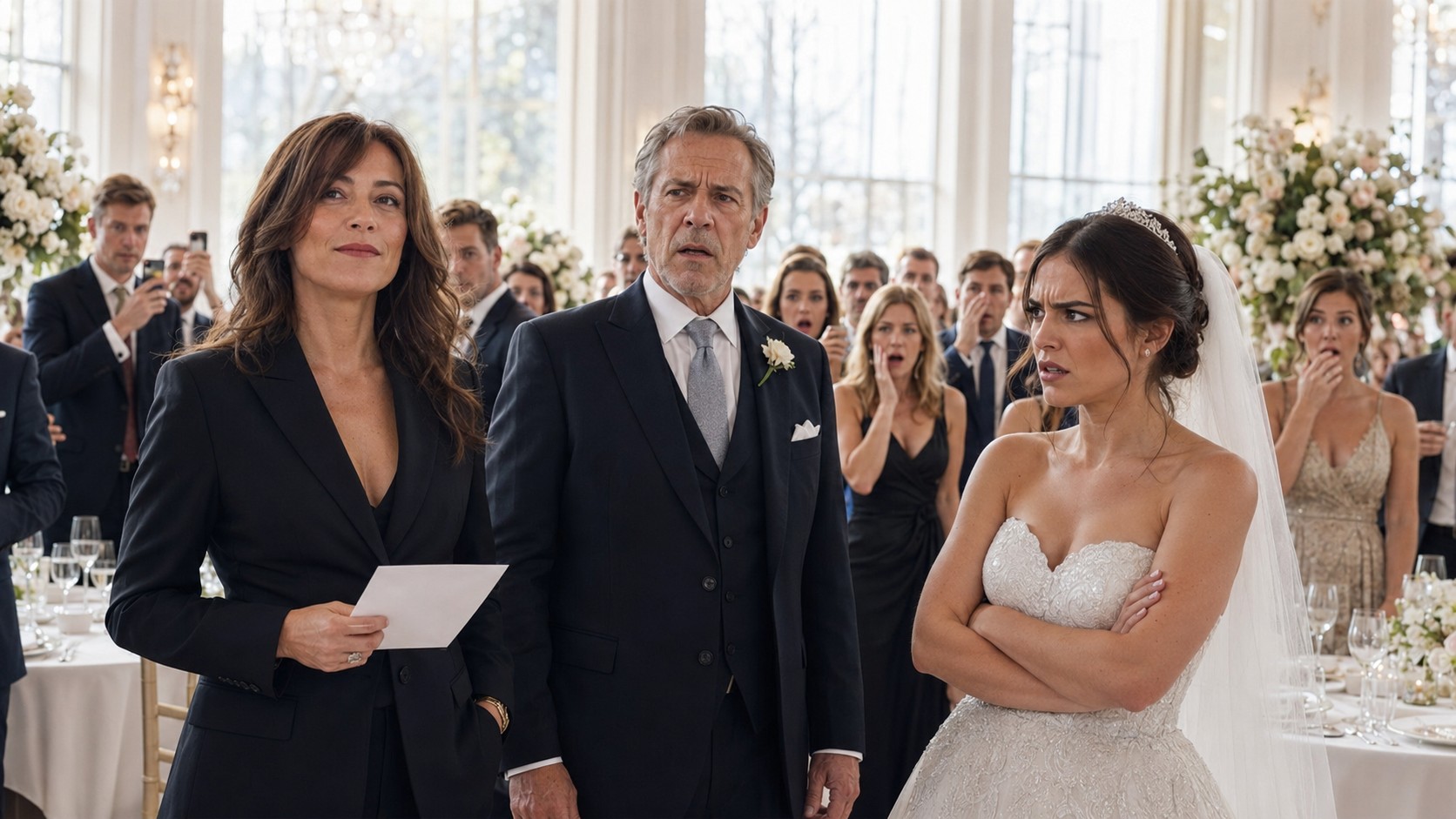

At My Sister’s Wedding, My Dad Handed Me A Family Rejection Letter — At The Reception. My Sister Thought I’d Break Down In Front Of The Cameras. I Simply Folded The Letter, Slipped It Into My Pocket, And Smiled. They Had No Idea… I Had Already…
### Part 1
The envelope was cream-colored, thick, expensive paper, the kind wealthy people use when they want cruelty to look elegant.
My father held it between two fingers while the wedding band played soft jazz behind him. Crystal glasses clinked somewhere near the champagne tower. Somebody laughed too loudly by the ice sculpture, and the sound cut off the second Franklin Whitmore raised his hand.
Two hundred guests turned toward us.
At least three cameras pointed at my face.
And my father said, “Rebecca, this is from all of us.”
He didn’t call me sweetheart. He didn’t say daughter. He said my name the way a judge reads a sentence.
My sister Emily stood beside him in her white satin gown, diamonds trembling at her ears, her lips pressed together to hide a smile. She thought she knew how this would end. She thought I would cry. Maybe run. Maybe break down in front of Charleston’s finest families, proving every ugly thing they had whispered about me for years.
Instead, I took the envelope.
The paper was cool against my fingers. The ballroom smelled like roses, perfume, buttercream frosting, and rain carried in from the harbor. The chandeliers poured gold light over everything, making the room look soft, romantic, almost holy.
That was the lie of expensive rooms. They made brutality look civilized.
I opened the envelope and read every word.
Rebecca,
After years of disappointment, distance, hostility, and embarrassment brought upon this family through your choices and behavior, we have decided it is healthier for everyone to formally separate ourselves from you.
You are no longer considered part of this family.
Please do not attend future holidays, birthdays, anniversaries, or gatherings. Do not contact us unless legally necessary.
We release you from any further obligation to this family, and we ask the same in return.
Signed,
Franklin Whitmore.
Emily Whitmore Carter.
Aunt Linda.
Uncle Robert.
Cousin Paige.
Cousin Matthew.
Even my mother’s older sister, Patricia.
For a moment, the ballroom disappeared. I saw only signatures, black ink pressed hard into expensive paper. Names of people who had eaten meals I paid for, borrowed money they never repaid, smiled into my camera calls while asking whether I could send “just a little help until Friday.”
I read it twice.
Then I folded the letter once, twice, slipped it into my purse, and smiled.
My father blinked.
That was when I knew.
For the first time in my life, Franklin Whitmore was afraid of me.
I had arrived in Charleston three hours before the ceremony. Rainclouds hung low over the harbor, turning the sky silver gray. The driver who picked me up from the airport kept glancing at me in the rearview mirror because I was wearing my dress blues.
People always stared at the uniform.
The gold buttons were polished. My ribbons were lined perfectly. My hair was twisted into a regulation bun so tight it made my scalp ache. I had spent twenty-one years in the Army learning how to move through hostile rooms without showing discomfort.
But the moment the car pulled up to the Ashcroft Hotel, that old heaviness settled behind my ribs.
The hotel looked like a place built for people who had never carried their own luggage. White columns. Brass doors. Valets in black coats. Fresh flowers everywhere, their sweet scent almost sharp.
As I stepped out, someone behind me whispered, “That must be the military sister.”
Not Rebecca.
Not daughter.
Not family.
Just the military sister.
I smiled anyway.
Inside the ballroom, everything glittered. Roses climbed the archway. Candles floated in glass bowls. Servers moved through the crowd with champagne trays. It was beautiful in the same way a showroom is beautiful—perfect, polished, and cold.
I spotted my father near the bar.
Franklin Whitmore was seventy, silver-haired, straight-backed, and dressed in a navy tuxedo that probably cost more than my first car. For one foolish second, I wondered if age had softened him.
Then his eyes met mine.
Nothing.
No smile. No pride. No warmth.
Just a nod, like I was a contractor who had arrived on schedule.
I walked toward him anyway.
“Hi, Dad.”
“You’re late.”
“The ceremony starts in forty minutes.”
“You could have come earlier. Emily’s been stressed.”
Of course she had.
Emily was always stressed when the universe failed to orbit her smoothly.
“I came as soon as my flight landed,” I said.
His eyes moved over my uniform. “You really wore that?”
There it was.
Twenty-one years of service, two deployments, a Bronze Star, and somehow the embarrassing thing was my uniform.
“It’s formal military protocol.”
“You could have worn a normal dress.”
A normal dress.
I almost laughed.
Instead, I said quietly, “I think Mom would have liked it.”
His jaw tightened. He still couldn’t stand hearing about her.
Before he could answer, Emily appeared beside us like a perfume commercial come to life. Blonde curls. White satin. Diamond bracelet. A smile so bright it had no warmth in it.
“Rebecca,” she said. “You made it.”
“Congratulations.”
“Oh my God, everyone’s been talking about your outfit.”
Not uniform.
Outfit.
A cameraman drifted nearby, pretending to film centerpieces while aiming directly at us. Emily noticed him. I noticed her noticing him.
Everything with my sister was staged.
“You’re at table fourteen,” she added.
I looked at the seating chart across the room.
Table fourteen sat by the kitchen doors.
My father’s golf buddies were closer to the head table than I was.
Something cold slid through my stomach, but I nodded. “Sounds good.”
Emily’s smile flickered. She wanted hurt. She needed it visible.
“Try not to disappear before cake this time,” she said.
That one hit closer.
Five years earlier, I had left Thanksgiving after Emily joked that soldiers got “government-funded trauma vacations.” My father laughed harder than anyone.
I never told them that two weeks before that dinner, I had lost a nineteen-year-old private under my command.
Some things become too sacred to explain to careless people.
“I’ll stay,” I said.
Emily smiled like she had won.
And by the time dinner was served, I already knew something was coming. The whispers were too coordinated. Relatives looked away too quickly. My father disappeared twice with Emily’s new husband, Daniel. The photographers kept drifting toward my table.
I didn’t know exactly what they had planned.
Not yet.
But when my father stood halfway through dessert and lifted the microphone, every instinct in my body went still.
He looked straight at me.
Then he reached into his jacket.
And I saw the cream-colored envelope.
### Part 2
My father walked toward my table slowly, like a man crossing a courtroom.
The jazz trio near the dance floor stumbled for half a beat, then kept playing softer. Forks stopped moving. A server froze with a tray of coffee cups balanced on one hand. Every face in the ballroom tilted toward me.
I stayed seated.
That bothered my father. I saw it in the small tightening around his mouth. He wanted me off balance before he delivered the blow.
“This is from all of us,” he repeated.
His voice carried through the microphone, smooth and controlled.
Emily stood near the head table, one hand resting on her bouquet, eyes bright with anticipation. Daniel, her new husband, looked confused. He glanced from Emily to my father, then to me.
That was the first clue he didn’t know everything.
I took the envelope from my father’s hand. The paper was heavy, almost luxurious. I could smell faint cologne on it. His cologne. Cedar and smoke and arrogance.
I opened it carefully.
The first sentence was designed to wound. The second was designed to shame. The signatures at the bottom were designed to bury me.
I read the letter while the room watched.
Years ago, this would have destroyed me.
At twenty-three, I would have cried in a bathroom stall, pressing my fist against my mouth so nobody heard. At thirty, I might have argued, my voice shaking, giving them exactly the evidence they needed to call me unstable.
But I was forty now.
I had stood in desert heat with dust stuck to my teeth. I had briefed generals who disliked being corrected. I had informed parents that their sons would not be coming home. I had learned the difference between pain and panic.
Pain could pass through you.
Panic made you careless.
So I did not panic.
I folded the letter once.
Then again.
Then I placed it in my purse.
“Thank you,” I said, looking up at my father, “for finally putting it in writing.”
The silence changed.
Before that moment, the room had been hungry. People didn’t want to admit it, but they had leaned forward waiting for humiliation. Now they leaned back, unsure what kind of show they had bought tickets to.
My father frowned.
Emily recovered first, of course.
She took the microphone from the stand near her table and laughed lightly. “Well, I think honesty is important in families.”
Families.
Interesting word from a woman who once returned my deployment care package unopened because it arrived during her birthday weekend and made her “feel weird.”
I stood.
The movement seemed to ripple across the ballroom. Chairs creaked. Someone whispered my name.
“I agree,” I said.
Emily’s smile tightened.
My father lowered his voice. “Don’t start something tonight.”
That almost made me laugh.
Start something.
As if he hadn’t just handed his daughter a formal exile notice between crème brûlée and wedding cake.
I picked up a champagne flute from my table. The glass was cold, slick with condensation. I took one small sip and let the bubbles burn down my throat.
Then I stepped into the center of the ballroom.
Toward the microphones.
Toward the cameras.
Toward the truth.
Emily moved quickly, too quickly. “Rebecca, maybe we should discuss this privately.”
“No,” I said gently. “Public honesty was your idea.”
Daniel looked at Emily. “What letter?”
She ignored him.
Another clue.
I took the microphone from the stand. The speakers hummed, low and electric. I looked around at the guests—women in silk, men in tuxedos, old family friends who had watched me grow up and believed whatever my father told them because believing him was convenient.
“I wasn’t planning to speak tonight,” I said. “Honestly, I wasn’t sure I should come.”
No one moved.
“My sister and I grew up six miles from here, in a white house with a broken porch swing my mother refused to throw away.”
My voice surprised me. Calm. Almost soft.
“Mom used to say broken things deserved patience.”
A few faces softened. My mother had been loved in Charleston. Not in the loud way my father was admired, but in the quiet way people remembered kindness.
“She believed family protected each other,” I said.
My father shifted.
Good.
“When I joined the Army at eighteen, my father told people I did it because I was rebellious. Because I wanted attention. Because I thought I was better than everyone.”
Emily’s eyes narrowed.
“The truth is, our electricity had been shut off twice, and I couldn’t afford college.”
The room went still.
Real still this time.
Not scandal-still.
Truth-still.
“I sent money home every month for years. Mortgage payments. Medical bills. Tuition. Emergency expenses. Emily’s car payment once.”
Several heads turned toward my sister.
“She’s exaggerating,” Emily said quickly.
I looked at her. “I kept receipts.”
That landed exactly where I wanted it to.
Not loud.
Not dramatic.
Just undeniable.
Daniel’s face changed. He turned toward Emily slowly. “You told me your father paid for college.”
Emily’s mouth opened, closed, opened again. “He did.”
“Not all of it,” I said.
My father’s voice hardened. “Enough.”
I looked at him. “No. You wanted closure. Let’s close it.”
His nostrils flared.
I remembered that look from childhood. It meant punishment was coming. Grounding. Silence. Money withheld. Affection withheld. Love turned into a locked room.
But I no longer lived in his house.
That simple fact still felt miraculous sometimes.
“For years,” I continued, “I thought if I helped enough, gave enough, stayed useful enough, maybe this family would eventually love me like it loved Emily.”
Emily laughed, sharp and ugly. “Oh, please.”
I ignored her.
“That’s what neglect does when it starts young. It teaches you to blame yourself for starving.”
A woman at table six covered her mouth.
My aunt Linda lowered her eyes.
Good.
Let them remember.
I reached into my purse.
The movement changed the air. My father saw it. Emily saw it. Daniel saw it.
I pulled out a thin manila folder.
Not thick. Not theatrical.
Just enough.
My father’s face lost color.
There it was.
The second clue became confirmation.
“Six years ago,” I said, “I discovered several loans had been opened under my Social Security number.”
Gasps moved through the room like a draft.
“At first, I thought it was random fraud.”
I opened the folder and removed the first page.
“Then I found signatures.”
My father stepped forward. “Rebecca.”
The way he said my name made me seven years old again for half a second.
Then I looked down at my medals, at the life I built without him, and came back to myself.
“Signatures connected to my father’s business accounts,” I said.
Daniel whispered, “Franklin?”
Emily shook her head. “She’s lying.”
“I confronted him privately,” I continued. “He cried. He said he was desperate. He promised he would fix it.”
My father looked at the floor.
That was his mistake.
Liars should never look down when the truth enters the room.
“He didn’t fix it,” I said. “He told relatives I was unstable after deployment.”
Aunt Linda’s head snapped up.
There it was.
The third clue.
I looked at her, and for the first time all night, she looked ashamed.
My father said, “Put those papers away.”
“No.”
One word.
Quiet.
Final.
Emily’s breathing turned shallow. The diamond bracelet on her wrist trembled when she lifted her hand to smooth her hair.
I removed another document.
“Insurance transfers after my mother’s death. Missing trust distributions. Forged authorizations. Hidden accounts. Business filings.”
Daniel stepped away from Emily.
Only one step.
But Emily felt it. I saw panic flare in her eyes.
“Daniel, honey,” she whispered, grabbing his sleeve. “Don’t listen to this.”
He looked at her hand on his arm. Then at me.
“Did you know?” he asked her.
Emily froze.
Wrong pause.
The wrong pause can ruin a life faster than a confession.
I looked at my father.
“You should have waited until after dessert,” I said.
Then the ballroom doors opened behind me.
Two men in dark suits stepped inside.
One scanned the room, then spoke calmly.
“Mr. Franklin Whitmore?”
And suddenly, my father had nowhere left to perform.
### Part 3
The agents did not rush.
That was what made them terrifying.
They entered the ballroom with the quiet confidence of people who had paperwork stronger than anyone’s reputation. No flashing lights. No shouting. No dramatic grab for handcuffs. Just two dark suits, polished shoes, and expressions that made every guest instinctively lean away from my father.
The older one repeated, “Mr. Franklin Whitmore?”
My father cleared his throat. “I think there’s been some misunderstanding.”
Of course.
Misunderstanding was his favorite word.
Not fraud.
Not theft.
Not betrayal.
Misunderstanding.
Franklin Whitmore could dress a knife in linen and call it a table setting.
The older agent stepped forward. “We only need a private conversation, sir.”
Nobody in that ballroom believed that meant anything good.
Whispers spread fast. A cousin of Daniel’s lifted her phone, pretending to check a message while recording. One of my father’s golf friends leaned toward his wife and murmured something behind his napkin. A waiter backed toward the wall with a tray of untouched cake slices.
Emily turned on me, her voice low and sharp. “You planned this.”
“No,” I said. “I prepared for it.”
There is a difference.
Planning comes from revenge.
Preparation comes from survival.
Daniel stepped farther away from Emily. His face had gone pale beneath the warm chandelier light.
“You knew?” he asked her.
Emily’s eyes filled with tears instantly.
I almost admired the speed.
My sister could summon tears the way other people sneeze.
“Daniel, baby, this is family drama,” she whispered. “Rebecca has always hated us. She’s always wanted to ruin me.”
“That’s not what I asked.”
The ballroom tightened around his words.
Emily looked at my father.
Another mistake.
Daniel saw it.
My father straightened his tuxedo jacket as if fabric could restore power. “I’m not discussing family matters in public.”
The older agent said, “Then perhaps we should move somewhere private.”
Southern wealthy families can survive almost anything except public exposure. Private cruelty is tradition. Public scandal is infection.
I watched my father calculate. His eyes moved from the agents to the guests, from Emily to me, from the cameras to the exits.
For years, he had controlled rooms with tone. He never needed to shout. One cold glance could make waiters apologize, relatives retreat, and me shrink inside my own skin.
But federal agents do not care about tone.
Emily suddenly raised her voice. “You ruined my wedding!”
There it was.
Not, Dad, is this true?
Not, Rebecca, I’m sorry.
Only the wedding.
The flowers. The cameras. The perfect white dress. The public image she had spent a year designing.
I looked at her for a long moment.
“No,” I said. “Your lies did.”
She stared at me like she wanted to slap me.
She didn’t.
Too many cameras.
That was another kind of prison. Image controlled her even when rage took over.
My aunt Linda stood suddenly from table three, her chair scraping loudly across the marble floor.
“Franklin,” she whispered, “tell me this isn’t true.”
My father snapped, “Sit down, Linda.”
That answer told the room enough.
A murmur rolled from table to table.
Uncle Robert avoided my eyes. Cousin Paige looked at her husband as if she might be sick. Patricia, my mother’s sister, pressed a hand to her throat and stared at the letter sticking halfway from my purse.
So they hadn’t all known.
Not everything.
They had signed because Franklin told them to. Because Emily cried. Because I had been made into a convenient villain years before anyone asked for evidence.
That realization hurt more than I expected.
Not enough to stop.
But enough to burn.
The older agent said, “Sir, we have questions regarding several financial accounts connected to your business and personal filings.”
Daniel stared at Emily. “Financial accounts?”
“Baby,” she said, reaching for him again.
He pulled away.
Not violently.
Gently.
That gentleness broke something in her face.
“You knew about this,” he said.
“I was trying to protect my family,” Emily whispered.
There it was again.
The sacred shield.
Family.
People like my father used that word to make victims feel selfish for bleeding.
“Protect them from what?” Daniel asked.
Emily pointed at me.
“Her. She’s always hated us because Dad loved me more.”
The sentence hung there, bright and rotten.
Several guests visibly winced.
The terrible thing was, Emily believed it. She had always believed love was a prize she won by being prettier, softer, easier to display. She never understood that being the favorite had damaged her too. It had turned her into a person who mistook attention for affection and obedience for loyalty.
“No, Emily,” I said. “I hated what you became because of it.”
Her face crumpled, then hardened.
“You think you’re so superior because you joined the military,” she snapped. “You disappeared for years. You abandoned us.”
Abandoned.
I tasted the word like metal.
“When I was deployed in Kandahar,” I said, “I called home after one of my soldiers died. He was nineteen.”
The room went very quiet.
“You told me not to sound depressing because you were hosting a pool party.”
Daniel looked at her like she had become a stranger in front of him.
Emily’s mouth trembled. “I don’t remember that.”
“I do.”
My father stepped toward me. “That’s enough.”
Another voice cut through the room.
“No.”
Everyone turned.
Aunt Linda stood gripping the back of her chair. Her face looked gray beneath her makeup.
“We didn’t know everything,” she said quietly.
My father’s eyes went hard. “Linda.”
But she kept going.
“You told us Rebecca had become unstable after deployment. You said she was harassing you about money. You said the letter would create boundaries.”
Boundaries.
God.
For one second, I nearly laughed.
For years, I had begged silently for a boundary. A boundary around my paycheck. My identity. My grief. My mother’s memory. My right to exist without being useful.
And now they had wrapped rejection in therapy language and called it health.
My father looked around the ballroom, realizing control was slipping away one witness at a time.
Then he looked at me.
Hate.
Fear.
Humiliation.
And under it all, something almost like regret.
Not for what he had done.
For misjudging how quietly I had been gathering proof.
The older agent stepped closer. “Mr. Whitmore, we need you to come with us.”
My father’s mouth tightened.
For one foolish second, I thought he might refuse. He had spent his life making smaller people bend. Maybe some part of him still believed the room belonged to him.
But then the younger agent spoke quietly into an earpiece.
My father heard it.
He adjusted his cuffs.
“I’ll cooperate,” he said.
Even then, he made it sound like generosity.
As they led him toward the side hall, Emily rushed after him. “Dad!”
He didn’t turn around.
That might have been the cruelest thing he did to her all night.
Daniel stood in the middle of the ballroom, staring at the floor. His wedding ring flashed under the chandelier, brand new and already meaningless.
I picked up my purse.
The letter was inside.
So was the folder.
So was six years of silence sharpened into evidence.
I started toward the exit.
Guests parted for me. Some looked ashamed. Some looked curious. Some looked like they wanted to apologize but didn’t want the responsibility of being heard.
Halfway to the doors, my phone vibrated.
Michael Hart, my attorney.
I answered quietly. “This isn’t a good time.”
His voice was low. “Rebecca, you need to hear this.”
I stopped walking.
Behind me, the ballroom buzzed with panic, whispers, and collapsing illusions.
“What is it?” I asked.
Michael paused.
Then he said, “We uncovered something else about your mother’s will.”
The air changed.
And suddenly the wedding, the agents, the letter, all of it felt like the surface of something much deeper.
### Part 4
I stepped outside into warm Charleston night air.
The hotel doors closed behind me, muting the chaos into a dull, expensive roar. Rain had started again, soft coastal drizzle that smelled like salt water, wet pavement, and the white lilies arranged along the entrance steps.
For a moment, I just stood under the awning and listened to my attorney breathe through the phone.
“Say that again,” I said.
Michael Hart was not a dramatic man. He had a dry voice, a careful manner, and the emotional range of a filing cabinet. That was why I trusted him. He did not exaggerate.
“We found evidence of a secondary trust your mother created six months before she died.”
I leaned against a stone column.
“That’s impossible. Dad handled the estate.”
“That’s what he wanted everyone to believe.”
Across the street, harbor lights shimmered on black water. A trolley rattled somewhere in the distance. Behind the hotel windows, guests moved in blurred clusters, their mouths open, hands flying, phones lifted.
My life was exploding ten feet behind me.
But my mother’s name froze me in place.
“What kind of trust?” I asked.
“A conditional inheritance.”
Rain tapped the edge of the awning, steady as fingers on glass.
“What conditions?”
Michael paused.
“You had to be formally separated from the Whitmore family.”
For several seconds, I couldn’t speak.
The letter in my purse seemed to gain weight.
“You’re telling me,” I said slowly, “that the letter activated it?”
“Yes.”
My knees felt strange. Not weak exactly, but distant, like they belonged to someone standing near me.
“Rebecca,” Michael said gently, “I think your mother knew there was a possibility your father would cut you out eventually.”
The first tear slipped down my face before I could stop it.
I hadn’t cried when my father handed me the letter.
I hadn’t cried when Emily called me unstable in front of two hundred people.
I hadn’t cried when federal agents walked into the ballroom and said my father’s name.
But this hurt in a different place.
Because my mother had seen me.
Even dying, even sick, even trapped in that house with Franklin Whitmore measuring every breath around his ego, she had seen me clearly enough to build protection into the future.
“What’s in the trust?” I asked.
“A lakehouse in northern Georgia. Investment accounts. Some heirlooms. And personal letters addressed to you.”
Letters.
My hand went to my mouth.
For fifteen years, I had owned only three things in my mother’s handwriting: a birthday card from when I turned seventeen, a recipe for lemon pound cake, and a note she once left in my lunchbox that said, You are braver than you think.
Emily had inherited her jewelry.
My father kept the house.
I got scraps.
Now there were letters.
“How many?” I whispered.
“Five.”
I closed my eyes.
The rain blurred with memory.
Mom at the kitchen table under yellow light, writing Christmas cards with her left hand curved slightly over the paper. Mom humming along to old Motown while stirring soup. Mom touching my cheek the night before she went into the hospital and saying, “Don’t let anyone make you hard, Beck. Strong is different from hard.”
I had tried.
God, I had tried.
“Your father attempted to challenge the trust years ago,” Michael continued. “The attorney handling it refused disclosure because the release conditions hadn’t been met.”
A laugh escaped me, quiet and bitter.
“So tonight he accidentally gave me what she left.”
“In legal terms,” Michael said, “yes.”
I looked through the tall ballroom windows.
My father was gone now, likely in some private room trying to talk his way through documents with people trained not to blink. Emily stood near the cake table, surrounded by relatives, her white dress glowing like a ghost. Daniel was nowhere near her.
For years, I thought justice would feel hot.
Triumphant.
Sharp.
But standing in the rain, all I felt was exhaustion loosening from my bones.
Revenge had never been the point.
Freedom was.
Michael told me he would send documents in the morning. I thanked him, ended the call, and stayed under the awning.
Twenty minutes passed.
Maybe thirty.
I watched rain gather in the seams of the sidewalk. Watched a valet jog to retrieve a silver Mercedes. Watched a young couple from another event run laughing beneath one umbrella, untouched by old family wars.
Then the hotel doors opened.
Daniel stepped out.
His bow tie hung loose. His tuxedo jacket was unbuttoned. The perfect groom had been replaced by a man who looked like he had aged ten years between courses.
For a moment, neither of us spoke.
Then he asked, “How long did you know about the fraud?”
“Six years.”
He stared out at the street. “And you waited.”
“I needed proof.”
He nodded slowly.
Rain blew sideways under the awning and dotted his lapel.
“She told me you were cruel,” he said.
“That probably made things easier for her.”
He closed his eyes briefly. “Was any of it real?”
I knew he wasn’t asking about the fraud.
He was asking about his marriage. His wedding. The woman upstairs in white satin.
“I think Emily loves attention,” I said. “I don’t know if she understands love beyond that.”
His jaw tightened.
“She said you were jealous of her.”
“I was,” I said honestly.
That surprised him.
“I was jealous that she got softness. Patience. Protection. I was jealous that I had to earn what she got for existing.”
Daniel looked at me then, and his expression shifted from shock to something like grief.
“I’m sorry,” he said.
Simple.
Sincere.
No performance.
It nearly broke me worse than the letter.
“You don’t owe me an apology.”
“Maybe not,” he said. “But somebody should have apologized to you a long time ago.”
I looked away because my eyes burned again.
Behind us, a burst of voices rose from inside the hotel. Emily’s voice cut through, high and furious, then disappeared behind the heavy doors.
Daniel exhaled. “They’re trying to control the narrative.”
“Of course they are.”
“Franklin says you arranged for agents to arrive during the reception for attention.”
I laughed once. “He handed me the letter with cameras pointed at my face.”
“I know.”
His voice went flat.
That was when I noticed he had taken off his wedding ring.
It sat in his palm, catching the entrance lights.
“I can’t stay married to her,” he said.
I did not answer.
He looked toward the harbor. “The papers aren’t even filed yet. The license hasn’t been submitted. My attorney says there may be options.”
“You talked to an attorney already?”
“My brother is one. He was at table nine.”
For the first time that night, I almost smiled.
Daniel slipped the ring into his pocket.
“I thought I married into a difficult family,” he said. “Not a criminal one.”
“Sometimes there’s overlap.”
He gave a tired laugh.
Then he looked at me. “Will you be okay?”
It was such a simple question.
No one in my family had asked it all night.
Maybe in years.
“I think,” I said slowly, “I already am.”
Daniel nodded.
Then he stepped into the rain and walked away without looking back.
I watched him disappear down the sidewalk.
Behind me, the doors opened again.
This time, it was Emily.
Mascara streaked.
Barefoot.
Still wearing the dress.
And in her hand, she held my mother’s pearl bracelet.
### Part 5
For a second, I forgot how to breathe.
My mother’s pearl bracelet dangled from Emily’s fingers, pale and luminous beneath the hotel entrance lights. Three strands of freshwater pearls. Tiny gold clasp. One pearl near the end slightly darker than the others.
I knew that bracelet.
I had watched my mother wear it to church, to holiday dinners, to my high school awards ceremony where my father forgot to clap. After she died, I asked where it went. My father told me it had been lost during estate cleaning.
Lost.
Emily stood barefoot on the wet stone, mascara trailing down her cheeks, white dress dragging behind her like spilled milk.
“You’re happy now?” she said.
Her voice shook, but not with sadness.
With rage.
I looked at the bracelet. “Where did you get that?”
She glanced down, then lifted her chin. “Dad gave it to me.”
“He said it was lost.”
Emily’s mouth twisted. “Maybe he just didn’t want you to have it.”
The words hit, but not deep.
Something inside me was already too tired to bleed for her.
“Give it to me,” I said.
She laughed. “No.”
The rain thickened around us. A valet near the curb suddenly found the pavement fascinating.
“That belonged to Mom.”
“She was my mother too.”
“Yes,” I said. “And she left it to me.”
Emily’s face flickered.
There.
A clue.
“You don’t know that,” she said too quickly.
“I will soon.”
Her grip tightened around the bracelet.
For the first time, I wondered how much she knew about the trust. Maybe not all of it. Maybe just enough to fear whatever was buried there.
“Did Dad tell you about the lakehouse?” I asked.
She stared at me.
Another wrong pause.
I took one step closer. “He did.”
Emily’s eyes flashed. “You don’t deserve it.”
There it was.
Not confusion.
Not surprise.
Possession.
I felt a strange calm settle over me. The same calm I used to feel before walking into a room where bad news had to be delivered cleanly.
“What else did he tell you?”
She looked away.
Behind the glass doors, guests moved through the lobby. Some pretended not to watch. One bridesmaid stood frozen near a floral arrangement, phone pressed against her chest.
Emily swallowed. “He said Mom was manipulated near the end. That she wasn’t thinking clearly.”
“My mother knew exactly what she was doing.”
“You don’t know that!” Emily shouted.
Her voice cracked across the entrance. The valet flinched.
“You were gone,” she continued. “You left. I was here. I watched her get sick. I watched Dad fall apart. You ran away and put on a uniform so everyone would call you brave.”
There it was.
The old knife, sharpened for years.
I could have told her the truth. That I had called every night until Mom became too tired to speak. That I had used leave days to sit beside her bed. That Mom was the one who told me to stay in the Army because “one of us should get out from under this roof.”
But some truths are wasted on people committed to misunderstanding you.
“I was eighteen,” I said. “I didn’t run away. I survived.”
Emily’s laugh came out broken. “You always make yourself the victim.”
“No. I spent years refusing to.”
That silenced her for half a second.
Then she held up the bracelet.
“You want this? Fine.”
Before I could move, she pulled her arm back toward the street drain.
The world narrowed to her hand.
Pearls.
Rainwater.
The black mouth of the gutter.
I crossed the space between us faster than either of us expected and caught her wrist.
Not hard enough to hurt.
Hard enough to stop her.
“Don’t,” I said.
Emily’s eyes widened. For the first time in our adult lives, she looked genuinely afraid of me.
Not because I was violent.
Because I was done yielding.
“Let go,” she whispered.
“Open your hand.”
“You’re hurting me.”
“No, I’m stopping you from destroying something that isn’t yours.”
The hotel doors opened.
Aunt Linda stepped out, followed by Patricia and two bridesmaids. Everyone froze.
Emily’s voice rose instantly. “She grabbed me!”
Of course.
Even now.
Even here.
I released her wrist and stepped back, palms visible.
“Open your hand,” I repeated.
Aunt Linda looked from me to Emily. “What are you holding?”
Emily’s face changed. She became smaller. Younger. The golden child caught with stolen candy.
“Nothing.”
Patricia came forward slowly. Her eyes landed on the pearls.
Her hand flew to her mouth.
“That’s Margaret’s bracelet.”
Margaret.
My mother’s name sounded strange after years of everyone saying Mom around me like it was a restricted word.
Patricia looked at Emily. “Franklin told me that was missing.”
Emily said nothing.
Aunt Linda’s expression hardened with shame and dawning understanding.
“How much did he take from her?” she whispered.
No one answered.
Because everyone finally understood that the answer was probably everything he could reach.
Emily’s fingers loosened.
The bracelet fell into my palm.
It was warm from her hand.
I closed my fingers around it and felt fifteen years collapse into one small circle of pearls.
Emily stepped back, trembling.
“You think this makes you better than me?” she said.
“No.”
I looked at her, really looked.
The perfect hair falling loose. The ruined makeup. The dress stained at the hem. The fury covering panic covering something emptier.
“I think it means I’m finished competing in a game Mom never wanted us to play.”
Her face crumpled.
For one moment, I saw my little sister. Eight years old. Pink backpack. Crying because Dad yelled at her for spilling juice in his office.
Then the moment passed.
She lifted her chin. “Dad will fix this.”
“No,” I said. “He won’t.”
And maybe that was the first time she understood.
Our father had not loved her better.
He had simply used her differently.
Patricia began crying quietly behind her hand. Aunt Linda whispered my name, but I couldn’t do one more family conversation under that awning.
I placed the bracelet carefully into my purse beside the letter and the folder.
Then I walked past them toward the curb.
“Rebecca,” Emily called.
I stopped.
For half a heartbeat, I wondered if she would say it.
Sorry.
Just one word.
Instead, she said, “You can’t just walk away from your family.”
I looked back at her.
Rain slid down my face, or maybe tears. I couldn’t tell anymore.
“I’m not walking away from family,” I said. “I’m walking away from people who taught me loneliness at the dinner table.”
Then I got into a waiting cab.
As the hotel disappeared behind me, my phone buzzed again.
A message from Michael.
Do not return to the hotel tonight. I just received a scanned copy of your mother’s first letter. Rebecca, your father’s name is mentioned on page two.
### Part 6
I checked into a small inn near the Battery under my middle name.
Old habits.
The lobby smelled like lemon polish and damp wood. A sleepy clerk with silver glasses handed me a brass key instead of a plastic card, and for some reason that almost made me cry. After years of hotels with identical carpets and humming ice machines, the place felt human. Uneven floors. Framed watercolors. A grandfather clock ticking too loudly by the stairs.
My room overlooked a narrow street shining with rain.
I locked the door.
Then I locked the chain.
Then I sat on the edge of the bed in my dress blues and stared at my phone.
Michael’s message glowed on the screen.
Your father’s name is mentioned on page two.
I wanted to call immediately.
Instead, I took off my jacket first.
Slowly.
Button by button.
There are moments when your life changes so violently that small rituals become the only thing keeping you attached to your body. I hung the jacket over a chair. Removed my shoes. Took out the pearl bracelet and placed it on the bedside table.
The pearls looked soft in the yellow lamp light.
Like they had been waiting.
Only then did I call Michael.
He answered on the first ring.
“I’m at the inn,” I said. “Tell me.”
“I’m sending the letter securely now. Read it before I explain.”
A few seconds later, the file arrived.
My hands were steady until I saw my mother’s handwriting.
Rebecca.
Not Becca.
Not Becky.
Rebecca.
My full name in her elegant, slanted script.
I enlarged the page and began reading.
My dearest Rebecca,
If this letter has reached you, then I am gone, and Franklin has done something I feared he might do. I hope I am wrong. I hope grief softened him. I hope he chose love over pride. But I have lived with your father long enough to know that men who worship control often mistake daughters for possessions.
I stopped.
The room blurred.
Outside, tires hissed over wet pavement.
I kept reading.
You were always the child who saw too much. Emily learned to survive by pleasing him. You learned by watching the exits. Neither of you should have had to learn survival in your own home.
I pressed my fist to my mouth.
There it was.
The truth no one had ever said out loud.
My mother had known.
Not vaguely.
Not emotionally.
Specifically.
I read page two.
Franklin will tell people you are difficult. He will say you abandoned us. He will turn your strength into disobedience and your silence into guilt. Do not believe him. I have documented what I could. If he attempts to cut you out, the trust will open. If he uses your name, your credit, or your inheritance, Mr. Albright has instructions.
Mr. Albright.
The Savannah attorney.
I whispered the name like a password.
Then came the sentence Michael warned me about.
Your father asked me twice to sign documents giving him control over your future inheritance. I refused. The third time, he brought Emily into the room and told me I was choosing you over her.
I closed my eyes.
I could see it.
My father standing beside Mom’s bed, voice low, polished, wounded. Emily crying because Dad’s pain always became everyone else’s emergency. Mom, sick and tired, being asked to divide her daughters like property.
I kept reading.
Please understand this: I did not love Emily less. I feared Franklin would turn her into a mirror for himself. I feared he would turn you into the debt collector for everyone else’s needs.
That broke me.
Not loudly.
I folded forward over my knees, phone in one hand, the other pressed against my chest as if I could hold the pieces together physically.
For years, I had wondered whether Mom would have chosen Emily too if she had lived.
Now I had the answer.
She had chosen truth.
When I finally lifted the phone again, I finished the letter.
One day they may mistake your loyalty for permission. Do not let them. One day they may mistake your silence for weakness. Let them. A quiet woman is not always a broken one. Sometimes she is simply gathering the courage to leave without looking back.
I love you beyond their ability to measure it.
Mom.
I sat there until the phone screen dimmed.
Then I called Michael back.
He didn’t ask if I was okay.
Good man.
“What are Mr. Albright’s instructions?” I asked.
“Albright died three years ago, but his firm preserved everything. There are sealed documents, financial records, and apparently audio notes from your mother.”
I stood so quickly the floor creaked. “Audio?”
“Yes.”
The word moved through me like electricity.
My mother’s voice.
For fifteen years, I had tried to remember it accurately. Some days I could. Some days all I had was a shape, a warmth, a cadence. Grief steals sound first.
“When can I hear them?”
“Soon. But Rebecca, there’s more. Franklin may have attempted to access the trust using medical competency claims after your mother died. If that’s true, it connects directly to the fraud investigation.”
I looked at the bracelet on the table.
Its pearls glowed quietly.
“So the agents already know?”
“They know enough. Your documentation opened one door. Your mother’s trust may open several more.”
A sound rose in my throat, half laugh, half sob.
My father thought he had spent fifteen years burying my mother’s intentions.
But she had built a room underground and left me the key.
“What do you need from me?” I asked.
“For now? Stay away from your family. Don’t answer calls from Franklin, Emily, or any relative without telling me. And tomorrow morning, we’ll start securing your mother’s assets.”
“My mother’s assets,” I repeated.
The words felt unreal.
After we hung up, I showered and stood under hot water until my skin went pink. I washed hairspray out of my bun. Washed rain from my face. Washed Charleston’s perfume and ballroom dust from my hands.
When I came out, my phone showed seventeen missed calls.
Emily.
Aunt Linda.
Unknown number.
Patricia.
Emily again.
Then one voicemail from my father.
I knew I shouldn’t listen.
I did anyway.
His voice came through low and controlled.
“Rebecca. You’ve made your point. Call me before this goes further. There are things about your mother you don’t understand.”
I listened twice.
Not because I believed him.
Because in the background, behind his voice, I heard another sound.
A woman crying.
Emily.
And then my father whispered away from the phone, barely audible, “Find out what Albright kept.”
The voicemail ended.
I stood barefoot in the quiet room, phone in my hand, my mother’s pearls beside me.
My father wasn’t calling to apologize.
He was still hunting.
And now I knew exactly what he was afraid I would find.
### Part 7
By sunrise, Charleston looked scrubbed clean.
That offended me a little.
After a night like that, the sky should have looked cracked. The streets should have carried visible evidence. But the city woke under pale gold light, magnolias dripping rainwater, church bells ringing somewhere far off, tourists already wandering with coffee cups and bright umbrellas.
Scandal does not stop the world.
It only changes who can stand inside it.
I met Michael at a quiet café three blocks from the courthouse. He wore a gray suit, no tie, and the expression of a man who had slept badly with purpose. He had a leather folder under one arm and ordered black coffee before sitting across from me.
“You look terrible,” I said.
“You look decorated and dangerous,” he replied.
It was the closest thing to a joke I had ever heard from him.
I wore civilian clothes now. Dark jeans, white shirt, navy blazer. My uniform hung back at the inn, cleaned and pressed. I needed Rebecca today, not Lieutenant Colonel Whitmore.
Though honestly, she came with me anyway.
Michael slid a document across the table.
“Before we begin, there’s something you should understand. Your mother’s trust wasn’t just emotional protection. It was legal architecture.”
“Meaning?”
“Meaning she anticipated interference.”
I read the top page.
Margaret Ellis Whitmore Irrevocable Conditional Trust.
My mother’s maiden name sat in the middle of the page like a door opening.
Michael tapped one clause. “The trust activates upon formal written disinheritance, familial rejection, or documented financial exploitation by Franklin Whitmore or any party acting under his influence.”
I stared at the words.
“She wrote ‘familial rejection’ into a legal document?”
“She had a very careful attorney.”
“She had a very careful fear,” I said.
Michael nodded once.
He showed me asset summaries. The lakehouse. Investment accounts. Jewelry. Letters. Audio recordings. A sealed memorandum. A list of items believed to be in Franklin’s possession.
That list made my stomach tighten.
Pearl bracelet.
Gold locket with blue enamel.
Three savings bonds.
One cedar recipe box.
Margaret’s personal journals, 1997–2011.
I looked up. “Journals?”
“According to the trust inventory, yes.”
“My father has them?”
“Possibly.”
The café noise seemed to fade.
My mother had kept journals. I remembered them suddenly. Slim leather books she tucked into the drawer of her nightstand. As a child, I thought they were boring adult things. Grocery lists. Church notes. Maybe recipes.
Now they felt like witnesses.
“What’s in the sealed memorandum?” I asked.
Michael’s expression shifted.
“I don’t know yet. It requires identity verification and formal acknowledgment from you. The Savannah firm is sending a representative tomorrow.”
“Why not today?”
“Because Franklin’s attorney contacted them at seven this morning.”
My coffee turned bitter in my mouth.
“He already knows.”
“He knows enough to panic.”
Michael pulled another page from the folder.
“Also, Daniel Carter’s attorney reached out. Daniel intends to cooperate if needed.”
That surprised me less than it should have.
“Is he safe from this?”
“Depends on whether Emily commingled anything after marriage. But given the timing, likely yes. He’s moving quickly.”
“Good.”
Michael studied me. “You feel sorry for him.”
“I feel sorry for anyone who discovers the truth in public.”
“That includes you.”
“I had six years of rehearsal.”
He did not smile.
A television mounted above the café counter suddenly caught my attention. Local news. No sound, only captions. A blurred clip of the wedding ballroom appeared on-screen.
Decorated Army officer disowned during sister’s wedding before federal agents arrive.
My face flashed across the screen.
I looked away.
Michael followed my gaze. “It’s spreading.”
“Of course it is.”
“Rebecca, public attention may pressure the investigation, but it can also make your family unpredictable.”
“My family was unpredictable in private. At least now people are watching.”
My phone buzzed.
Unknown number.
Then again.
Then Emily.
Then Patricia.
I turned it face down.
Michael said, “Don’t answer.”
“I know.”
But when it buzzed a fifth time, a text preview appeared.
Aunt Linda.
Please. I need to tell you what Franklin made us sign.
I showed Michael.
He frowned. “Could be useful. Could be manipulation.”
“Both things can be true.”
“That should be on your family crest.”
Despite myself, I laughed.
Then I opened the message.
Aunt Linda had sent a photo.
Not of the rejection letter.
Of another document.
A non-disclosure agreement.
My father had made relatives sign it before the wedding.
My pulse slowed.
There was my name.
There was the phrase emotional disturbance.
There was language about protecting the family from reputational harm caused by Rebecca’s anticipated outburst.
Anticipated.
So they hadn’t just planned humiliation.
They had prepared to use my reaction as proof.
My father wanted me publicly discredited before the investigation closed around him.
A red herring suddenly clicked into place. The letter wasn’t only cruelty. It was strategy.
If I exploded, he could point to the room and say, See? Unstable. Vindictive. Unreliable witness.
Michael read the document twice.
His face went cold.
“This is very useful.”
“I thought so.”
A second message arrived from Linda.
I’m sorry. I believed him. Patricia did too. He said you threatened to expose private family matters unless Emily paid you.
I sat back slowly.
There it was.
The story he had built.
I was not a daughter seeking justice.
I was a jealous sister attempting extortion.
No wonder Emily had looked excited. She thought the cameras would capture my collapse and complete their narrative.
But I hadn’t collapsed.
I had folded the letter.
Smiled.
And let the truth enter through the front doors in dark suits.
Michael placed the NDA into his folder.
“Rebecca, I need to ask you something uncomfortable.”
“Go ahead.”
“Did you ever threaten Emily?”
“No.”
“Did you ask her for money?”
I laughed. “Emily still owes me eight thousand dollars from 2014.”
He wrote something down.
Then his phone rang.
He answered, listened, and his eyes sharpened.
“Send it now,” he said.
A few seconds later, his email chimed.
He opened the attachment.
The color left his face.
“What?” I asked.
He turned the screen toward me.
It was a scanned page from my mother’s sealed memorandum.
Only one paragraph was visible.
If Franklin attempts to portray Rebecca as unstable, request review of Dr. Hensley’s private letter dated March 3, 2011. It contains my statement regarding Franklin’s financial coercion and my fear for Rebecca after my death.
I read it once.
Then again.
Dr. Hensley had been my mother’s physician.
My father had always said she adored him.
Apparently, she had been taking statements.
Michael whispered, “Your mother didn’t just protect you.”
I finished the sentence.
“She documented him.”
The café door opened behind me.
A bell chimed.
I looked up instinctively.
Emily stood in the doorway wearing oversized sunglasses and yesterday’s ruined pride.
And beside her was my father’s attorney.
### Part 8
Emily looked smaller in daylight.
Not humble. Never that.
Just less convincing.
Without the chandeliers, the satin, the orchestra, and the audience trained to admire her, she looked like a tired woman hiding behind designer sunglasses at nine in the morning.
The man beside her was Mercer Doyle, my father’s attorney. I recognized him from fundraisers and courthouse steps. Tall, silver-haired, expensive watch, smile like a polished blade.
Michael stood immediately.
I stayed seated.
That choice mattered.
Standing would suggest alarm. Running would suggest guilt. I lifted my coffee and took one slow sip as Emily walked toward our table.
Mercer smiled. “Rebecca.”
“Mr. Doyle.”
Emily removed her sunglasses.
Her eyes were swollen.
A bruise-colored shadow sat beneath her lower lashes. For a moment, I felt a tiny pull of pity, old and reflexive.
Then she spoke.
“You need to stop.”
The pity disappeared.
Michael said, “My client is not speaking with you without counsel.”
Emily ignored him. “Do you understand what you’re doing to Dad?”
I looked at her.
Really looked.
“He committed crimes, Emily.”
Her mouth tightened. “You don’t know that.”
“I know he used my identity. I know he took money Mom tried to protect. I know he lied to everyone about me.”
Mercer lifted one hand. “These are serious allegations.”
“They came with serious documents.”
His smile didn’t move, but his eyes hardened.
Michael said, “Unless you have formal business, leave.”
Mercer slid a small envelope onto the table.
I did not touch it.
“What is that?” I asked.
“A proposal,” he said. “An opportunity to resolve family matters discreetly.”
Family matters.
There it was again.
The language of burying bodies under flower beds.
Michael picked up the envelope, opened it, scanned the page, and gave a humorless laugh.
“No.”
I looked at him. “What?”
He handed it to me.
Settlement Agreement.
They were offering to “restore family contact,” issue a “private clarification,” and provide a payment from Franklin’s personal accounts in exchange for my withdrawal of cooperation from “non-family investigative channels.”
I read it twice because the audacity deserved attention.
Then I looked at Emily.
“You thought I wanted contact?”
Her lips trembled. “You wanted Dad’s love your whole life.”
The sentence struck cleanly.
Because it was true.
That was the ugliest part of manipulation. Sometimes the people hurting you know exactly where the soft place is because they made it soft.
“Yes,” I said.
Emily’s eyes flickered with triumph.
“I did,” I continued. “But wanting something doesn’t mean I’m still willing to bleed for it.”
Mercer leaned forward. “Rebecca, no one benefits from escalation.”
“Women like me always hear that right before someone asks us to swallow the truth.”
Michael’s mouth twitched, but he stayed silent.
Emily whispered, “He’s our father.”
“No. He’s your father. He made it very clear last night that I’m no daughter of his.”
“You don’t mean that.”
“I didn’t write the letter.”
Her face crumpled.
For half a second, I thought she might apologize.
Instead, she said, “I was angry.”
“You signed it.”
“Dad said it was symbolic.”
“It said not to contact you unless legally necessary.”
Mercer’s expression sharpened at my exact memory.
Good.
Let him know I remembered every word.
Emily leaned closer. “He’s seventy, Rebecca. If this goes federal, if they charge him, he won’t survive prison.”
I set the agreement down.
The café smelled suddenly too sweet—cinnamon rolls, burnt espresso, sugar warming under glass.
“Then he should have spent seventy years becoming the kind of man who didn’t belong there.”
Emily recoiled like I had slapped her.
Mercer finally dropped the friendly act. “Your military career may not shield you from scrutiny either.”
Michael’s voice turned ice-cold. “Careful.”
Mercer smiled. “I’m merely noting that public accusations can invite review. Emotional stability. Combat trauma. Financial motives.”
There it was.
The threat.
Not subtle.
Not even creative.
I felt my pulse slow.
People think courage feels like fire. Sometimes it feels like ice.
I opened my purse and removed my phone.
“What are you doing?” Emily asked.
“Recording the rest of this conversation.”
Mercer’s face changed.
Only slightly.
But enough.
Michael said, “South Carolina is a one-party consent state.”
Mercer stood. “We’re done here.”
“No,” I said. “You came to my table.”
Emily grabbed the envelope, but Michael placed his hand over it first.
“That stays,” he said.
Mercer looked at him.
Michael looked back.
Neither blinked.
Finally, Mercer released a soft breath through his nose. “This could have been handled privately.”
I stood then.
Slowly.
“Last night my father handed me a rejection letter in front of two hundred people and three cameras. Private ended there.”
Emily’s eyes filled again.
This time, the tears looked real.
“You hate me,” she whispered.
I thought about lying. Thought about softening it. Thought about giving her the comfort she had never given me.
“I don’t hate you,” I said. “I don’t trust you. I don’t admire you. I don’t want you near me. But hate would require me to keep carrying you, and I’m done.”
Her face went blank.
Maybe no one had ever told her they were done before.
Mercer touched her elbow. “We’re leaving.”
As they turned, Emily looked back.
“Mom would be ashamed of you.”
The café seemed to tilt.
Michael took one step forward, but I lifted a hand.
“No,” I said quietly. “Mom left instructions because she was ashamed of him.”
Emily’s mouth opened.
Nothing came out.
Then she walked out.
The bell above the door jingled cheerfully after them.
For several seconds, I stood there listening to my own breathing.
Michael picked up the settlement agreement.
“This is attempted witness tampering adjacent,” he said.
“Adjacent?”
“I’m being polite.”
“Don’t be.”
He slipped it into the folder.
My phone buzzed again.
This time, a message from an unknown number.
Ms. Whitmore, this is Claire Albright from Albright & Stone in Savannah. I represent your mother’s trust. We need to meet today. We located the audio recordings, but one file appears to have been accessed recently.
I showed Michael.
His face darkened.
“Recently?” I said.
Another message arrived before he could answer.
It was only six words.
Franklin knows about the last tape.
### Part 9
Michael drove us to Savannah himself.
He said it was because the documents were too sensitive for email now. I suspected it was also because he didn’t trust me not to drive angry.
The highway stretched ahead under a washed-blue sky. Marsh grass flashed gold along the roadside. My phone sat silent in the cup holder, turned off for the first time in years. Without its buzzing, the car felt almost sacred.
I watched live oaks pass by, their branches heavy with Spanish moss.
My mother had loved Savannah.
When I was nine, she took me there for my birthday because Emily had the flu and my father refused to “waste a reservation.” Mom and I ate pralines by the river, toured old houses, and bought postcards we never mailed. She wore a blue dress and the pearl bracelet. I remembered her laughing when wind off the water wrecked her hair.
That memory had no father in it.
Maybe that was why it felt clean.
Albright & Stone occupied the second floor of a restored brick building near a square shaded by ancient oaks. The lobby smelled of paper, leather, and old air-conditioning. Claire Albright met us at the door.
She was in her late thirties, Black, composed, with close-cropped hair and sharp eyes. She carried herself like someone who had inherited both grief and discipline.
“My father handled your mother’s trust,” she said after introductions. “He spoke highly of Margaret Whitmore.”
Hearing my mother’s full name from a stranger’s mouth made my chest tighten.
Claire led us into a conference room where three banker’s boxes sat on the table.
I stopped in the doorway.
“Those are hers?”
“Yes,” Claire said. “Copies only. Originals are in secure storage.”
Three boxes.
My mother’s final defense reduced to cardboard and labels.
Or preserved by them.
Claire opened the first box and removed a folder.
“Before we discuss the audio, you need context. Your mother came to my father in 2011. According to his notes, she was afraid your father was pressuring her to revise estate documents.”
“She was sick then,” I said.
“Yes. But according to Dr. Hensley, she was competent. Very competent.”
Claire handed me a copy of the doctor’s letter.
Margaret Ellis Whitmore is of sound mind and clearly understands the legal consequences of her estate planning decisions.
I read the sentence three times.
My father’s old story dissolved under it.
Claire continued. “Your mother made statements to both my father and Dr. Hensley regarding financial coercion. She also expressed concern that Franklin would isolate you from family resources after her death.”
Michael asked, “And the tapes?”
Claire’s expression changed.
“There are four standard audio recordings and one sealed recording labeled only Rebecca—when necessary.”
My skin prickled.
“When necessary?” I repeated.
Claire nodded. “The sealed recording was not meant to be played unless Franklin challenged the trust, attempted to access it, or harmed you financially.”
“He did all three,” Michael said.
“Yes.”
Claire folded her hands.
“Yesterday evening, after the wedding incident went public, someone attempted remote access to our archived index through an old client portal.”
“Franklin?” I asked.
“We can’t prove that yet. But the login credentials belonged to Mercer Doyle’s office.”
Michael swore softly.
Claire glanced at him.
He said, “Apologies.”
“Accepted.”
She turned back to me. “They accessed the inventory list but not the recording itself. However, they now know the sealed tape exists.”
“What’s on it?”
Claire looked at the boxes.
“I don’t know. My father’s notes say only this: Client was emotional but clear. Recording contains disclosure regarding F.W. and E.W.”
E.W.
Emily Whitmore.
My stomach tightened.
“What did Emily do?”
Claire’s face softened slightly. “Ms. Whitmore, we should listen together.”
She placed a small digital recorder on the table. Beside it, she set a sealed envelope that had already been opened for transfer. My name was written across the front in my mother’s hand.
Rebecca—when necessary.
My fingers went cold.
Michael sat beside me, close enough to intervene, far enough to let the moment belong to me.
Claire pressed play.
Static.
A chair creaked.
Then my mother’s voice filled the room.
Soft.
Tired.
Alive.
“Is it recording?”
Another voice answered, male, likely Mr. Albright. “Yes, Margaret.”
My hand flew to my mouth.
Fifteen years vanished.
I was back in the kitchen. Back in the passenger seat. Back with my head in her lap during thunderstorms while she stroked my hair and told me lightning was just the sky making room for light.
Her voice continued.
“Rebecca, sweetheart, I am so sorry if you are hearing this. I tried to leave you truth in gentler ways. But if this recording has been released, then gentleness has failed.”
I closed my eyes.
Michael’s hand rested quietly on the table, not touching mine, just there.
My mother breathed shakily on the tape.
“Your father has been moving money. More than he admits. He asked me to sign access to accounts intended for you. I refused. He became very cold after that.”
A pause.
“And Emily…”
The room seemed to hold its breath with me.
“Emily heard more than she should have. Franklin told her I was punishing her by protecting you. She was angry. She said if I loved both my daughters, I would make things equal.”
Mom’s voice broke slightly.
“I tried to explain that equal is not always fair when one child has been given everything and the other has been asked to pay for it.”
A tear dropped onto my hand.
The tape continued.
“Two weeks later, a page disappeared from my desk. A draft letter to Rebecca. Franklin denied taking it. Emily cried and said I was accusing her because I preferred Rebecca. I did not have strength for the fight.”
My jaw tightened.
The missing draft.
“What was in the letter?” I whispered, though the tape couldn’t answer me.
Then Mom did.
“That draft contained the location of the lakehouse deed, account numbers, and the name Albright.”
Emily had known.
Maybe not the whole structure.
But enough.
Enough to help bury it.
My mother coughed softly on the recording.
“If Emily participated, I pray it was because she was young and afraid. But fear does not erase harm. Rebecca, do not let them convince you that forgiveness is the price of peace. It is not.”
I broke then.
Silently, completely.
Because my mother had given me permission no one else ever had.
Not to forgive.
Not to return.
Not to shrink my pain into something easier for them to digest.
The tape clicked softly as it ended.
No one spoke.
Then Claire’s office phone rang outside the room.
Once.
Twice.
She stood and stepped out.
Michael handed me a tissue.
I laughed through tears. “You carry tissues?”
“I represent families in litigation.”
“Fair.”
Claire returned less than a minute later.
Her face had changed.
“That was our receptionist,” she said. “Mercer Doyle is downstairs.”
Michael stood. “Of course he is.”
Claire looked at me.
“He’s not alone.”
My pulse slowed.
“Who’s with him?”
Claire hesitated.
“Emily. And two men claiming to be from a private security firm.”
Outside the conference room, footsteps echoed on the stairs.
And for the first time all day, I understood my father was no longer trying to hide the truth.
He was trying to reach it before I could use it.
### Part 10
Claire locked the conference room door before the footsteps reached the hall.
It was a small sound.
Click.
But in that moment, it felt like a line drawn across the floor.
Michael was already gathering documents. “Do you have secure storage in this office?”
“Yes,” Claire said. “Fireproof room, keypad, no external windows.”
“Move the boxes.”
I stood. “What about the recording?”
Claire removed the tiny memory card from the recorder and slipped it into a small evidence sleeve. “This stays with me.”
A heavy knock struck the outer office door.
Not polite.
Not violent.
Confident.
“Ms. Albright?” Mercer Doyle’s voice called. “We know you’re in there.”
Claire’s eyes hardened. “He does not get to speak to me like that in my father’s office.”
The receptionist said something faintly beyond the door. Mercer replied too low to catch.
Then Emily’s voice rose.
“Rebecca, open the door.”
I almost laughed.
Even now, she thought doors opened because she wanted them to.
Michael looked at me. “Do not engage.”
I nodded.
Then Emily said, “I know you heard it.”
The room went still.
Claire’s face tightened.
Emily’s voice trembled through the wood. “I know about the tape. Dad told me what Mom said. It wasn’t true.”
I closed my eyes.
There it was.
Proof she knew enough to be afraid.
Claire moved quickly, carrying one box toward a narrow side door. Michael took another. I grabbed the third, its cardboard edges biting into my palms.
The box was heavier than expected.
My mother’s paper had weight.
We moved into the secure room just as Mercer knocked again.
“Ms. Albright, withholding trust materials under disputed competency conditions may expose you to liability.”
Claire muttered, “He can expose himself to the elevator.”
Under other circumstances, I might have liked her immediately.
The secure room smelled like metal and dust. Shelves lined the walls, stacked with labeled containers. Claire placed the evidence sleeve in a small lockbox, entered a code, then shut it behind a steel door.
Only then did she call building security.
Michael called someone else.
Federal contact, I guessed.
I stood with my mother’s box at my feet and listened to Emily outside.
“She’s twisting everything!” Emily cried. “Mom was sick. She didn’t know what she was saying. Rebecca always made Mom feel guilty.”
The old anger stirred.
Not explosive.
Clean.
I walked back toward the conference room door.
Michael whispered, “Rebecca.”
“I won’t open it.”
I stood on my side of the door and spoke clearly.
“Emily.”
Silence.
Then: “Finally.”
“You said Mom didn’t know what she was saying.”
“She didn’t.”
“Then why are you scared of what she said?”
No answer.
Mercer cut in. “This conversation is inappropriate.”
“It became appropriate when you showed up with private security.”
“We are here to preserve contested materials.”
Claire snapped, “You are here without a court order.”
Another silence.
Then Emily said softly, “Rebecca, please.”
That word.
Please.
It touched the old part of me that had once wired money from war zones because Emily cried into poor phone connections. The part that heard please and forgot self-respect.
I took a breath.
“What do you want?”
“Don’t release the tape.”
“I didn’t release it. I listened to it.”
“She was wrong about me.”
“Were you in the room when Dad pressured her?”
Silence.
“Did you take the draft letter from her desk?”
Still silence.
My throat tightened.
“Emily.”
Her voice came smaller. “I was twenty-three.”
I closed my eyes.
There it was.
Not denial.
Defense.
“I was twenty-three,” she repeated. “Dad said Mom was confused. He said you were manipulating her from the Army. He said if Mom left things uneven, it would destroy us.”
“So you helped him hide it.”
“I didn’t understand.”
“You understood enough to keep quiet for fifteen years.”
She made a sound like a sob.
Mercer interrupted sharply. “Emily, stop speaking.”
Too late.
Michael was recording. Claire too, probably. I hoped so.
Emily said, “You left me with him.”
That hit me harder than I expected.
Because under all the lies, that was the small true thing. I had left. I had saved myself. She had stayed in the house with our father’s moods and grief and manipulation.
For one second, I saw us both as girls inside the same burning home, each choosing a different exit.
Then I remembered she had locked mine behind me.
“I was a child too,” I said.
“You were eighteen.”
“Yes. A child with a duffel bag and no money.”
“You were strong.”
“I shouldn’t have had to be.”
The words echoed in the hallway.
For once, Emily had nothing to say.
Then Mercer’s voice turned hard. “Ms. Whitmore, this is your final opportunity to resolve matters privately.”
I smiled though he couldn’t see me.
“My father already tried that with a settlement agreement. Then with threats. Now with intimidation. Tell him the pattern is getting boring.”
A thud sounded against the outer office wall.
One of the security men, maybe.
Claire moved toward the door. “Building security is coming.”
Michael checked his phone. “So are federal agents.”
For the second time in twenty-four hours, that sentence changed the temperature of a room.
Outside, Mercer lowered his voice.
“We’re leaving.”
Emily cried, “No, I need to talk to her!”
“You’ve done enough talking.”
Footsteps retreated.
I opened the conference room door only after Claire confirmed through the peephole that the hallway was clear.
The receptionist sat at her desk, pale but upright. A plant had been knocked sideways. A framed certificate hung crooked on the wall.
“They didn’t touch anything important,” she said.
Claire walked over and straightened the certificate with one firm motion.
Then she looked at me. “Your family has terrible manners.”
I laughed once, but it came out shaky.
Michael’s phone rang.
He answered, listened, then looked at me.
“Franklin has been detained for further questioning.”
I leaned against the conference table.
It should have felt like victory.
It didn’t.
It felt like a door closing in a house I no longer lived in.
Claire returned to the secure room and brought out one item from the box.
A sealed envelope.
“Your mother left this separate from the legal materials,” she said. “It’s marked for after the first recording.”
My name was written on the front.
Rebecca, after you hear my voice.
I opened it with trembling fingers.
Inside was one page.
At the bottom, beneath my mother’s signature, was a postscript.
Do not go back to the Charleston house alone. What Franklin wants most is hidden where grief began.
The Charleston house.
Our childhood home.
The one my father claimed he sold years ago.
Michael saw my face.
“What is it?”
I looked up.
“He never sold the house.”
### Part 11
The house on Waverly Lane should have been gone.
That was what my father told everyone. Sold after my mother died. Too many memories. Too much maintenance. Too painful.
He moved into a polished waterfront condo six months later and spoke of the old place with rehearsed sadness whenever someone mentioned it.
But by late afternoon, Michael confirmed the truth through property records.
The house had never been sold.
It had been transferred into a holding company connected to my father’s business.
Then rented occasionally.
Then left vacant.
Then quietly maintained.
“He kept it,” Michael said over speakerphone as Claire drove us back toward Charleston. “Through a corporate entity.”
I stared out the window at the passing marshland.
“What Franklin wants most is hidden where grief began.”
My mother’s words looped in my head.
Not where love began.
Not where family began.
Where grief began.
The house.
Waverly Lane sat beneath old oak trees in a neighborhood where porches sagged beautifully and people pretended not to notice decay if the last name was respectable enough. When Claire pulled up to the curb, I recognized the broken porch swing immediately.
It was still there.
Weathered. Gray. Hanging slightly crooked.
My throat tightened.
My mother had refused to throw that swing away. “Broken things deserve patience,” she always said.
The white paint had peeled. Ivy climbed one side of the porch. The windows were dark. But someone had cut the grass within the last month.
Michael arrived ten minutes later with a locksmith and two plainclothes federal agents I recognized from the wedding—older agent, younger agent. The older one introduced himself properly this time.
Agent Calloway.
“Ms. Whitmore,” he said. “We’re here to observe and preserve evidence if found.”
Not protect.
Not comfort.
Observe and preserve.
That was enough.
The locksmith opened the door in under four minutes.
The smell hit me first.
Dust.
Old wood.
Closed rooms.
And beneath it, faintly, lemon cleaner, like memory refusing to leave.
I stepped inside.
The foyer was smaller than I remembered. Childhood makes every room enormous. The staircase still curved to the second floor. The wallpaper was faded yellow roses. A dark rectangle on the wall showed where my mother’s mirror once hung.
My boots sounded too loud on the hardwood.
Emily and I used to race down that hallway in socks until Mom yelled we would crack our heads open. Dad’s study had been to the left. Living room to the right. Kitchen straight back.
“Where did grief begin?” Claire asked softly.
I knew.
“The study.”
My father’s study had always been forbidden. Heavy door. Brass handle. Shelves of law books he never read but liked visitors to see. After Mom’s funeral, he locked himself inside for three days. When he came out, he smelled like bourbon and rage, and he never spoke her name gently again.
We entered carefully.
The room was mostly empty now. No desk. No books. Dust marked where furniture used to sit. Afternoon light sliced through the blinds, making the air visible.
Agent Calloway looked around. “Any hidden compartments you know of?”
“No.”
Then I saw it.
The baseboard behind where my father’s desk had been.
One section sat slightly proud of the wall.
A memory surfaced.
Mom kneeling there with a screwdriver when I was twelve, laughing because she dropped an earring behind the shelf. Dad snapping at her to leave his office alone. Her face closing.
I pointed.
“There.”
The younger agent photographed the wall before touching anything. The locksmith pried the baseboard gently. Behind it was a narrow cavity.
Inside sat a metal box.
Small.
Black.
Locked.
No one spoke as Agent Calloway lifted it out.
The box was heavier than it looked.
Claire documented the seal. Michael watched like a man seeing a case turn into a storm.
The locksmith opened it with careful tools.
Inside were journals.
Three leather books.
A stack of envelopes.
A flash drive.
And a photograph.
The photograph lay on top.
My mother, younger, standing on the porch swing with me at about sixteen and Emily at thirteen. Mom’s arms around both of us. I was smiling awkwardly. Emily was leaning into her. Dad was not in the picture.
On the back, in Mom’s handwriting:
My girls, before Franklin taught them to stand on opposite sides of love.
I had to sit down.
The floor was dusty.
I didn’t care.
Claire crouched beside me but didn’t speak.
Michael put the journals into evidence sleeves. Agent Calloway examined the flash drive.
Then the younger agent found one envelope marked Franklin.
Not Rebecca.
Franklin.
Agent Calloway opened it after photographing the seal.
Inside was a single page.
He read silently.
His face changed.
“What is it?” I asked.
He handed it to Michael, who read it and closed his eyes briefly.
Then Michael passed it to me.
Franklin,
If you are reading this, then you have found what I hid because I no longer trusted the man I married. I know about the accounts. I know about the pressure. I know you believe Rebecca’s strength threatens you because you cannot control it.
Do not confuse her silence for surrender.
If you take from her, if you turn Emily against her, if you use my death as a weapon, then one day the truth will outlive you.
Margaret.
My hands shook.
Not from grief this time.
From awe.
My mother had not been passive.
She had not simply suffered quietly.
She had fought with every tool a dying woman had left.
Paper.
Witnesses.
Memory.
Truth.
Agent Calloway lifted the flash drive. “We’ll need to process this.”
Michael nodded. “Chain of custody.”
I barely heard them.
I was staring at the study doorway.
Because on the threshold, half-hidden in shadow, lay a fresh footprint in dust.
Not ours.
Someone had been in the house recently.
And when I looked closer, I saw something tucked beneath the edge of the old rug.
A torn piece of white satin.
### Part 12
Emily had been here.
The torn satin told me before anyone said it out loud.
Not proof in the legal sense, maybe. But I knew that fabric. I had watched it drag through rain outside the Ashcroft Hotel. I had seen the hem stained gray as she stood barefoot holding my mother’s bracelet.
Agent Calloway photographed it.
Michael muttered, “Of all the reckless…”
Claire crossed her arms. “She came looking for the box.”
I looked around the study.
The room seemed colder now.
“When?” I asked.
Agent Calloway examined the dust near the doorway. “Recently. Possibly last night or early morning.”
“She followed Dad’s instructions,” I said.
The voicemail replayed in my mind.
Find out what Albright kept.
But maybe my father had sent Emily here before he knew about the Savannah records. Maybe he knew my mother had hidden something in the house and never found it. Maybe the rejection letter had been only one part of a larger move: discredit me, trigger nothing if possible, search everything if necessary.
He had underestimated my mother.
That was his oldest mistake.
We moved through the house room by room.
The kitchen still had blue tile. One cabinet door hung loose. I remembered sitting at the table doing homework while Mom cooked soup and Emily practiced dance routines in socks. I remembered Dad walking in, changing the air without touching anything.
Some people enter a room like weather.
My father entered like a locked door.
Upstairs, my old bedroom had been stripped bare. No bed. No posters. Nothing but sun-faded rectangles on the wall where my life used to hang.
Emily’s room still had pink wallpaper.
That stopped me.
“Why clear mine and leave hers?” Claire asked.
I stood in the doorway.
A small white bookshelf remained against the wall. A cracked plastic star stuck to the ceiling. The closet door had glitter stickers spelling EM.
Because Emily’s childhood was worth preserving.
Mine was evidence to remove.
I didn’t say that aloud.
In my parents’ bedroom, Agent Calloway found a loose floorboard inside the closet. Empty. Scraped clean. Someone had gotten there first.
Emily, maybe.
Or Franklin years ago.
But tucked into the corner beneath a strip of old carpet padding was one more thing.
A cassette tape.
No label.
Just dust and age.
Michael looked at it. “Can it still be played?”
Claire said, “Our office can digitize it.”
Agent Calloway bagged it.
The sun had begun lowering by the time we returned downstairs. Golden light pooled across the foyer. Dust drifted like ash.
I stood beside the broken porch swing before leaving.
The chain creaked in the breeze.
I touched the back of it, and my fingers came away gray.
Broken things deserve patience.
No, Mom.
Some broken things deserve release.
My phone was still off, but Michael’s rang as we stepped onto the porch.
He answered, listened, then looked at me.
“Emily’s been picked up for questioning.”
I stared at him.
“Where?”
“Near your father’s condo.”
I waited for the old protective reflex.
It came.
A small, stupid tug beneath my ribs.
My sister. My baby sister. Crying. Afraid.
Then I remembered her holding my mother’s bracelet over a storm drain.
The tug loosened.
“What did she have on her?” I asked.
Michael listened again, then relayed, “Documents. A key ring. And a journal page.”
The porch seemed to tilt.
“A page from Mom’s journal?”
He nodded.
I looked toward the upstairs window, Emily’s room glowing pink in the sunset.
“She found something before us.”
Agent Calloway’s expression sharpened. “We’ll need to know what was on that page.”
Michael held up one finger, listening. His face grew darker.
“What?” I asked.
He ended the call slowly.
“The page was dated two days before your mother died.”
The air left my lungs.
“And?”
Michael looked almost sorry.
“It mentions a bank account in your name. One your father may have used after her death.”
I gripped the porch railing.
“Used for what?”
He hesitated.
Then said, “Transfers to Emily.”
The old house creaked behind me.
For fifteen years, my father had stolen from me.
For fifteen years, Emily had benefited.
And now, finally, the paper trail had reached her hands.
That night, I stayed in Charleston under federal advice, not family pressure. Michael arranged a secure hotel. Claire returned to Savannah with copies of everything. Agent Calloway promised updates in the careful language of investigations.
I slept badly.
Dreamed of my mother’s voice playing from old walls.
The next morning, Michael arrived with news.
Franklin had retained criminal defense counsel.
Emily had stopped cooperating.
Mercer Doyle was distancing himself.
And Daniel Carter had submitted a sworn statement.
I read Daniel’s statement in the hotel room while sunlight cut across the carpet.
He described Emily’s comments before the wedding. Her expectation that I would “finally expose myself as unstable.” Her admission that the letter would “make Rebecca show everyone who she really is.” Her private conversation with Franklin about “the old house” and “Mom’s hidden nonsense.”
At the bottom, Daniel wrote one sentence that made me sit down.
I believe Emily Carter knew the wedding letter was intended to discredit Rebecca Whitmore before anticipated legal proceedings.
The golden couple was finished.
The perfect family was finished.
And still, the hardest part came three hours later when the hotel phone rang.
Not my cell.
The room phone.
I answered carefully.
Emily’s voice whispered, “Rebecca, please don’t hang up.”
I said nothing.
Then she began to cry.
Not pretty crying.
Not wedding crying.
Child crying.
“Dad said if I didn’t help him, he would tell everyone what I did to Mom’s last letter.”
The room went silent around me.
My hand tightened on the receiver.
“What did you do, Emily?”
### Part 13
Emily breathed into the phone like she was running.
For a few seconds, all I heard was static, fear, and the faint murmur of people in the background. She wasn’t alone. Police station, maybe. Attorney’s office. Somewhere with bad fluorescent lights and consequences.
“What did you do to Mom’s last letter?” I asked again.
Her voice broke. “I burned it.”
The words entered me slowly.
Not like a knife.
Like cold water rising.
“What letter?”
“The one she wrote you before she died.”
I sat on the edge of the hotel bed.
The carpet beneath my bare feet felt rough, real, ugly. I focused on that so I didn’t float away.
“Why?”
Emily sobbed. “Dad said it would destroy us. He said Mom wasn’t herself. He said you would use it to take everything.”
“You were twenty-three,” I said. “Old enough to know burning a dying woman’s letter was wrong.”
“I know.”
I waited.
For once, she didn’t argue.
She didn’t say but you left.
She didn’t say Dad made me.
She didn’t say family.
She only cried.
“What was in it?” I asked.
“I don’t know all of it. I read some.”
My chest hurt.
“Tell me.”
“She said she was sorry. She said she should have protected you better. She said…” Emily’s voice collapsed. “She said I needed to stop letting Dad make me cruel.”
I closed my eyes.
There it was.
The sentence Emily couldn’t survive.
Not because Mom hated her.
Because Mom saw her.
Emily whispered, “I hated her for writing that.”
I believed her.
That was the worst part.
“I hated her because she saw me and still loved you. I thought love meant choosing. Dad made it feel like everything was choosing.”
For the first time, Emily sounded less like a villain and more like a wreckage site.
But wreckage still cuts you if you walk barefoot through it.
“Why are you telling me now?” I asked.
“Because Dad is going to say it was all me.”
There it was.
The survival instinct.
Still not apology first.
Fear first.
“He said I misunderstood. He said I acted emotionally. Mercer told me if I cooperate, maybe I can avoid charges, but Dad called me from holding and said if I turned on him, he would ruin me.”
Of course he did.
Franklin Whitmore had used both daughters differently, but in the end, he would sacrifice either one to save himself.
Emily cried harder. “I don’t want to go to prison.”
I looked at the pearl bracelet on my nightstand.
“I can’t help you with that.”
Silence.
Then, small and stunned, “What?”
“I can tell the truth. That’s all.”
“But you know Dad manipulated me.”
“Yes.”
“So tell them that.”
“I will tell them exactly what I know. I won’t lie to protect you.”
“I’m your sister.”
The old magic words.
They landed at my feet and broke.
“No,” I said quietly. “You signed a letter saying I wasn’t.”
Emily made a wounded sound.
I felt it.
I did.
But feeling something does not make it your responsibility.
“I was angry,” she whispered.
“You were cruel.”
“I’m sorry.”
There it was.
Finally.
The word I had waited for my whole life.
I thought it would open a door inside me.
It didn’t.
It only stood there, too late and too small, in a room already emptied.
“I believe you,” I said.
Hope rushed into her voice. “You do?”
“I believe you’re sorry now.”
“Rebecca—”
“But I’m not coming back.”
She went silent.
Outside my window, Charleston traffic moved under a bright morning sky. Somewhere below, a woman laughed on the sidewalk. Life kept being ordinary around extraordinary pain.
“I can’t be your sister anymore,” I said. “Not the way you want. Not the way Dad trained you to need me. I hope you tell the truth. I hope you become someone better. But you’ll have to do it without me.”
Emily whispered, “You’re abandoning me.”
“No,” I said. “I’m refusing to abandon myself again.”
I hung up before she could answer.
Then I sat very still.
No triumph.
No cheering.
No dramatic music.
Just a woman in a hotel room, grieving a sister who was still alive.
Six weeks later, I drove alone to northern Georgia.
The legal process had not ended, but enough had settled for the trust to transfer access. My father faced charges connected to identity theft, wire fraud, tax issues, and estate interference. Emily accepted counsel and eventually cooperated, though not before trying twice to soften her own role.
Daniel received an annulment.
Aunt Linda wrote me a letter of apology. I read it once, then placed it in a drawer. Patricia sent flowers. I donated them to a veterans’ hospital.
My father called one time from an attorney-monitored line.
I declined.
There was nothing he could say that would return what he took. And there was nothing I wanted from him badly enough to hear him try.
The lakehouse sat at the end of a narrow road lined with pine and gold autumn leaves. It was smaller than I expected. White siding. Green shutters. A dock reaching into still water. No marble. No chandeliers. No performance.
Inside, it smelled faintly of cedar, dust, and old books.
On the kitchen table, Claire had arranged five envelopes.
My mother’s letters.
I stood there for a long time before touching them.
Then I made tea, because Mom always said hard truths deserved something warm beside them, and I opened the first letter.
Rebecca, if you are reading this, something I prayed against has happened. I am sorry for the pain that brought you here. But I am not sorry you are free.
I read until sunset.
She told me about her childhood. About meeting my father when he was charming and ambitious and not yet cruel enough to fear. About the day I was born and how I stared at her “like I had questions about the hospital management.” About Emily, too, with tenderness but honesty.
She did not ask me to forgive.
Not once.
In the fourth letter, she wrote:
Forgiveness is holy when it is freely chosen. It is another cage when demanded by people who still hold the key.
I carried that sentence outside to the dock.
The lake reflected the sky in long streaks of orange and gold. A heron stood in the reeds, motionless as a thought. Cold air moved through the pine trees. For the first time in years, silence did not feel like punishment.
It felt like room.
I took the cream-colored rejection letter from my purse.
I had carried it too long.
Beside it, I placed a copy of my father’s voicemail transcript, Emily’s confession summary, and the settlement agreement Mercer Doyle had slid across the café table.
Paper.
So much paper.
For years, paper had trapped me. Loan documents. Forged signatures. Letters. Lies made official.
Now paper had freed me too.
I did not burn them.
Fire felt too dramatic for people who had already taken enough oxygen from my life.
Instead, I placed them in a folder labeled Evidence and locked them in the file cabinet Michael had insisted I buy.
Then I returned to the dock wearing my mother’s pearl bracelet.
The darker pearl rested against my wrist.
Imperfect.
Beautiful.
Still part of the strand.
A month later, I accepted a position teaching leadership ethics to young officers. Not because I was finished serving, but because service had changed shape. I bought a used kayak. Learned the names of birds. Let my hair grow past regulation length for the first time since I was eighteen.
In winter, I met a man named Aaron at a local bookstore after he accidentally took my coffee and apologized like he had violated federal law. He was a widower, a history teacher, gentle in a way that did not ask me to become softer for his comfort.
I did not fall in love quickly.
I no longer trusted quick things.
But I let kindness sit beside me.
That was enough.
As for my family, people asked whether I ever forgave them.
The honest answer is this: I stopped needing the question.
My father mistook control for love until control was all he had left. Emily mistook attention for love until attention became evidence. The relatives who signed my exile mistook silence for truth because truth would have cost them comfort.
I did not forgive them in the way people mean when they want a pretty ending.
I did not return for holidays.
I did not answer prison letters.
I did not rebuild what they destroyed and hand them rooms inside it.
But I did stop waking up with arguments in my mouth. I stopped rehearsing speeches no one deserved to hear. I stopped trying to become the kind of daughter my father might have loved, because that daughter would have been smaller than me, quieter than me, less alive than me.
The night of Emily’s wedding was supposed to be my public ending.
A rejection letter.
A ballroom.
A father saying, You’re no daughter of mine.
But my mother had hidden a door inside that sentence.
And when Franklin Whitmore finally said the words meant to erase me, he opened the one thing he could never control.
My freedom.
So if you have ever been the useful one, the blamed one, the strong one, the one people call difficult because you finally stopped carrying what they broke, remember this:
Some families do not lose you in one dramatic moment.
They lose you slowly, every time they choose comfort over truth.
And one day, when they hand you the final proof that you were never safe with them, you may discover you are not being abandoned at all.
You are being released.
THE END!
Disclaimer: Our stories are inspired by real-life events but are carefully rewritten for entertainment. Any resemblance to actual people or situations is purely coincidental.
