Part 1
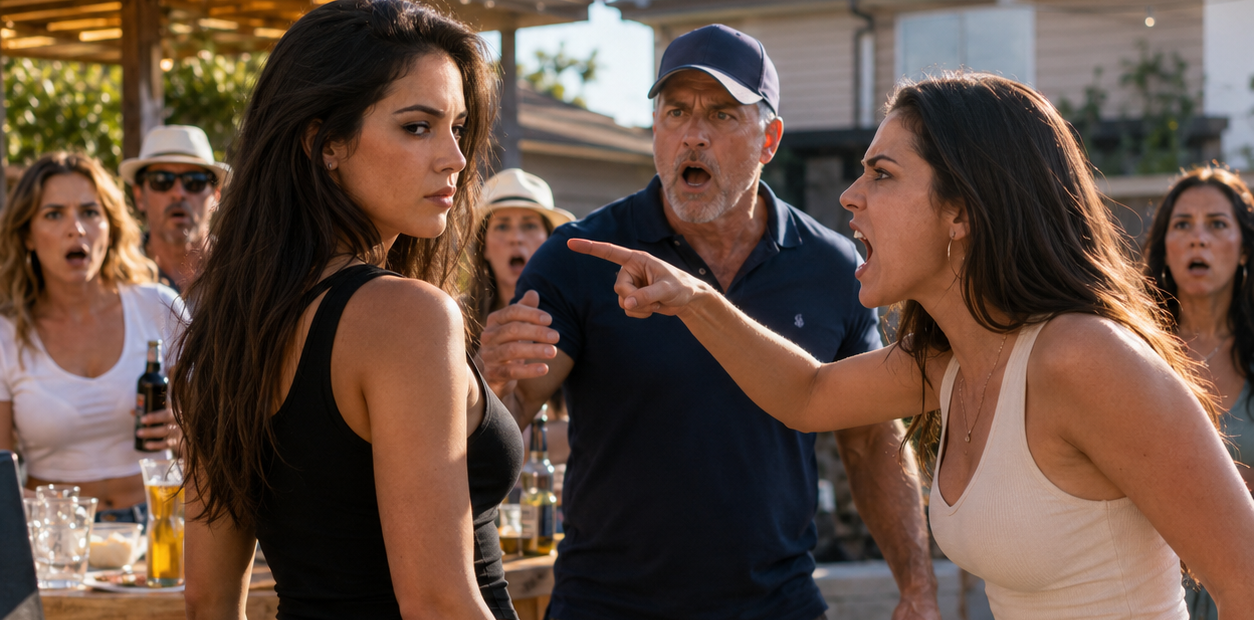
The champagne glass hit Aunt Donna’s patio floor so hard it didn’t just break. It exploded.
One second earlier, my cousin Rick had been laughing with barbecue sauce on his fingers and beer on his breath, performing for the whole family like he had bought tickets to his own show. The next second, glass scattered across the polished wood, tiny bright pieces catching the late Texas sun.
Nobody moved.
Not the uncles by the smoker.
Not the grandkids with popsicle juice running down their wrists.
Not Aunt Donna, standing by the folding table with a bowl of potato salad pressed against her chest.
And definitely not Walter Briggs, the retired Navy SEAL who had just dropped the glass.
He stared at me like I had stepped out of a grave.
I wished I had stayed home.
That was the thought running through my head as the cicadas screamed from the oak trees and the smell of brisket smoke hung thick in the humid evening air. I had driven three hours from my little house outside Temple, Texas, because Aunt Donna had called me personally.
“Claire,” she had said, her voice thin but warm, “I’m turning seventy-five. I’d really love to see you.”
So I came.
I brought a peach cobbler. I wore clean jeans, a blue cotton shirt, and the same old boots I used for yard work. I told myself I would hug Aunt Donna, eat something polite, avoid politics, and leave before sunset.
That plan lasted about twenty minutes.
Rick started drinking before noon.
Rick had always been loud in the way some men are loud when they’re scared of being ordinary. He sold RVs outside Dallas and talked like every conversation had a scoreboard. He had a white polo stretched over his stomach, sunglasses hooked into his collar, and that same grin he’d worn since high school, the one that said he had never once confused confidence with kindness.
“Well, look who finally came back from Area 51,” he shouted when I arrived.
A few cousins laughed.
I smiled, handed Aunt Donna the cobbler, and said, “Good to see you too, Rick.”
That should have been the end of it. But Rick hated quiet people. Quiet people made him nervous because they gave him nothing to swing at.
All afternoon, he needled me.
“You still doing that Army thing?”
“No, Rick. I retired years ago.”
“Must be nice. Government checks and all that.”
I let it pass.
“You ever actually shoot anything?”
I looked at the potato salad instead of his face. “Occasionally.”
“Occasionally,” he repeated, drawing laughs from two cousins who should have known better.
I let that pass too.
At fifty-three, I had learned something most people only learn after enough funerals. Not every insult deserves a fight. Peace is expensive. You protect it when you can.
Then Walter Briggs arrived.
A black SUV rolled up the driveway around four o’clock. Out stepped a tall, lean old man in a navy blazer, even though the Texas heat could have melted asphalt. White hair. Straight back. Eyes pale blue and watchful.
Veterans recognize other veterans before introductions. It’s in the shoulders. The scan of exits. The way the hands stay free.
Aunt Donna introduced him as an old friend of Uncle Harold’s.
Walter shook hands around the patio, polite and measured, until his eyes landed on me. Something crossed his face. Not recognition exactly. More like his mind had tripped over a half-buried memory.
I looked away first.
By early evening, Rick had gathered a crowd near the cooler. The sun sat low over the fields, turning the dust gold. I was sitting near the railing with iced tea sweating in my hand when Rick wandered over.
“So,” he said loudly, “you ever do anything dangerous in the Army?”
I shrugged. “Sometimes.”
“What’s that mean?”
“It means sometimes.”
A few people laughed.
Rick grinned wider. “Come on, Claire. Don’t be mysterious. You kick down doors? Fight terrorists? Save the president?”
“No.”
“Hand-to-hand combat?” he asked, making a karate chop with one greasy hand.
I should have shut it down.
Instead, maybe because I was tired, maybe because I was sick of shrinking myself down to make other people comfortable, I answered honestly.
“Only when I had to.”
Rick slapped the table. “Oh, come on.”
I took a slow sip of iced tea.
Then came the line.
“Let me guess,” Rick said, loud enough for half the patio to hear. “They called you Princess.”
Laughter rolled through the group.
I looked him directly in the eye.
“Hades,” I said.
The champagne glass shattered one second later.
Walter Briggs had gone completely pale.
Not surprised pale.
Haunted pale.
He whispered, “No.”
Rick blinked. “What?”
Walter took one slow step toward me. Then another. His mouth opened, but no words came out at first.
“You were Task Unit Seven,” he said finally.
I didn’t answer.
“You flew Kandahar extraction routes.”
The patio had gone dead silent.
Walter’s breathing changed.
“I heard you were dead,” he said.
I set my tea down carefully.
“Not dead,” I said.
The old SEAL straightened his back.
Then, in front of my entire family, Walter Briggs raised his hand and saluted me.
And for the first time in my life, Rick Donnelly stopped laughing.
### Part 2
Nobody knew what to do with the silence.
That was the worst part.
People imagine dramatic moments as loud things. Shouting. Crying. Somebody knocking over a chair. But sometimes the heaviest moments arrive quietly, and everybody just sits there trapped inside them.
Walter held the salute for three seconds.
Three long seconds.
Then I stood because my body remembered manners before my mind did, and I returned it.
Rick’s mouth hung slightly open. Aunt Donna looked from Walter to me and back again, her face folding into confusion. One of my younger cousins, Melanie, actually whispered, “What is happening?”
I wished I had an answer small enough for that patio.
Walter lowered his hand slowly. His eyes stayed on mine.
“Claire Donovan,” he said, like he was testing the name against memory. “My God.”
Rick forced a laugh. It came out thin. “Okay, seriously. Is this some military joke?”
Walter turned his head toward Rick.
“You got any idea who your cousin is?”
Rick tried to smirk, but his face had lost confidence. “Apparently not.”
“No,” Walter said. “Apparently not.”
I sat back down because my knees had started to feel strange. Not weak. Just aware. War leaves old wires inside you, and certain words still send electricity through them.
Aunt Donna came closer. “Claire, sweetheart, what is he talking about?”
“Nothing important,” I said.
Walter’s expression hardened. “With respect, ma’am, that is not true.”
I gave him a warning look.
He ignored it.
Old SEALs are like that.
He pulled out the chair across from me and sat down slowly, like his own knees were filing complaints. The family stayed frozen around us. Even the country music from the speaker sounded embarrassed, some soft old song playing too cheerfully under the moment.
Walter leaned forward.
“You disappeared,” he said.
“I meant to.”
“I heard stories for years. Some people said you’d gone private sector overseas. Some said you died. Some said you changed your name.”
“I kept my name.”
“Not your number.”
I looked away.
Rick cleared his throat. “Can somebody please explain what Hades means?”
Walter stared at him for a second. “You ever hear soldiers use call signs?”
“Sure.”
“Most of them are jokes. Dumb stories. Somebody tripped getting out of a Humvee. Somebody burned coffee. Somebody said something stupid on the radio.”
Rick nodded slowly.
Walter pointed toward me.
“That one wasn’t a joke.”
The air changed again.
I could feel my family rebuilding me in their heads. For years, I had been the strange cousin. The divorced one. The woman with the old truck and the vegetable garden. The one who skipped birthdays, left Christmas early, and never brought anybody to Thanksgiving.
People do that when they don’t know your story. They invent one.
Walter’s voice lowered. “There are men alive because of her. SEALs. Rangers. Marines. Medics. Pilots. Men with kids and grandkids now.”
I stared at the grain in the patio table.
Rick said, “Come on.”
Walter looked at him.
“Son, do not do that.”
Rick’s cheeks reddened. “I just mean, you’re talking like she was some kind of legend.”
“She was worse,” Walter said.
Nobody laughed.
I sighed. “Walter.”
He nodded once, but he didn’t apologize.
Aunt Donna sat beside me and took my hand. Her fingers were soft and cool, powdered with flour from whatever cake she had been fussing over earlier.
“Claire,” she said gently, “what did you do?”
I could have given her the clean version. The comfortable one. I had used it for years.
“I flew.”
Rick frowned. “Flew what?”
“Helicopters.”
That answer landed harder than I expected. Maybe because nobody had ever imagined me in the air. Maybe because I had always seemed so grounded, so plain, so careful. A woman who watered tomatoes at six in the morning did not fit easily into their picture of war.
Walter said, “Black-zone extraction.”
I closed my eyes for one second.
Aunt Donna squeezed my hand. “What does that mean?”
“It means,” I said carefully, “we went into places other aircraft were told not to.”
Walter added, “Places nobody wanted to touch.”
The grill popped behind us. A burst of fat hit the coals, sending up a sharp smell of smoke and burned pepper. The sound made my shoulders tighten before I could stop them.
Walter noticed.
He always would have.
“Kandahar,” he said.
That single word opened something cold inside me.
Rick leaned forward now, curiosity replacing embarrassment. “What happened in Kandahar?”
I took my hand from Aunt Donna’s and folded both hands in my lap. My left thumb moved over the scar across my palm, a habit I hated because it told on me.
“Nothing we need to talk about at a birthday party.”
Walter looked at me with old grief.
“It was more than nothing.”
Aunt Donna’s eyes filled. “Were you hurt?”
I almost smiled. That was such a motherly question. So simple. So impossible.
“Not in the way you mean.”
Walter looked at the darkening fields beyond the patio. “Fall of 2003,” he said. “Recon unit got pinned outside the city. Sandstorm moving in. Command ordered air support to withdraw.”
The family listened without breathing.
I kept my eyes on the table.
Walter continued, “One pilot didn’t.”
Rick’s voice came softer now. “Claire?”
I didn’t answer.
Walter said, “They called her Hades because when men went into hell, she came to get them.”
The cicadas screamed louder in the trees.
For one strange second, nobody on that patio saw me as strange, quiet Claire anymore.
And that frightened me more than Rick’s laughter ever had.
Then Walter leaned closer and asked the question I had spent twenty years avoiding.
“Why did you vanish after Kandahar?”
My stomach went tight.
Because Kandahar had been bad.
But what came after was what buried me.
### Part 3
I did not answer Walter right away.
Instead, I watched the first firefly flicker near Aunt Donna’s fence line. It blinked once, vanished, then blinked again farther left, like a tiny signal trying to survive the dark.
I had spent years envying fireflies.
They appeared when they wanted, disappeared when they needed, and nobody demanded explanations.
Rick sat down across from me without being invited. His beer remained unopened in his hand. That alone told me the evening had turned serious. Rick never wasted beer unless fear or shame got in the way.
Aunt Donna looked smaller than she had that morning.
“Claire,” she said, “you don’t have to tell us.”
I loved her for saying that.
But Walter was right. Some stories rot when they stay buried too long. They do not disappear. They leak into your sleep, your temper, your marriage, your body. They become the reason you flinch at fireworks and sit with your back to the wall in restaurants.
So I breathed in the smell of brisket smoke, cut grass, and warm beer, and I began.
“Kandahar wasn’t supposed to be anything special,” I said.
Walter gave a dry little laugh. “That’s how every bad story starts.”
I nodded.
“It was supposed to be quick. A recon team in, information gathered, extraction before sunrise. We had support aircraft in the area, but the weather was turning. Sandstorm building faster than the forecast said.”
Rick rubbed his palms on his shorts. “You were flying?”
“Co-pilot that night. But our pilot had taken shrapnel two days earlier. He was cleared on paper, not in reality.”
Walter’s eyebrows moved. He had not known that part.
I looked down at my tea glass. The ice had melted into a weak brown puddle.
“The storm hit early,” I said. “At first it was just dust on the horizon. Then it swallowed everything. Sky, ground, distance. You lose the world in storms like that. You don’t see. You guess. You trust instruments and training and whatever God you still believe in.”
Aunt Donna whispered, “Lord.”
“The recon team was already moving toward extraction when the first shots came over the radio. At first, nobody knew how bad it was. Static. Shouting. Coordinates broken in pieces.”
I heard it again as I spoke.
Not memory exactly.
More like a recording played through bone.
“Then one of them said they were surrounded.”
Rick’s face had gone gray under his tan.
“Command ordered us to hold position. Then withdraw. The storm was too dangerous. Enemy fire too heavy. That was the official reasoning.”
Walter said nothing, but his jaw worked.
I continued.
“Our pilot wanted to turn back.”
“Did you?” Rick asked.
I looked at him.
“They were still alive.”
Nobody spoke after that.
That was the thing civilians never understood about war. It was not always about politics or strategy or flags. Sometimes it was only one voice on the radio saying, We are still here, and you either moved toward it or away from it.
“I took control,” I said. “Not heroically. Not dramatically. I just did it. I told command we had engine fluctuation and needed to adjust course.”
Walter’s eyes narrowed with sudden understanding. “You lied on the channel.”
“Yes.”
Rick stared. “Could you get in trouble for that?”
I smiled faintly. “Eventually.”
Aunt Donna looked horrified.
“The closer we got, the worse visibility became. Dust was hitting the windshield like gravel. Alarms kept chirping. My crew chief, Eddie Morales, was in the back yelling distance estimates because he could see flashes through the side.”
Saying Eddie’s name hurt.
I had not spoken it aloud in years.
Walter noticed that too.
“We came in too hard,” I said. “Hit the ground badly. Skids bounced. For half a second I thought we had rolled. Then the door opened and the first wounded man came in.”
The patio had gone so quiet I could hear the ice machine inside Aunt Donna’s kitchen drop a fresh batch with a hollow clatter.
“One man was missing part of his leg. Another had blood all down his face and couldn’t remember his own name. Somebody kept yelling that they had one more behind a berm.”
I stopped.
The family waited.
A little boy near the sliding door whispered, “Mom?”
His mother pulled him inside.
I took a breath.
“Gunfire was hitting the aircraft. You don’t hear it the way movies make it sound. Not clean cracks. It’s more like metal being punched by hammers. Fast. Ugly. Personal.”
Rick’s eyes flicked toward my scarred hand.
“Eddie jumped out to help carry the last man.”
Walter slowly lowered his head.
I kept going because if I stopped there, I would not start again.
“An RPG hit close. Not direct. Close enough. The blast threw Eddie sideways. Set part of the side panel on fire. Hydraulic fluid. Smoke. Screaming.”
Aunt Donna covered her mouth.
I smelled it again.
Burning metal.
Hot dust.
Blood.
“I remember thinking, this is where we die.”
Rick’s voice came out small. “But you didn’t.”
“No.”
“How?”
I stared at my hands.
“That is the part people like to call courage,” I said. “But courage is too clean a word. I was terrified. Angry. Half-blind. I just refused to leave while someone was still reaching for the door.”
Walter’s eyes shone in the patio light.
I looked up at him.
“You were there,” I said.
He nodded.
“North ridge,” he whispered. “Different unit. Listening to the channel. We all heard you.”
That surprised me enough to make my throat close.
Walter leaned back. “When your bird lifted out of that storm, every man on our ridge knew we had witnessed something impossible.”
I looked away before my face could betray me.
Rick finally asked, “So why did you disappear?”
The warm evening suddenly felt colder.
I had told them about the fire.
Now came the ash.
“Because,” I said, “the men with clean uniforms needed someone dirty enough to blame.”
And when Walter heard that, his eyes went hard.
### Part 4
Aunt Donna told everyone to eat.
Nobody did.
The brisket sat untouched in foil trays. Potato salad sweated under plastic wrap. Flies bumped lazily against the mesh food covers, confused by the sudden lack of human noise. Somewhere inside the house, the dishwasher hummed like nothing in the world had changed.
I envied appliances for that.
Rick leaned forward, elbows on his knees.
“What do you mean blame?”
I looked at Walter first. He gave me one short nod. Permission, maybe. Or apology.
“After we got back,” I said, “the story should have been simple. A bad mission. Bad weather. Bad command decisions. A rescue that saved lives and cost too much.”
Aunt Donna whispered, “Cost too much how?”
I swallowed.
“Eddie Morales didn’t make it.”
Nobody said anything.
People always go quiet around the dead, even when they never knew them. Especially then. A stranger’s death asks more of the imagination.
“He was twenty-six,” I said. “Loved cinnamon gum. Hated country music. Had a baby girl he had only seen in pictures.”
Rick looked down.
“After we landed, everything blurred. Medical crews. Fire crews. Debrief rooms. Coffee that tasted burned. Men asking the same questions in different ways, writing down only the parts they wanted.”
Walter’s voice was low. “Who was the commanding officer?”
I gave him the name.
“Daniel Mercer.”
Walter went still.
That name did not mean much to most of my family. To Walter, it meant enough. His face changed in a way only another veteran would catch. A tightening around the mouth. A flash of old disgust.
Rick noticed. “You know him?”
“Everybody knew Mercer,” Walter said. “Even people who wish they didn’t.”
I continued before the bitterness in the air could grow legs.
“Mercer ordered air support to withdraw before the ground team was secured. That order would have left them there. When I came back with survivors, his decision became a problem.”
Melanie, my younger cousin, frowned. “But you saved them. Wouldn’t that make him happy?”
“No,” I said. “It made him exposed.”
That landed heavily.
I had to give my family credit. They were not military people, but they understood power. Most Americans do. They have seen bosses lie, politicians dodge, managers protect themselves, parents rewrite family history. Uniforms and medals do not change human nature. They just dress it better.
“Mercer said I disobeyed a lawful order,” I said. “Said I endangered my crew. Said I had a pattern of reckless judgment.”
Rick’s face twisted. “But he was the one who left them.”
“Yes.”
“Didn’t the rescued men speak up?”
“Some tried.”
Walter made a sound under his breath.
“But those men were wounded, scattered, transferred, recovering. Reports moved faster than truth. Mercer had rank, connections, and a very polished way of sounding reasonable.”
I remembered the conference room.
The fluorescent lights.
The smell of stale coffee and floor wax.
Mercer sitting across from me, hands folded, voice calm as Sunday church.
Captain Donovan, trauma affects memory.
Captain Donovan, you seem emotionally compromised.
Captain Donovan, grief can distort judgment.
“They didn’t court-martial me,” I said. “That would have opened too many doors. They buried me instead. Quiet reprimands. Frozen promotions. Psychiatric evaluations used like weapons. Assignments designed to make me quit.”
Aunt Donna’s eyes filled again. “Why didn’t you tell us?”
I almost laughed, but there was no humor in it.
“And say what? That the Army I gave my life to had decided I was inconvenient? That men with stars on their shoulders had more use for my silence than my service?”
Rick flinched.
Good.
I was tired of softening sharp things.
“My marriage collapsed not long after,” I said. “Mark hated what I became. Or maybe he hated what I could no longer pretend to be.”
Aunt Donna knew that name. Everybody did. Mark had been handsome, charming, clean-cut. The kind of man families trust because he knows how to shake hands and compliment the curtains.
“He said I brought the war into the house,” I said. “He wasn’t entirely wrong. I couldn’t sleep. Couldn’t sit in restaurants. Couldn’t handle fireworks. Some nights I woke up on the floor because I had rolled off the bed trying to get under cover.”
Aunt Donna cried quietly now.
Rick did not look at me.
“I disappeared,” I said, “because disappearing was easier than explaining.”
For a while, nobody moved.
Then Walter spoke.
“Mercer is in Austin tomorrow night.”
My chest tightened.
“What?”
“Veterans fundraiser. Big one. He’s the guest speaker.”
I stared at him.
The old name moved through me like cold water.
Rick looked between us. “You’re kidding.”
Walter shook his head. “No.”
Aunt Donna’s hand found mine again. “Claire?”
I stood so quickly my chair scraped backward.
“I need air.”
But there was no air on that patio anymore. Only smoke, memory, and the sudden impossible knowledge that the man who had buried my life was one hour down the highway.
And Walter had not told me the worst part yet.
### Part 5
Walter caught me near Aunt Donna’s side yard, where the grass sloped toward a dry creek bed and the party noise softened behind the trees.
The sky had gone purple. Mosquitoes floated in the damp air. Someone had turned the music back on, but quieter now, like even the speakers understood they had missed a funeral.
“Claire,” Walter said.
I kept walking.
“Claire.”
I stopped beside the old birdbath Aunt Donna’s husband had made from concrete and broken blue tiles. I remembered Uncle Harold gluing those tiles on one summer afternoon while I sat nearby eating watermelon. I had been seventeen then, all knees and anger, desperate to leave Texas and become someone nobody could control.
Funny how life answers certain prayers too literally.
“What worst part?” I asked.
Walter came up beside me.
He did not pretend not to understand.
“The Kandahar files,” he said, “were partially declassified last year.”
I turned slowly.
“What?”
“I only found out two months ago. A friend sent me a summary. Redacted, but enough survived.”
The night seemed to press closer.
“Enough for what?”
Walter’s eyes held mine.
“Enough to prove Mercer lied.”
For twenty years, I had imagined those files locked away forever. Paper buried in government boxes. Audio degraded. Names blacked out. Truth flattened under official language until nobody living could use it.
“What exactly is in them?” I asked.
“Radio transcripts. Weather reports. Maintenance records. A command log that shows the withdrawal order came before your final approach.”
My mouth went dry.
“That doesn’t prove why.”
“No,” Walter said. “But it proves what.”
Behind us, a burst of laughter rose from the patio, then died quickly when whoever laughed remembered the mood.
Walter reached into his blazer pocket and pulled out a folded piece of paper. He handed it to me.
I did not open it.
“What is this?”
“Fundraiser details.”
“I’m not going.”
“I think you are.”
I looked at him sharply. “You don’t know me.”
“No,” he said. “But I know running.”
That hit harder than I wanted.
Walter looked toward the dark field.
“After Vietnam,” he said, “I spent seven years pretending I hated people. Truth was, I was terrified one of them might ask the right question.”
I said nothing.
“Mercer built a whole second life on top of what he did,” Walter continued. “Board seats. Speaking fees. Patriotic speeches. Young officers quoting him like scripture.”
My hand tightened around the folded paper.
“Don’t,” I said.
“Don’t what?”
“Make this about justice.”
“What should it be about?”
“Survival.”
He nodded slowly. “Survival is good. But survival is not the same as being alive.”
I hated him a little for that.
Old soldiers have a cruel talent for saying the thing you avoid saying to yourself.
I drove home that night with Aunt Donna’s leftover cobbler in the passenger seat and Walter’s folded paper in my shirt pocket. The highway between Waco and Temple stretched black and empty under my headlights. Bugs struck the windshield in soft, wet ticks. Every few miles, a gas station sign glowed red or blue in the distance, then slipped behind me.
At home, I did not turn on the television.
I sat at my kitchen table under the yellow light and unfolded the paper.
Austin Veterans Memorial Center.
Saturday, 7:00 p.m.
Guest Speaker: General Daniel R. Mercer, Ret.
Under that, someone had printed a promotional line.
Leadership Under Fire: Moral Courage in Impossible Conditions.
I laughed once.
It sounded ugly in the empty kitchen.
I barely slept.
When I did, I dreamed of dust.
By morning, I had decided not to go. By lunch, I was ironing a black blouse. By three, I was telling myself I could still change my mind. By five-thirty, I was driving south toward Austin with both hands tight on the wheel.
The Veterans Memorial Center looked expensive in that quiet institutional way. Polished stone. Tall windows. Flags arranged with perfect symmetry. The parking lot was full of luxury SUVs, retired officers’ sedans, and pickup trucks with veteran plates.
Inside, the air smelled like lemon polish, wine, and cologne. Donors in suits mingled with old officers wearing miniature medals. Waiters carried shrimp cocktails on silver trays. A string quartet played softly near a wall of framed photographs.
The whole place honored sacrifice comfortably.
Walter met me near the entrance.
“You came,” he said.
“I’m still deciding whether that was a mistake.”
He smiled faintly. “Most important decisions feel like that.”
Then I saw Daniel Mercer.
He stood near the stage surrounded by admirers. Tall. Silver-haired. Straight-backed. Perfectly dressed. He wore his age like authority and his guilt like it had been tailored out of sight.
People laughed at something he said.
Then he turned and saw me.
His smile vanished.
Not slowly.
Instantly.
Recognition flashed across his face, followed by something smaller and much more satisfying.
Fear.
Mercer excused himself and walked toward us.
“Claire Donovan,” he said.
His voice was exactly the same.
Smooth.
Controlled.
Deadly in clean shoes.
“General Mercer,” I replied.
His eyes moved over my face. “You look well.”
“That makes one of us.”
Walter coughed into his fist, badly hiding amusement.
Mercer’s smile returned, thin as paper. “This is not the place.”
I stepped closer.
“No,” I said. “You made sure there never was one.”
The ballroom lights flickered once, signaling dinner.
Mercer looked past me toward the stage.
Then he leaned near my ear and whispered, “Careful, Claire. People still know what happened to you.”
He walked away before I could answer.
And for the first time all night, I understood.
Mercer had not come to ignore me.
He had come prepared to bury me again.
### Part 6
Walter and I sat near the back.
That had been my choice. I wanted an exit in sight and a wall behind me. Old habits are not dramatic when you live with them every day. They are just furniture you arrange your life around.
The ballroom glowed under chandeliers. Forks clicked against plates. Conversations rose and fell in polite waves. At the front table, Daniel Mercer smiled for photographs with donors, veterans, and two local politicians who kept adjusting their ties.
Every few minutes, Mercer’s eyes found me.
Each time, his expression said the same thing.
You should have stayed buried.
Dinner tasted like cardboard. Chicken in cream sauce. Green beans too soft. Rolls wrapped in cloth napkins. I moved food around my plate until Walter leaned over and said, “You’re murdering that potato.”
“I needed an outlet.”
He almost smiled.
The announcer took the stage at seven forty-five. He was a cheerful man with a round face and a radio voice, the kind of person who could introduce a highway ribbon-cutting like it was the moon landing.
“Tonight,” he said, “we honor courage, leadership, and the difficult decisions made by those who serve.”
My stomach tightened.
Walter’s hand curled around his water glass.
“General Daniel R. Mercer,” the announcer continued, “has spent his life embodying moral courage in impossible conditions.”
The applause started before Mercer even stood.
Then the whole room rose.
Walter stayed seated.
So did I.
Mercer noticed.
Of course he did.
He moved to the podium with practiced humility. One hand over his heart. Head slightly bowed. The man knew performance the way pilots know weather.
He began with jokes. Then gratitude. Then stories about young soldiers and sacrifice and leadership under pressure. His voice filled the ballroom warmly. He had always been good at sounding like a monument.
For a while, I thought maybe he would leave it alone.
Then his eyes lifted toward the back.
Toward me.
“In war,” Mercer said, “memory is not always reliable.”
Walter went still beside me.
Mercer continued, “Trauma can shape stories. Pain can turn confusion into accusation. Sometimes those who serve carry wounds that distort their understanding of events.”
A few heads turned.
Heat rose in my face.
The old trap.
Same words. Same technique. He did not need to name me. That was the beauty of it. He could poison the room without leaving fingerprints.
“Leadership,” he said, “requires discipline. Obedience. The humility to understand that not every emotional impulse is courage.”
Walter whispered, “Son of a—”
I put one hand on his arm.
But Mercer was not finished.
“Over the years,” he said, “I have seen certain former personnel build myths around themselves to survive disappointment.”
The room shifted. People sensed blood without understanding the wound.
My chest tightened, but not from fear now.
From recognition.
I was twenty-nine again, sitting under fluorescent lights while Mercer explained my own mind to men who had already decided I was unstable.
Then Walter stood.
His chair scraped loudly across the floor.
Every head turned.
“I was there,” Walter said.
His voice carried better than the microphone.
Mercer froze.
The announcer moved awkwardly near the stage. “Sir, perhaps questions can—”
“I was there,” Walter repeated.
Mercer’s jaw tightened. “Walter, sit down.”
That was his mistake.
He said it like an order.
Walter Briggs had spent his life obeying orders worth obeying. This was not one.
“No,” Walter said. “You talked long enough.”
Whispers rippled across the tables.
Walter pointed toward me.
“That woman flew into a firestorm while you ordered good men abandoned.”
The ballroom exploded.
Mercer gripped both sides of the podium. “You do not know what you’re talking about.”
A voice near the front said, “I do.”
A man in a wheelchair pushed himself back from a table.
Gray beard. Dark suit. Empty left pant leg pinned neatly at the knee.
I knew him even before his eyes met mine.
Tommy Alvarez.
He had been twenty-four when I dragged him by his vest across the floor of my burning aircraft. He had screamed for his mother and apologized for bleeding on my boots.
Now he was old enough to be a grandfather.
“She saved my life,” Tommy said.
The room went silent.
Then another man stood. Heavyset, bald, leaning on a cane.
“She brought my brother home.”
Another.
“I heard the radio. We were told nobody was coming.”
Another.
“I saw the bird come down through dust. I saw her crew take fire.”
Walter’s voice shook. “The files were declassified, Mercer. Not all of them. But enough.”
Mercer’s face had gone pale.
Not haunted like Walter at the BBQ.
Exposed.
A woman at the front table stood slowly. She wore a black dress and held a folded photograph against her chest.
“My son died two years after that mission,” she said, voice trembling. “But he told me Captain Donovan was the reason he got to come home first.”
I could not breathe.
The woman turned toward me and raised the photograph.
“He said Hades came back.”
For twenty years, I had carried the dead like stones in my pockets.
Now the living stood around me.
One by one.
Mercer stepped back from the podium.
The microphone screeched.
Then Tommy Alvarez lifted a shaking hand to his forehead.
He saluted me.
Walter followed.
Then another veteran.
Then another.
The room blurred.
I did not cry.
Not then.
I was too stunned.
But when Daniel Mercer stepped down from the stage and pushed through the side exit without looking at anyone, a young reporter near the wall lowered her camera and stared straight at me.
She held up a manila envelope.
And mouthed, “You need to see this.”
### Part 7
I did not take the envelope right away.
That sounds strange, but it is true.
For twenty years, I had wanted proof. Not applause. Not pity. Proof. Something flat and official. Something with dates, signatures, typed names, radio logs. Something that could sit on a table and say what I had never been able to make people hear.
But when proof finally appeared in the hands of a twenty-something reporter wearing black heels and a press badge, my first instinct was to step back.
Because proof does not only confirm what happened.
It also confirms what you lost.
The reporter’s name was Emily Vaughn. She worked for a regional veterans magazine, though she had the eyes of someone who wanted bigger storms. She led Walter and me into a quiet side hallway outside the ballroom. The carpet was thick. The lights buzzed softly overhead. Behind the wall, people murmured like churchgoers after a scandal.
Emily held out the envelope.
“I received copies from a source last month,” she said.
Walter asked, “What source?”
“I can’t say.”
I gave her a tired look. “That is always what reporters say right before ruining somebody’s week.”
She smiled nervously. “Probably fair.”
I took the envelope.
My fingers felt numb.
Inside were printed pages. Some official. Some photocopied. Some marked with black redactions like thick bruises across the text.
The first page was a radio transcript.
My old call sign appeared halfway down.
HADES TWO: Ground team remains active. Adjusting approach.
COMMAND: Negative. Withdraw all air assets.
HADES TWO: Unable to comply. Survivors transmitting.
COMMAND: Repeat, withdraw.
I stopped reading.
The hallway stretched and tilted for one second.
Walter’s hand touched my elbow. “Breathe.”
“I am.”
“You’re not.”
I inhaled hard.
The next document was worse.
A memo. Internal. Dated three days after Kandahar.
Subject: Narrative containment recommendations.
Narrative containment.
That phrase sat on the page like a cockroach.
I read lines in fragments.
Unauthorized deviation.
Psychological strain.
Protect command continuity.
Avoid public contradiction from surviving enlisted personnel.
Walter swore under his breath.
Emily watched me carefully. “There’s more.”
Of course there was.
There is always more when your life has already been damaged beyond repair. People think the big injury is the truth. It rarely is. The big injury is realizing how many hands helped hide it.
I flipped to another page.
A witness statement.
Signed.
My breath stopped.
Mark A. Donovan.
My ex-husband.
For a moment, the hallway disappeared.
I saw our old kitchen in Fort Hood housing. Yellow curtains. A coffee mug shaped like a boot. Mark standing with his arms folded while I tried to explain why I could not sleep. His handsome face tired, impatient, embarrassed by the broken woman war had returned to him.
I looked down again.
The statement was short.
Captain Donovan demonstrated increasing emotional instability prior to separation. She expressed resentment toward command and repeatedly exaggerated her role in combat operations.
I heard a sound.
It took me a second to realize I had made it.
Walter saw the name. His face changed.
“Claire.”
I folded the paper carefully.
Too carefully.
Emily lowered her voice. “I’m sorry.”
Sorry is a small bucket for a house fire.
Rick appeared at the end of the hallway, moving awkwardly in his dress shirt. I had forgotten he came after Walter called him from the road. He had stood near the back of the ballroom, silent for once in his life.
He looked from me to the envelope.
“What happened?”
I held up the page.
“My husband helped them.”
Rick’s face tightened.
“Mark?”
I nodded.
For years, I had believed Mark left because he could not live with my nightmares.
That was painful enough.
But this was different.
This meant he had not merely walked away from the wreckage.
He had signed one of the beams that fell on me.
Emily spoke gently. “There may have been pressure.”
I laughed once. “Pressure does not forge a signature.”
Walter said nothing.
That was how I knew he agreed.
My phone buzzed in my purse.
I ignored it.
It buzzed again.
Then again.
Rick pulled his out and looked down.
His eyes widened.
“What?” I asked.
He swallowed. “The clip from the ballroom is already online.”
Walter closed his eyes. “Damn.”
My phone buzzed again.
This time I looked.
Unknown number.
Then a text appeared.
Claire, it’s Mark. We need to talk before you believe things you don’t understand.
The hallway seemed to shrink around me.
I stared at the message until the words blurred.
Then a second text came.
Please. Mercer wasn’t the only one who lied.
### Part 8
I met Mark because anger makes you curious.
That is not noble, but it is honest.
He wanted to come to my house. I said no. He wanted to meet somewhere private. I said absolutely not. We settled on a diner outside Georgetown with cracked red booths, old ceiling fans, and waitresses who called grown men “sweetheart” while pouring coffee strong enough to remove paint.
I arrived twenty minutes early and chose a booth facing the door.
Mark arrived seven minutes late.
That told me enough before he even sat down.
He was still handsome in the way certain men age when life has not asked them to carry much visibly. Gray at the temples. Expensive watch. Clean shirt. Good shoes. He paused when he saw me, like he expected the years to soften the room for him.
They did not.
“Claire,” he said.
“Mark.”
He slid into the booth across from me. The vinyl squeaked under him. He smelled like aftershave and rain, though the sky outside was painfully clear.
For a few seconds, neither of us spoke.
Then he said, “You look good.”
I stared at him.
He looked down. “Right. Stupid thing to say.”
The waitress came by with coffee. I ordered mine black. Mark asked for cream, then changed his mind, then changed it back. His hands were not steady.
Good.
I placed the photocopied statement on the table between us.
“Explain.”
He stared at it like he had hoped the page might disappear if he looked sad enough.
“Claire, it was complicated.”
“No. Weather is complicated. Marriage is complicated. Signing a statement that says your wife lied about combat is specific.”
He flinched.
“I didn’t say you lied.”
I tapped the page.
“You said I exaggerated.”
“I said what they told me to say.”
The diner noises sharpened. Silverware. Ice machine. A baby fussing near the front. Tires hissing over pavement outside.
“Who told you?” I asked.
Mark rubbed both hands over his face.
“Mercer’s people contacted me during the review. They said you were in trouble. They said if I cooperated, things could stay quiet.”
“Quiet for whom?”
He did not answer.
I leaned back.
“For whom, Mark?”
His jaw tightened. “For both of us.”
“No,” I said. “Try again.”
He looked older then. Finally.
“For me,” he admitted.
There it was.
Not a monster’s confession.
A coward’s.
“They said if the case became public, spouses would be dragged in. That my career could be affected. That your behavior at home would become part of the record.”
“My behavior.”
“You were not okay, Claire.”
“I know.”
He blinked, surprised by that.
I leaned forward. “I was having nightmares. I was grieving Eddie. I was being investigated by men protecting themselves. I was not okay. That did not make me a liar.”
His eyes reddened.
“I know that now.”
“Did you know it then?”
His mouth opened.
Closed.
That silence answered more cleanly than words.
I took a slow drink of coffee. It burned my tongue. I welcomed it.
Mark whispered, “I was scared.”
I almost laughed.
Everyone had been scared. Eddie had been scared. Tommy Alvarez had been scared. The men in that sandstorm had been scared. I had been scared flying blind into gunfire with alarms screaming in my ears.
Fear did not make Mark special.
It made him responsible for what he chose next.
“You let them use you,” I said.
“Yes.”
“And then you left.”
He nodded slowly.
“And then,” I continued, “you let my family believe I was unstable, bitter, exaggerating, strange.”
“I didn’t talk to your family much after the divorce.”
“But you talked enough.”
His eyes dropped.
There it was again.
Mark had always confessed in pieces, like a man paying debt with pennies.
“My brother called you once,” I said. “After I missed Mom’s birthday. He told me you said I needed help but wouldn’t accept it.”
Mark rubbed his forehead. “I thought that was true.”
“No,” I said quietly. “You needed it to be true.”
That one landed. I watched it hit him.
He reached across the table.
I moved my hand away before he touched me.
“Claire,” he said, voice cracking, “I am sorry.”
For years, I had imagined that apology.
In some versions, I cried. In others, I shouted. In a few, I forgave him because the younger me still wanted the marriage to mean something pure.
But sitting across from him in that diner, I felt none of that.
Only a clean, dry certainty.
“I believe you’re sorry,” I said.
Hope flashed across his face.
I killed it gently.
“But I do not forgive you.”
He looked like I had struck him.
“I know people say forgiveness is for the person giving it,” I continued. “Maybe that’s true for some. For me, forgiveness would be another thing I did to make a coward feel better.”
Mark’s eyes filled.
“I loved you,” he whispered.
I folded the statement and placed it back in my purse.
“You loved the version of me that made you proud in public and quiet at home.”
He had no answer.
Outside, a pickup truck backfired in the parking lot.
My body reacted before my mind did. Shoulders tight. Hand against the table. Breath caught.
Mark saw it and reached again.
“Don’t,” I said.
He stopped.
That was the difference between us now.
He stopped because I told him to.
I stood and left money for the coffee.
At the door, Mark called after me.
“Mercer is going to release a statement blaming you again.”
I turned.
The diner seemed to fall quiet behind me.
Mark’s face was pale.
“He called me this morning,” he said. “He asked if I would stand by my original statement.”
My pulse slowed in a dangerous way.
“And what did you say?”
Mark swallowed.
“I told him I needed time.”
Of all the answers he could have given, that one told me exactly who he still was.
### Part 9
Rick was sitting on my porch when I got home.
He had brought a paper bag from the bakery in town and two coffees balanced in a cardboard tray. He looked ridiculous in the heat, sweating through his shirt, one knee bouncing like a teenager outside the principal’s office.
I parked beside his truck and sat for a moment with both hands on the steering wheel.
The house looked the same. White siding. Tin roof. Tomato plants leaning against wire cages. A wind chime made from old keys clicking softly by the door.
But I was not the same woman who had left that morning.
That is one of the mean tricks truth plays. It changes you, then drops you back into familiar places and waits for you to notice the mismatch.
I got out.
Rick stood too quickly. “Hey.”
“Hey.”
He held up the bag. “Peach turnovers.”
“You already apologized with baked goods once.”
“I panicked and upgraded.”
Despite everything, I almost smiled.
We sat on the porch steps. The boards were warm under my palms. Across the road, a neighbor’s dog barked at nothing. Texas afternoon light flattened the whole yard into hard gold.
Rick handed me coffee.
“I saw the clip again,” he said. “The ballroom one.”
“Everyone has.”
“My son texted me. Said, ‘Dad, isn’t that Aunt Claire?’ I told him yes.”
“That must have been strange.”
Rick looked at his shoes. “He asked why we never talk about you.”
I waited.
Rick swallowed. “I didn’t have a good answer.”
A fly landed on the coffee lid. I flicked it away.
Rick leaned forward, elbows on knees.
“I owe you more than an apology for the BBQ.”
“Yes.”
He looked at me, surprised by the bluntness, then nodded.
“When we were younger,” he said, “after your divorce, people said things.”
“What people?”
“Our parents. Mark. My dad mostly repeated whatever he heard. Said you came back wrong. Said you had a chip on your shoulder. Said the Army probably stuck you behind a desk because you couldn’t handle real pressure.”
The old anger moved through me, but it was slower now. Less fire, more weight.
“And you believed it.”
Rick winced. “Yeah.”
I took a sip of coffee.
It was too sweet. Rick had guessed wrong, but I drank it anyway.
“Why?” I asked.
He rubbed his hands together. “Because it was easy.”
That answer was better than any excuse.
He looked toward the road. “You made people uncomfortable. You didn’t explain yourself. You left early. You didn’t laugh at stupid jokes. So when somebody gave us a story that made your silence your fault, we took it.”
I said nothing.
Rick’s voice thickened. “That’s ugly, isn’t it?”
“Yes.”
He nodded. “I’m sorry.”
This apology felt different from the first. Less like a man trying to escape guilt. More like one deciding to sit in it.
“I can accept the apology,” I said. “But I’m not interested in pretending nothing happened.”
“I don’t expect that.”
“Good.”
He looked relieved anyway.
Then my phone rang.
Unknown number.
Rick glanced at it.
“You want me to go?”
“No.”
I answered on speaker.
“Captain Donovan?” a woman asked.
The title hit me strangely.
“This is Claire.”
“My name is Denise Harrington. I represent the board of the Lone Star Veterans Foundation. After last night, we are conducting an emergency review regarding General Mercer’s involvement with our organization.”
Rick’s eyebrows rose.
I said, “All right.”
“We also received documentation from multiple veterans and families this morning. There is significant concern that General Mercer knowingly misrepresented the Kandahar operation in public remarks and official biographies.”
A breeze moved the wind chime. The old keys clicked together softly.
Denise continued, “Would you be willing to provide a statement?”
I looked out at my tomato plants.
For twenty years, silence had been my shelter.
Now everyone wanted words.
“I’ll think about it,” I said.
“There is some urgency. General Mercer has informed us that he intends to issue his own statement tonight.”
Of course he did.
Men like Mercer always tried to reach the microphone first.
“What is he saying?” I asked.
A pause.
“That you are a troubled former officer with a long history of resentment and unreliable memory.”
Rick whispered, “That son of a—”
I held up a hand.
Denise lowered her voice. “Captain Donovan, I am sorry to ask this, but do you have anything that directly challenges that characterization?”
My eyes moved to the purse beside me.
Mark’s signed statement was in there.
So were the transcripts.
So was the truth, finally heavy enough to use.
“Yes,” I said.
Rick turned toward me.
Denise exhaled softly. “Can you send it?”
I looked at my cousin, at the bakery bag, at the porch boards, at the life I had built out of quiet and avoidance.
Then my phone buzzed with a new message.
Walter.
Mercer called me. He wants a private meeting with you before he releases anything.
I stared at those words.
Rick read them over my shoulder and went pale.
Because we both understood what it meant.
Daniel Mercer was not done burying things.
He was just running out of dirt.
### Part 10
Walter told me not to meet Mercer alone.
I told Walter I had flown into a sandstorm with half a cockpit of alarms screaming at me, so a retired general in a hotel lounge did not make my top five list of bad ideas.
Walter said, “That attitude is exactly why someone needs to go with you.”
He came anyway.
The meeting was at a downtown Austin hotel with marble floors, brass lamps, and air conditioning cold enough to preserve meat. Mercer chose a corner lounge near a window overlooking traffic. Even in disgrace, he picked high ground.
He stood when I arrived.
Walter stayed two steps behind me.
Mercer noticed and gave a humorless smile. “Still bringing backup, Claire?”
I sat without being invited. “Still afraid of witnesses, Daniel?”
His smile faded.
Good.
Walter remained standing.
Mercer gestured to the chair beside me. “Walter.”
“I’m fine.”
“You always were dramatic.”
Walter leaned closer. “And you always mistook cowardice for strategy.”
For one second, I thought Mercer might snap. Instead he sat slowly and folded his hands on the table.
There was no champagne here. No podium. No flags. Just three old people and a small candle flickering in a glass cup.
Mercer looked different up close than he had on stage. Thinner. Skin looser around the jaw. The confidence was still there, but cracked now, light showing through in unpleasant places.
“I assume you know why I asked you here,” he said.
“You want me to stay quiet.”
“I want to prevent an ugly public spectacle.”
Walter snorted.
Mercer ignored him. “This situation is painful for many people.”
“Which people?” I asked.
His eyes hardened.
I leaned forward. “Be specific. Is it painful for the men you abandoned? The families you lied to? Eddie Morales’s daughter? Or just you?”
The name hit him.
Not hard enough.
But it hit.
Mercer looked toward the window. Cars moved below us in red and white lines.
“You have no idea what command pressure was like that night.”
That old sentence.
That old escape hatch.
I nodded. “You’re right. I was busy landing.”
Walter made a soft sound that might have been approval.
Mercer’s fingers tightened. “You think this is simple because you were in the aircraft. You had one task. I had the entire operation.”
“No,” I said. “I think it is simple because men were alive and you ordered everyone away from them.”
His face reddened.
“We were blind.”
“Yes.”
“We could have lost more aircraft.”
“Yes.”
“The storm made extraction nearly impossible.”
“Yes.”
He stared at me. “Then you admit—”
“I admit it was terrifying,” I said. “I admit there were risks. I admit I broke an order. What I do not admit is your right to lie about why.”
That silenced him.
A waiter approached. Mercer waved him away too sharply.
Walter finally sat, not because he was tired, but because he wanted to look Mercer in the eye.
“The files are out,” Walter said. “Not everything, but enough.”
Mercer’s jaw shifted.
“And there are survivors,” Walter continued. “Families. Crew statements. You issue one more lie tonight, and tomorrow will be worse for you.”
Mercer looked at me.
“What do you want?”
That question should have felt satisfying.
It did not.
I thought about giving him a speech. I thought about Eddie. Tommy. Mark. The years alone. The way fireworks still made my body forget where it was. The birthday parties I avoided because laughter felt unsafe. The marriage that had not survived truth or cowardice.
What did I want?
The answer surprised me by being small.
“I want the record corrected.”
Mercer blinked.
“That’s all?”
“No,” I said. “But it is all you can give.”
His expression changed. For one brief second, I saw relief. He thought this was a negotiation. He thought I wanted a quiet signed statement, maybe an apology, maybe his resignation from a board nobody outside Austin cared about.
Then I continued.
“You will publicly state that your previous descriptions of Kandahar were false. You will acknowledge that the withdrawal order came before the ground team was secure. You will acknowledge that my actions saved lives. You will request formal review of my reprimand.”
His relief vanished.
“And,” I said, “you will say Eddie Morales’s name.”
Mercer looked down.
That was the first time he seemed unable to perform.
Walter’s voice was low. “Say it now.”
Mercer’s mouth tightened.
“Eddie Morales,” he said.
I waited.
Mercer swallowed.
“Crew chief.”
“Not enough,” I said.
His eyes lifted.
I held his gaze.
“He was not an equipment loss. Not collateral language. Not a line in a report. He was a man.”
Mercer’s face changed again. Something old moved through it. Shame, maybe. Or fear wearing softer clothes.
“He was a man,” Mercer said quietly.
For a moment, nobody spoke.
Then Mercer reached into his coat and pulled out a folded document.
Walter’s hand shifted slightly, ready.
Mercer noticed and gave a bitter smile. “It’s paper, Briggs.”
He slid it across the table.
“I drafted a statement this afternoon.”
I unfolded it.
The first line made my blood go cold.
In light of recent emotional accusations by former Captain Claire Donovan—
I stopped reading.
Then I slowly tore the statement in half.
Mercer stared.
I tore it again.
And again.
The pieces fell onto the polished table like dead white leaves.
“No,” I said.
Mercer’s eyes darkened. “You have no idea what you’re forcing.”
I stood.
“No, Daniel. I know exactly what I’m refusing.”
Walter rose beside me.
Mercer stayed seated, breathing hard.
As I turned to leave, he spoke one last time.
“Mark was not the only family member who gave them what they needed.”
I froze.
Walter whispered, “Claire.”
Mercer looked up at me with exhausted cruelty.
“Ask why your brother stopped calling.”
### Part 11
My brother’s name was Paul.
For years, I had told myself Paul and I drifted apart because families do that. People get busy. They marry. They divorce. They raise kids, lose jobs, gain weight, move houses, pick sides without admitting they picked sides.
Paul was six years older than me and had once taught me how to change a tire in the parking lot of a Dairy Queen. When I joined the Army, he cried harder than our mother did, though he blamed allergies. After Kandahar, he called every Sunday for about six months.
Then less.
Then not at all.
I had blamed myself.
That was one of my specialties.
I drove straight from Austin to his house outside Belton. Walter followed in his own SUV without asking permission. Good. I would have told him no if he had asked, and we both knew it.
Paul lived in a brick ranch with a basketball hoop over the garage and a flag hanging near the porch. His wife, Sandy, opened the door. She looked surprised, then worried, then like she had expected this day and hoped to be dead first.
That told me enough.
“Claire,” she said.
“Is Paul home?”
She hesitated.
“Sandy.”
Her shoulders dropped. “He’s in the den.”
Paul was heavier than I remembered. Gray beard. Reading glasses. A recliner angled toward a television playing a baseball game with the sound muted. When he saw me, he did not smile.
He closed his eyes.
That hurt more than surprise would have.
“You know,” I said.
He nodded.
Sandy hovered in the doorway until Walter appeared behind me. Then she quietly disappeared into the kitchen.
Paul looked at Walter. “Who’s this?”
“Someone who stood up when it mattered,” I said.
Paul flinched.
I sat across from him.
“Mercer said I should ask why you stopped calling.”
Paul stared at his hands.
The house smelled like lemon cleaner and old coffee. Somewhere down the hall, a clock ticked loudly.
“Did you talk to investigators?” I asked.
“Yes.”
The word was barely audible.
Walter stayed near the wall, silent as a judge.
“What did you say?”
Paul rubbed his beard. “They called me after Mark gave them my number. Said they were conducting a wellness review. Said you might be a danger to yourself.”
My stomach tightened.
“What did you say?”
“I told them you were not yourself.”
“That was all?”
His eyes shone.
“Paul.”
“I told them you were angry. That you snapped at Mom. That you missed family things. That you seemed obsessed with what happened overseas.”
I leaned back.
Obsessed.
A word people use when they want pain to sound unreasonable.
“Did you tell them why?”
“I didn’t know why.”
“You could have asked me.”
He looked up sharply. “You wouldn’t talk!”
“I was drowning.”
“We didn’t know that!”
I stood so fast the chair legs hit the floor behind me.
“You knew enough to call me unstable to strangers.”
Paul’s face crumpled. “They made it sound like helping.”
I laughed, and the sound scared both of us.
“Helping whom?”
He had no answer.
I looked around his den. Family photographs covered one wall. Paul’s children at graduations. Sandy at the beach. Grandkids in Halloween costumes. I was in none of them.
Not one.
There is a special kind of grief in seeing proof that people continued loving each other in your absence.
Paul followed my gaze.
“We didn’t know how to reach you,” he said.
“No,” I said. “You didn’t know how to sit with what I had become.”
His eyes filled.
“I was scared, Claire.”
There it was again.
The anthem of the people who left.
Mark was scared.
Mercer was scared.
Paul was scared.
And somehow I had paid the bill for all of them.
Walter stepped forward slightly. “Fear explains. It does not erase.”
Paul looked at him, then back at me.
“I’m sorry,” he whispered.
I wanted that to be enough.
God help me, part of me wanted it.
Paul was my brother. Once, when I was twelve and broke my wrist falling out of a pecan tree, he carried me half a mile home even though I screamed the whole way and bit his shoulder. Once, he punched a boy behind the gas station because the boy called me trash. Once, he wrote me letters during basic training with weather reports, football scores, and terrible jokes.
Those things were real.
So was this.
“I am not going to hate you,” I said.
Hope flickered in his face.
“But I am not going to pretend betrayal becomes harmless because it wore a worried expression.”
His eyes closed.
“You want to repair this?” I asked.
He nodded quickly.
“Then tell the truth. Publicly. To the board. To the reporter. To the family.”
His face went pale.
“There will be consequences.”
“Yes,” I said. “That is what truth costs when you wait twenty years to tell it.”
I walked out before I could soften.
On the porch, Sandy stood crying quietly with one hand over her mouth. I passed her without speaking because I did not trust myself.
Walter followed me to the driveway.
“You okay?”
“No.”
He nodded.
My phone buzzed.
A message from Emily Vaughn.
Mercer just released his statement.
I opened the link.
Read the first sentence.
Then the old world finally caught fire.
### Part 12
Mercer’s statement was a masterpiece of cowardice.
Not sloppy. Not angry. Not desperate in any obvious way.
That was what made it dangerous.
He expressed “deep concern” for veterans suffering from “unresolved trauma.” He praised my service in vague language, then questioned my memory in precise language. He said recent accusations had been “inflamed by incomplete documents and emotional testimony.” He asked the public to “avoid rushing to judgment.”
He never mentioned Eddie Morales.
He never mentioned the withdrawal order.
He never mentioned the men who stood in that ballroom.
By morning, the story had spread anyway.
Emily published her article at 6:10 a.m.
By seven, my phone was vibrating so much I put it in a mixing bowl on the kitchen counter just to stop hearing it rattle against wood. Calls from reporters. Unknown numbers. Old Army contacts. Veterans I had not spoken to in twenty years. One voicemail from Tommy Alvarez that was just breathing for ten seconds before he said, “We’ve got you, Captain.”
That one broke me a little.
At eight-thirty, Walter arrived with black coffee and a folder.
“You look terrible,” he said.
“I feel beautiful.”
He handed me the coffee. “Liar.”
Rick showed up twenty minutes later with his laptop, two phone chargers, and the expression of a man who had finally found a useful job.
“I can help sort messages,” he said.
“You hate email.”
“I hate guilt more.”
So we worked.
Walter contacted veterans. Rick organized statements. Emily verified documents. Denise from the foundation scheduled an emergency board meeting. By noon, Paul had sent his statement.
I read it twice.
Then a third time.
He admitted investigators contacted him under the guise of concern. He admitted he repeated claims about my emotional state without understanding the command politics involved. He admitted his words had contributed to a false picture of me.
At the bottom, he wrote one line that sat in my chest like a stone.
My sister survived combat and came home to a family that mistook her pain for dishonesty.
I hated him for writing it.
I loved him for finally writing it.
Both things can be true.
Mark’s statement came later. It was weaker. More polished. He admitted pressure. Regret. Poor judgment. He did not admit cowardice, but cowardice rarely signs its real name.
I sent it to Emily anyway.
By evening, three surviving members of the Kandahar extraction had gone on record. Tommy Alvarez gave an interview from his living room, his granddaughter sitting beside him holding his hand. The mother with the photograph spoke too. Eddie Morales’s daughter, now grown, released a single sentence through Emily.
My father deserved truth before he became a symbol.
That sentence did what no document could.
It made people stop arguing.
The foundation removed Mercer from its board that night.
Two military historians requested the full file.
A congressional aide contacted Emily.
Mercer’s second statement came at 11:43 p.m.
This one was shorter.
He acknowledged “errors in previous public descriptions.” He expressed “regret.” He said the Kandahar operation “deserved further review.”
Still no Eddie.
Walter read it at my kitchen table and threw the printed copy into my trash.
“Not enough.”
“No,” I said. “But it’s cracking.”
Three days later, Mercer called me.
I let it ring.
He called again.
I let it ring again.
On the third call, I answered.
His voice sounded smaller.
“Claire.”
“What?”
A long pause.
Then, “I will say his name.”
We met at the same hotel, but not in the lounge. This time, Mercer came to a public press room arranged by the foundation. Cameras. Reporters. Veterans. Families. Walter sat in the front row. Tommy Alvarez watched from his wheelchair. Eddie’s daughter, Marisol, stood near the wall with her arms crossed, face unreadable.
Mercer walked to the podium.
He looked ten years older.
He read from a paper, but halfway through, his hand started shaking. He lowered the page.
“I ordered withdrawal before the ground team was secure,” he said.
The room went silent.
“I allowed Captain Claire Donovan to be portrayed as reckless because acknowledging the full truth would have exposed my failure.”
A reporter’s camera clicked.
Mercer swallowed hard.
“Her actions saved lives.”
Walter lowered his head.
“And Crew Chief Eddie Morales,” Mercer continued, voice breaking slightly, “was not an equipment loss, not a footnote, not acceptable collateral. He was a brave man who died helping others live.”
Marisol closed her eyes.
For a moment, I thought Mercer might look at me.
He did not.
Good.
This was not for me alone anymore.
Afterward, reporters shouted questions. Veterans gathered around Marisol. Walter stepped outside to cry where nobody could politely notice. Rick stood beside me, quiet.
Mercer approached once the room thinned.
“I know you said forgiveness is not a transaction,” he said.
“It isn’t.”
“I am asking anyway.”
I looked at him for a long moment.
He seemed sincere.
That did not change my answer.
“No.”
His face tightened, but he nodded.
I continued, “You can live honestly now or not. That is yours. My forgiveness is not your retirement gift.”
He took that like a man taking a sentence he knew he had earned.
When he walked away, I felt no triumph.
Only space.
Wide, unfamiliar space.
And for the first time in twenty years, I wondered what I might build inside it.
### Part 13
A year later, Aunt Donna held another barbecue.
This one was smaller.
Not because people were unwelcome, but because truth rearranges rooms. Some relatives stayed away out of shame. Some came and behaved like they were walking through a church. Some tried too hard. That was almost worse than mockery, but not quite.
Rick was at the grill when I arrived.
He wore a faded Rangers cap, an apron that said Kiss the Cook and Prepare to Be Disappointed, and the serious expression of a man entrusted with meat and redemption.
When he saw me, he lifted his tongs like a salute, then caught himself and lowered them.
“Too much?” he asked.
“A little.”
“Working on it.”
“I can tell.”
Aunt Donna hugged me so tightly my ribs complained. She looked older, but lighter somehow. Her hair was pinned up. Her hands smelled like vanilla and onions.
“You came early,” she said.
“I brought cobbler.”
“You always bring cobbler.”
“I’m consistent.”
She touched my cheek gently. “You’re smiling more.”
“Don’t spread rumors.”
She laughed.
The patio looked exactly as it had the year before. Same oak trees. Same folding chairs. Same old speakers playing country music under the murmur of family voices. But the air felt different. Not perfect. Not healed in that cheap movie way. Just cleaner.
Paul came with Sandy.
He stood near the edge of the patio for ten minutes before approaching me.
“Claire,” he said.
“Paul.”
He looked nervous. Good. Nervous meant he understood the bridge was narrow.
“I brought Mom’s photo albums,” he said. “Thought maybe later, if you wanted, we could go through them. There are pictures you should have.”
That was not an apology.
It was better.
It was an action.
“We’ll see,” I said.
He nodded. “That’s fair.”
Mark sent flowers that morning.
I left them on the porch until the heat wilted them.
His card said he hoped someday we could remember the good years without pain. I did remember the good years. That was the problem. Good years do not erase betrayal. Love arriving late, wrapped in regret, is still late.
I threw the card away.
Not angrily.
Finally.
Walter arrived around four in his black SUV, wearing the same navy blazer despite the heat. He brought Tommy Alvarez with him, and Tommy brought his granddaughter, a sharp-eyed college girl who asked me more questions in ten minutes than most reporters had managed in an hour.
“You really flew through a sandstorm?” she asked.
“Yes.”
“Were you scared?”
“Yes.”
She seemed pleased by that answer. “Good. Grandpa said brave people are scared.”
“Your grandpa is smarter than he looks.”
Tommy pointed at me. “Careful, Hades.”
The name landed differently now.
For years, I had carried it like a locked door. Now it felt almost like a hand on my shoulder.
After dinner, people drifted into small conversations. Kids chased fireflies near the fence line. The smoker cooled with a soft metallic ticking. The sky over the Texas fields turned orange, then pink, then deep blue.
Rick came over with two iced teas.
“Peace offering,” he said.
“You already apologized.”
“I know. This is maintenance.”
I took one.
He sat beside me on the patio steps.
For a while, we watched the kids run.
“My son wrote a school essay about you,” Rick said.
“Oh no.”
“It was actually pretty good.”
“Did he mention the BBQ?”
Rick winced. “He mentioned that his dad learned not to run his mouth.”
“Smart kid.”
“Gets it from his mother.”
That made me laugh.
Rick looked relieved every time I laughed around him, like each laugh proved something could still be repaired. Maybe it could. Not all at once. Not by pretending. But slowly, with enough honest days stacked together.
Walter came out and leaned against the railing.
“You speaking next week?” he asked.
I sighed. “You are a terrible influence.”
“Veterans group needs you.”
“They need coffee and funding.”
“They need that too.”
The group in Killeen had become part of my Tuesdays. Folding chairs. Burned coffee. Young soldiers who stared at the floor until they didn’t. Old veterans who cursed too much and cried when nobody made a big deal out of it. I did not save anybody there. That was not how healing worked.
But sometimes I sat beside someone in the dark long enough for them to believe morning might exist.
That mattered.
Emily’s article had led to a formal correction in my record. Not full justice. Full justice is a fantasy people sell in speeches. But the reprimand was removed. The operation summary was amended. Eddie’s name was included in the official account. Marisol received his corrected commendation in a ceremony so quiet and painful that nobody tried to turn it into inspiration.
Mercer resigned from three boards and stopped giving speeches. Last I heard, he was living near San Antonio and volunteering anonymously with some veterans archive project. Maybe guilt had finally found a useful job. Maybe not.
That was no longer mine to carry.
As night settled, Aunt Donna tapped a spoon against a glass and asked everyone to gather around. My body tensed at the sound before I could stop it. Walter noticed but said nothing.
Aunt Donna raised her glass.
“To family,” she said, then paused. “And to telling the truth before silence becomes a habit.”
Nobody cheered loudly.
They just lifted their glasses.
That felt right.
Later, when most people had gone inside for cake, I stayed on the patio alone. The boards beneath my boots had been repaired where Walter’s glass shattered the year before. If you knew where to look, you could still see the faint outline of the patch.
I liked that.
Damage repaired honestly should not have to disappear completely.
Walter stepped outside and stood beside me.
“You ever miss flying?” he asked.
I looked up.
The first stars were coming out over the oak trees.
“Sometimes.”
“The good parts?”
“There were good parts.”
He nodded.
The night smelled like smoke, cut grass, sugar, and summer dust. Somewhere down the road, a dog barked. A child laughed inside the house. Dishes clattered in Aunt Donna’s kitchen.
Ordinary sounds.
Once, ordinary life had felt impossible to reenter. Too soft. Too loud. Too careless with its own safety.
Now it felt like something I had earned.
Rick stuck his head out the door. “Claire, cake.”
“In a minute.”
He disappeared.
Walter smiled. “You know, Hades never meant death.”
I looked at him.
He shrugged. “Not to the men who used it.”
I watched a firefly blink near the fence, vanish, then return.
“No,” I said. “It meant coming back.”
Walter nodded.
For a long time, I had thought survival meant staying hidden where nobody could touch the wound. I had been wrong. Survival was not silence. It was not forgiveness handed out to people who arrived late with apologies. It was not pretending the past had become harmless.
Survival was standing on a repaired patio, surrounded by people who finally knew the truth, and realizing the past no longer owned every room inside you.
I went inside for cake.
And when Rick made a terrible joke about his brisket being “combat tested,” everyone froze for half a second.
Then I laughed first.
Not because everything was forgotten.
Because it wasn’t.
Not because everything was forgiven.
Because it didn’t need to be.
I laughed because I was alive, because the night was warm, because Aunt Donna’s cake leaned dangerously to one side, because Walter was stealing extra frosting, because Tommy Alvarez was telling a group of children that I once scared an entire command post half to death.
I laughed because Hades had gone into hell and come back again.
This time, I brought myself home.
THE END!
Disclaimer: Our stories are inspired by real-life events but are carefully rewritten for entertainment. Any resemblance to actual people or situations is purely coincidental.
