Part 1
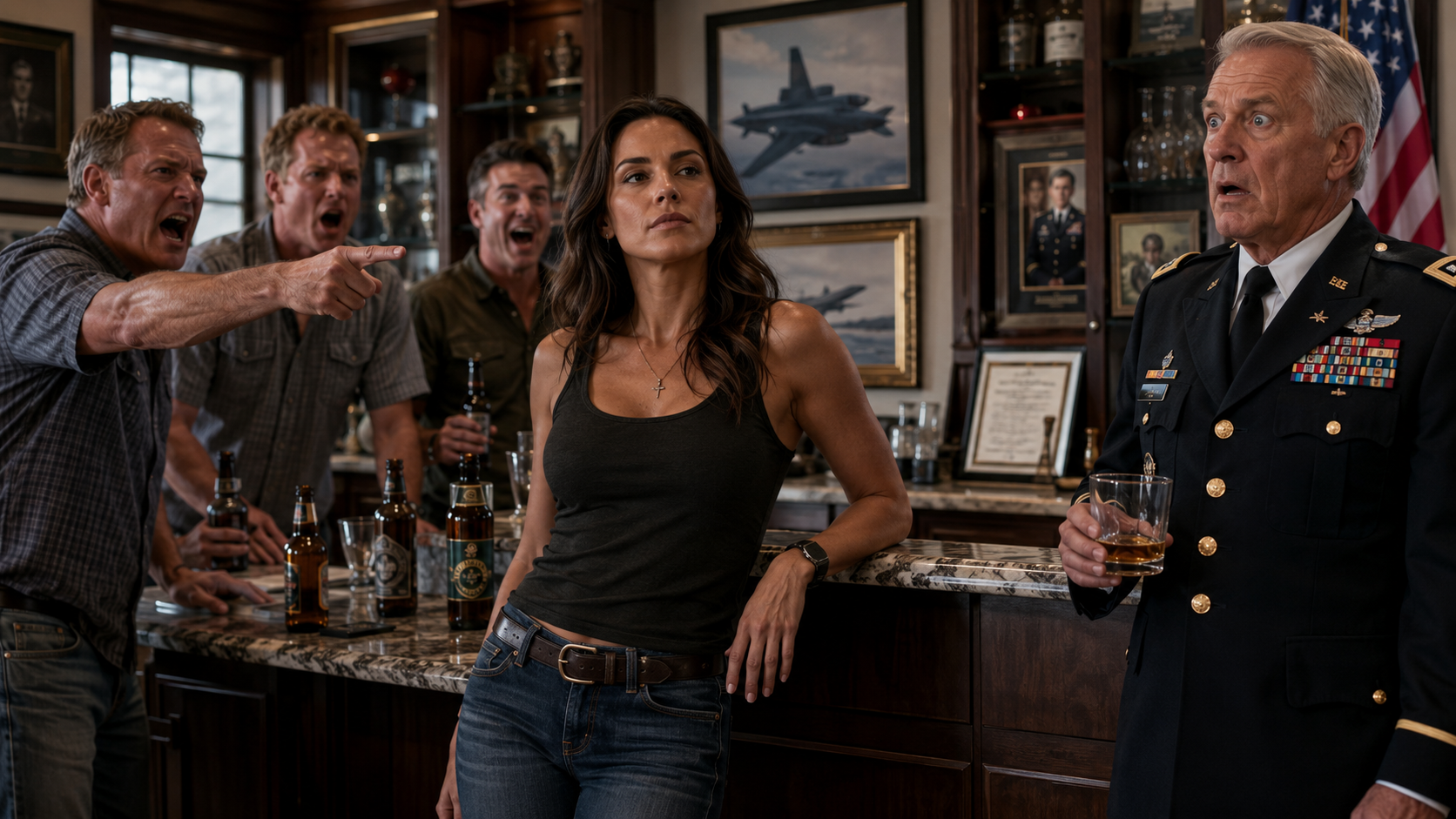
The laughter started before I even sat down.
“Can you cook?” Blake Whitmore asked from the far end of the table, holding his fork like he was about to conduct an orchestra.
The whole dining room cracked up.
I smiled, set down my wine glass, and said, “Only if it’s easier than landing a Black Hawk in a sandstorm.”
More laughter.
Everyone thought I was joking.
Everyone except one man.
A retired three-star Army aviation general nearly dropped his bourbon.
That was the moment everything changed.
At the time, though, I didn’t know it. I was just trying to survive another Saturday night in Preston Hollow, another polished Dallas dinner party where the grass was too perfect, the steaks were too expensive, and the women were sorted into categories before they finished their first glass of wine.
My husband, Greg, loved those rooms.
I tolerated them.
By the time we pulled into Blake and Marcy Whitmore’s circular driveway, my right knee was already throbbing. Rain had rolled through Dallas all week, and old injuries have a way of keeping their own weather forecast. Greg parked behind a white Range Rover and glanced over at me.
“You okay?”
“Just stiff.”
He nodded.
Not worried. Not annoyed. Just used to it.
Somehow that felt worse.
After twenty years together, pain had become furniture in our marriage. Present, familiar, never discussed unless someone tripped over it.
Inside, Blake’s house smelled like grilled beef, fireplace smoke, and candles that probably cost more than my first car payment. Country music drifted from hidden speakers. Men clustered near the bar, laughing too loudly. Women gathered around the kitchen island, holding stemless glasses and smiling with their eyes sharpened.
“Sarah,” Marcy said when she saw me.
Not warmly. Not coldly.
Like someone remembering to include a garnish.
Greg disappeared almost immediately into a conversation about commercial roofing contracts. That was his company—Lone Star Commercial Roofing. Though lately, he’d started calling it LoneStar Strategic Exterior Solutions, because apparently adding words made roof repair sound like national defense.
I ended up beside the kitchen island with the wives.
That was what everyone called us.
The wives.
As if marriage had erased our first names and assigned us matching uniforms.
Marcy poured wine into her glass. “So, Sarah, what do you do all day now?”
Now.
That word landed softly and still found bone.
“Oh,” I said, “a little of this and that.”
She nodded as if I’d confirmed something she already believed, then turned to another woman to discuss grandchildren.
I didn’t have children.
That usually ended those conversations.
An hour later, we sat around Blake’s long dining table beneath a chandelier made of glass rods and bad decisions. The men naturally took the center seats. The women filled in around them.
I landed across from Blake.
Beside him sat Duke Hollander, a retired salesman who became an expert on any topic within thirty seconds of hearing about it. Duke had opinions about football, taxes, medicine, border security, and especially the military.
Men like Duke fascinated me.
The less they knew, the louder they sounded.
Dinner had barely started when Blake leaned back and looked at Greg.
“You’re a lucky man.”
Greg grinned. “I know.”
Marcy rolled her eyes. “You better say that.”
Then Blake turned his fork toward me.
“So, Sarah. Serious question.”
I already knew where this was going. I could smell it like rain on concrete.
“What’s that?”
“Can you actually cook?”
A few people laughed.
Blake kept going. “I mean, Greg’s always taking clients out to dinner. Usually that’s a bad sign.”
More laughter.
I looked at Greg.
Just for one second.
I waited for him to say something. Anything. A redirection. A joke at Blake’s expense. A simple, “Careful, she’s more dangerous than she looks.”
Instead, Greg chuckled into his drink.
Not loudly.
Not cruelly.
Just enough.
Something settled inside me then.
Not rage.
Rage would have been cleaner.
This was disappointment finally taking off its coat and making itself comfortable.
Blake spread his hands. “Come on, Sarah. Settle the debate.”
The table waited.
I took a sip of water.
Then I shrugged.
“Only if it’s easier than landing a Black Hawk in a sandstorm.”
The timing was perfect.
Half the table laughed before I finished the sentence. Duke slapped the table. Someone repeated it like it was the funniest thing they’d heard all year.
But one person did not laugh.
Lieutenant General Frank Dawson, retired, sat two seats down from Blake. Seventy-something. Silver hair. Sharp eyes. The kind of man who could stay quiet for an hour and still command the room.
His bourbon glass stopped halfway to his mouth.
He stared at me.
Not through me.
At me.
My stomach tightened.
Because I knew that look.
Recognition.
The laughter moved on around us. Someone started talking about golf. Marcy asked whether anyone wanted more wine. Greg leaned toward Blake and said something about a city contract.
But Frank kept looking at me.
A few minutes later, he leaned forward.
“Excuse me.”
The table quieted.
His voice wasn’t loud.
It didn’t need to be.
He looked straight at me and said, “Captain Mitchell.”
Every sound in the room disappeared.
For one second, all I heard was the soft hum of the air conditioning.
Nobody had called me that in years.
Not Mrs. Mitchell.
Not ma’am.
Not sweetheart.
Captain.
I glanced at Greg.
He looked confused.
Blake looked confused.
Everyone looked confused except Frank.
I managed a small smile.
“Not anymore.”
Frank studied me another second. Then he nodded slowly.
“I thought so.”
And that was it.
He didn’t explain. Didn’t tell a story. Didn’t embarrass me. He simply returned to his drink.
But the room had shifted.
People kept sneaking glances at me for the rest of the night, as if I had grown a second face or misplaced an identity they thought belonged somewhere else.
When Greg and I finally left, the September air outside was still warm and damp. Valet attendants moved cars through the driveway. Guests lingered near the front entrance, glowing under porch lights.
Greg walked ahead toward our SUV.
I was halfway there when someone called my name.
“Sarah.”
I turned.
Frank Dawson stood a few feet away. The driveway lights cut long shadows across his face.
For a moment, neither of us spoke.
Then he handed me a business card.
“I’d appreciate a phone call.”
I looked down.
Plain white card. Name. Number. Nothing else.
“General,” I said.
“Frank.”
I nodded. “Frank.”
His expression softened slightly. “You may not remember me.”
“I remember the name.”
“I figured.”
For a second, it looked like he wanted to say more. Instead, he reached into his jacket pocket, pulled out a pen, and wrote something on the back of the card.
Then he handed it back.
I looked down.
Six words.
We need to talk about Kandahar 2011.
The world tilted beneath my feet.
Not visibly.
Just enough to bring back rotor noise, brown sky, radio static, burning metal, and the taste of sand behind my teeth.
When I looked up again, Frank was already walking toward his car.
Behind me, Greg called from the driver’s seat.
“You coming?”
I folded the card carefully and slipped it into my purse.
For the first time all night, I wasn’t thinking about Blake, Duke, Marcy, or Greg laughing at the table.
I was thinking about Kandahar.
And wondering why, after all these years, someone had finally opened that door.
### Part 2
I didn’t sleep that night.
Every time I closed my eyes, I saw Frank’s handwriting on the back of that card.
Kandahar 2011.
Six words.
Six words heavy enough to crack open a decade.
By two in the morning, I was sitting alone in the kitchen with a cup of coffee I didn’t need. The house was dark except for the stove light. The dishwasher hummed softly. Rain tapped against the windows in thin, nervous fingers.
Greg had gone to bed an hour earlier.
He had asked me only one question.
“You ever know that guy?”
“That guy” meant Lieutenant General Frank Dawson, retired.
“A little,” I said.
“Military stuff?”
“Military stuff.”
He accepted that answer because Greg had learned to accept the easiest version of me.
That was part of the problem.
I rubbed my knee beneath the table and stared at Frank’s card again.
For years, I had worked hard not to think about Afghanistan. Not because I was ashamed. Not because I was hiding. Life simply moves on, whether you are ready or not.
One day you are flying in brownout conditions with your crew chief yelling over the headset.
Then somehow you are standing in a Dallas grocery store comparing almond milk prices.
People think the hard part is war.
Sometimes the hard part is becoming ordinary afterward.
At sunrise, I went upstairs and opened the storage closet.
It took me fifteen minutes to find the plastic bin.
The lid had dust on it.
Inside were the pieces of a woman I used to be: flight logs, old photos, paperwork, a folded uniform I had not touched in years. I sat cross-legged on the carpet, my knee complaining, and started going through it all.
There I was at twenty-two, sunburned and terrified on my first day of flight school.
There I was beside a Black Hawk, helmet tucked under my arm.
There I was in Iraq, smiling like someone who had no idea what time would take.
And then Afghanistan.
Kandahar Province.
2011.
I closed the album.
Some memories don’t fade.
They wait.
Around nine that morning, my phone rang.
Unknown number.
I knew who it was before answering.
“Hello?”
“Captain Mitchell.”
His voice was calm. Direct. Exactly like the night before.
“Frank.”
“I appreciate you taking the call.”
I looked out at the backyard. Rainwater clung to the patio furniture. “You wrote Kandahar on a business card. That usually gets my attention.”
A faint chuckle. “Fair.”
“What do you want?”
“The truth.”
I almost laughed. “You’ll need to be more specific.”
“The operation is under final review for declassification.”
I sat up straighter.
“What?”
“I thought you knew.”
“No.”
A pause.
Then Frank said, “A number of operations from that period are being reviewed. Yours is one of them.”
Yours.
That word hit strangely.
As if the mission had ever belonged to me alone.
“What does that have to do with you?”
“I read the original after-action reports when they came across my desk years ago.”
I said nothing.
He continued. “I remembered the pilot.”
My hand tightened around the phone.
“Frank.”
“You saved lives that day.”
I closed my eyes.
Immediately, the kitchen disappeared.
Rotor chop.
Sand.
Radio calls stepping over each other.
Fuel concerns.
A closing window.
Men on the ground who needed extraction.
A crew waiting for me to decide.
I opened my eyes again and stared at my quiet suburban kitchen.
“You don’t need to tell me that,” I said.
“No,” Frank answered. “But maybe someone else does.”
I knew then where this was heading, and every part of me wanted to step away.
“Frank, I’m not interested in being anyone’s inspirational luncheon story.”
“Good. I hate those.”
Despite myself, I smiled.
“There’s an event next month,” he said. “Military Aviation Heritage Foundation. Dallas.”
“No.”
“You haven’t heard the details.”
“I don’t need them.”
“The board wants to recognize several veterans connected to newly declassified operations. You’re one of them.”
My coffee had gone cold.
“Frank, I haven’t flown in years.”
“That doesn’t change what happened.”
“I’m not that person anymore.”
The words came out too quickly.
Too honestly.
Silence stretched between us.
Then Frank said, “That’s where you’re wrong.”
I hated how badly I wanted to believe him.
Before hanging up, he added one more detail.
“One of the major sponsors is Lone Star Commercial Roofing.”
I froze.
Greg’s company.
“You’re sure?”
“Yes.”
“And Greg knows?”
“I assumed he did.”
A bitter little laugh escaped me before I could stop it.
Frank heard it.
“I take it he doesn’t.”
“No,” I said. “He doesn’t.”
After we hung up, I sat at the kitchen table for a long time.
The rain had stopped. Sunlight pushed through the clouds, turning the windows bright and exposing every fingerprint on the glass.
I did not tell Greg about the call.
I told myself I wasn’t hiding it.
But the truth was simpler and uglier.
I wanted one piece of my life that Greg had not already touched, minimized, edited, or explained away.
That afternoon, I drove to Greg’s office to drop off his dry cleaning because he’d left it in my car.
Lone Star Commercial Roofing occupied the fourth floor of a glass building near the tollway. The lobby smelled like lemon cleaner and money. His assistant, Linda, waved me through.
“He’s on a call, but you can leave it in his office.”
Greg’s office looked like a museum exhibit titled Successful Texas Man.
Framed newspaper clipping.
Golf trophy.
Photo with a state senator.
Signed Cowboys helmet.
A shadow box containing his old Army patches.
Greg had served.
I want to be fair about that.
He had worn the uniform honorably. He had done his time. But over the years, around business clients and country club men, he had learned to let silence do generous work.
If someone assumed he had deployed more than he had, he didn’t correct them.
If someone called him a combat guy, he smiled modestly.
That particular kind of modesty some men use when they want credit without making a claim.
I used to tell myself it didn’t matter.
Maybe it didn’t.
Until my real history became inconvenient beside his polished one.
Behind his desk sat framed photos.
Greg at a charity gala.
Greg holding a golf trophy.
Greg shaking hands with a developer.
There had once been another photo there.
Me in uniform, standing beside a Black Hawk, dust on my face, helmet under my arm.
Greg used to say it was his favorite.
It was gone.
That night, after Greg went to bed, I opened our shared digital album.
I felt foolish doing it, like a jealous wife in a bad TV drama.
But I checked anyway.
Vacation photos were there.
Christmas photos.
House projects.
Greg at fundraisers.
Greg at ribbon cuttings.
Greg smiling beside men who thought his handshake meant something.
But my cockpit photo was missing.
So was my promotion ceremony.
So was the picture from Kandahar after we made it back to base, the one where I looked so tired I barely recognized myself.
Not all of my military photos were gone.
Just the ones where I looked like someone nobody could dismiss.
I sat in the dark kitchen with the laptop open, staring at blank spaces where my life used to be.
Greg came in from the garage twenty minutes later.
“You okay?”
I closed the laptop.
“Fine.”
He tossed his keys into the bowl near the door. “I’m starving. You want Mexican?”
I looked at him.
At this man who had edited me in small, quiet ways, then walked into the kitchen asking about fajitas.
“Sure,” I said.
“Manny’s?”
“Perfect.”
And that was marriage sometimes.
Not a slammed door.
Not an affair.
Not a single unforgivable sentence.
Sometimes marriage was a woman sitting at a table, realizing her husband had been slowly erasing her while asking what she wanted for dinner.
### Part 3
The following Wednesday, I met Frank Dawson at a veterans’ breakfast in Fort Worth.
Greg thought I had physical therapy.
That was almost true. My knee hurt badly enough that morning to qualify as medical activity.
The breakfast was held at a VFW hall off Camp Bowie Boulevard, a low brick building with faded flags near the entrance and a parking lot full of pickup trucks. Inside, the coffee was weak, the bacon was overcooked, and the folding chairs complained every time someone shifted.
I loved it immediately.
Not because it was elegant.
Because nobody there was pretending.
A man near the door had a hearing aid that whistled whenever he laughed. Two women in Navy caps argued about VA parking. An older Marine with a cane told the same joke three times, and everyone let him.
There was comfort in a room where people didn’t need you to explain why you stood up slowly.
Frank waved from a table near the back.
He had two coffees waiting.
“Captain,” he said.
“Sarah,” I corrected.
He nodded once. “Sarah.”
We talked first about nothing.
Weather.
Traffic.
Dallas construction.
The kind of small talk veterans use when the big talk is sitting nearby like a dog that may or may not bite.
Finally, Frank opened a leather folder and pulled out several papers.
“Nothing classified,” he said. “Public-facing summary documents. Preliminary event materials.”
Still, seeing my name in that font made my throat tighten.
Captain Sarah Mitchell.
Operation reference.
Kandahar Province.
August 2011.
I touched the paper with two fingers.
“I didn’t make this happen by myself,” Frank said. “But when I heard your name was eligible, I encouraged them to stop dragging their feet.”
“Why?”
He leaned back.
“Because I remembered the report.”
“You remembered one report from fifteen years ago?”
“I remembered the pilot who landed when every sensible person would have turned back.”
I looked away.
“That’s not exactly how it happened.”
“No,” he said. “It never is.”
That answer earned more respect from me than praise ever could have.
People who haven’t been there love clean hero stories. Courage without fear. Decisions without doubt. War wrapped like a movie trailer with music underneath.
Real life is messier.
That day in Kandahar had been sand and bad visibility and radio traffic collapsing into itself. It had been a crew chief’s voice in my ear and my own hand damp inside my glove. It had been men on the ground with minutes they did not have.
I made a call.
Other people made theirs.
Some of us went home injured.
Some people did not go home the same.
That was the truth.
Frank studied me over his coffee.
“You’re wondering how I recognized you.”
“I am.”
“Your name helped. Your age. Your face, once I placed it. But mostly, it was the way you answered that idiot at dinner.”
I blinked.
Frank shrugged. “People inventing a story usually add too much detail. You didn’t. You said it like someone remembering weather.”
That hit harder than expected because he was right.
I hadn’t meant to say it.
The line had come out on instinct, like catching yourself against a wall before falling.
“I didn’t want anyone to know,” I admitted.
“Why?”
“Because then they ask questions.”
“Questions aren’t always attacks.”
“No,” I said. “Sometimes they’re invitations to bleed in public.”
Frank’s expression changed.
Not pity.
Recognition.
“I understand that.”
I believed him.
After breakfast, I drove back toward Dallas with his folder on the passenger seat and an ache behind my ribs. I should have felt proud. Instead, I felt exposed.
By the time I got home, Greg was in his home office on a conference call. His voice traveled down the stairs in that polished tone he used for clients.
“Absolutely. We’re proud to sponsor it. Anything supporting veterans is close to my heart.”
I paused at the bottom of the stairs.
Close to my heart.
The phrase made something cold unfold inside me.
I stood there listening as my husband talked about veterans with warm authority while knowing almost nothing about the veteran living in his own house.
That evening, he came into the kitchen carrying a folder.
“You won’t believe who’s attending the aviation fundraiser.”
I was chopping onions.
“Who?”
“Three city council members. Two developers. Maybe a local news crew.”
“That’s nice.”
“It’s going to be huge.”
“Sounds like it.”
He opened the refrigerator and grabbed sparkling water. “We should probably buy you something nice to wear.”
The knife stopped in my hand.
“What exactly is this event again?”
“Recognition dinner.”
“For who?”
He shrugged.
“Some pilot.”
Some pilot.
I looked down at the cutting board.
Little white onion pieces blurred for a second.
“Did you read the materials?”
“I skimmed them.”
“Of course.”
He looked at me. “What does that mean?”
“Nothing.”
That was a lie.
It meant everything.
The next few days became almost absurd.
Greg had every opportunity to learn the truth and missed all of them.
His assistant printed sponsor packets. He didn’t read past the logo.
The foundation sent an email with my name in the subject line. He forwarded it to Linda without opening the attachment.
Someone mentioned “Captain Mitchell” during a call. Greg answered another line halfway through.
It was like watching a man walk past a burning building because he was checking his reflection in a window.
Meanwhile, his friends remained exactly the same.
Blake still made jokes.
Duke still acted like his documentary habits made him a military historian.
Marcy still looked at women like she was grading produce.
At another barbecue, Duke cornered me near the buffet.
“There she is,” he said. “Our helicopter comedian.”
I smiled. “Duke.”
“You know, those Black Hawks are basically flying tanks.”
“They’re not tanks.”
“Well, you know what I mean.”
“Not really.”
He laughed, missing the warning. “Pretty much fly themselves now, don’t they?”
I tilted my head.
“Have you ever autorotated one into a dust bowl with a tailwind?”
Duke blinked.
“Well, not personally.”
“That’s usually where the brochure gets thin.”
For one glorious second, Duke’s face emptied.
Then he laughed too loudly and walked away.
I should have felt satisfied.
Instead, I felt tired.
There is a kind of humor that protects you.
And there is a kind that reminds you protection was necessary.
The official invitation arrived three days later.
Heavy cream paper. Embossed lettering. Formal enough to make my mailbox feel underdressed.
I opened it in the kitchen with a paring knife because I couldn’t find the letter opener.
Military Aviation Heritage Foundation Annual Recognition Dinner.
Frontiers of Flight Museum.
Dallas, Texas.
Guest of Honor: Captain Sarah Mitchell.
I sat down slowly.
For a while, I just stared at my name.
Not because I didn’t recognize it.
Because I did.
That was the problem.
I had spent years answering to smaller versions of myself.
Mrs. Mitchell.
Greg’s wife.
Ma’am.
Sweetheart.
The woman who didn’t cook enough.
That old rank on thick paper felt like a hand reaching through time.
Then I saw the sponsor list at the bottom.
First line.
Lone Star Commercial Roofing.
Greg’s company.
I held the invitation in both hands and listened to the quiet house around me.
Greg still had no idea.
And for the first time in years, I decided I was not going to protect him from what he had failed to see.
### Part 4
I wish I could tell you I had some brilliant plan.
That I sat in my kitchen plotting revenge like a chess player.
I didn’t.
The truth was less dramatic.
For several days, I did nothing.
I bought groceries. I paid bills. I went to physical therapy. I folded laundry while watching reruns of shows where crimes were solved neatly in forty-two minutes.
Life kept moving.
The only difference was that every morning I woke up knowing something Greg didn’t, and every night I wondered whether I should tell him.
The answer changed depending on how tired I was.
Some mornings, silence felt petty.
Some nights, it felt like justice.
One Thursday afternoon, I sat on the back patio with iced tea sweating against my palm and finally admitted the truth.
I wasn’t trying to embarrass Greg.
I just didn’t want to rescue him anymore.
There was a difference.
For years, I had softened rooms for him. I explained things away. I absorbed awkwardness. I pretended not to notice when he allowed people to misunderstand me because their misunderstanding benefited him.
Now I was tired.
And tired people eventually stop carrying things that don’t belong to them.
Frank called that evening.
“You free tomorrow?”
“For what?”
“Coffee.”
“Is this a command?”
“Request.”
“Sounds suspiciously like a command.”
“Old habits.”
We met near White Rock Lake at a coffee shop filled with retired teachers, cyclists, and laptop people pretending not to listen to everyone else’s conversations.
Frank was early.
Of course he was.
Men like Frank were physically incapable of being late.
He sat outside beneath a shade umbrella with two coffees already on the table.
“You’re predictable,” I said.
“Reliable,” he corrected.
I sat down.
For a while, we discussed the ceremony. Schedule. Media. Security. Seating. The foundation wanted a short speech from me.
“I don’t give speeches,” I said.
“You talk.”
“That’s different.”
“Not as different as you think.”
I looked out toward the lake. A man in a faded cap stood near the shoreline fishing. A young couple walked past holding hands. Their dog wore a red bandana and looked happier than most people I knew.
Frank watched me.
“You look troubled.”
“I am.”
“Want to talk about it?”
I stirred my coffee even though I hadn’t added anything.
“I keep telling myself this isn’t revenge.”
“But?”
“But part of me wants Greg to feel what I felt.”
Frank nodded.
“No shame in admitting that.”
“There should be.”
“No,” he said. “There would be shame in building your life around it.”
That one stayed with me.
We sat quietly for a moment.
Then Frank said, “You know why my first marriage ended?”
I looked up. “No.”
“Because I treated my wife like support staff.”
The bluntness surprised me.
“I wasn’t cruel,” he said. “That’s the trap. I provided. I worked. I stayed faithful. I thought that made me a good husband.”
“It didn’t?”
“It made me a decent employee of the marriage. Not a partner.”
I didn’t speak.
He looked across the lake.
“She had a life before me. Talents. Dreams. Accomplishments. I treated them like side notes in my biography.”
The comparison was too obvious to avoid.
“What happened?” I asked.
“One day, she left.”
“Did you try to get her back?”
“Of course.”
“And?”
“She told me late respect was just another kind of insult.”
I felt those words under my skin.
Late respect was just another kind of insult.
Frank took a sip of coffee.
“I spent five years learning that decent men can still do real damage.”
Greg wasn’t evil.
That was what made the whole thing harder.
Villains are simple.
Insecure people are complicated.
When I got home, Greg was in the kitchen, scrolling through his phone.
“Blake invited us over Sunday,” he said.
“I’m busy.”
He looked up. “Doing what?”
“Something else.”
“What something else?”
I stared at him.
It was such a small question. Such an ordinary husband question. But underneath it lived years of assumption—that my time was available unless assigned value by him.
“I don’t need to submit a calendar request, Greg.”
His face changed.
“Sarah, what’s going on with you lately?”
I almost told him.
The invitation was in my purse. Frank’s folder was hidden beneath old magazines in my office. The truth sat so close I could practically hear it breathing.
Instead, I said, “I’m remembering things.”
“What does that mean?”
“It means I’m busy Sunday.”
He studied me, confused and slightly irritated, as if I had changed the rules of a game he thought he owned.
“Okay,” he said finally.
But it wasn’t okay.
Not really.
The next afternoon, I did something I hadn’t done in years.
I drove to a storage facility near Richardson and unlocked a unit Greg thought held Christmas decorations and old patio furniture.
It did.
But in the back, behind a fake tree and two cracked storage tubs, sat a black footlocker.
My hands shook when I opened it.
Inside was my other life.
Uniform pieces.
Flight gloves.
A faded squadron patch.
A small notebook.
A photo of my crew.
And beneath all of it, sealed in a plastic sleeve, was a letter I had never shown Greg.
It wasn’t classified. It wasn’t dramatic. Just a formal commendation from a commander who had retired years ago.
But there were lines in it I had refused to reread.
Exceptional judgment under extreme conditions.
Critical role in successful extraction.
Disregard for personal safety.
I sat on the concrete floor of that storage unit, surrounded by dust and Christmas ornaments, and cried so quietly even I barely heard it.
Not because of the letter.
Because I realized I had hidden it from myself too.
That night, Greg came home late from a sponsor meeting.
He was energized, talking fast.
“This event is going to be great for the company. Frank Dawson is a big deal. If we get photographed with him, that’s huge.”
I watched him loosen his tie.
“Photographed with him?”
“Yeah. Veteran support looks good. Authentic. You know.”
Authentic.
The word landed like a slap.
“What about the honoree?” I asked.
“What about them?”
“Do you know anything about them yet?”
Greg shrugged. “Some Black Hawk pilot from Afghanistan.”
I looked at my husband across our perfect kitchen island.
White quartz.
Brass fixtures.
Fresh lemons in a bowl.
A room designed to look warm for people who rarely noticed coldness.
“Some pilot,” I repeated.
“Yeah,” he said, already checking his phone. “Apparently she did something impressive.”
She.
For one second, I thought he would realize.
He didn’t.
And that was when I finally understood.
Greg had not just forgotten who I was.
He had trained himself not to look.
### Part 5
The night before the ceremony, Greg found out by accident.
Not because I told him.
Not because Frank warned him.
Not because anyone finally decided he deserved mercy.
He discovered it the way careless people often discover the truth—while looking for something that benefited them.
I was downstairs reading when I heard a sharp scrape from his home office.
A chair shoved back hard.
Then silence.
Not ordinary silence.
The kind that makes your skin listen.
I waited.
Nothing.
After a full minute, I walked upstairs.
Greg stood behind his desk, perfectly still, holding a printed event program. His face had gone pale. Not dramatically. Just enough that I knew.
He had finally seen it.
At the top of the page, beneath the foundation seal, were the words:
Guest of Honor: Captain Sarah Mitchell.
For a long moment, neither of us spoke.
The air felt thin.
Greg looked at the paper, then at me, then back at the paper, as if reality might rearrange itself out of pity.
“What is this?” he whispered.
I leaned against the doorframe.
“It’s a recognition dinner.”
“You’re the honoree?”
“Looks that way.”
He swallowed.
“Why didn’t you tell me?”
There it was.
Not How did I not know?
Not What did I miss?
Not Sarah, I’m sorry.
Why didn’t you tell me?
I watched him grip the paper with both hands.
“I wanted to,” I said.
“Then why didn’t you?”
“Because I got curious.”
His brow furrowed. “Curious?”
“I wanted to see how long it would take you to notice.”
The words hit him hard.
His mouth opened, then closed.
“That’s not fair.”
“No,” I said. “It isn’t.”
He looked relieved for half a second, like I had agreed with him.
Then I finished.
“It wasn’t fair that I had to wonder.”
His eyes dropped back to the paper.
“I honestly didn’t know.”
“I know.”
That seemed to hurt more than an accusation.
Because ignorance was not much of a defense after twenty years.
He sat slowly.
“I thought you didn’t like talking about the military.”
“I didn’t like bleeding for people who only wanted entertainment.”
“That’s not what I did.”
I tilted my head.
Greg looked away.
Because we both knew it was exactly what he had done.
Maybe not with questions. Maybe not directly. But every time I tried to mention something real, he changed the subject, softened it, joked over it, or let the room move on.
Eventually, I stopped offering.
He had mistaken my silence for absence.
“I took down some photos,” he said suddenly.
“Yes.”
“You noticed?”
“Yes.”
“I was going to put them somewhere safer.”
I laughed once.
It came out flat and ugly.
“Safer than your office?”
He rubbed his forehead.
“I didn’t want clients asking questions.”
“About your wife?”
“About things I didn’t know how to explain.”
“That’s almost honest.”
He flinched.
Good.
Not because I enjoyed hurting him.
Because truth should leave a mark.
He stood again and paced toward the window. Outside, our neighborhood glowed with porch lights and sprinkler systems. Perfect lawns. Quiet houses. Respectable lives.
“I was proud of you,” he said.
“No, Greg. You were proud privately. There’s a difference.”
He turned back.
“What do you want me to say?”
I shook my head.
“That question is the whole problem.”
He looked exhausted suddenly.
Old.
Smaller than I remembered.
“I’m sorry,” he said.
The words arrived too late and too thin.
I had imagined that apology for years without realizing it. In my imagination, it had weight. It would unlock something. It would make me cry. It would make me soften.
But hearing it there, in his office, while he held proof he could no longer ignore, I felt almost nothing.
Late respect was just another kind of insult.
“I need to sleep,” I said.
“Sarah.”
“The ceremony is tomorrow.”
“Can we talk?”
“We are talking.”
“No, I mean really talk.”
I looked at him.
“Really talking requires listening before there’s a consequence.”
He had no answer.
I went to the guest room.
Not because I wanted drama.
Because I wanted a door between us.
The next morning, the house felt like a museum after closing.
Everything was still there. Coffee maker. Mail pile. Greg’s shoes near the garage door. My jacket over a chair.
But the life inside it had left.
Greg barely spoke during breakfast. He moved carefully around me, as if sudden movement might break whatever remained.
At one point, he looked across the kitchen table.
“I really didn’t know.”
I spread butter across toast I had no appetite for.
“I know.”
He winced.
I think he wanted me to yell.
Yelling would have helped him. It would have turned me into a storm he could endure. Instead, I gave him clear weather and visibility.
There was nowhere for him to hide.
The ceremony was scheduled for six at the Frontiers of Flight Museum near Love Field.
I drove separately.
Greg said he wanted us to arrive together.
I said no.
That was all.
No explanation.
Just no.
The museum looked beautiful in the early evening. The setting sun flashed against polished aircraft displays. American flags lined the entrance. Volunteers in navy blazers greeted guests. Children pointed at planes suspended from the ceiling, their voices bright with wonder.
For the first time in weeks, my nerves arrived.
Not because of Greg.
Not because of Blake or Duke or Marcy.
Because suddenly this was not about a dinner party insult anymore.
This was about people.
Real people.
Real memories.
Real consequences.
Frank found me near the entrance.
“You look nervous.”
“I am.”
“Good.”
“That’s your encouragement?”
“It means you’re taking it seriously.”
He straightened his tie.
“You’ll be fine.”
I wasn’t sure, but I appreciated the lie.
Guests continued arriving. Veterans. Donors. Military families. City officials. Reporters. Business owners wearing patriotism like cufflinks.
Then I saw Greg enter with Blake, Duke, Marcy, and several associates.
The moment Blake saw me standing beside Frank Dawson, confusion flickered across his face.
Then concern.
Then something close to panic.
Greg approached slowly.
His smile looked painful.
“You look beautiful,” he said.
I nodded. “Thank you.”
Frank shook Greg’s hand politely.
No hostility.
No coldness.
Just professionalism.
Somehow that made it worse.
We took our seats.
Nearly three hundred people filled the room.
Dinner was served.
Conversations drifted beneath the aircraft hanging overhead.
Then the lights dimmed.
The program began.
Several veterans were recognized. A scholarship was announced. A young widow received an award on behalf of her husband, and the room stood without being asked.
Then Frank walked toward the stage.
The room quieted immediately.
He did not need the microphone to command attention.
It simply made things official.
“Good evening,” he began.
He spoke about service, duty, memory, and the danger of allowing quiet people to disappear from history.
Then he paused.
And said, “Kandahar, 2011.”
My heartbeat changed.
Across the table, Greg became motionless.
Frank described the mission simply.
A deteriorating weather situation.
A joint team on the ground.
A closing extraction window.
A pilot with reasons to turn back.
A crew that chose to continue.
He did not exaggerate.
That was what I respected most.
He did not turn fear into fireworks.
He let the truth stand on its own legs.
“There were opportunities to wait,” Frank said. “There were professional reasons to turn away. But there were Americans on the ground who needed help.”
The room was silent.
Veterans listened differently now.
They were not hearing a speech.
They were recognizing a language.
“The pilot involved never requested recognition,” Frank continued. “Never sought publicity. In fact, she spent years avoiding both.”
A soft laugh moved through the room.
Frank looked toward me.
“Which means she is probably going to be annoyed with me tonight.”
More gentle laughter.
Then his face changed.
“Ladies and gentlemen, Captain Sarah Mitchell.”
For a second, I could not move.
Then the applause began.
People stood.
One row.
Then another.
Then another.
Three hundred people rose to their feet.
The sound filled the museum and pressed against my chest until I could hardly breathe.
I stood.
As I walked toward the stage, I glanced toward Greg’s table.
Blake looked stunned.
Marcy looked ashamed.
Duke looked as if someone had unplugged him.
Greg looked devastated.
Not because I was being honored.
Because he finally understood how much he had failed to see.
### Part 6
The plaque was simple.
Dark wood. Brass plate. My name engraved cleanly.
Captain Sarah Mitchell.
For conspicuous courage and exceptional aviation judgment during Operation Resolute Lantern, Kandahar Province, 2011.
I stared at it for half a second too long.
Operation Resolute Lantern.
There it was.
A name I had not said aloud in years.
Frank stepped back and gestured toward the microphone.
My hands were steady.
That surprised me.
My knee hurt. My throat felt tight. My heart was trying to beat its way out of my chest.
But my hands were steady.
“I don’t really know how to give speeches,” I said.
A few people laughed.
“Most pilots aren’t chosen for their conversational skills.”
More laughter.
Good.
The room loosened.
I looked out at the faces. Veterans. Families. Reporters. Donors. People who knew the cost of service and people who had only purchased seats near it.
“I appreciate this honor,” I said. “But the truth is, nobody does these things alone.”
I spoke about crew chiefs, mechanics, medics, radio operators, the people who kept aircraft flying, the people who made decisions without applause. I spoke about families who carried burdens nobody saw. I spoke about the strange loneliness of coming home and realizing the world kept spinning without knowing where you had been.
I did not give them a hero speech.
Heroes are easy to consume.
People are harder.
So I stayed human.
“When people ask about courage,” I said, “they usually imagine something loud. But sometimes courage is quiet. Sometimes it is continuing to do your job when you are afraid. Sometimes it is asking for help years after you convinced yourself you didn’t need any. Sometimes it is remembering your own name after others have spent years calling you something smaller.”
The room went very still.
I did not look at Greg.
I didn’t need to.
“I accept this on behalf of everyone who was there, especially those who still carry that day in ways no plaque can hold.”
When I finished, the applause felt warmer than before.
Less formal.
More personal.
Afterward came the handshakes.
So many hands.
Veterans approached me first. They didn’t ask foolish questions. They understood where not to step. One former crew chief grinned and said, “Ma’am, I bet your maintenance guys had opinions about that landing.”
I laughed for the first time all night.
“They had several.”
A woman whose son had served in Afghanistan hugged me without warning. She smelled like rose perfume and powder. I stiffened for half a second, then let her.
“My boy never talked much after he came home,” she whispered. “But he would’ve liked hearing you tonight.”
That nearly broke me.
Reporters asked questions. I answered carefully. Frank hovered nearby, not controlling, just present.
Then Blake made his mistake.
Of course he did.
Men like Blake can survive shame for approximately eight minutes before trying to turn it into a joke.
I was speaking with a foundation board member when I heard him behind me.
“Well,” Blake said too loudly, “I guess Sarah does more than cook.”
Nobody laughed.
Not one person.
The silence lasted maybe two seconds.
It felt like twenty.
I turned slowly.
Blake’s smile collapsed piece by piece.
Frank glanced in his direction once.
Just once.
Blake looked down at his shoes.
Marcy whispered something harsh under her breath and pulled him away by the elbow.
Duke approached fifteen minutes later.
He looked genuinely uncomfortable. Not performative. Not theatrical. Actually uncomfortable, which I respected more than I expected.
“Sarah,” he said.
“Duke.”
“I owe you an apology.”
I waited.
“I was ignorant.”
“That’s a start.”
He winced, then nodded. “A fair one.”
I almost smiled.
He shifted his weight.
“I talk too much about things I don’t understand.”
“Yes.”
He gave a short laugh. “You don’t soften much, do you?”
“I used to.”
His face changed.
Maybe he heard the rest of that sentence even though I did not say it.
“I’m sorry,” he said.
This time, I believed him.
Not enough to become friends.
But enough to let the moment end cleanly.
Greg found me near the aircraft exhibit after the crowd thinned.
A restored cockpit sat behind velvet rope. Children had pressed fingerprints against the glass all evening. The museum lights reflected off the canopy like moonlight on water.
Greg stood beside me with his tie loosened.
For a while, neither of us spoke.
Then he said, “I was scared.”
I looked at the aircraft, not him.
“Of what?”
“That people would think you were bigger than me.”
There it was.
Small.
Ugly.
Real.
The first honest thing he had said in years.
I turned toward him.
“What hurt me wasn’t that you felt small.”
His eyes lowered.
“It was that you kept making me smaller so you could feel bigger.”
He nodded like he had been expecting the sentence.
Maybe he had.
“I know.”
His voice cracked.
“I know that now.”
“Now,” I said.
The word sat between us.
He swallowed.
“I didn’t know how to stand next to someone like you.”
“You could have started by standing up for me.”
Silence.
No defense left.
Behind us, laughter drifted from the reception area. Silverware clinked. Someone called Frank’s name.
Greg looked at me.
“Are you leaving me?”
I looked at the man I had loved for twenty years.
The man who knew how I took my coffee.
The man who had held my hand through surgery.
The man who had also laughed when another man mocked me, erased my photos, borrowed veteran pride for business, and turned my silence into permission.
“I’m deciding whether I still respect you,” I said.
His face folded.
“I love you.”
I almost felt sorry for him.
Almost.
“Late love doesn’t repair early disrespect.”
He flinched.
Good.
Some truths should not arrive gently.
“Sarah, please.”
I looked back at the cockpit display.
For years, I had confused endurance with loyalty. I had mistaken patience for grace. I had believed that if a person wasn’t cruel on purpose, the hurt counted less.
But hurt does not need a master plan to become damage.
“I’m going home,” I said.
“I’ll come with you.”
“No.”
“You shouldn’t drive alone after tonight.”
I turned then.
“Greg, I flew through a sandstorm with hydraulic warnings and men screaming over the radio. I can drive myself home from Love Field.”
He looked away.
I walked past him before he could answer.
Outside, the air had cooled. The sky over Dallas was dark blue, almost black, and the museum lights glowed behind me.
I sat in my car for a long moment before starting the engine.
My plaque rested on the passenger seat.
Frank’s folder was beneath it.
For the first time in years, I felt the strange, terrifying shape of my own life returning to my hands.
And I knew something with absolute clarity.
This ceremony had not ended my marriage.
It had only revealed that my marriage had been ending quietly for a long time.
### Part 7
Two weeks later, Greg asked me to go to counseling.
He said it carefully, standing in the kitchen with both hands on the counter, as if he were approaching a skittish animal.
“I found someone,” he said. “A marriage counselor.”
I poured coffee into my mug.
“That’s good.”
Hope flickered across his face.
“You’ll come?”
“No.”
The hope died so quickly I almost looked away.
Almost.
“But you said that’s good.”
“It is. You should go.”
“Sarah.”
“Greg.”
“We need help.”
“You need help. I need space.”
He stared at me like I had changed languages mid-sentence.
For years, he had been the practical one. The steady one. The man with plans and meetings and folders and solutions. Now he stood barefoot in our kitchen, unable to negotiate with the one person he had assumed would always stay.
“I’ll change,” he said.
“I hope so.”
“For us.”
I set my mug down.
“No. For you.”
His mouth tightened.
“Is there someone else?”
The question was so insulting I laughed.
Not because it was funny.
Because even now, he needed another man to explain why I might leave.
“No, Greg. There is not someone else.”
“Then why are you acting like this?”
I stared at him.
“Like what?”
“Like you’ve already decided I’m the enemy.”
“You’re not my enemy.”
“Then why won’t you fight for this?”
That one landed.
Not because it was true.
Because it was such a perfect example of how little he had understood.
“I did fight for this,” I said quietly. “You just called it overreacting.”
He looked down.
“I didn’t know.”
“You keep saying that like it’s a blanket you can hide under.”
He closed his eyes.
I almost softened.
Old habits.
Then I remembered Blake’s table.
Greg chuckling into his drink.
My missing photos.
Some pilot.
I picked up my coffee.
“I’m moving into the guest room until I find an apartment.”
His eyes opened.
“Apartment?”
“Yes.”
“You’re serious.”
“Yes.”
He gripped the counter.
“What am I supposed to tell people?”
There it was again.
The real wound.
Not losing me.
Explaining losing me.
I smiled sadly.
“Try the truth. It’ll be new for you.”
I moved into a small apartment near White Rock Lake three weeks later.
One bedroom.
Second floor.
Terrible water pressure.
Excellent morning light.
The first night, I slept on a mattress on the floor because the bed frame hadn’t arrived. Rain tapped against the window. My knee ached. Boxes surrounded me like quiet witnesses.
I should have felt lonely.
Instead, I felt peace.
Not happiness exactly.
Peace.
There is a difference.
The divorce process began without fireworks. Greg hired an attorney. So did I. He did not fight me on money. I think guilt made him generous, or maybe he had finally learned that taking from me would not make him larger.
Blake sent flowers.
I never saw them. Greg told me later.
“What did the card say?” I asked.
He looked embarrassed.
“I was out of line.”
“That’s it?”
“Pretty much.”
“Most honest thing he’s ever written.”
The flowers went to a VA clinic waiting room.
Duke sent a three-page email.
I read the first page and deleted it.
The phrase “with all due respect” appeared twice before the first apology. That was enough.
Marcy sent nothing.
That felt appropriate.
Some of Greg’s friends disappeared from my life so completely it was almost a magic trick. Invitations stopped. Group texts went quiet. Certain women who used to air-kiss my cheek in foyers suddenly forgot my number.
I missed none of them.
Not one.
The funny thing about losing fake community is how quickly your calendar improves.
Frank and I became friends.
Real friends.
Not dramatic. Not romantic. Nothing that would make a gossiping dinner table happy. Just two people who had survived different versions of pride and regret, meeting occasionally for bad coffee and honest conversation.
He introduced me to a monthly gathering of female veterans in Fort Worth. We met in the back room of a diner that served excellent pie and coffee so weak it deserved medical attention.
Army.
Navy.
Air Force.
Marines.
Different ages. Different stories. Same scars, some visible, most not.
Nobody treated me like a hero.
Nobody treated me like a victim.
Nobody treated me like Greg’s wife.
I cannot explain how refreshing that felt.
One woman named Tessa had flown medevac missions and now ran a landscaping business. Another, Nadine, had been a mechanic and could fix anything except, according to her, “men with podcasts.” A retired Air Force colonel named June brought lemon bars every month and had a laugh like a starter pistol.
They welcomed me without ceremony.
No one asked me to perform my pain.
No one asked me to prove my service.
At my third meeting, Tessa slid into the booth beside me and said, “You know, there’s a foundation looking for mentors for girls interested in aviation.”
I stirred my terrible coffee.
“I’m not sure I’m mentor material.”
June snorted from across the table.
“Honey, none of us are. That’s why kids believe us.”
So I went.
The program met on Saturdays at a small aviation museum outside Arlington. Twelve girls showed up the first day, ages thirteen to seventeen, all elbows, ponytails, nervous energy, and carefully hidden ambition.
One girl named Riley stayed after class.
She had dark hair, bitten fingernails, and the wary expression of a kid used to adults disappointing her.
“Were you really a Black Hawk pilot?” she asked.
“I was.”
“Was it hard?”
“Yes.”
“Because you were a woman?”
I thought about that.
“Sometimes. Mostly because helicopters are complicated and people are exhausting.”
She smiled.
Small.
Real.
Then she asked, “Did people ever act like you didn’t belong?”
I looked at her face and understood, suddenly, that this was not a question about me.
“All the time,” I said.
“What did you do?”
I could have given her something polished. Something inspirational. A sentence fit for a poster.
Instead, I told her the truth.
“At first, I worked twice as hard and hoped they’d notice. Later, I learned to stop asking permission from people who benefited from my doubt.”
She looked down at her shoes.
Then she nodded.
That night, back in my apartment, I unpacked the last box.
At the bottom was the photo Greg had removed from his office.
Me beside the Black Hawk.
Dust on my face.
Helmet under my arm.
Eyes tired but alive.
I bought a simple frame the next morning and hung it in my living room where sunlight hit it every afternoon.
Not hidden.
Not softened.
Not made safe for anyone else.
A month later, Greg called.
I almost let it go to voicemail.
Then I answered.
His voice was quiet.
“I went to counseling today.”
“I’m glad.”
“She asked me what I missed most about you.”
I said nothing.
“I told her I missed how safe you made me feel.”
My chest tightened despite myself.
Then he continued.
“And then I realized I never asked if I made you feel safe.”
The apartment was silent around me.
Outside, traffic moved along the wet street.
“That’s a good realization,” I said.
“I’m sorry, Sarah.”
This time, the apology had weight.
Maybe because there was no audience.
Maybe because he did not ask for anything afterward.
But weight is not the same as repair.
“I believe you,” I said.
His breath caught.
“But I’m still not coming back.”
On the other end of the line, Greg was silent.
Then he whispered, “I know.”
And for the first time, I think he actually did.
### Part 8
The divorce was finalized on a Tuesday morning.
No storm.
No dramatic courthouse confrontation.
Just fluorescent lights, a tired clerk, signatures, and the strange quiet of a life becoming legally separate from another.
Greg wore a navy suit.
I wore a gray dress and low heels because my knee had opinions about symbolism.
When it was done, we stood outside the courthouse beneath a pale Dallas sky.
For a moment, we looked like any other middle-aged couple waiting for valet parking.
Except we were no longer a couple.
Greg held the envelope with his copies inside.
“I don’t know what to say.”
I looked at the traffic moving beyond the courthouse steps.
“Then don’t say anything.”
He nodded.
His face had changed over the past few months. Less polished. Less certain. Maybe that was growth. Maybe it was grief. Maybe both.
“I really did love you,” he said.
“I know.”
His eyes filled.
“I just didn’t love you well.”
That was the cleanest truth he had ever given me.
“No,” I said. “You didn’t.”
He wiped at his face quickly, embarrassed even in pain.
Old habits die slowly.
“Can we be friends someday?”
I thought about lying to make the moment easier.
Then I chose not to.
“I don’t know.”
He nodded again.
This time, he did not argue.
That mattered.
But it did not change my answer.
I walked to my car alone.
On the passenger seat sat a folder of final papers and a paper bag from the bakery near my apartment. Inside was a slice of chocolate cake.
I had bought it before court.
Not for celebration exactly.
For marking.
Some endings deserve witnesses, even if the witness is dessert.
That evening, I ate cake at my small kitchen table while rain moved across the windows. My apartment smelled like coffee, cardboard, and the lavender candle Tessa had given me as a divorce gift.
The card had said, Your new life deserves better lighting.
I laughed for five full minutes when I opened it.
Life did not become perfect after that.
That would be a lie.
My knee still hurt before storms. Some nights, the old memories came back sharp enough to steal sleep. Some mornings, I woke up reaching across the bed before remembering there was no one there.
Loneliness visited.
But so did relief.
And relief stayed longer.
The mentorship program grew. Riley kept showing up. So did more girls. A local news station ran a short segment about women in aviation, and somehow I ended up on camera again, standing beside a training helicopter and trying not to look like I wanted to escape.
After the segment aired, Frank called.
“You looked uncomfortable.”
“I was uncomfortable.”
“Good interview, though.”
“I said um eleven times.”
“Only nine. I counted.”
“Of course you did.”
He laughed.
A week later, I received an email from a regional aviation school asking if I would consider speaking at their summer program. Then another from a veterans’ leadership group. Then a nonprofit wanted help designing scholarships for young women interested in flight training.
It happened slowly.
Then suddenly.
My life, the one I thought had ended quietly years ago, began opening doors.
Not the same doors.
Better ones.
One Saturday afternoon, after a mentorship session, Riley stayed behind again. She was taller now, or maybe she just stood straighter.
“I applied for the aviation summer program,” she said.
I tried to keep my voice calm.
“You did?”
“Yeah.”
“How do you feel?”
“Like I might throw up.”
“That’s usually a sign you care.”
She looked at the helicopter behind us.
“My mom thinks it’s unrealistic.”
I leaned against the table.
“Most realistic things started as unrealistic to someone else.”
Riley smiled.
Then she said, “When people ask how I got interested, I tell them about you.”
For a second, I couldn’t answer.
There are compliments that flatter you.
And there are compliments that return something you lost.
“Then make sure you become better than me,” I said.
She grinned.
“Obviously.”
That night, I drove home with the windows down. The air smelled like hot asphalt and cut grass. My right knee ached, but not badly. The sky over Dallas glowed orange at the edges.
At a red light, I caught my reflection in the rearview mirror.
Forty-four years old.
Divorced.
Decorated.
Scarred.
Still here.
For years, I had thought the hardest thing I ever did was land that aircraft in Afghanistan.
I was wrong.
The hardest thing was walking away from a life that kept asking me to shrink.
The hardest thing was not forgiving someone just because he finally understood the damage.
The hardest thing was accepting that love arriving late does not erase disrespect that arrived early and stayed too long.
A month after the divorce, Greg sent one final letter.
Not an email.
A real letter.
His handwriting was careful, almost unfamiliar.
He wrote that counseling had forced him to see things he had avoided. He wrote that he was sorry for laughing, sorry for hiding my photos, sorry for using his service as a polished business accessory while ignoring mine. He wrote that he hoped one day I would let him apologize in person.
At the bottom, he wrote:
I know I don’t deserve another chance. I just wanted you to know I finally see you.
I read it twice.
Then I folded it and placed it in a box with the divorce papers.
Not because I hated him.
Because the letter belonged to the past.
And I no longer lived there.
The following Friday, the women veterans’ group held a cookout at Tessa’s house. Someone burned the burgers. June brought lemon bars. Nadine fixed Tessa’s broken porch light in under seven minutes while insulting the wiring.
Frank came by near sunset with a cooler of drinks and left early because, as he put it, “You people are loud.”
We were.
Loud in the best way.
At one point, Tessa raised her paper cup.
“To Sarah,” she said.
I groaned. “Don’t.”
“To Sarah,” June repeated, ignoring me completely, “who landed twice. Once in Kandahar and once back in her own damn life.”
Everyone cheered.
I laughed, embarrassed and happy and sad all at once.
That is how healing often feels.
Not clean.
Not simple.
A mixture.
Smoke from the grill drifted into the evening air. Cicadas buzzed in the trees. Someone’s dog barked at absolutely nothing. The porch light Nadine had fixed clicked on, washing the yard in gold.
For the first time in a long time, I did not feel like someone’s wife, someone’s punchline, someone’s quiet support system, or someone’s forgotten history.
I felt like myself.
Sarah Mitchell.
Captain Sarah Mitchell.
And this time, when I said my own name, I did not lower my voice.
THE END!
Disclaimer: Our stories are inspired by real-life events but are carefully rewritten for entertainment. Any resemblance to actual people or situations is purely coincidental.
