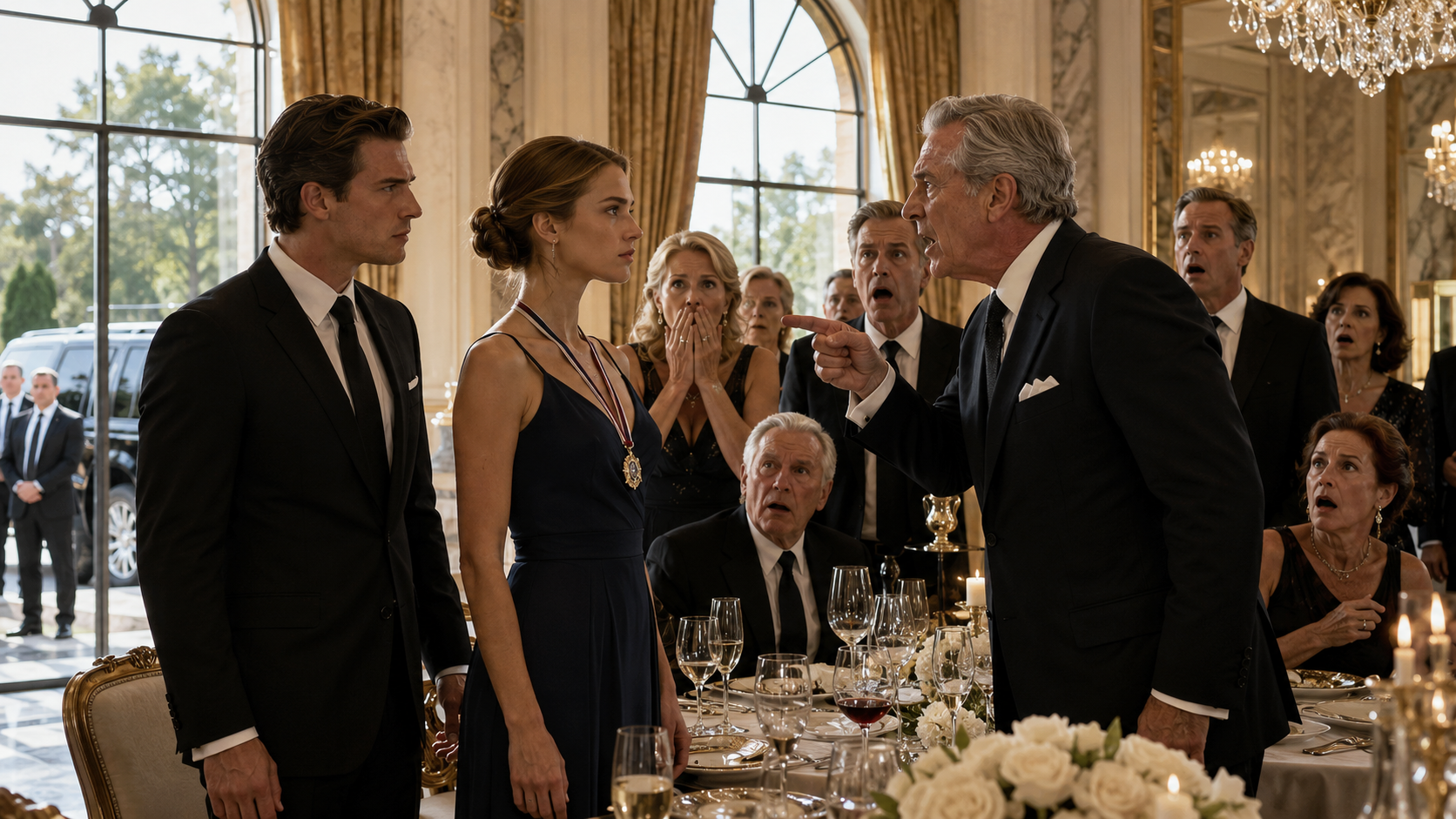

My Dad Mocked My Military Necklace As “Cheap Tin” In Front Of His Rich Friends. Then My Brother Stole It During Dinner, And Dad Defended Him. What They Didn’t Know Was That It Was A Classified Pentagon Access Key. Less Than 24 Hours Later, Black Federal SUVs Filled The Driveway…
### Part 1
By the time I pulled into my father’s driveway at 6:43 p.m., every luxury SUV in Davidson Ridge was already lined up outside his house like a dealership had decided to host a reunion for men afraid of aging.
Black Escalades. White Range Rovers. One silver Bentley parked too close to the fountain because Richard Colton had money but apparently not depth perception.
My father loved inviting people richer than him.
He said it was networking. I called it emotional begging with appetizers.
I shut off my engine and sat there for a few seconds with both hands on the steering wheel. The evening was cold enough to fog the edges of my windshield, but inside the car, everything felt still. Controlled. Familiar.
The titanium chain rested against my collarbone beneath my dress uniform.
Not decorative. Not sentimental in the ordinary way. But important.
The kind of important you don’t explain at dinner parties.
I touched the clasp once with my thumb, then stepped out.
Inside the house, roasted garlic, butter, and expensive wood polish hit me immediately. Somewhere near the dining room, somebody was laughing too loudly. Frank Sinatra played softly through hidden ceiling speakers, because every wealthy retired man in America seemed legally required to pretend his soul stopped developing in 1964.
My father spotted me before I reached the archway.
“There she is,” Richard Hayes announced, already holding a glass of red wine. “Captain America herself.”
A few people chuckled.
I smiled the way I’d been trained to smile around men who mistook cruelty for wit.
“Good to see you too, Dad.”
He leaned in and kissed the air beside my cheek without touching me. That was his version of affection. Close enough to perform, far enough to avoid warmth.
The dining room looked like a magazine spread nobody was allowed to actually live in. White candles. Imported linen napkins. Crystal glasses. A centerpiece that looked like it had been assembled by someone who charged by the emotional wound.
My brother Julian stood near the fireplace in a navy blazer and loafers without socks, because apparently that was what desperation looked like when it owned a Porsche.
“You made it,” he said, giving me a one-arm hug.
“I-77 was moving faster than your last startup,” I said.
A neighbor laughed into her wine.
Julian’s smile tightened.
“Still got jokes.”
His wife Chloe drifted over carrying a charcuterie board like she was presenting evidence at trial. Blonde extensions, diamond bracelet, and the permanent expression of someone offended by coupons.
“Oh my God,” she said, staring at my uniform. “You actually wore that.”
I looked down at myself. “That is usually how uniforms work.”
She blinked once, deciding whether I was stupid or insulting her.
It was always fun watching Chloe process basic human interaction.
Dinner began ten minutes later.
My father sat at the head of the table like a king who had conquered suburban banking. Julian sat to his right, Chloe beside him, glowing under the chandelier like she’d been professionally lit for disappointment.
I sat halfway down the table between Nancy Colton and a retired orthopedic surgeon named Bill, who smelled faintly of cigar smoke and lemon aftershave.
At first, everyone behaved.
They asked shallow questions.
I gave shallow answers.
Yes, I was still stationed in North Carolina. Yes, the work was demanding. No, I could not discuss it. Yes, the chicken was excellent.
Then Richard got comfortable.
He always got cruel after the second glass.
“Julian understands presentation,” he announced, slicing into his rosemary chicken. “That’s what success is now. Presentation. Confidence. Vision.”
Julian nodded as if they were discussing missile defense instead of an app that helped wealthy people reserve private golf simulators by the hour.
“Investors are circling,” Julian said.
I nearly choked on my water.
The last thing I’d heard about his company involved unpaid contractors, two maxed-out credit lines, and a landlord threatening legal action over missed rent.
But in my family, confidence was considered evidence.
Reality was optional.
I stayed quiet.
Years in military intelligence teach you something useful about silence. People reveal themselves when they think you aren’t competing for air.
At 7:58 p.m., my father leaned back in his chair and lifted his glass.
“I’ll say one thing,” he said. “Julian knows how to look successful.”
Then his eyes moved to me.
The table changed.
It was slight, but I felt it. That little collective inhale before a public humiliation. Everyone knew Richard well enough to recognize when he was about to perform.
His wine glass tilted toward my chest.
“And then there’s whatever the hell that thing is.”
I looked down.
The titanium chain lay visible against my uniform collar.
Chloe laughed immediately.
“Oh my God, thank you,” she said. “I thought I was the only one wondering.”
Richard shook his head. “You walk into a beautiful dinner wearing military ribbons and a damn dog collar.”
A few people gave uncomfortable smiles.
I took a sip of water.
“It’s important,” I said.
“A welder make it for you?” my father asked.
More laughter.
Julian smirked into his wine.
My father leaned forward. “It looks like cheap tin from a truck stop. Ruins the whole aesthetic.”
There it was.
That old familiar sting.
Not pain exactly. More like hearing a song you hated in childhood and realizing your body still remembered every note.
I set my fork down carefully.
“I didn’t realize my neck was affecting the property value.”
One neighbor snorted into his drink.
Richard rolled his eyes. “Everything with you becomes a joke.”
“No,” I said. “Usually just family dinners.”
Julian looked down to hide a smile.
Chloe didn’t hide hers. She reached for her wine glass while watching me.
Then suddenly, red wine splashed across my uniform collar in a dark wave.
A full glass.
The room gasped.
Chloe grabbed napkins dramatically.
“Oh my God, Eleanor. I am so, so sorry. That totally slipped.”
It didn’t.
I’d spent enough years around liars to recognize rehearsal.
Red wine dripped slowly down the front seam of my jacket.
My father sighed like I had personally inconvenienced gravity.
“For God’s sake,” he muttered.
I stood.
Nobody moved.
Nobody apologized except the woman who caused it, and even she was smiling around the edges.
“I’ll clean it up,” I said.
The powder room sat halfway down the hall beside the staircase. Marble counter. Gold fixtures. Towels nobody was allowed to use.
I locked the door halfway behind me and looked into the mirror.
The stain spread across my collar like fresh paint.
I reached up and unclasped the titanium necklace carefully.
The chain settled into my palm with a solid metallic weight.
Then I placed it on the edge of the marble sink beside the faucet.
Just for a minute.
Water rushed from the tap as I started blotting wine out of government-issued fabric. From the dining room, I could still hear my father talking. Still hear Chloe laughing. Still hear Julian charming people who had no idea his entire life was balanced on unpaid invoices and borrowed arrogance.
I cleaned the stain as best I could.
Then I turned off the water.
The house seemed suddenly quieter.
I looked at the sink.
The marble edge was empty.
For half a second, my mind rejected what my eyes already understood.
The necklace was gone.
And the only thing left beside the faucet was two tiny drops of water sliding slowly toward the drain.
### Part 2
I checked the floor first.
That’s what people do when reality becomes inconvenient. They look for the harmless explanation. The stupid explanation. The explanation that lets everyone go back to dinner.
I looked under the floating vanity. Behind the hand soap. Between the folded towels. In the tiny trash basket lined with a white plastic bag.
Nothing.
The necklace was gone.
I stood very still in that ridiculous powder room, listening.
Through the cracked door, the dining room sounded normal again. Glasses clinked. Silverware tapped plates. My father laughed at something, big and pleased with himself. The house still smelled like butter and wine and money pretending not to rot.
But underneath all of it, I felt something else.
Not panic.
Procedure.
My breathing stayed even. My heartbeat didn’t spike. Training does that to you. It doesn’t make you emotionless. It just teaches your body to wait its turn.
I opened the powder room door and stepped into the hallway.
Who had access?
Everyone.
Who had motive?
More than one.
Who had the kind of desperation that made theft feel like opportunity?
That narrowed the room.
I walked back toward the dining room.
Julian was no longer seated.
He stood near the front entry, pulling on his charcoal wool coat. His keys dangled from one finger. Chloe hovered beside him, clutching her little gold purse and pretending not to look at me.
“There she is,” Julian said too quickly. “Hey, I’ve got to run downtown. Last-minute investor thing.”
I stopped six feet away.
“At 8:30 on a Saturday night?”
He shrugged. “Tech world never sleeps.”
“Neither do casinos.”
One of the neighbors coughed into his napkin.
Julian smiled thinly. “Still doing the bitter military sister routine?”
I ignored him and looked at my father.
“My necklace is gone.”
Richard didn’t look up at first. “What?”
“The titanium chain I was wearing. I left it in the powder room while I cleaned my uniform. It’s gone.”
That finally got his attention.
Not concern.
Annoyance.
“Oh, Jesus Christ, Eleanor.”
Chloe folded her arms. “You’re not implying someone here stole it, are you?”
I looked at her.
“You tell me.”
Her mouth tightened.
Julian slid one arm into his coat. “Maybe it fell somewhere.”
“It didn’t.”
“Maybe the catering staff grabbed it.”
“We don’t have catering staff,” I said.
A small silence dropped over the table.
Nancy Colton suddenly became fascinated by her potatoes.
Richard tossed his napkin down. “This is exactly what I mean.”
“What do you mean?”
“You turn every situation into some kind of military operation.”
“My property disappeared from your house.”
“Your cheap little army necklace disappeared,” he corrected. “Let’s not act like Fort Knox got breached.”
A few guests shifted uncomfortably.
Nobody defended me.
That didn’t hurt anymore.
What hurt was remembering when it used to.
Richard leaned back. “If you lost your little army toy, buy another one.”
There it was.
The line that settled everything.
Not because of the insult. I’d heard worse from better men.
Because of how casually he said it.
Like my work was a costume. Like service was embarrassing. Like the only meaningful thing in the room was Julian’s borrowed confidence and Chloe’s jewelry financed by debt.
Julian checked his watch dramatically. “I seriously need to go.”
I stepped slightly to the side, blocking the door without making it obvious.
“What investor?”
He smiled. “Confidential.”
“That’s new for you.”
Richard snapped, “For God’s sake, Eleanor. Stop interrogating your brother.”
“I asked a question.”
“He answered it.”
“No,” I said. “He performed an answer.”
Julian laughed, but it came out thinner than before.
“Captain Conspiracy. Some of us actually make money on weekends.”
I stared at him.
His left hand flexed once against his coat pocket.
Tiny movement.
Most people would miss it.
Interrogators wouldn’t.
“You seem nervous,” I said.
“You seem paranoid.”
Chloe jumped in fast. “Oh my God, not everybody is plotting against you because you work for the government.”
I glanced down at the faint wine stain near my collar.
“No,” I said. “Usually people plotting against me are smarter than this.”
Julian’s jaw tightened for half a second.
Then the charming mask returned.
That was my brother’s gift. He could lie without looking guilty because he believed consequences were for slower people.
I moved away from the door.
“Drive safe.”
His eyes narrowed slightly.
Guilty people hate it when you stop pushing.
Silence scares them more than accusations.
Julian opened the front door fast enough to let cold air sweep through the foyer. Chloe followed him, talking loudly about valet parking downtown, even though the restaurant she meant had closed eight months earlier.
Another lie.
Small. Sloppy. Automatic.
The door shut.
Three seconds later, headlights flashed across the front windows.
Then the Porsche engine tore down the driveway like he was late escaping a crime scene.
Nobody spoke.
Richard picked up his wine glass again. “You always do this.”
“Do what?”
“Bring tension into a room.”
I looked through the dining room windows toward the empty driveway.
Something inside me went completely cold.
Not angry.
Certain.
Because my brother hadn’t stolen jewelry.
He had stolen something he didn’t understand.
And if I was right about what he’d just taken out of that house, the worst night of Julian Hayes’s life had already begun.
### Part 3
I left without saying goodbye.
Nobody stopped me.
My father had already gone back to pouring wine for the neighbors, smoothing over the scene like spilled sauce on expensive linen. That told me everything. In Richard Hayes’s world, nothing was real until it embarrassed him publicly.
The cold air outside felt clean against my face.
Davidson Ridge looked perfect beneath the streetlights. Perfect lawns. Perfect stone walkways. Perfect fake lives packed into houses too large for the people inside them.
I walked to my car.
Not a luxury SUV. Not a German sports car.
A dark gray 2017 Honda Accord with one dent near the rear bumper from a drunk man in Norfolk who reversed too quickly outside a seafood restaurant in 2021.
Julian mocked that car constantly.
“Captain, you know they pay officers actual money, right?”
I never bothered explaining the difference between wealth and financial stupidity.
I got into the driver’s seat, closed the door, and let the silence settle.
No tears.
No shaking hands.
No dramatic breakdown.
People think military training turns you cold. It doesn’t. It teaches you that panic is expensive, and sometimes you can’t afford it.
I reached across the passenger seat and opened my laptop case.
The device inside looked boring on purpose. Matte black. No visible logo. No decorative anything. The kind of machine an accountant might use in an airport lounge.
That was intentional.
Dangerous systems rarely look dangerous.
I powered it on.
Beyond my windshield, my father’s dining room windows glowed warm yellow through the trees. Tiny silhouettes moved behind curtains. People laughing. Eating dessert. Discussing golf memberships and market returns while a federal nightmare unfolded less than fifty yards away.
I entered my first password.
Then my second.
Then I authenticated through a physical access card and a biometric scan.
The screen loaded into a restricted interface most civilians would mistake for a dull software update.
What nobody inside that house understood was simple.
The necklace was not jewelry.
The titanium chain itself was almost worthless. My father had accidentally been right about that. Cheap metal. Plain design. No elegance. No sparkle.
The value was hidden in the clasp housing.
A hardened encrypted access key tied to secure Department of Defense logistics authorization systems.
Portable. Protected. Traceable.
And absolutely not something that belonged in the pocket of a bankrupt tech founder with impulse control issues.
I opened the recovery interface.
The system requested authorization.
I entered the override sequence from memory, leaving out the parts no one outside my chain of command would ever know.
For one second, nothing happened.
Then a map of Charlotte appeared.
Blue traffic lines. Security overlays. Coordinate tags.
And there it was.
A pulsing red dot near the southern warehouse district.
Active.
Moving.
I leaned closer.
Julian wasn’t downtown.
Julian wasn’t meeting investors.
He was near Remington Street, by the old freight rail district.
My stomach tightened.
Recognition, not fear.
Six months earlier, we had received a briefing about underground hardware brokers moving restricted components through shell companies in the Carolinas. Civilians imagined black market tech dealers as hackers in neon-lit rooms wearing hoodies.
The real ones looked boring.
Loading docks. Storage units. Paperwork. Men with LLCs and expensive watches pretending to sell salvaged electronics.
I zoomed in.
The red dot stopped outside Warehouse 18B.
A black SUV arrived beside him forty seconds later.
No plates visible from the traffic feed.
Professional.
That changed the room inside my head.
This was no longer a rich idiot stealing from his sister during dinner.
This was an unauthorized civilian attempting to move restricted federal hardware through an underground broker to save his failing company.
Federal theft.
National security exposure.
Possible counterintelligence concern.
I opened a separate secured folder and pulled up public financial indicators connected to Julian’s company.
Most intelligence work is not glamorous. It is depressing accounting with higher stakes.
There it was.
Vendor complaints.
Emergency loans.
Payroll delays.
A lawsuit filed nine days earlier by a software contractor demanding more than two hundred thousand dollars.
Julian’s company wasn’t struggling.
It was dying.
And desperate people love telling themselves they’re just one bold move away from survival.
I looked back toward my father’s glowing house.
Richard was probably eating cheesecake. Probably telling the Coltons that Julian had vision. Probably still irritated that I had disrupted dinner over “cheap tin.”
I almost laughed.
Then the red dot moved again.
Warehouse entrance.
Stationary.
Meeting someone.
I sat back slowly.
Julian had probably felt the abnormal weight in the clasp. Maybe he had opened it out of curiosity. Maybe he had seen the internal hardware and convinced himself anything military-looking must be valuable to the right buyer.
He didn’t think about loyalty.
He didn’t think about danger.
He thought about money.
That was the Hayes family religion.
I reached for the secure phone mounted inside my center console.
The small red indicator light blinked steadily in the dark.
Most civilians think local police handle theft.
Most civilians never touch anything classified.
The second Julian attempted to transfer that key, this situation left the jurisdiction of normal family drama.
I entered my authentication sequence.
Agency code.
Officer identification.
Encrypted phrase.
The line clicked twice, then routed through a secure relay.
It was late.
Too late to call anyone unless the world was on fire.
The phone rang once.
“Thorne.”
No greeting. No confusion.
Just General Marcus Thorne’s deep, controlled voice, sounding like somebody had already been held accountable.
I straightened automatically.
“Sir. Captain Eleanor Hayes.”
A pause.
“Why are you calling this line?”
I looked at the pulsing red dot.
And somewhere beneath all the years of family dinners, birthday disappointments, childhood memories, and swallowed insults, something shut off inside me.
Not emotionally.
Operationally.
“My apologies for the hour, sir,” I said evenly. “I have a compromised asset.”
The silence that followed had weight.
Then Thorne asked, “What asset?”
I told him.
His breathing changed once.
That tiny shift told me exactly how bad this had become.
“Location?” he asked.
I transmitted the coordinates.
“Civilian involved?”
“Yes, sir.”
“Identity?”
I looked out through the windshield at my father’s house.
For one second, I remembered Julian teaching me how to drive when I was sixteen. His hand on the dashboard. His laugh when I almost hit the mailbox. His voice saying, “Relax, Ellie. You’re not defusing a bomb.”
Memory is ugly like that.
It arrives exactly when clarity matters.
I swallowed once.
“Male. Thirty-four. Civilian technology founder. No clearance. Significant financial distress indicators.”
I did not say brother.
Not once.
Because once this entered official systems, family stopped being relevant.
Thorne understood that too.
“You believe transfer is imminent?”
“Yes, sir.”
“Probability?”
“High.”
Another pause.
Then the question that made my stomach tighten for the first time all night.
“Foreign contact?”
I pulled up the vehicle trace. Shell registration. Obscured routing. False documentation patterns.
“Possible, sir. Not confirmed.”
“Yet,” he said.
That word sat between us like a loaded weapon.
Then General Thorne said, “Stand down, Captain. Do not approach. Do not attempt recovery independently. Maintain distance and await contact.”
“Yes, sir.”
“Military police and federal agents will take it from here.”
“Yes, sir.”
Then his voice changed.
Lower. Colder.
“If the hardware has exchanged hands, this becomes counterintelligence. Not theft. Not family. Counterintelligence.”
I closed my eyes briefly.
Julian had spent his life believing consequences were negotiable.
Tonight, he had wandered into the one system in America that does not negotiate.
“Understood, sir.”
The line disconnected.
No speech.
No comfort.
Real power rarely wastes words.
I lowered the handset into its dock.
Across Charlotte, federal systems were already waking up.
And somewhere in a warehouse district, my brother still believed he was about to save his company with stolen military hardware.
He had no idea the United States government was already on its way to meet him.
### Part 4
I slept for exactly ninety-two minutes.
Not because I was nervous.
Because once federal systems activate around a compromised asset, your phone starts vibrating with encrypted updates nobody else in your family is legally allowed to know.
At 5:14 a.m., surveillance confirmed visual contact on Warehouse 18B.
At 5:47, a transaction attempt had been observed.
At 6:03, emergency warrants were approved.
At 7:11, possible foreign-broker involvement was flagged.
That one stayed with me.
There is a difference between your brother being greedy and your brother stumbling into international espionage.
Only one of those still leaves room for sympathy.
By 9:26 Sunday morning, I was sitting at my father’s kitchen table drinking black coffee while classical piano played softly through hidden speakers, as if the house itself was trying to pretend nothing ugly could exist under a chandelier.
The kitchen looked ridiculous.
Fresh fruit trays. Imported pastries. A live omelet station beside the Viking stove because apparently retirement brunch required performance eggs.
Richard stood near the windows in cream-colored slacks, smiling like a man who thought wealth made him wise.
Neighbors floated around holding mimosas.
Chloe wore white linen and oversized sunglasses indoors.
And Julian leaned against the marble island sipping espresso like a man who believed he had beaten the universe.
I watched him over the rim of my coffee.
Most people would have seen confidence.
I saw damage control.
His smile arrived half a second late whenever someone spoke to him. His left hand tightened around the espresso cup between sentences. There was a tremor near his thumb.
Adrenaline.
Sleep deprivation.
Fear trying to hide inside arrogance.
Federal surveillance was likely still watching the house from somewhere outside Davidson Ridge.
Julian had no idea.
That was the strange part. Even after stealing classified hardware and trying to sell it through criminal channels, my brother still believed he was the smartest man in every room.
My father clapped him on the shoulder.
“Tell them the good news.”
Julian gave a modest smirk, the kind men practice when they want applause but don’t want to seem needy.
“Well,” he said, “looks like the company’s alive after all.”
A few guests turned.
Richard beamed.
“My son secured new funding overnight.”
“Dad,” Julian said softly.
“No, let me brag.” Richard lifted his mimosa. “This is what real business instincts look like.”
There it was again.
That sideways glance toward me.
Look at your brother.
Look what success looks like.
Look what happens when someone matters.
Julian took another sip of espresso.
“Anonymous backer. Major influx of capital.”
“How major?” Richard Colton asked.
Julian shrugged. “Enough to solve every problem we had.”
That almost made me laugh.
Every problem.
Meanwhile, three federal agencies were building a case file around him thick enough to stop a door.
Chloe slid beside him proudly.
“I told him investors would come around. People recognize vision.”
Vision.
Interesting word for attempted transfer of restricted government property.
Richard pointed his champagne flute toward me. “You could learn something from your brother, Eleanor.”
I set my coffee cup down gently.
“What exactly did the investor buy into?”
Julian answered too quickly. “Software expansion.”
“What kind?”
“Enterprise integration.”
“That doesn’t mean anything.”
His smile hardened. “It means you wouldn’t understand it.”
The kitchen got quieter.
Wealthy people pretend to hate drama, but they always move closer when it starts breathing.
I leaned back.
“I understand debt.”
A neighbor coughed into his mimosa.
Richard’s face tightened. “Why are you always like this?”
“Like what?”
“Combative.”
I glanced at Julian.
His fingers shook harder now. Not enough for civilians to notice. Enough for me.
People under pressure leak information through their hands first.
“Did the capital clear?” I asked.
That question landed differently.
Julian’s expression paused before he caught it.
“Wire transfers take time.”
“How much time?”
“Twenty-four hours, usually.”
There it was.
No completed transfer.
No money cleared.
No protection.
Which meant federal agents likely allowed the transaction attempt to continue long enough to identify the other parties before moving in.
Standard procedure.
Julian thought he was negotiating his future.
He was sitting inside evidence collection.
He lifted his espresso again. “Deals don’t happen instantly, Eleanor. You’d know that if your entire career wasn’t built on taking orders.”
Richard smiled.
Chloe laughed softly.
I looked at my brother and realized something almost sad.
He genuinely thought he still had options.
That is what arrogance does. It convinces people consequences are part of a negotiation long after the negotiation has ended.
I set my coffee mug onto the marble.
Clink.
Sharp enough to cut through the room.
“So the money isn’t in your account yet?” I asked.
His jaw tightened.
“It’ll clear tomorrow.”
I nodded once.
Then I gave him the first honest thing I’d said all morning.
“That’s unfortunate.”
Richard frowned. “What’s that supposed to mean?”
I didn’t look away from Julian.
“Because you don’t have twenty-four minutes.”
And right then, somewhere outside beyond the front windows, heavy tires rolled slowly across the gravel driveway.
### Part 5
The sound swallowed the kitchen whole.
Julian turned toward the windows first.
Then froze.
Three black SUVs moved through the circular driveway in perfect formation.
No flashing lights.
No markings.
Just dark glass, heavy frames, and the controlled movement of people who did not need to announce authority because they carried it.
One SUV blocked the gate.
Another sealed the lower driveway exit.
The third stopped directly in front of the house.
Nobody spoke.
The brunch guests stared through the windows with champagne glasses halfway to their mouths, frozen like mannequins in expensive linen.
Richard frowned. “What the hell is this?”
Outside, doors opened almost simultaneously.
Military police stepped out first.
Body armor. Tactical rifles. Communication headsets. Calm hands.
Then federal agents followed in dark jackets, carrying hard cases and sealed evidence bags.
No one rushed.
No one shouted.
That silence always unsettles civilians the most.
Movies teach people that serious operations sound like chaos.
Real professionals barely speak.
Chloe grabbed Julian’s arm.
“Oh my God.”
Julian’s face lost color so quickly it looked physical.
His espresso cup tipped, spilling dark coffee over his knuckles and onto the marble floor.
Richard straightened immediately, slipping into his favorite identity: wealthy suburban man who believed rules were for people with cheaper watches.
“This is ridiculous,” he snapped.
He stormed toward the foyer.
I stayed where I was.
Once federal recovery teams arrive, social status stops being useful. That is always hard for men like my father.
Richard yanked the front door open.
“Excuse me!” he barked across the lawn. “This is private property.”
Nobody answered.
The agents continued moving.
Two secured the driveway. Another walked toward the side yard. One military police officer spoke quietly into his shoulder mic while scanning windows.
Richard stepped onto the porch.
“I asked you people a question.”
Still nothing.
Watching wealthy men realize their importance has no federal jurisdiction is fascinating.
It breaks something inside them.
Richard puffed out his chest.
“I know judges in this county.”
One agent finally looked at him.
Not intimidated.
Not angry.
Mildly inconvenienced.
“Please step aside, sir.”
Richard turned red. “Do you have any idea whose house this is?”
Honestly, I almost smiled.
They absolutely knew whose house this was.
That was why they were here.
Behind me, Nancy whispered, “Richard, maybe call a lawyer.”
Another guest quietly picked up her purse.
People always start preparing exits once reality enters the room.
Julian still had not moved.
That caught my attention.
Guilty people usually talk too much once pressure hits. They deny accusations before anyone makes them. Julian didn’t.
He stared at the vehicles like his brain could not process the scale of what he had touched.
Then the final SUV door opened.
The atmosphere changed instantly.
Even the agents shifted.
Straighter posture. Sharper attention.
General Marcus Thorne stepped onto the driveway wearing full service uniform beneath a dark overcoat.
Fifty-eight. Silver hair cut perfectly short. Calm eyes that made everyone around him feel guilty automatically.
I had seen senators fold under less pressure than that man created by simply entering a room.
Richard marched toward him.
Finally. Someone important enough to recognize.
“Sir,” my father said sharply. “I demand an explanation for this harassment.”
General Thorne did not slow down.
He did not acknowledge the question.
He walked straight past Richard like my father physically did not exist.
That hurt Richard more than any insult could have.
“Excuse me,” Richard snapped. “I’m talking to you.”
Still nothing.
General Thorne climbed the steps while agents continued securing the property.
Chloe whispered frantically, “What’s happening?”
Julian did not answer.
His breathing had changed.
Short. Uneven.
Fear breaking through.
The general entered the foyer.
For one second, the house went dead quiet except for the soft hiss of the espresso machine.
Then Marcus Thorne looked directly at me.
Not my father.
Not Julian.
Me.
He gave one sharp professional nod.
“Asset secured, Captain.”
The words hit the room like a collision.
Every face changed.
Richard blinked. “Captain?”
One guest lowered her glass.
Chloe looked between me and the general like her brain could not organize the information quickly enough.
But Julian understood immediately.
That was the moment he realized this was never about jewelry. Never about family drama. Never about embarrassing his sister at dinner.
His knees shifted slightly, like his body forgot how to balance.
General Thorne removed his black leather gloves slowly.
Then he looked toward Julian.
“Julian Hayes.”
Nobody had raised their voice once.
That somehow made everything worse.
Richard stepped forward. “Now hold on one damn minute.”
Two federal agents moved instantly between them.
“Sir,” one said, “remain where you are.”
Richard stared in disbelief. “You cannot be serious.”
The agent looked at him.
“We are very serious.”
Julian finally spoke.
“This is insane,” he said weakly. “I didn’t do anything.”
General Thorne looked at him for a long moment.
Then he glanced at me.
And standing in my father’s luxury kitchen, surrounded by terrified millionaires and half-eaten pastries, I watched the exact second my family understood they had completely misunderstood my life.
All those years, they thought I was the embarrassing daughter with the ugly military necklace.
They had never realized I belonged to a world powerful enough to arrive without warning and shut their entire reality down before brunch was finished.
### Part 6
The kitchen stayed frozen for three full seconds.
Then Julian broke first.
“No,” he said.
Not loud.
Not dramatic.
Just one small word from a man whose mind had finally caught up to his body.
He backed away from the island so fast his espresso cup tipped completely. Coffee spread across the marble counter and dripped onto the floor beside untouched pastries nobody would ever finish eating.
Richard looked between us wildly.
“Eleanor. What the hell is this?”
I didn’t answer.
The operation had moved past explanations.
Julian’s breathing turned ragged. His eyes darted toward the foyer, the windows, the back hallway leading to the patio doors.
Looking for exits.
That is the thing about people who spend their lives escaping consequences. When real consequences arrive, they think movement alone can save them.
General Thorne remained still.
“There has been no misunderstanding,” he said.
Julian shook his head. “You don’t understand. I didn’t know what it was.”
Chloe grabbed his sleeve. “Baby, just tell them whatever they need.”
He yanked away from her.
“Don’t touch me.”
That shocked her more than the agents.
Julian never stopped performing confidence around people, not even during arguments. But fear strips personality fast.
One brunch guest had her phone halfway out.
Without turning, an agent said, “Phones stay off.”
The woman nearly dropped it.
Richard marched toward me now, face flushed with anger and embarrassment.
“You brought this into my house?”
I looked at him calmly.
“No. Julian did.”
That hit harder than yelling.
Richard pointed toward General Thorne. “You need to tell your boss this is out of control.”
“My boss?”
The phrase almost sounded funny standing there with a four-star general coordinating a federal containment operation in my father’s kitchen.
“Richard,” General Thorne said.
My father turned instantly.
Finally, authority he thought he could negotiate with.
“Yes,” Richard snapped. “Thank God. Explain why armed men are terrorizing my family over some stupid necklace.”
General Thorne looked at him with the expression surgeons use before explaining that the damage is irreversible.
Then Julian moved.
Fast.
He bolted toward the back hallway.
Chloe screamed.
“Julian!”
He made it three steps.
Two federal agents intercepted him so quickly it looked mechanical. One caught his arm. The other drove him against the wall beside the wine cabinet hard enough to rattle the crystal inside.
“Federal agents,” one barked. “Stop resisting.”
“I didn’t do anything!” Julian shouted.
His voice cracked.
The agent twisted his arms behind his back while another secured heavy steel handcuffs around his wrists.
The sound changed the room.
Real handcuffs do not sound like they do in movies.
They are heavier.
Colder.
More final.
Chloe screamed again. “You’re hurting him!”
Richard lunged forward. “Get your hands off my son!”
Three agents shifted instantly between them.
Not violent.
Not emotional.
Immovable.
Julian struggled once, then realized resistance was pointless. Sweat covered the side of his face. His expensive sweater had twisted off one shoulder during the takedown.
The golden boy image cracked open.
Underneath it was only fear.
Richard looked back at me in complete disbelief.
“Eleanor, say something.”
I stayed still.
“Tell them to release him.”
No answer.
“For God’s sake, he took a necklace.”
Finally, I stepped forward.
The kitchen went silent again.
Even Chloe stopped crying long enough to listen.
I looked directly at my father.
“It wasn’t a necklace, Richard.”
Nobody moved.
The agents held Julian upright while his breathing came rough and broken.
“It was a level-five encrypted Department of Defense access key.”
The words landed slowly because half the room didn’t understand them yet.
Richard blinked. “What?”
“Julian didn’t steal jewelry from his sister.”
I looked toward my brother.
“He attempted to sell classified government property through an unauthorized broker.”
A woman near the dining room gasped.
Richard stared as if I had begun speaking another language.
“That’s impossible.”
General Thorne said quietly, “Unfortunately, it is not.”
Julian shook his head violently. “I didn’t know. I swear to God, I didn’t know what it was.”
One agent tightened his grip.
“That will be part of your statement,” he said.
Julian looked at me now.
Not remorseful.
Terrified.
“Ellie, please. I didn’t know.”
And there it was.
Not guilt for stealing from me.
Not shame for betraying me.
Just fear over consequences.
I studied him for a long second and realized something sad.
He was probably telling the truth.
He truly had not understood what he stole.
But ignorance only matters before consequences begin, not after.
General Thorne stepped closer.
For the first time, actual disgust crossed his face.
“You are not going to a local precinct,” he said. “You are going to federal detention.”
Julian stopped breathing for half a second.
Then his knees buckled.
The agents had to catch him before he hit the floor.
A horrible choking sound escaped his throat as the last scraps of arrogance drained out beside my father’s imported wine cabinet.
No confidence.
No charisma.
No polished entrepreneur act.
Just a terrified man in handcuffs realizing his entire life had collapsed between Saturday dinner and Sunday brunch.
Around him, every wealthy neighbor who had once envied Richard Hayes’s perfect family stood watching in absolute silence.
### Part 7
The agents pulled Julian upright.
Or tried to.
His legs barely worked.
The same man who spent years strutting through country clubs talking about disruption and innovation now looked like someone had removed the floor from beneath his life.
“Please,” he choked. “Eleanor, please.”
I said nothing.
Two agents guided him toward the foyer while he stumbled against a side table and knocked over one of Chloe’s decorative ceramic bowls.
It shattered on the hardwood.
Funny enough, that was what finally broke Chloe completely.
She collapsed beside the kitchen island, sobbing into both hands, mascara streaking down her cheeks while one heel twisted sideways under her.
“This can’t be happening,” she cried. “Julian, say something.”
He tried.
Nothing useful came out.
Fear had stripped all the polish away. No startup vocabulary. No investor voice. No charming grin. Just panic, raw and ugly.
One agent paused long enough to read the charges as they moved.
Unauthorized possession of restricted federal hardware.
Attempted transfer of classified government property.
Pending counterintelligence investigation.
Each phrase hit the house like another crack spreading through glass.
The brunch guests stood motionless near the dining room entrance, pretending not to stare while absolutely staring.
Nobody touched the food anymore.
Mimosas sat abandoned on countertops.
The omelet chef had disappeared at some point without telling anyone.
Smart man.
Richard still had not fully moved.
That surprised me most.
My father always had something to say. Opinions were his favorite hobby. But now he stood in the center of the kitchen looking like someone had removed gravity from the room.
His reputation was collapsing in real time, and he knew it.
Davidson Ridge ran entirely on gossip disguised as concern.
By dinner, every country club wife within thirty miles would know federal agents stormed Richard Hayes’s brunch and dragged his son away over national security charges.
In neighborhoods like that, bankruptcy can be survived.
Humiliation cannot.
Julian twisted once more near the front door.
“Dad,” he said.
Richard flinched.
“Dad, do something.”
There was nothing left to do.
That is the terrifying part about systems larger than money.
Influence stops working eventually, and my father had spent his whole life assuming influence was permanent.
The front door opened.
Cold morning air swept inside.
Outside, the black SUVs waited across the driveway like patient predators.
Julian looked back at me one final time.
Not angry anymore.
Desperate.
“I didn’t know,” he whispered.
I believed him.
That was the tragedy.
He really had not understood what he stole.
But he had understood it was mine.
That had been enough for him.
The agents took him down the front steps.
Across the street, neighbors pretended to water plants and adjust curtains while openly staring.
Chloe sobbed harder.
“Oh my God. Oh my God.”
Richard finally looked at me.
Really looked.
Not like the difficult daughter. Not like the embarrassing military kid ruining dinner aesthetics.
For the first time in my life, my father looked at me like he had no idea who I was.
Under that confusion sat something worse.
Need.
“Eleanor,” he said quietly.
I stayed still.
“You can fix this.”
There it was.
The final insult hidden inside the request.
After years of mocking my career, dismissing my service, and treating my life like a second-place failure compared to Julian’s fake success, my father suddenly wanted access to the power behind it.
Not respect.
Access.
“I know you can stop this,” he said quickly. “Talk to your general. Explain this whole thing was a misunderstanding.”
I watched him.
“Julian made a mistake.”
“Yes,” I said.
Encouraged, Richard stepped closer. “Exactly. He didn’t understand what he was doing.”
“Neither did you.”
That stopped him.
The house went quiet except for Chloe crying softly near the island.
I looked around slowly.
Imported countertops. Custom wine cabinets. Designer furniture. Everything my father had collected so people would think he mattered.
Now none of it could protect him from the consequences sitting in his driveway.
Funny how fast status turns into decoration.
Richard’s voice lowered. “I’m asking you as your father.”
That might have worked years ago.
Before the jokes.
Before the comparisons.
Before the dinner where he defended Julian for stealing from me because he thought the object around my neck looked cheap.
I walked toward the foyer slowly.
Not angry.
Not triumphant.
Finished.
General Thorne stood outside near the lead SUV, speaking quietly with another officer while agents loaded evidence containers into a vehicle.
Julian was already secured inside the second SUV, head lowered.
Gone.
I stopped at the doorway and turned back one last time.
Richard stood alone in the kitchen.
Not physically alone.
Spiritually alone.
The guests were already keeping distance from him. Nobody wanted contamination from scandal.
He suddenly looked older than sixty-four.
Smaller too.
As if the arrogance holding him upright had collapsed under its own weight.
I studied the man who spent my life trying to convince me I was less valuable because my success did not look elegant enough for his friends.
Then I spoke quietly.
“You always told me I didn’t understand the value of things, Dad.”
His face tightened.
I glanced toward the driveway.
“But you just traded your son’s freedom for a piece of cheap tin.”
The words settled heavier than yelling ever could.
Richard opened his mouth.
Nothing came out.
Deep down, he knew I was right.
If he had listened, if he had cared, if he had treated me like a daughter instead of a social embarrassment, none of this would have happened.
I stepped outside.
Cold air filled my lungs.
General Thorne opened the rear SUV door for me with one sharp nod.
No speeches.
No sympathy.
Just respect.
The kind my own family never learned how to give.
I slid into the black leather seat.
The door closed with a final thud.
And for the first time all weekend, maybe the first time in years, I felt completely at peace.
Not because Julian was arrested.
Not because Richard was humiliated.
But because I had finally stopped shrinking myself for people who only respected appearances.
The convoy rolled down the driveway, leaving behind the mansion, the brunch, the gossip, and the ruins they had built with it.
I never looked back.
### Part 8
The highway outside Charlotte was almost empty by the time the convoy dropped me back near Fort Liberty.
I remember sitting alone afterward in my office parking lot at 2:17 in the morning with a paper cup of vending machine coffee cooling in my hand.
Everything was quiet.
Not outside.
Inside.
No tension in my shoulders. No mental preparation for the next insult. No exhausting little calculations about how to keep peace around people determined to misunderstand me anyway.
Just quiet.
Peace feels strange when you grow up around people who treat disrespect like normal family communication.
A lot of people probably think the hardest part was watching federal agents drag my brother out of the house.
It wasn’t.
The hardest part happened years before that.
It was sitting through dinners where my accomplishments became jokes because they didn’t match somebody else’s idea of success.
It was learning that some families only celebrate you when your life improves their image.
It was realizing that no matter how disciplined, loyal, or responsible you become, some people have already assigned your role in the family and will punish you if you try to outgrow it.
There is usually a golden child in families like mine.
And then there is the person expected to absorb dismissal quietly so everyone else can stay comfortable.
My father never said, “You matter less.”
People like Richard don’t speak that directly.
They communicate through comparisons. Through embarrassment. Through selective pride.
Julian got admiration for potential.
I got criticism for presentation.
That does something to a person after enough years.
You start overexplaining yourself.
You start minimizing your accomplishments because people act uncomfortable every time you succeed differently than expected.
You start trying to earn respect from people emotionally committed to withholding it.
And honestly, that is exhausting.
One thing the military taught me early was that respect and approval are not the same thing.
Approval depends on preference.
Respect depends on conduct.
Someone might dislike your personality, your politics, your career, your style, your humor. But if you consistently show discipline, competence, honesty, and responsibility, mature people can still respect you.
Immature people only respect what impresses their friends.
That was my father’s real problem.
He cared more about appearance than substance.
The expensive neighborhood mattered.
The right social circles mattered.
The son with startup buzzwords mattered.
Meanwhile, the daughter serving in military intelligence embarrassed him because it didn’t sound glamorous enough over cocktails.
A lot of parents do this without admitting it.
They train children to believe love must be earned through performance instead of character.
Those children grow into adults who tolerate terrible treatment because they confuse acceptance with self-erasure.
I did that for years.
I told myself Richard was proud in his own way.
I told myself Julian was just immature.
I told myself Chloe was harmless.
I told myself family was supposed to be complicated.
But complicated is not the same as cruel.
That lesson took me too long to learn because I confused patience with loyalty.
They are not the same thing.
Patience is healthy.
Loyalty is honorable.
But self-abandonment disguised as family peace will destroy your confidence slowly over time.
And the scary part is that it happens quietly.
You laugh off insults.
You ignore favoritism.
You excuse disrespect because “that’s just how they are.”
Then one day you realize you built your personality around avoiding conflict with people who never protected your feelings in the first place.
For me, that day came when my father defended Julian after the theft.
Not because of the necklace itself.
Because of what it revealed.
Richard did not care that something important to me had disappeared.
He cared that I was disrupting the atmosphere by reacting to it.
Some families prioritize comfort over truth for so long that accountability itself starts feeling offensive to them.
Eventually, reality collects the debt.
That was what happened to Julian.
Not overnight.
Over years.
Every excuse became another brick.
Every rescue became permission.
Every avoided consequence became training.
People think arrogance appears suddenly.
Usually, it is built carefully by environments that reward image while excusing behavior.
Julian did not become reckless because he was successful.
He became reckless because nobody meaningful ever forced him to sit still inside failure long enough to grow from it.
And my father helped build that version of him while mocking the version of me that learned discipline instead.
That was the irony.
The child he considered weak survived pressure.
The child he considered impressive collapsed the second pressure became real.
I don’t say that with satisfaction.
That was the saddest part.
Because deep down, I don’t think my father hated me.
I think he worshiped appearances so long that he lost the ability to recognize value unless other wealthy people approved of it first.
That happens more often than people admit.
Some adults never emotionally mature past high school status systems.
Bigger houses.
More expensive watches.
More impressive children.
Different packaging, same insecurity.
But here is what I finally learned in that parking lot holding terrible coffee at two in the morning.
Dignity gets quieter as you grow older.
You stop needing applause.
You stop needing revenge speeches.
You stop trying to win rooms full of people committed to misunderstanding you.
Eventually, you realize peace begins the moment you stop auditioning for respect from emotionally unavailable people.
That was the real ending of my story.
Not the arrest.
Not the federal charges.
The peace afterward.
### Part 9
I thought about Julian a lot in the weeks after the arrest.
Not constantly.
Not emotionally.
Just in those quiet moments where your mind starts replaying old memories differently because you finally understand how the story ended.
The strange thing is, Julian was not born a villain.
Life is rarely that clean.
When we were kids, my brother could be funny as hell. He once convinced half the neighborhood that our father had bought a peacock during a midlife crisis just because he got bored one summer afternoon.
People believed him too.
That was Julian’s gift.
He knew how to make people feel good around him.
The problem was that eventually he learned charm could replace accountability if he used it often enough.
And honestly, society rewards that behavior for a long time.
Good-looking people get second chances faster.
Confident people get trusted faster.
People who speak smoothly often receive opportunities more competent people never even hear about.
Julian figured that out early.
Every time he missed a deadline, someone extended it.
Every time one of his business ideas failed, another investor gave him another shot because he sounded convincing explaining the previous disaster.
Every time he overspent, someone helped him recover before consequences fully landed.
And my father reinforced all of it.
That matters.
Entitlement rarely grows alone.
Somebody usually waters it.
Richard treated Julian like a future success story no matter what happened.
Failure became temporary.
Debt became entrepreneurial risk.
Recklessness became vision.
Meanwhile, responsibility looked boring by comparison.
That is another dangerous thing modern culture does.
We romanticize chaos when attractive people create it, especially in business.
Someone loses millions wearing nice shoes, and suddenly people call him disruptive instead of irresponsible.
Someone works quietly, pays bills on time, builds stable relationships, and stays disciplined for twenty years.
Nobody makes documentaries about that person.
But you know who sleeps better at night?
The boring person.
Every single time.
That is one lesson I wish more people understood before social media convinces them their life is failing because it looks normal.
Normal is underrated.
Reliable income is underrated.
Living beneath your means is underrated.
Having integrity when nobody is watching is extremely underrated.
Julian spent years building the appearance of success instead of the structure required to survive pressure.
That catches up eventually.
Always.
The frightening part is that most catastrophic decisions don’t feel catastrophic while you’re making them.
They feel temporary.
That is how people talk themselves into crossing ethical lines.
I’ll fix it later.
I just need one break.
This isn’t technically hurting anybody.
I’m smarter than the system.
That last one destroys people constantly.
Especially intelligent people.
Because intelligence without discipline becomes arrogance surprisingly fast.
Julian genuinely believed he could control situations larger than himself because most of his life trained him to expect escape routes.
Until suddenly there weren’t any.
General Thorne once told a room full of junior officers something I never forgot.
“The first bad decision rarely destroys careers. The second one usually does.”
At the time, he was talking about secure network protocols, but honestly, it applies to life in general.
Most people do not wake up planning to become disasters.
They normalize smaller compromises first.
Then their moral boundaries become flexible enough to justify almost anything under pressure.
That was Julian.
His company started collapsing.
His lifestyle became impossible to maintain.
Investors stopped believing the performance.
Instead of shrinking his ego to fit reality, he tried forcing reality to fit his ego.
That path never ends well.
If you are under pressure right now, slow down before desperation starts negotiating with your ethics.
A lot of people destroy their lives trying to preserve appearances for people who barely think about them anyway.
The expensive apartment.
The luxury car.
The fake online image.
The pressure to look successful every hour of the day.
None of that matters once your integrity collapses.
And once trust disappears, rebuilding it takes longer than building wealth ever did.
Military life taught me that competence means nothing without character.
You can be brilliant and still dangerous.
You can be ambitious and still weak.
You can understand systems and still destroy your own life because emotionally, you never learned restraint.
That is why discipline matters more than motivation.
Motivation changes daily.
Discipline survives ugly seasons.
Julian had confidence.
But confidence without accountability eventually mutates into entitlement.
And entitlement creates people who believe consequences only happen to other families.
Until one morning, federal agents walk through the front door during brunch.
The saddest realization wasn’t that my brother committed a federal crime.
It was realizing he had spent years becoming someone none of us actually knew anymore while everybody around him kept applauding the performance.
That happens outside criminal situations too.
People hide behind performance constantly.
Sometimes the charismatic man at the party is drowning in debt.
Sometimes the successful-looking couple secretly hates each other.
Sometimes the loudest person in the room is one unpaid bill away from panic.
That is why I tell younger soldiers something simple now whenever they ask me about success.
Build a life that stays stable when nobody is impressed.
Because eventually applause fades.
And when it does, your habits, your character, and your integrity are the only things left carrying your weight.
### Part 10
The first call from my father came three days after Julian’s arrest.
I was in my apartment, standing barefoot in the kitchen, eating cold leftover noodles from the carton because I was too tired to pretend dinner needed a plate.
My phone lit up on the counter.
Richard Hayes.
I watched it ring until the screen went dark.
Then it rang again.
And again.
By the fourth call, I answered.
Not because I wanted to hear his voice.
Because avoiding him was still giving him a kind of power, and I was done organizing my life around his emotional weather.
“What?” I said.
There was silence first.
Then my father exhaled.
“Is that how you answer your father now?”
I almost laughed.
Not because it was funny.
Because even after federal agents took his son away, Richard still believed tone was the emergency.
“What do you need?”
“I need you to stop being cold.”
There it was.
Three days.
Not “I’m sorry.”
Not “I was wrong.”
Not “I should have listened.”
He needed me to be warmer while cleaning up the wreckage he helped create.
“Julian has a lawyer,” he said.
“I assumed.”
“A good one.”
“Good.”
“He says things may look worse than they are.”
“They usually say that before they invoice.”
My father’s voice sharpened. “This isn’t a joke.”
“No,” I said. “It stopped being a joke when he stole restricted federal property from my neck.”
“He didn’t know what it was.”
“He knew it wasn’t his.”
Silence.
That one landed.
Then Richard lowered his voice.
“Eleanor, I know you’re angry.”
“I’m not angry.”
“You are.”
“No,” I said, looking down at the noodles going cold in my hand. “I’m finished.”
He hated that.
Anger gives people something to argue with.
Finished gives them a closed door.
“You don’t mean that.”
“I do.”
“Family doesn’t abandon family.”
I closed my eyes.
There it was again.
Family.
That word people use like a key after they spent years breaking the lock.
“Did you think that when I said my necklace was missing?”
He said nothing.
“Did Julian think that when he took it? Did Chloe think that when she dumped wine on my uniform? Did you think that when you mocked my service in front of strangers?”
“That was dinner banter.”
“No,” I said. “That was contempt with candles.”
His breathing changed.
For once, he had no polished response.
Then he did what Richard always did when truth cornered him.
He switched to guilt.
“Your mother would be devastated by this.”
My mother had been dead eight years.
He brought her up whenever he ran out of leverage.
I felt something in me go still.
“Don’t use Mom as a shield.”
“I’m saying she believed in keeping family together.”
“She also believed in telling the truth. You just liked the parts of her that were convenient.”
Another silence.
Longer this time.
When he spoke again, his voice sounded smaller.
“I’m losing my son.”
“No,” I said. “You’re meeting him.”
That was cruel.
Also true.
Richard made a sound like I had slapped him.
“You think you’re better than us now?”
The old accusation.
The one families use when they can no longer control the person they trained to feel small.
“No,” I said. “I think I stopped pretending worse behavior deserves equal access.”
“Eleanor—”
“I’m not calling anyone for Julian. I’m not softening anything. I’m not writing a character statement. I’m not helping you turn this into a misunderstanding.”
“He could go to prison.”
“Yes.”
“He’s your brother.”
“He was my brother when he stole from me too.”
The line went quiet.
For the first time, I heard something underneath my father’s anger.
Fear.
Not for me.
Not even fully for Julian.
For himself.
For the life he had built around appearances now cracking in public.
“I don’t know what to tell people,” he whispered.
That was the most honest thing he had ever said to me.
Not “I don’t know how to help my son.”
Not “I don’t know how to repair my relationship with my daughter.”
I don’t know what to tell people.
That was Richard Hayes in one sentence.
I set the noodles down.
“Tell them the truth.”
He gave a bitter laugh. “You think it’s that simple?”
“Yes.”
“You always were naive.”
“No,” I said quietly. “I was just raised by cowards long enough to mistake honesty for cruelty.”
He inhaled sharply.
I didn’t apologize.
Some truths don’t need softening.
“I’m going to hang up now,” I said.
“Eleanor, wait.”
But there was nothing left to wait for.
“I hope Julian gets a fair trial,” I said. “I hope you get exactly as much comfort as you gave me.”
Then I ended the call.
My apartment went silent again.
No chandelier.
No marble.
No audience.
Just a half-eaten carton of noodles, a humming refrigerator, and the strange lightness that comes after saying the thing you used to be too afraid to say.
For a moment, guilt tried to rise.
Then it passed.
Peace returned.
And I let it stay.
### Part 11
The strange thing about cutting toxic people out of your life is that the silence afterward feels suspicious at first.
Not peaceful.
Suspicious.
Like your nervous system keeps waiting for the next insult, the next passive comment, the next moment someone reminds you that your existence makes them uncomfortable unless you are useful.
That feeling stayed with me for a while.
A few weeks after Julian’s arrest, I caught myself sitting alone in my apartment on a Thursday night eating grocery store sushi over the sink because I was too tired to find a plate.
Then I realized something.
Nobody had criticized me in days.
No jokes about my clothes.
No comments about my career.
No subtle reminders that I wasn’t glamorous enough.
No emotional negotiations.
Just quiet.
It almost felt unnatural.
That was when I understood how normalized dysfunction had become inside my family.
A lot of people grow up believing tension is simply part of love.
They think walking on eggshells is maturity.
They think tolerating disrespect makes them loyal.
It doesn’t.
It makes them exhausted.
One lesson I wish somebody taught more adults is this: peace and silence are not the same thing.
Some people live in quiet homes filled with resentment, criticism, and emotional manipulation.
Other people live alone in tiny apartments eating bad sushi and feel safer than they ever did surrounded by family.
Emotional safety matters more than appearances.
That realization changes how you look at relationships, especially family relationships, because society pushes this idea that blood automatically deserves unlimited access to your life no matter how people treat you.
I don’t believe that anymore.
Family matters.
Loyalty matters.
Forgiveness matters sometimes.
But respect matters first.
Always.
If someone consistently humiliates you, dismisses you, manipulates you, or treats your value like a debate topic, you are allowed to create distance.
That does not make you cruel.
It makes you healthy.
I know the lines people use.
“That’s just how your father is.”
“She doesn’t mean it that way.”
“Keep the peace.”
“Be the bigger person.”
You know what usually happens to the person constantly forced to be bigger?
They slowly disappear.
Piece by piece, they become quieter. Smaller. More careful. More apologetic for taking up space.
Eventually, they wake up realizing they built their entire personality around avoiding conflict with emotionally immature people.
That is not peace.
That is survival mode wearing nice clothes.
Real peace feels different.
Real peace lets you breathe normally.
Real peace does not require performance.
Real peace allows you to exist without constantly calculating other people’s reactions.
I did not fully understand boundaries until after my family collapsed publicly.
Before that, I thought boundaries were dramatic ultimatums people posted online next to inspirational quotes.
Turns out boundaries are much simpler.
Boundaries are instructions.
They teach people how they are allowed to treat you if they want continued access to your life.
Healthy people adjust when boundaries appear.
Manipulative people get angry because boundaries remove control.
That distinction matters.
After Julian’s arrest, a few extended relatives contacted me asking why I had gone so far.
That question fascinated me.
Nobody asked why stealing restricted hardware went too far.
Nobody asked why mocking my career went too far.
Nobody asked why disrespect had become normal for years.
But the second consequences arrived, suddenly everyone became deeply concerned about family unity.
That happens constantly in toxic systems.
People tolerate bad behavior forever until accountability embarrasses them publicly.
Then accountability becomes the problem instead of the behavior that caused it.
I stopped participating in that kind of thinking.
Life got better afterward.
Quieter too.
And quieter is underrated.
You don’t need constant chaos to prove your life has meaning.
You don’t need luxury everything.
You don’t need to impress people who secretly enjoy watching you feel insecure.
Most people would be happier with stable finances, a few trustworthy friends, decent sleep, honest relationships, and enough self-respect to leave rooms where they are consistently diminished.
That is not a boring life.
That is a peaceful one.
I think a lot about dignity now.
Not pride.
Not ego.
Dignity.
There is a difference.
Pride needs witnesses.
Dignity survives privately.
Pride screams.
Dignity stays calm.
Pride tries to win every argument.
Dignity understands that some people are committed to misunderstanding you because it protects the story they tell themselves about their own lives.
Eventually, you stop fighting for approval from those people.
That was the real victory in my story.
Not watching Julian arrested.
Not watching my father lose social status.
None of that brought me happiness.
Relief, maybe.
Clarity, definitely.
But not happiness.
What changed my life was realizing I no longer needed their permission to believe I had value.
That was freedom.
Real freedom.
### Part 12
Julian’s case moved slowly.
Federal cases usually do.
Movies make justice look fast. In real life, it arrives wearing gray suits, carrying sealed folders, and asking questions so specific they make lies sweat.
I was interviewed twice.
Both times, I told the truth.
Nothing more.
Nothing less.
I did not exaggerate Julian’s intent. I did not soften his choices. I did not protect him from facts, and I did not add cruelty where accuracy was enough.
He eventually took a plea.
I found out through official channels before my father called.
Unauthorized possession. Attempted transfer. Cooperation considered. Sentence reduced, but not erased.
He would serve time.
Not forever.
Long enough.
Richard called me the evening the plea became public.
I almost didn’t answer.
Then I did.
His voice sounded older.
“They’re saying five years,” he said.
I stood by my apartment window watching rain slide down the glass.
“Yes.”
“You knew?”
“Yes.”
He gave a bitter little laugh. “Of course you did.”
I said nothing.
There was no accusation in his voice this time. No command. No performance.
Just exhaustion.
“I sold the house,” he said.
That surprised me.
Davidson Ridge had been his kingdom. His proof. His stage.
“Why?”
“You know why.”
I did.
Scandal travels faster in wealthy neighborhoods because nobody there admits they enjoy gossip. They call it concern and deliver it with baked goods.
Richard’s perfect home had become a landmark.
The brunch house.
The federal house.
The place Julian Hayes got dragged away.
“I’m moving to Asheville,” he said. “Smaller place.”
“That’ll be good.”
He inhaled slowly.
“I suppose you think I deserve this.”
I watched rainwater collect along the window ledge.
“I think you built a life where reputation mattered more than relationships. Now the reputation is gone, and you’re noticing what relationships are left.”
He didn’t respond.
For once, he didn’t argue.
That almost made me sad.
Almost.
“I loved you,” he said suddenly.
I closed my eyes.
That sentence should have felt like warmth.
Instead, it felt like a bill sent years after the service was no longer needed.
“I believe you,” I said.
His breath caught.
“But you didn’t respect me.”
A long silence.
Then, quietly, “I didn’t know how.”
That was probably the closest Richard Hayes would ever come to an apology.
And maybe, in another version of my life, I would have accepted it as enough.
But love arriving after damage does not automatically become healing.
Sometimes it is just late.
“I hope you learn,” I said.
“Does that mean you’ll visit?”
I looked around my small apartment.
The plain furniture. The clean counters. The quiet.
“No.”
He swallowed audibly.
“Eleanor.”
“I’m not saying never to punish you,” I said. “I’m saying no because peace took me a long time to build, and I’m not handing you a key to it just because you finally feel lonely.”
“That sounds final.”
“It is.”
Rain tapped softly against the window.
I expected anger.
Instead, my father sounded defeated.
“I don’t know who I am without all of it.”
That was the saddest thing he had ever said.
The house. The parties. The neighbors. Julian’s fake success. My supposed failure.
All of it had been scaffolding around a man who never learned how to stand alone.
“You’ll have to find out,” I said.
“I’m scared.”
I believed him.
Still, belief is not the same as responsibility.
“I hope fear makes you honest,” I said.
Then I ended the call.
I did not cry.
Maybe that sounds cold.
It wasn’t.
It was clean.
I had spent too many years mistaking emotional wreckage for proof that something mattered.
Sometimes healing feels uneventful.
No dramatic music.
No final confrontation.
Just a woman standing in her apartment during a rainstorm, choosing not to reopen a door that almost destroyed her.
Months later, I received a letter from Julian.
Six pages.
Handwritten.
The first two were apology.
The next three were explanation.
The last one asked if I could ever forgive him.
I read it once.
Then again.
He admitted he stole the necklace because he thought it might be worth something. He admitted he was drowning financially. He admitted he had resented me for years because I seemed “untouchable” while his life kept falling apart.
That word stayed with me.
Untouchable.
He had mistaken discipline for ease.
That is common.
People see the calm surface of someone else’s life and assume it costs nothing to maintain.
He wrote that prison had given him time to think.
Maybe it had.
Maybe he meant every word.
I hoped he did.
But forgiveness is not a reset button.
And remorse does not entitle people to renewed access.
I folded the letter, placed it back into the envelope, and put it in a drawer.
Then I wrote one sentence back.
I hope you become better than the man who took it.
That was all.
No promise.
No reunion.
No late sibling redemption scene.
Some bridges burn because the fire reveals they were never safe to cross.
### Part 13
Two years later, I stood in a quiet conference room at Fort Liberty watching morning light spread across a polished table.
My new necklace rested beneath my uniform collar.
Same plain titanium.
Same boring design.
Different clasp.
Same meaning.
General Thorne had retired the year before. He sent me one email after the ceremony, exactly three sentences long.
Proud of your conduct.
Keep your standards.
Do not let civilians make you explain discipline.
That was Marcus Thorne’s version of a hug.
I printed it and kept it inside my desk.
Not because I needed praise.
Because respect, when it comes cleanly, deserves to be remembered.
Life did not transform into some perfect movie ending after Julian went to prison and Richard moved away.
That is not how real endings work.
I still had long days. Bad coffee. Paperwork. Insomnia after difficult assignments. Rent. Groceries. Traffic. Dental appointments. A downstairs neighbor who believed bass music was a spiritual practice.
But my life was mine.
That mattered more than luxury ever had.
I built routines that protected me.
Sunday morning runs before the heat got ugly.
Coffee from the same little shop near base where the owner knew my order and never asked intrusive questions.
Quiet dinners with friends who did not treat sarcasm like a weapon.
A small apartment full of objects I actually used.
No crystal glasses.
No decorative towels.
No rooms designed for people I secretly disliked.
Eventually, I met someone.
Not dramatically.
Not in a rainstorm.
Not because I needed saving.
His name was Daniel. He was a trauma nurse with tired eyes and a dry sense of humor. We met when I volunteered at a veterans’ support event and he corrected the way I stacked folding chairs.
I told him he was bossy.
He said, “You look like someone who respects efficient systems.”
I liked him immediately.
Daniel never asked me to perform softness.
He never acted threatened by my competence.
He never treated my silence like an insult or my career like a costume.
The first time he saw the titanium necklace, he didn’t mock it.
He didn’t demand an explanation.
He simply glanced at it and said, “Important?”
I said, “Yes.”
He nodded.
“Then I won’t touch it.”
That was it.
No interrogation.
No joke.
No need to reduce something serious into something small.
Respect can be that simple.
People raised around disrespect often expect love to feel complicated. They think healthy relationships are boring because nobody is constantly proving devotion through crisis.
But boring can be beautiful.
Boring can be someone making coffee while you answer emails.
Boring can be sitting in the same room reading different books.
Boring can be a hand on your back in a crowded place, not claiming you, just reminding you that you are not alone.
I learned to trust that.
Slowly.
Carefully.
Without apologizing for the pace.
The last time I heard from Richard was through a holiday card.
No return address beyond Asheville.
The front showed a watercolor cabin in snow.
Inside, he wrote:
I am learning to be quieter. I hope you are well.
No demand.
No guilt.
No request.
Just that.
I placed it in a drawer beside Julian’s letter.
Not because I planned to answer.
Because once in a while, evidence of change can exist without requiring access.
That is a boundary too.
Julian was released early for cooperation and good conduct.
I learned that from a notification, not from him.
He did not call.
Maybe he finally understood.
Maybe he didn’t.
Either way, my peace did not depend on his understanding anymore.
That is the thing about healing.
At first, you want people to understand what they did to you. You want them to feel the exact shape of the wound. You want the apology to match the damage.
But eventually, if you are lucky, you stop needing the people who broke something to be the ones who fix it.
You repair what you can.
You grieve what you cannot.
And you move forward without asking the past for permission.
Sometimes people ask if I regret calling General Thorne.
I don’t.
Julian chose theft.
He chose the broker.
He chose desperation over integrity.
My father chose mockery.
He chose appearances.
He chose to ignore the value of something because it did not look expensive to him.
I chose duty.
I chose truth.
I chose myself.
For a long time, I thought choosing myself would feel selfish.
It didn’t.
It felt like breathing after years in a room with no windows.
If you have ever been the overlooked one, the dismissed one, the difficult one, the one who made people uncomfortable by refusing to pretend everything was fine, I hope you hear me clearly.
You do not need to become louder to become valuable.
You do not need to become richer to become worthy.
You do not need the people who underestimated you to finally applaud before your life counts.
A peaceful life built on integrity will outlast a performative life built on appearances.
Always.
My father mocked my necklace because he thought value had to shine.
Julian stole it because he thought value could be sold.
Neither of them understood the truth.
Some things are valuable because of what they protect.
Some people are valuable because of what they refuse to become.
And me?
I stopped trying to prove cheap tin could matter to people who only worshiped gold.
I already knew what it was worth.
That was enough.
THE END!
Disclaimer: Our stories are inspired by real-life events but are carefully rewritten for entertainment. Any resemblance to actual people or situations is purely coincidental.
