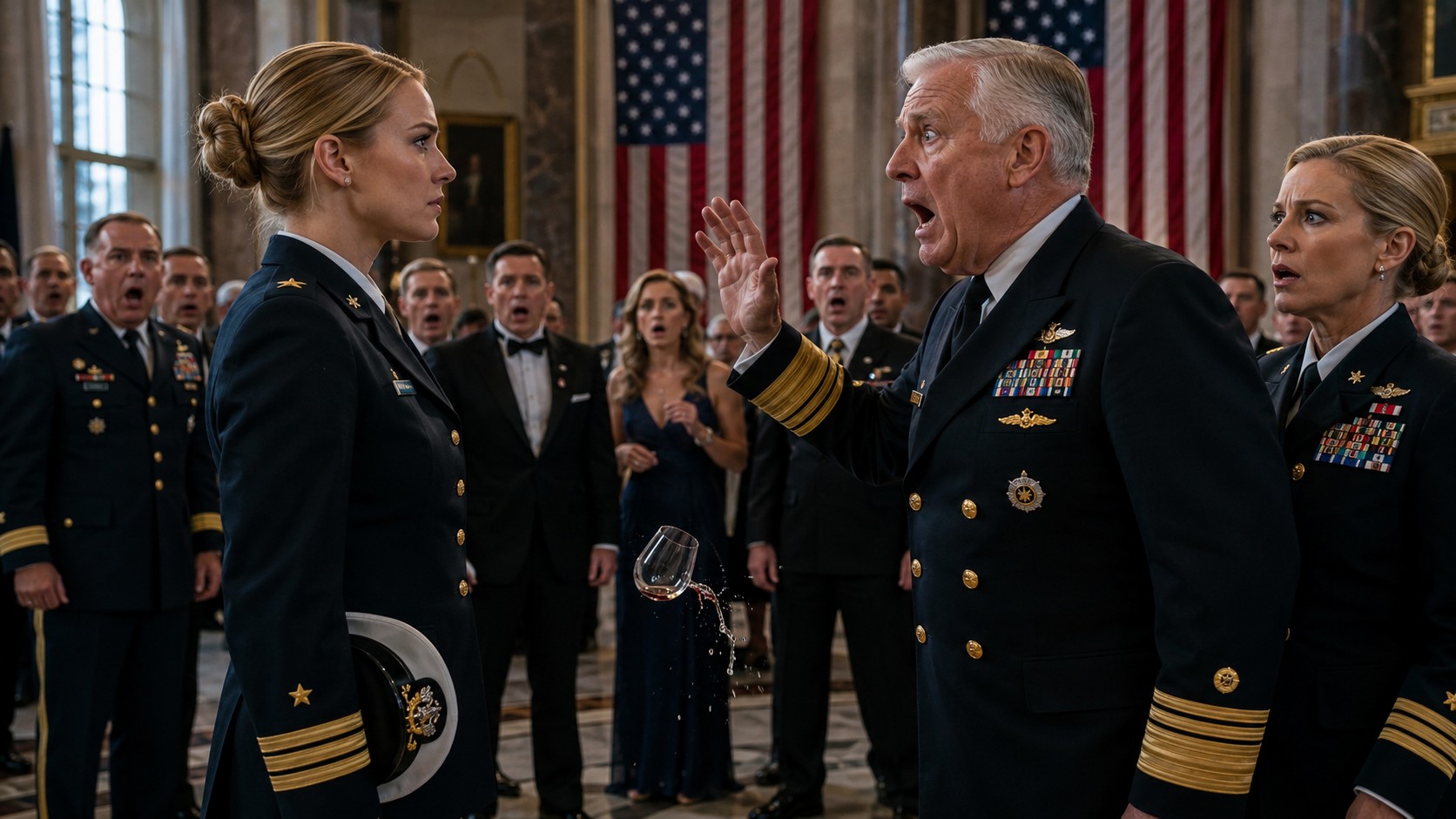

My Father The Admiral Announced His New Wife’s Daughter As The “Youngest Commander Ever.” They Were Celebrating, Champagne In Hand, When I Entered In Full Uniform. The Crowd Went Silent. His Glass Slipped. “Who Approved This Rank?!” He Shouted. My Family Utterly Stunned.
The Badge He Couldn’t Borrow
### Part 1
The glass slipped from my father’s hand before I said a word.
Champagne hit the polished floor in a bright spray, crawling between the black shoes of admirals, captains, donors, wives, and the kind of people who smiled with their teeth while measuring everybody else’s rank. The flute shattered a heartbeat later. The sound cut through the ceremony like a fired round.
Until that second, the room had been glowing.
Gold light from the chandeliers washed over the Navy hall in Norfolk, bouncing off brass buttons and silver hair and framed portraits of men who had spent their lives being saluted. The air smelled like waxed floors, expensive perfume, sea salt dragged in on coats, and the lemon oil somebody had used on the podium. A Navy banner hung behind the stage, deep blue and immaculate, the kind of blue my father used to say separated order from chaos.
He stood beneath it like he owned the color.
Admiral Marcus Vale had one hand lifted toward my stepsister, Tessa Marlow, who stood beside him in dress whites so bright they almost hurt to look at. Her smile was perfect. Her chin was raised just enough. A camera flash caught the pearls at her ears. She looked like the picture the Navy wanted to put on brochures.
“My daughter,” my father had been saying, voice rich with pride, “Commander Tessa Marlow, my legacy, my proof that service still means sacrifice.”
Then he saw me.
I was standing at the back of the hall near the open doors, where the night wind slipped in cold off the Elizabeth River and brushed against the sleeves of my uniform. I had arrived without announcement, without escort, without the little family fanfare he had arranged for Tessa.
The silver oak leaf on my shoulder boards caught the blue light from the hallway.
My father’s mouth stopped moving.
For a second, he looked almost old. Not powerful. Not untouchable. Just a man staring at something he had buried and expected never to see again.
The conversations around me died in layers. First the officers nearest the door. Then the women by the champagne table. Then the group of reporters who had been whispering beside the flags. Tessa’s smile trembled but held. She looked from him to me, then down at my shoulders, then back to him.
My father’s voice cracked when it finally came.
“Who authorized that rank?”
No one breathed.
I should have answered. A younger version of me would have. The girl who used to stand straight in his study, waiting for him to look up from his reports. The midshipman who mailed home her academy grades like offerings. The officer who kept thinking one clean achievement, one perfect record, one quiet act of service would finally make him say he was proud.
But that girl had been gone for a long time.
I stepped forward instead.
The heel of my shoe clicked once against the floor. Then again. Every sound in that room seemed too sharp. My father’s face hardened, anger rushing in to cover the fear. I knew that expression better than I knew my own reflection. It meant he was calculating. It meant he was choosing which part of the truth to kill first.
Tessa whispered something I couldn’t hear.
My father took one step away from the broken glass.
“This is not your stage, Rowan.”
That was my name in his mouth: not daughter, not officer, not Commander. Just Rowan, flat and inconvenient.
I looked at the Navy banner behind him, then at the crowd that had come to watch him crown a lie. I could see Captain Miles Arden near the left wall, his jaw tight. I could see Admiral Joanna Price in the second row, hands folded calmly in her lap. I could see my stepmother, Claire, standing near the floral arrangement, her fingers digging into her clutch.
Everyone was waiting to see whether I would beg, explain, or disappear.
I did none of those things.
I stopped at the center aisle, far enough away that my father still had to look at me across the room he thought he controlled.
The lights hummed above us. The river wind moved through the open doors. A thin line of champagne ran toward my shoe like a vein opening on the floor.
Then the master of ceremonies turned pale, touched his earpiece, and looked toward the entrance behind me.
Two uniformed investigators stepped into the hall carrying a sealed navy folder.
That was when my father’s anger changed shape, and I realized he still didn’t understand the worst part.
I hadn’t walked in to ruin his ceremony.
I had walked in because the Navy had finally come to remember what he had made it forget.
### Part 2
I grew up in a white house on the Chesapeake, where every window faced the water and every room smelled faintly of salt, polish, and rules.
My father liked things aligned. Shoes under beds. Books squared on shelves. Breakfast plates set two inches from the edge of the table. Even grief had to stand at attention in our house. When my mother died, I was eleven, and the first thing I remember after the funeral was my father folding the flag from her coffin with hands so steady they looked borrowed from a statue.
People told me he was brave.
I remember thinking he looked empty.
My mother, Lydia Vale, had been warm in ways my father never understood. She taped my crooked drawings to the fridge. She burned pancakes and called them “campfire style.” She sang old Motown songs while watering herbs on the back porch. She had a laugh that made strangers smile before they knew why.
After she was gone, the house got quieter than a church after a casket leaves.
My father did not say he missed her. He said, “We continue.”
That became the law.
Two years later, he married Claire Marlow, a woman with perfect posture, soft hands, and a daughter named Tessa who knew how to cry without making her mascara run. Tessa arrived with monogrammed luggage, a violin case she never opened, and a way of making my father laugh at dinner that felt like watching someone else unlock a room I had lived outside my whole life.
She called him “Sir” for the first month.
By Christmas, she called him “Dad.”
I did not.
Not because I didn’t want to. Because he had trained me to believe wanting was weakness.
At first, I tried to be better. Better grades. Better uniforms. Better silence. I joined junior sailing because he loved the water. I studied navigation because he said the ocean punished careless people. I learned knots until my fingers blistered, then hid the blisters because he hated complaints.
Tessa learned how to look interested while he talked.
That worked better.
When I won a regional science award for a program that could map storm movement, my father glanced at the certificate and said, “Useful hobby.”
When Tessa gave a speech at her prep school about military families, he framed the photo.
I was sixteen when I first realized love in that house was not a thing you received. It was a position you competed for, and I had been assigned to lose.
Still, I followed him into the Navy.
People later assumed I did it to prove something. They were right, but not in the way they thought. I didn’t want to beat him. I wanted to find the place where his pride lived and stand there long enough for him to recognize me.
At Annapolis, I learned pain had structure. Wake-up calls before dawn. Cold metal rails under my palms. The sour smell of sweat in wool uniforms. Voices barking through gray mornings. For the first time in my life, harshness felt fair because it applied to everyone.
I was good there.
Not loud. Not beloved. Good.
I could read systems faster than most people could read rooms. I saw patterns in maintenance failures, weather models, personnel rotations, and communications delays. I could look at a mess of data and feel where it was lying. My instructors noticed. My classmates came to me when something didn’t make sense.
My father came to one ceremony my plebe year.
He shook hands with two admirals, complimented the band, and told me my posture had improved.
That was the whole visit.
Tessa visited that same spring wearing sunglasses too large for her face and a sundress the color of cream. She walked beside him through the Yard as if she already belonged there. By the end of lunch, he had introduced her to three officers, two academy staff members, and one retired captain who said she had “command presence.”
She was seventeen.
I was the one in uniform.
That night, I sat on the seawall with my shoes beside me and my feet dangling over black water. The air smelled like algae and diesel. Somewhere behind me, laughter spilled from Bancroft Hall. I held my mother’s old silver bracelet in my fist until its edges pressed crescents into my palm.
Before she died, she had told me something I did not understand then.
“Your father respects mirrors, Rowan. Not people. Be careful what you reflect back.”
At sixteen, I thought she meant vanity.
At twenty, I began to wonder if she meant fear.
And when Tessa called me three weeks later to say she was thinking of joining the Navy too, I heard my father laughing proudly in the background.
That was the first time I felt the floor shift beneath me and understood that he was not building a family.
He was building a monument, and he had already chosen whose face would be carved into it.
### Part 3
I did not become the kind of officer my father respected.
That was the first accusation he dressed up as disappointment.
After graduation, I went into naval intelligence and information warfare, not destroyers, not carriers, not the kind of command that looked good in framed photographs. My work happened in windowless rooms where the coffee tasted burnt, the air was always too cold, and the most dangerous thing in the world could arrive as a flicker in a signal stream.
My father called it “the basement Navy.”
He never said it in public. Marcus Vale was too polished for that. In public, he told people all service mattered. In private, he said things like, “The fleet is still run by people who can feel a deck move under their boots.”
I learned to smile.
Tessa learned faster.
She commissioned two years after me and somehow moved through the service like doors were opening before she touched them. Every evaluation had the same shining language. Natural leader. Unusual poise. Exceptional bearing. A future command officer.
I read those words once in a forwarded family email while eating vending machine crackers at 2:14 in the morning, waiting for a threat assessment to finish compiling.
My father had sent the email to twenty-three people.
He had never sent one about me.
I told myself it did not matter. I had real work. Quiet work. Necessary work. That was what mature people said when they were starving and didn’t want anyone to hear their stomach growl.
The year I turned thirty-two, I was assigned to a joint analysis cell outside Fort Meade. The building was ugly in the way government buildings were ugly: beige walls, flat roof, badge readers that beeped like tired birds. Inside, though, was a map of the world made of signals. Everything pulsed. Shipping lanes. Subsea cables. Satellite relays. Encrypted chatter. The hidden nervous system of conflict.
That was where I belonged.
I had a team of twelve analysts, three linguists, two systems officers, and one chief petty officer who could smell bad data from across the room. We were not glamorous. We were not photographed. Most of what we stopped could never be discussed, which meant nobody clapped when the world did not fall apart.
Then the interference started.
At first it looked like noise: a repeated distortion inside routine fleet traffic in the Gulf of Aden. One analyst called it sunspot garbage. Another blamed a bad relay. But there was a rhythm to it that bothered me. Not a message exactly. More like a hand tapping the same wall from different rooms.
I stayed late to pull old logs.
The cleaning crew came through at midnight, pushing carts that smelled of bleach and paper towels. Fluorescent lights buzzed above my head. My screen painted my hands blue. The deeper I went, the more the pattern tightened.
Someone was mapping our response habits.
Not attacking. Studying.
When I brought it up the next morning, my supervisor frowned at the projection. “That’s thin, Vale.”
“It’s early,” I said.
“That’s another word for thin.”
He wasn’t wrong. In our world, paranoia and brilliance often wore the same coat. The trick was knowing when to follow them anyway.
For nine days, I tracked the distortion through relay jumps and timing gaps. On the tenth day, the pattern vanished completely.
That scared me more.
That same afternoon, my father called for the first time in three months. I answered because old habits are stubborn parasites.
“I assume you’ve heard,” he said.
No hello. No how are you.
“Heard what?”
“Tessa’s being considered for accelerated command review.”
I stood in the hallway outside the operations floor, one hand pressed against the cinderblock wall. Someone nearby was microwaving fish, and the smell turned my stomach.
“She hasn’t met the sea-time requirement,” I said.
“She has enough.”
“That’s not what the instruction says.”
There was a pause, small but sharp.
“You always did hide behind instructions.”
I watched two junior officers walk past carrying binders and laughing about something normal. My father lowered his voice.
“Tessa understands command presence. She inspires people. That matters.”
“And I don’t?”
He exhaled through his nose. Not quite a laugh. Worse.
“You analyze, Rowan. You don’t lead.”
The line went quiet after he hung up.
I stood there for several seconds with the phone still against my ear, listening to nothing.
Then my chief appeared at the end of the hall, face pale.
“Ma’am,” he said, “the interference is back.”
I followed him into the operations room, my father’s words still burning under my skin. On the main display, a cluster of signals flashed red across the map. Not noise anymore. Not a theory.
A carrier strike group had just gone blind in pieces, and the timing was too perfect to be an accident.
For the first time in years, I forgot my father entirely.
Then I saw the name of the ship at the center of the pattern, and the blood in my hands went cold.
Tessa’s training squadron was attached to its escort group.
### Part 4
The room changed when the first alarm sounded.
Not loudly. That was the strange thing. Real danger in secure spaces did not arrive with movie sirens and dramatic shouting. It arrived through clipped voices, chairs rolling back, fingers hitting keys too fast, and the sudden absence of jokes.
My coffee sat untouched beside my keyboard, a brown ring forming under the paper cup. The air smelled like overheated plastic and old carpet. On the main screen, the strike group’s communications map pulsed with gaps where there should have been clean lines.
Someone was not just interrupting traffic.
They were shaping what we could see.
“Confirm relay status,” I said.
“Relay three is stable,” Ensign Park answered.
“Four?”
“Green.”
“Then why are we seeing packet loss between systems that aren’t using either one?”
No one answered.
That was the question. That was the hook under the skin.
I leaned closer to my monitor. The distortion was buried inside friendly authentication traffic, wearing our own structure like a stolen uniform. It was elegant. Patient. Whoever built it knew our habits well enough to predict them, and arrogance well enough to assume no one would notice until the fleet obeyed a lie.
My supervisor, Commander Haskins, came in with his sleeves rolled up and his expression already annoyed.
“Vale, tell me this is not another ghost pattern.”
“It’s not a ghost.”
“You said that last week.”
“Last week it was watching. Today it’s steering.”
That got him quiet.
We had twenty-nine minutes before the affected ships entered a scheduled maneuver window. On paper, routine. In reality, the kind of movement that could become fatal if navigation confidence was compromised at the wrong second.
I requested an immediate advisory to Fleet Command.
Haskins hesitated.
That hesitation stayed with me for years.
Not because he was careless. Because every system teaches people to fear being wrong more than being late. He saw my evidence, saw how thin parts of it still looked, and weighed his career against a possibility.
I did not have that luxury.
“Send it under my authority,” I said.
His eyes snapped to mine. “You’re not authorized for a fleet-wide operational alert.”
“I’m authorized to escalate a credible threat.”
“This is not clean enough.”
“Then write me up after the ships turn.”
The room went dead still.
He could have stopped me. He almost did. I watched the decision pass behind his eyes, anger first, then calculation, then something like reluctant trust.
“Do it,” he said.
The next twenty-six minutes were a knife dragged slowly across glass.
We rerouted traffic through a clean path, forced authentication resets, and pushed a warning up the chain with every scrap of evidence attached. My linguist found a timing marker embedded in the distortion. My chief traced the false handoff. Park identified a spoofed maintenance sequence that should not have existed outside a restricted planning channel.
The strike group adjusted course six minutes before the maneuver window.
Six minutes.
On the screen, the red gaps collapsed into blue lines one by one. Nobody cheered. Nobody hugged. Park covered her mouth and looked at the floor. My chief whispered something that sounded like a prayer but might have been profanity.
I sat back and realized my hands were shaking.
By morning, the incident had a name I was not allowed to say outside secure rooms. By evening, it had a classification level high enough to bury everyone involved under silence. The after-action report did not use heroic language. Government documents rarely did. It said decisive escalation prevented operational compromise.
That was all.
For a week, I slept in fragments. Twenty minutes at my desk. Three hours at home. Forty-five minutes on the couch with the TV murmuring to an empty room. The world kept moving as if it had not come within six minutes of tragedy, because that is what the world does when people in windowless rooms do their jobs.
Then the personnel notice arrived.
Not in a ceremony. Not with a call from my father. Just a secure message at 6:03 on a gray Thursday morning.
Selection approved. Commander, United States Navy. Effective date withheld pending classified review.
I read it three times.
The silver oak leaf existed first as pixels. Then as metal in a small box delivered without fanfare. I held it in my palm while rain tapped against my apartment window, light and steady. I thought I would feel triumphant.
Instead, I felt tired.
I almost called my father.
That is the embarrassing truth. My thumb hovered over his name. I imagined saying it casually, letting him hear what I had earned without asking for anything. Commander. Your daughter. The one who analyzes. The one who does not lead.
Before I could make that mistake, a Navy bulletin flashed across my tablet.
There was Tessa’s face.
Lieutenant Commander Tessa Marlow Demonstrates Exceptional Composure During Fleet Communications Disruption.
The article did not say she saved anyone. It did not have to. It placed her in the glow near the event, close enough for readers to fill in the rest. My father was quoted beneath her photograph.
“Officers like Tessa remind us that legacy is not inherited. It is earned.”
I stared at that sentence until the letters blurred.
Then I noticed the date of the photograph.
It had been taken the morning after the incident, outside a briefing room Tessa should not have had access to.
Someone had opened a door for her.
And whoever did it had started stealing the shape of my silence.
### Part 5
My father’s invitation arrived on cream cardstock thick enough to feel like a verdict.
Dinner at the house. Family only. Saturday at seven.
There was no apology for the months of silence. No mention of my work, my life, or the fact that the last time we spoke he had told me I did not lead. Just his name embossed at the bottom in navy ink.
Admiral Marcus E. Vale.
Even his invitations stood at attention.
I almost threw it away. I carried it to the trash, held it over the bin, and stood there while the city moved outside my apartment window in strips of headlights and rain. Then I thought of Tessa’s bulletin photo. I thought of my father’s quote. I thought of the briefing room she should not have entered.
I went.
The Chesapeake house looked unchanged from the road. White columns. Black shutters. Copper lanterns burning beside the door. The lawn trimmed into obedience. But walking up the front steps felt like pressing on a bruise to see if it still hurt.
Claire opened the door wearing silk and a smile that stopped at her cheeks.
“Rowan,” she said. “You came.”
That was how people in my family said they were disappointed.
Inside, the house smelled of roasted garlic, polished wood, and the same lemon furniture oil that had lived in those walls since my childhood. My mother’s blue vase was gone from the entry table. In its place stood a framed photo of Tessa shaking hands with my father under a ship’s flag.
I looked at it too long.
Claire noticed.
“She’s worked very hard,” she said softly.
“I’m sure she has.”
Her eyes tightened, but she stepped aside.
Dinner was already performing without me. Young officers crowded near the fireplace. A retired senator laughed too loudly beside the piano. Tessa stood at the center of the living room in a sea-green dress, one hand wrapped around a wineglass, telling a story about the communications disruption.
“The whole deck went tense,” she said. “You could feel it. Like the ship itself was holding its breath.”
People leaned in.
I stood near the doorway and listened.
She had never been on the affected ship that day. Her squadron had been attached to the escort group, yes, but from a training platform miles outside the actual event window. She was turning proximity into courage, and the room was letting her.
“My commanding officer told me later,” she continued, smiling, “that calm travels faster than orders.”
My father laughed with pride so naked it made me look away.
“That’s my girl,” he said. “Born for command.”
A small sound left me before I could stop it. Not a laugh exactly. More like disbelief with edges.
My father heard it.
He always heard disobedience.
“Something to add, Rowan?”
The room turned.
I could have asked Tessa which deck she meant. I could have asked what time the disruption reached her console, or what channel she used, or why her name appeared in a hallway outside a briefing room before the official incident summary had even been drafted.
Instead, I lifted my glass of water.
“Sounds like a long day.”
Tessa’s smile thinned.
My father’s stare hardened. “Not everything can be understood from behind a screen.”
There it was again. The basement Navy. The safe wars. The daughter who did not count unless her work could decorate his story.
After dinner, I escaped to the back porch.
The night was damp and cold. Waves slapped softly against the pilings below the lawn. A foghorn moaned somewhere out in the dark, low and lonely. I wrapped my arms around myself and tried not to look through the windows, where my father was touching Tessa’s shoulder while introducing her to another officer.
“Ugly, isn’t it?”
I turned.
Captain Miles Arden stood near the porch steps, hands in his coat pockets. We had gone through Annapolis together. He had once been the kind of person who made trouble look charming, but age had sharpened him. There was gray at his temples now and caution in his eyes.
“What are you doing here?” I asked.
“Your father invited half the promotion ecosystem.” He glanced toward the windows. “Family only, my ass.”
I almost smiled.
Miles stepped closer, lowering his voice. “There was an inquiry.”
My skin went cold.
“About what?”
“Tessa’s accelerated review. Sea-time waiver. Command qualification. Somebody flagged it.”
“Somebody?”
“Anonymous.”
“And?”
“It disappeared before it reached the Inspector General.”
The foghorn sounded again.
I looked through the window at my father, at the perfect angle of his shoulders, at the way people still turned toward him like plants toward light.
Miles followed my gaze. “Rowan, I don’t know who buried it. But whoever did had access high enough to scare people quiet.”
I said nothing.
He touched the porch rail, then added, “Be careful. This doesn’t smell like favoritism anymore. It smells like a system protecting itself.”
A gust of wind came off the water and lifted the hair at the back of my neck.
Through the glass, Tessa was laughing. My father lifted his drink. Everyone around him smiled.
And for the first time, I understood that my father had not merely chosen her over me.
He had built a lie large enough for the Navy to stand inside.
### Part 6
The restricted personnel system was not supposed to feel personal.
It was rows of data, coded access, qualification dates, evaluation chains, administrative comments. Dry things. Boring things. The kind of records people assumed had no pulse.
But that night, sitting alone in a secure room after midnight, I felt like I was opening a coffin.
The building around me was nearly silent. The daytime hum of voices had drained away, leaving only the ventilation system and the occasional distant click of a door. My badge lay beside the keyboard. The monitor glow turned my hands the color of skim milk.
I did not search Tessa’s file first.
That would have been too obvious. My father had taught me something useful, even if he never meant to. Direct approaches were for people with nothing to hide. Systems revealed themselves at the edges.
I searched waiver approvals over eighteen months. Then command qualification exceptions. Then sea-time adjustments tied to accelerated boards. Names populated the screen. Most were ordinary. Medical delays. Operational needs. Transfer complications. Boring exceptions with boring signatures.
Then Tessa’s record appeared.
It gleamed.
There was no other word for it. Perfect evaluations. Perfect timing. Perfect phrases repeated with slight variations by officers who should not have sounded identical. Her sea-time requirement had been satisfied by a waiver citing “equivalent operational exposure during active fleet communications compromise.”
I stared at that line until my eyes ached.
Equivalent operational exposure.
That was how theft dressed itself for work.
The waiver was signed by a review authority three levels below my father, which almost made me laugh. Almost. Because the metadata told another story.
Modified via secure command terminal: Admiral Marcus E. Vale.
My father had not just advocated for her. He had reached into the machinery and moved the gears.
I copied the metadata. Then the waiver. Then the evaluation language. Then the access history, which showed two edits made at hours when my father’s office should have been closed.
My breathing stayed even. That surprised me. I had imagined rage would feel hot. This felt cold and exact.
I opened a second window and searched for my own incident report.
Access denied.
Not unusual. The operation was classified.
I tried the citation index.
A partial record appeared, heavily redacted. Decisive escalation. Operational compromise prevented. Analyst cell leadership.
No name.
That was expected.
Then I saw a linked administrative note attached to a public affairs review.
Recommend no individual attribution due to classification. Consider broader narrative highlighting visible fleet composure.
Visible fleet composure.
Tessa’s article had not been an accident. It had been a substitute.
I leaned back slowly.
The room smelled like dust warming inside machines. Somewhere down the hall, a printer woke up and began to chatter, then stopped. My own reflection hovered in the dark window beyond the monitor: pale face, still mouth, silver oak leaf hidden in a drawer because my official ceremony had been delayed by secrecy.
My father had once told me honor was what you did when no one watched.
Now I knew what he did when no one watched.
I saved the files to an encrypted drive and began a second backup through a compartmented channel. My fingers moved automatically. Label. Hash. Duplicate. Verify.
At 12:47 a.m., the cursor froze.
For one second, I thought the system had crashed.
Then a small notification appeared in the corner of the screen.
Session mirrored.
My pulse kicked.
I disconnected from the network, shut the terminal down hard, and sat in the sudden black reflection of my own face. The room seemed larger without the monitor glow. Every shadow had edges.
Someone had been watching my session in real time.
I gathered the drive, slipped it inside the inner pocket of my jacket, and left without turning on the hall light. My shoes made no sound on the government carpet. At the elevator, I held my breath until the doors opened.
When I stepped into the parking lot, the night air hit my face cold enough to sting.
My phone buzzed before I reached my car.
Unknown sender.
The message was only four words.
You misread the file.
I stared at it under the sodium lights while the empty parking lot stretched around me.
Then a second message appeared.
Go home, Commander.
That was when fear finally found me, not because they had threatened me, but because they had used the rank no one was supposed to know yet.
### Part 7
Admiral Joanna Price did not look surprised when I placed the folder on her desk.
That bothered me more than if she had.
Her office sat on the fourth floor of a building that seemed designed to discourage emotion. Gray carpet. Gray walls. A narrow window facing another gray building. The only warm thing in the room was a mug of coffee gone cold beside a stack of marked reports.
She had been my instructor at Annapolis, back when I was still young enough to think fairness was a rule and not a fight. She was the first woman I ever saw make a room obey without raising her voice. She did not dominate space. She clarified it.
Now she read my evidence in silence.
I watched her eyes move across the pages. Tessa’s waiver. The metadata. The altered access logs. The public affairs note. The mirrored session warning. The anonymous messages.
Outside her window, rain slipped down the glass in crooked lines.
Finally, she closed the folder.
“How much do you want the answer to be something else?” she asked.
My throat tightened.
A strange question. A merciful one.
“Less than I did yesterday.”
She nodded, as if that was the correct response. “Your father has been building toward this for years.”
I looked at her sharply. “You knew?”
“I suspected.” Her mouth flattened. “There is a difference, and it is one powerful men rely on.”
I sat back.
The chair was stiff and uncomfortable. Government furniture had a way of reminding you not to relax.
Price tapped the folder once. “If you submit this through personnel channels, it will vanish.”
“It already did once.”
“Then stop knocking on the door they control.”
“Inspector General?”
“Inspector General. And not as a daughter. Not as a rival. As an officer reporting unlawful influence.”
The word daughter landed badly. I looked away.
Price noticed, of course.
“Rowan,” she said, softer now, “Marcus Vale knows how to fight family battles. He will make you sound bitter, jealous, unstable, overlooked. He will make the facts look emotional. Do not help him.”
“I’m not emotional.”
The lie tasted metallic.
Price almost smiled. “Of course you are. You just don’t have to let him use it.”
I left her office with the folder pressed flat beneath my coat.
For three days, I built the report. I wrote like I was defusing something. No adjectives. No accusations without evidence. No personal history. No mention of childhood, dinners, stepdaughters, portraits, or the old ache of wanting my father to turn his head and see me.
Undue command influence. Unauthorized modification. Improper waiver. Potential misrepresentation in public affairs materials. Request for formal inquiry.
When I submitted it through the encrypted IG portal, dawn was just beginning to lighten the blinds in my apartment. The room smelled like cold coffee and the lavender detergent I used because my mother once had. My finger hovered over the final button.
Then I clicked.
For one clean second, I felt relief.
By noon, the portal receipt had disappeared.
Not marked pending. Not reassigned. Gone.
By 2:00 p.m., my access history had been scrubbed again.
At 3:17, a message appeared in my personal email.
Stop dressing envy as integrity.
I printed it. Folded it. Added it to the file.
Fear had become useful by then. It sharpened things. Made every sound distinct. The elevator ding. The wet hiss of tires outside. The soft buzz of my phone on the table.
That evening, I drove to a diner off Route 1 where truckers ate meatloaf under fluorescent lights and nobody looked twice at a woman in uniform sitting alone. Miles Arden slid into the booth across from me ten minutes later.
He looked tired.
“You need to back up everything offline,” he said instead of hello.
“I did.”
“Not enough.”
The waitress poured coffee. It smelled burnt and honest. Miles waited until she left, then pushed a brown envelope across the table.
“No return address. It showed up in my office because someone knew I’d get it to you.”
Inside was a photocopy of an old disciplinary memo from 2004. Baltic training rotation. Command waiver irregularity. Influence concern. Recommendation buried.
The signature at the bottom belonged to my father.
But the handwritten note clipped to it made my chest tighten.
Ask Chief Lowell what Marcus did the first time.
Miles watched my face.
“You know him?”
“Chief Daniel Lowell,” I said. “He served with my father when I was a kid.”
Miles leaned closer. “Rowan, this goes back further than Tessa.”
Outside, a semi rolled past, shaking the window glass.
I looked down at the old memo, at my father’s signature, at the ghost of a pattern older than my career.
For years, I had thought Tessa was the lie.
Now I understood she might only be the latest version.
### Part 8
Chief Daniel Lowell lived in a small brick house outside Annapolis with crab traps stacked beside the garage and an American flag snapping hard in the winter wind.
He opened the door before I knocked twice.
Age had carved him down but not softened him. His shoulders were narrower than I remembered, his hair mostly gone, his hands twisted at the knuckles. But his eyes were the same: pale, direct, and tired of nonsense.
“Little Vale,” he said.
No one had called me that in twenty years.
For half a second, I was eight years old again, standing on the pier while he taught me to tie a bowline because my father had lost patience after three tries.
Then the present returned.
“Chief.”
He stepped aside.
His house smelled like coffee, old paper, and the faint brine of fishing gear. A football game played silently on the television. On the mantel sat photographs of ships, grandchildren, and younger men in uniforms who still believed the institution they served would protect itself from men like my father.
Lowell poured coffee into two mugs and handed me one without asking if I wanted it.
“Your mama liked sugar,” he said.
I looked up.
“You knew my mother well?”
“Everybody knew Lydia. She made people feel less inspected.”
That hit so cleanly I had to look down at the mug.
We sat at his kitchen table. The wood was scratched, real, nothing like the polished surfaces in my father’s house. Lowell pulled a folder from the chair beside him and set it between us.
“I should’ve spoken years ago.”
“Why didn’t you?”
“Because I was a coward in the uniform of a loyal man.”
No self-pity. No drama. Just fact.
He opened the folder.
The first documents were old. Training waivers. Evaluation adjustments. A recommendation for a young officer under my father’s command whose failure during a Baltic exercise had been softened, then reversed, then turned into a commendation. The officer’s family name had political weight. My father’s career rose shortly afterward.
“Marcus learned early,” Lowell said. “Not that rules could be broken. Everybody knows that. He learned rules could be rewritten if the room liked your future enough.”
I turned a page.
There were notes in my mother’s handwriting.
My breath stopped.
I knew her slant instantly. The clean loops. The firm pressure. Grocery lists, birthday cards, notes tucked into lunch boxes. Seeing it on a document marked confidential felt like finding her voice inside a locked room.
“What is this?”
Lowell’s jaw worked once. “Your mother found out.”
I stared at him.
“She wasn’t Navy,” he continued, “but she wasn’t blind. Marcus brought things home. Talked too much when he thought she wasn’t listening. She knew he’d helped bury that Baltic report. She told him legacy built on fraud wasn’t legacy. It was debt.”
The kitchen seemed to tilt.
My father had erased her slowly after she died. The photos. The vase. The songs. The stories. I thought it was grief. Cruel grief, but grief.
“What happened after she confronted him?”
Lowell looked toward the dark window above the sink. “He changed. Got colder. Started talking about loyalty like it meant silence.”
He pushed another sheet toward me.
This one was recent. A printout of Tessa’s qualification record with red marks in the margins. Lowell had circled a training entry claiming she completed a sea command requirement aboard the USS Hartwell during a specific storm exercise.
“The Hartwell was in dry dock,” I said.
Lowell nodded.
The words on the page blurred for a moment, then sharpened.
“So the entry is false.”
“Not exaggerated. Not generous. False.”
I set the paper down carefully.
Lowell folded his hands. “Tessa knew enough to sign it.”
That mattered. I had wondered whether she was only being used, whether she was vain but unaware, whether my anger had turned her into something simpler than she was. The signature removed that mercy.
My phone buzzed on the table.
A message from Claire.
Your father wants you at the house tomorrow. Alone. This can still be handled privately.
I laughed once, quietly.
Lowell did not.
“That’s how he survives,” he said. “Private rooms. Private pressure. Private shame.”
Another buzz.
This time from an unknown number.
Bring the folder, Rowan. Or lose the rank you think is yours.
Lowell’s face darkened as he read it.
He stood, went to the hallway closet, and returned with a sealed envelope.
“Then don’t bring him the folder,” he said. “Bring him this.”
Inside was a copy of my mother’s old statement, signed but never submitted.
At the bottom, in her handwriting, were seven words that made the room go silent around me.
Marcus will destroy anyone who threatens the monument.
### Part 9
My father’s house looked smaller the next day.
That was the first surprise.
For years, memory had made it enormous: columns like courthouse pillars, windows like judgment, the front door like an entrance to a life where I was always being graded. But under a pale winter sky, with dead leaves gathered against the steps, it looked like what it was. Wood. Paint. Glass. A house built too close to the water, constantly fighting rot.
Claire let me in without smiling.
“He’s in the study.”
Of course he was.
My father’s study smelled of leather, cigar boxes he no longer used, and the ocean pressing damply through old walls. Medals lined the shelves. Photographs stood in disciplined rows. Tessa with my father at a commissioning ceremony. Tessa with my father on a ship tour. Tessa with my father under flags, under lights, under the warm gaze he had never turned on me.
There was one photograph of me.
Academy graduation.
Half-hidden behind a model destroyer.
My father stood by the window, hands clasped behind his back. He did not turn when I entered.
“You’ve been busy.”
“So have you.”
He faced me then.
Even out of uniform, he carried command like a weapon. Gray sweater. Dark slacks. Silver hair. Straight spine. If strangers saw him, they would still trust him with a crisis. That was the danger of men like him. Their discipline disguised their decay.
“Sit down,” he said.
“I’ll stand.”
His eyes flicked over me. He hated small refusals more than open rebellion.
Claire hovered near the door.
“Leave us,” he told her.
She looked at him, then at me, and for the first time I saw something like fear beneath her polish. Not fear for me. Fear of what might spill onto her clean floors.
The door closed.
My father walked to his desk and lifted a folder. “You have filed reckless allegations.”
“I filed documented allegations.”
“You filed grief.”
There it was. Fast and practiced.
“You are angry because Tessa advanced in a way you did not.”
“I advanced quietly.”
His mouth tightened.
A small victory. He had not known I would say it.
“I know about your selection,” he said. “I also know selections can be reviewed.”
“Is that a threat?”
“It is reality.”
“No. It’s habit.”
His face changed.
I had touched something.
He came around the desk slowly. “You think because some classified board gave you a title, you understand command? Command is not data. It is not suspicion. It is not hiding in dark rooms while others carry the visible burden.”
“The visible burden,” I repeated. “Is that what we’re calling falsified sea time now?”
His jaw flexed.
For the first time, he looked away.
I should have felt satisfaction. Instead I felt a dull, old sadness. He was guilty. Of course he was. But some childish part of me had still wanted him to deny it in a way I could believe.
He lowered his voice. “Tessa has presence. She can carry the Vale name into places you never could.”
“She isn’t a Vale.”
“She is more my daughter than you have ever chosen to be.”
The words landed. Clean. Intended.
I did not move.
The room made small sounds around us: the tick of a brass clock, the groan of old wood, the distant slap of water against the seawall. My mother’s statement rested inside my coat, warm from my body.
“You don’t want a daughter,” I said. “You want a reflection that salutes.”
His eyes sharpened.
Before he could answer, the study door opened.
Tessa stepped in.
She wore a cream coat, her hair pinned back, face pale with anger or fear or both. Claire was behind her, whispering for her not to interfere.
Tessa ignored her.
“Just give him what he wants,” she snapped at me. “You always have to make everything ugly.”
I looked at her.
“What does he want?”
Her mouth opened, then closed.
My father turned. “Tessa.”
That one word carried warning.
But panic had made her careless.
“The folder,” she said. “The old one. The one from that chief. Dad said if you handed it over, the IG complaint could be corrected before the ceremony.”
The room froze.
My father’s face went flat.
Tessa realized too late what she had admitted.
I looked from her to him, and something inside me settled into place with a quiet finality.
There would be a ceremony. There would be an audience. There would be no private correction.
My father had planned to crown her in public and bury me in private one last time.
I reached into my coat, but not for the folder he expected.
I pulled out my mother’s statement and placed it on his desk.
His face drained before he even touched it.
That was how I knew he recognized her handwriting.
### Part 10
The ceremony was three days later.
I slept very little before it.
Not because I was afraid of my father. That would have been simple. I was afraid of the old reflex in me, the one that still wanted to soften truth if it made him look wounded. Children of cold parents learn to read weather in faces. We become experts at lowering the wind.
But this time, lowering the wind would have meant letting the storm sink other people.
So I dressed carefully.
The uniform lay on my bed under the morning light, dark fabric pressed sharp, ribbons aligned, shoes polished until my apartment window reflected in them. The silver oak leaf rested in its box. I looked at it for a long time before pinning it on.
Not because I doubted I had earned it.
Because I understood what wearing it into that hall would cost.
Outside, Norfolk was gray and wet. Rain streaked the cab window as I rode toward the Navy hall. The driver had sports radio on low. Men argued about a quarterback’s injury while my phone filled with messages I did not answer.
Claire: Please do not embarrass this family.
Tessa: You’re jealous and everyone knows it.
Unknown: Last chance.
Miles: Price is already inside. Walk in when you’re ready.
That final message steadied me.
The hall glowed exactly as I remembered from every Navy event I had ever attended. Warm chandeliers. Polished floor. Blue banners. The smell of flowers, wool, champagne, and the river sneaking in beneath the doors. A string quartet played something tasteful enough to disappear.
I entered late on purpose.
Not dramatically. Precisely.
My father was already at the podium. Tessa stood beside him in dress whites, chin lifted, smile set. Behind them, the Navy banner hung like a verdict waiting to be corrected.
“Tonight,” my father said, “we celebrate excellence, sacrifice, and the sacred trust of command.”
Sacred.
The word made my hand curl once at my side.
He continued, voice smooth and deep. “Commander Tessa Marlow represents the finest tradition of our service. She has earned not only rank, but respect.”
That was when I stepped through the open doors.
Cold air followed me in.
A few heads turned. Then more. The music faltered but did not stop. I saw the moment people noticed my shoulder boards. Saw recognition ripple into confusion. Saw officers glance from me to Tessa, from Tessa to my father.
My father saw me last.
The champagne glass fell.
Now, standing in the aisle with every eye on me, I understood something I had not expected. Public silence had weight. It pressed on the chest. It begged to be filled by the loudest liar.
My father recovered first.
“Who authorized that rank?” he demanded.
I did not answer.
The two investigators entered behind me with the sealed folder. Admiral Price rose from her seat in the second row. Her face was calm, almost severe. The room shifted toward her authority like iron filings toward a magnet.
“Admiral Vale,” she said, “step away from the podium.”
A murmur moved through the hall.
Tessa looked at my father. “Dad?”
He ignored her. His eyes were on me.
“You did this,” he said.
“No,” I replied. My voice sounded quieter than his but carried farther. “You did.”
One of the investigators approached Price and handed her the sealed folder. She opened it, scanned the first page, and looked toward the master of ceremonies.
“This promotion ceremony is suspended pending formal review.”
The words struck the room harder than the breaking glass.
Tessa’s mouth parted. “You can’t suspend my promotion in the middle of—”
Price turned to her. “Lieutenant Commander Marlow, you are advised not to make any further statements without counsel.”
Lieutenant Commander.
Not Commander.
The correction landed visibly. Tessa flinched as if slapped.
My father stepped down from the stage. “This is a disgrace.”
Price looked at him. “Yes. It is.”
For one second, I thought he might actually stop. Might see the investigators, the witnesses, the officers he had spent his life impressing, and choose dignity.
Instead, he pointed at me.
“My daughter has pursued a personal vendetta fueled by resentment. Her claims are the product of ambition without command temperament.”
There it was, delivered perfectly. The story he had prepared.
I walked forward until I stood beneath the stage lights. They were hot on my face. I could smell champagne drying on the floor, sweet and sour.
“I submitted records,” I said. “Not feelings.”
His eyes burned.
“And I am not here as your daughter.”
The hall was utterly still.
I turned toward Admiral Price and saluted.
“Commander Rowan Vale, reporting as ordered.”
A sound moved through the crowd. Not applause. Not outrage. Something better.
Recognition.
My father looked at my shoulder boards again, and this time he understood they were not costume, not envy, not rebellion.
They were official.
Then Price opened the second page of the folder, and her expression changed just enough for me to know the next cut would go deeper than rank.
She looked at my father and said, “Admiral Vale, we also need to discuss the statement signed by your late wife.”
For the first time in my life, my father had no command ready.
### Part 11
The hearing room had no windows.
I appreciated that.
Windows invite performance. People look through them when they want to seem thoughtful. They let light soften faces that have not earned softening. This room had only a long table, a recording device, a flag in the corner, and fluorescent lights that made everyone equally tired.
My father sat across from me in service dress blues.
He looked smaller without an audience.
Not weak. Marcus Vale would never allow weakness where others could see it. But contained. Reduced to the size of his own answers. His medals rested over his heart in neat rows, bright little witnesses to a life he had spent curating.
Tessa sat two chairs away from him with counsel beside her. She avoided looking at me. Her hands were folded too tightly on the table, knuckles pale. Without cameras and chandeliers, she seemed younger, almost ordinary.
The inquiry lasted eleven hours.
Questions came clean and relentless.
Who authorized the waiver?
Why was sea-time equivalency granted?
Why did the metadata show access from Admiral Vale’s private terminal?
Who approved public affairs language connecting Lieutenant Commander Marlow to an incident beyond her operational role?
Why was an anonymous inquiry deleted?
Who mirrored Commander Vale’s restricted session?
My father answered like a man trying to preserve architecture during an earthquake. Carefully. Technically. With pauses long enough for counsel to earn their fee. He admitted involvement but not intent. Acknowledged irregularities but not misconduct. Used words like discretion, tradition, leadership assessment, administrative flexibility.
Tessa broke first.
Not nobly. Not completely. But enough.
By the seventh hour, after being shown her signature on the false training entry, she began crying. Real tears this time, messy and angry. Mascara gathered under her eyes. She kept saying she thought it was “handled,” that my father told her requirements were “interpretive,” that everyone knew the Navy made exceptions for promising officers.
“Did you know the USS Hartwell was in dry dock during the period listed?” an investigator asked.
Tessa looked at her attorney.
The attorney looked down.
“Yes,” she whispered.
The room seemed to inhale.
I felt no joy.
That surprised me less than it might have once. By then, I understood that vindication was not happiness. It was a door opening out of a burning room. You were glad to leave, but you still smelled like smoke.
Then they read my mother’s statement.
Not all of it. Just enough.
Her words entered the record in a voice that was not hers, flattened by procedure, stripped of warmth. But I heard her anyway. I heard the woman who burned pancakes, sang on the porch, and noticed rot beneath polish before anyone else dared name it.
She had documented the Baltic waiver. She had described my father’s growing obsession with legacy. She had written that he viewed accountability as betrayal. She had planned to submit the statement to a trusted officer.
She died before she could.
My father stared at the table while they read.
For once, I could not read his face.
After the session ended, I walked into the hallway and leaned against the wall. My legs felt strangely hollow. Miles found me near a vending machine humming under bad lighting.
He handed me a bottle of water.
“You okay?”
“No.”
He nodded as if that was the only honest answer.
We stood side by side in silence. Down the corridor, Tessa emerged with Claire. Claire had aged ten years in one day. Tessa saw me and stopped.
For a moment, I thought she might apologize.
Instead, she wiped under her eyes and said, “You got what you wanted.”
I looked at her for a long second.
“No,” I said. “I got what you signed.”
Her face twisted.
Claire put a hand on her arm and pulled her away.
Miles waited until they disappeared around the corner. “Your father asked to speak with you privately.”
I laughed under my breath.
“Of course he did.”
“He says it concerns your mother.”
The hallway noise faded.
There it was again. The old hook. The one baited with love, memory, unfinished grief.
I looked toward the closed hearing room door, and for one dangerous second, I was no longer a commander or an officer or the woman who had brought evidence into the light.
I was eleven years old, wanting to know what else had been taken from me.
### Part 12
My father chose the pier.
That told me more than he meant it to.
The old pier behind the Chesapeake house had always been his favorite stage for serious conversations. He liked the water behind him, the horizon wide, the wind making his silence seem profound. When I was a child, I thought wisdom lived there. Later, I realized he simply preferred places where people could not easily walk away without looking dramatic.
I went anyway.
The evening was cold enough to make my eyes water. The bay lay dark and restless, small waves smacking the pilings with patient irritation. The air smelled of salt, mud, and approaching rain. Gulls wheeled overhead, crying like rusted hinges.
My father stood near the end of the pier in a dark overcoat.
No uniform.
That was new.
For a few seconds, neither of us spoke. The boards creaked under my shoes. Across the water, lights from distant houses trembled in broken lines.
“You look like your mother in this light,” he said.
I almost left.
Not because it hurt. Because it was so obviously placed. A polished hook lowered into familiar water.
“What did you want to tell me?”
He looked out at the bay. “She was going to ruin everything.”
There it was. Not grief. Not regret. The truth, ugly and immediate.
I waited.
His jaw tightened. “She didn’t understand the Navy. Not really. She thought institutions could survive public shame untouched. She thought truth was always worth the cost.”
“She was right.”
He turned to me then, and for a moment I saw the man under the admiral. Tired. Angry. Afraid of a world where his name no longer entered rooms before he did.
“She would have destroyed my career.”
“No. You did that.”
His eyes flashed. “You think this is simple because you’ve never had to carry a legacy.”
I looked back toward the house. Through the windows, warm light glowed over furniture my mother never chose and photographs that had replaced her.
“What legacy?” I asked. “A false waiver in the Baltic? Tessa’s fake sea time? Deleted complaints? My work turned into her publicity? Is that the legacy?”
He stepped closer. “I made hard choices.”
“You made selfish ones.”
“For this family.”
“No,” I said. “For your reflection of it.”
The wind moved between us.
For years, I had imagined this conversation. In some versions, he apologized and I broke down. In others, I screamed. In the weakest ones, he finally said he was proud and I forgave him because wanting love had made me cheap.
But standing there with the cold coming off the water, I felt none of those stories fit.
He reached into his coat and pulled out an envelope.
“I’m submitting a statement,” he said. “If you add context, if you explain there was family tension, that you may have misunderstood certain administrative decisions, the board may allow retirement without public censure.”
I stared at him.
That was the apology.
Not I hurt you.
Not I used her.
Not I buried your mother’s warning.
Help me keep the monument standing.
A laugh rose in my throat, small and bitter, but I let the wind take it.
“You asked me here to protect your name.”
“Our name.”
“No.” I shook my head. “That was always your mistake.”
His face hardened. “You would disgrace your own father?”
I looked at the water. Black waves. White foam. The same bay that had watched me try to become visible to a man committed to not seeing me.
“I’m not disgracing you,” I said. “I’m refusing to keep doing your maintenance.”
His mouth opened, then closed.
For once, I did not rush to fill the silence.
Finally, he said, very quietly, “I loved you in my way.”
I believed him.
That was the worst part. Not because it healed anything, but because it explained how little his way was worth. Some people love like landlords. They maintain ownership, demand gratitude, and call it shelter.
“I know,” I said. “And I’m done living in it.”
The first drops of rain touched the pier, darkening the boards between us.
My father looked older than he had at the ceremony. Older than he had in the hearing room. Maybe he had always been old, and power had simply lit him well.
“Rowan,” he said.
I turned to leave.
He did not follow.
My phone buzzed as I reached the lawn. A message from Admiral Price.
Final determination issued. Read when ready.
I looked back once.
My father remained at the end of the pier, a dark figure against darker water, still waiting for the world to arrange itself around his loss.
This time, I did not go back to comfort him.
### Part 13
I read the final determination in my car while rain covered the windshield and blurred my father’s house into pale streaks of light.
The document was short. Government endings usually are.
Admiral Marcus E. Vale: formal censure. Removal from advisory command consideration. Early retirement effective immediately. Referral of associated administrative misconduct for permanent record.
Lieutenant Commander Tessa Marlow: promotion nullified. Command eligibility suspended. Reassignment pending further review.
Commander Rowan Vale: no adverse findings. Classified commendation confirmed. Selection and assignment affirmed.
I sat there until the screen dimmed.
No music swelled. No one applauded. The rain ticked against the roof. The heater blew warm air against my knees. Somewhere inside the house, maybe Claire was crying. Maybe Tessa was blaming me. Maybe my father was standing alone in his study, staring at the place where his portrait would no longer mean what it used to.
I expected triumph.
What came instead was quiet.
Not peace yet. Quiet.
There is a difference.
The weeks after that passed in strange fragments. A formal meeting. A new office. Reporters calling numbers they should not have had. Old family friends sending careful messages that used words like unfortunate and complicated. People loved complicated when simple made them uncomfortable.
Miles took me out for coffee one morning near Fort Meade. The place smelled like cinnamon, wet coats, and burnt espresso. We sat by the window while commuters hurried past under umbrellas.
“You know half the fleet is pretending they always believed you,” he said.
“That must be exhausting for them.”
He smiled.
It was the first time I had laughed without bitterness in months.
Nothing dramatic happened between us then. No sudden romance, no movie ending, no hand reaching across the table while violins played. Just two officers drinking coffee after surviving different kinds of storms. But when he walked me to my car, he touched my shoulder lightly and said, “You’re not invisible anymore, Rowan.”
I thought about that after he left.
The truth was, I had never been invisible. I had been looking for my reflection in the wrong eyes.
Spring came slowly.
My new office had no view of the water, which suited me. It faced a parking lot, a row of young trees, and a flag that snapped hard on windy days. The walls were bare at first. I did not hang medals. I did not frame the determination letter. I brought in one thing only: my mother’s silver bracelet, set in a small shadow box beside my desk.
On my first day leading the division, a junior analyst knocked too softly on my door.
“Ma’am, sorry to bother you.”
I looked up from a stack of briefings. “If you found something, it’s not a bother.”
She stepped in, nervous, holding a tablet. “It may be nothing.”
I almost smiled.
“Nothing has started a lot of trouble,” I said. “Show me.”
She did.
And I listened.
That became my rule. Not because I was gentle by nature. I wasn’t always. Not because every suspicion deserved a parade. But because I knew what happened when rooms taught people to stay quiet for the comfort of powerful men.
Months later, my father sent one final message.
No greeting.
We should talk.
I read it standing outside my office at dusk, the hallway empty except for the low hum of lights. For a long time, those three words would have undone me. I would have searched them for remorse, tenderness, a hidden doorway back to the father I once thought existed.
This time, they looked small.
I typed one sentence.
The record already spoke.
Then I blocked the number.
Not in anger. Anger would have meant I was still standing in his weather, waiting for the pressure to change. This was cleaner. A door closing. A lock turning. A life choosing its own air.
That fall, I returned to the Chesapeake alone.
The house had been listed for sale. A discreet sign stood near the drive, swinging slightly in the wind. The paint looked tired. The lanterns were off. Without my father’s parties and polished guests, the place seemed less like a monument than a shell the tide had finally gotten into.
I did not go inside.
I walked around back to the pier.
The old rope was still looped around the post where Chief Lowell had taught me the knot my father had no patience to teach. I touched it and felt the rough fibers catch against my palm. The water below moved silver under the late afternoon sun. The air smelled of salt, grass, and distant rain.
I thought of my mother.
I thought of Tessa, who had wanted a crown badly enough to sign a lie.
I thought of my father, who had built his name like a ship and never checked whether the hull was rotten.
Then I thought of the young analyst in my office saying, It may be nothing.
That was where the future was. Not in the house. Not in the old wound. Not in the applause my father had given someone else.
The future was in the room where quiet people would be heard before the alarms became necessary.
I stood on the pier until the sun lowered and the bay turned the color of brushed steel. For the first time, the horizon did not look like something I had to earn permission to cross.
It looked open.
My father had spent his life chasing a legacy loud enough to drown out the truth.
I built mine differently.
One record. One choice. One quiet refusal at a time.
And when the wind came off the water, cold and clean, I did not hear his voice in it anymore.
THE END!
Disclaimer: Our stories are inspired by real-life events but are carefully rewritten for entertainment. Any resemblance to actual people or situations is purely coincidental.
